
Why Asbestos Management Software Is Replacing Spreadsheets and Paper Registers
Spreadsheets, PDFs and paper registers might feel familiar, but they are a weak foundation for controlling asbestos risk across a live estate. Asbestos management software gives duty holders, estates teams and property managers a single place to hold records, track actions and demonstrate compliance with the Control of Asbestos Regulations and HSE guidance.
That matters whether you oversee one school, a hospital block, a retail portfolio or hundreds of buildings across a multi-academy trust. When asbestos information is scattered across shared drives and email chains, people miss re-inspections, contractors work from outdated data and reports take far too long to produce.
A well-run digital system turns that fragmented picture into something practical, auditable and far easier to manage day to day.
Why Duty Holders Are Turning to Asbestos Management Software
The legal duty to manage asbestos is ongoing. Under the Control of Asbestos Regulations, duty holders must know where asbestos-containing materials may be present, assess the risk, keep records current and ensure anyone liable to disturb those materials has the right information before work begins.
Asbestos management software supports that day-to-day duty. It does not replace a competent surveyor or a properly written management plan, but it makes both far more useful by keeping the underlying information live, accurate and accessible.
Without a dedicated system, asbestos data typically ends up scattered across:
- Survey reports saved as PDFs in shared folders
- Old paper registers that no longer reflect current building layouts
- Photographs stored on individual devices
- Re-inspection dates noted in diaries or spreadsheets
- Contractor communications buried in email threads
That setup creates avoidable risk. If a maintenance team cannot quickly confirm what is in a ceiling void, plant room or riser, there is a real chance of accidental disturbance.
A digital platform helps you:
- Store all asbestos records in one accessible location
- Track material condition changes over time
- Schedule and evidence re-inspections
- Control who can view or edit records
- Produce reports quickly for internal teams, governors, trustees or regulators
- Maintain a clear audit trail of every action taken
For many organisations, the biggest gain is not convenience alone. It is the ability to demonstrate that asbestos is being managed systematically rather than reactively — and that distinction matters enormously when a regulator or insurer asks questions.
Managing Complex Estates: Where Software Makes the Biggest Difference
Managing asbestos in a single building is one challenge. Managing it across a complex, multi-site estate is another entirely. Schools, multi-academy trusts, local authorities, healthcare estates, housing portfolios and commercial landlords often inherit decades of surveys in mixed formats with inconsistent risk descriptions.

Asbestos management software helps transform that complexity into a structure you can actually work with. Instead of hunting through historic documents, you can view your entire estate through one dashboard and prioritise action based on risk, condition and location.
Answering Practical Questions Quickly
On a large estate, the software should let you filter and sort records so you can answer operational questions without delay:
- Which buildings have overdue re-inspections?
- Where are the highest-risk materials located?
- Which sites still rely on presumed asbestos entries rather than confirmed sampling results?
- Which blocks are due refurbishment and need updated information before works begin?
That visibility is especially useful where buildings vary significantly in age and use. A Victorian school, a 1960s office block and a modern extension each present different asbestos management challenges. A central system helps you see those differences clearly and allocate resources accordingly.
Consistency Across Multiple Sites
One of the most persistent problems in estate-wide compliance is inconsistency. If different sites use different room naming conventions, condition scores or report formats, comparing risk across buildings becomes genuinely difficult.
Good asbestos management software enforces a consistent structure for:
- Room and area references
- Material descriptions and condition ratings
- Risk assessment scores
- Photographic records
- Recommended actions and re-inspection intervals
That consistency makes board-level reporting easier and reduces confusion when staff change, buildings are acquired or estates are restructured following mergers.
Key Benefits of Asbestos Management Software for Estates Teams
The best systems do far more than store a register. They actively support compliance work, contractor communication and senior decision-making. Here are the benefits that matter most in practice.
1. A Live, Accurate Asbestos Register
A static register becomes outdated almost immediately. A live digital register can be updated after surveys, re-inspections, remedial works or removals, so teams are never relying on superseded versions.
When a management survey is completed or updated, the results feed directly into the register rather than sitting in a separate PDF. That keeps your records genuinely current rather than just technically present.
2. Faster Access for the Right People
Facilities staff, compliance managers and approved contractors can access the information they need without waiting for someone to locate and forward a document. Access controls can restrict visibility where required, so sensitive records are not available to everyone on the system.
3. Better Planning Before Maintenance or Refurbishment
When planned works are scheduled, teams can review asbestos information early and avoid costly delays. If further investigation is needed — for example, sampling of presumed materials — it can be arranged before contractors arrive on site rather than causing a last-minute stoppage.
4. Cleaner Audit Trails
Every update, review and action can be logged with a timestamp and user record. If you ever need to demonstrate what was known, when it was reviewed and what was done in response, that record is immediately available.
This is particularly valuable during HSE inspections or insurance reviews, where the ability to produce a clear, timestamped history of decisions can make a significant difference to the outcome.
5. Reduced Administrative Burden
Automated reminders and standardised reporting save significant time. That matters for estates teams already managing fire safety, water hygiene, statutory testing and contractor control alongside asbestos obligations.
6. Stronger Reporting for Governance
Trust boards, senior leadership teams and property committees need clear summaries rather than stacks of survey PDFs. Software helps turn technical asbestos data into practical reporting that non-specialist decision-makers can act on with confidence.
What Good Asbestos Data Looks Like in Practice
For any organisation, good asbestos data is data that is current, clear and usable by the people responsible for keeping occupants and contractors safe. It should support day-to-day management decisions, not sit untouched in a folder.
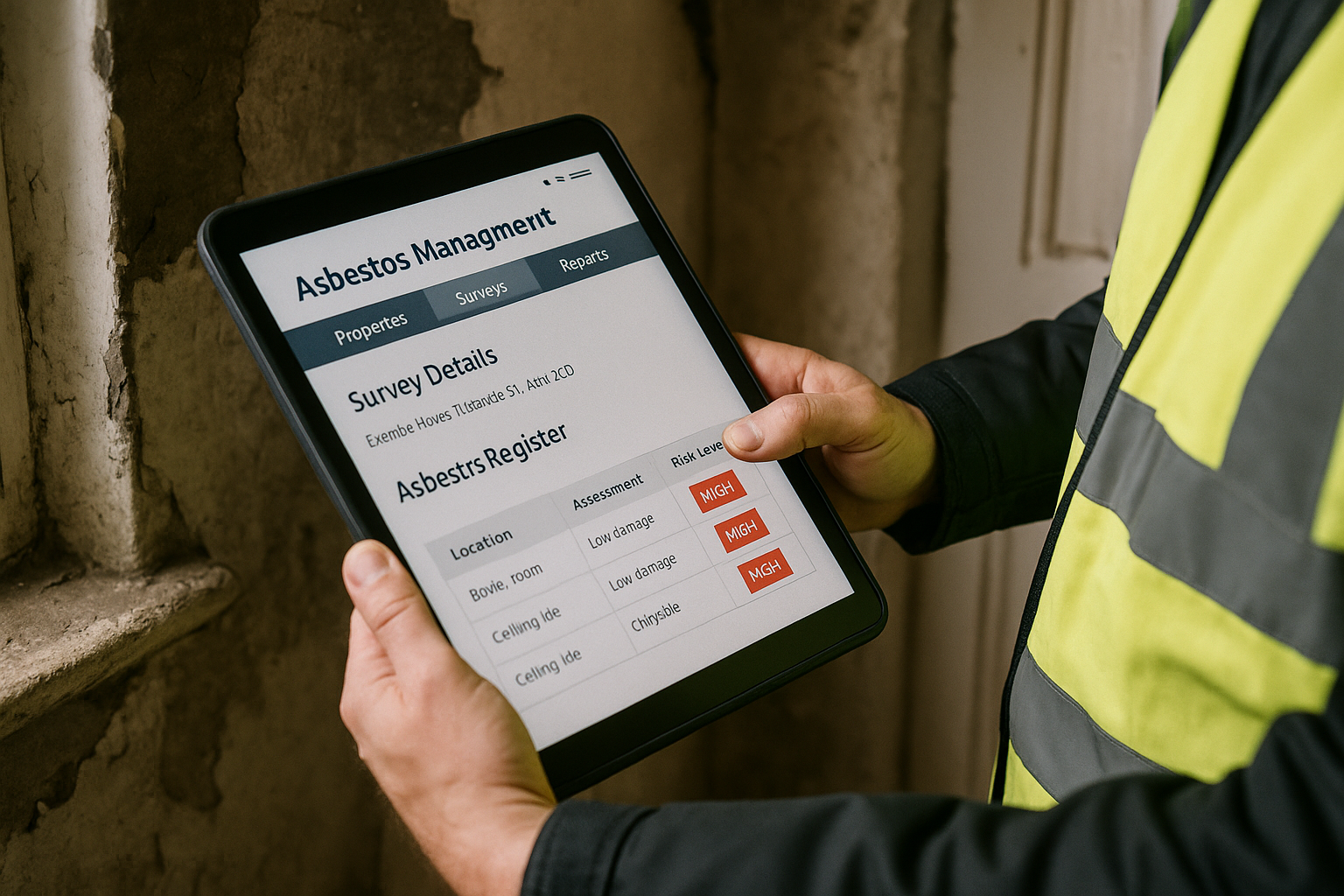
In practical terms, good data should be:
- Complete — all known or presumed asbestos-containing materials are recorded
- Accurate — descriptions, locations and condition notes are reliable and specific
- Current — re-inspections and changes are reflected promptly after they occur
- Consistent — the same approach is applied across every building in the estate
- Accessible — relevant staff and contractors can see the right information when they need it
- Traceable — records link back to the surveys, inspections and actions that produced them
Schools and multi-academy trusts face a particular challenge here: mixed building stock. A trust may be responsible for pre-war buildings, system-built classrooms, 1970s blocks and newer refurbishments all at once. Asbestos records across that estate can vary wildly in age, format and quality.
Asbestos management software helps standardise those records. Instead of each school holding information in a different format, the trust applies one consistent structure across every site.
Practical Signs Your Data Needs Attention
If any of the following sound familiar, your asbestos data may not be robust enough to support safe management:
- Room names in reports do not match current building plans
- Materials are listed as presumed with no review of whether sampling is now practical
- Re-inspection dates are unclear, missing or overdue
- Survey PDFs exist, but there is no central action tracker
- Contractors rely on site staff to locate the latest register manually before starting work
For organisations in the capital where building stock is particularly varied and aged, arranging an updated asbestos survey London service can be a sensible first step when records are fragmented or significantly out of date.
Mobile Access: iOS and Android Functionality for Site Teams
Desktop access is useful, but asbestos information is frequently needed on the move. That is why mobile access on iOS and Android devices has become a standard expectation for modern asbestos management software.
Mobile functionality can make a real operational difference. Surveyors can record information in real time, site managers can check records before works begin and contractors can confirm whether materials in their work area are known or presumed asbestos-containing materials — all without returning to an office or waiting for someone to send a document.
Mobile access should allow users to:
- View the asbestos register by building, floor or room
- Check photographs and material condition notes on site
- Record re-inspection findings directly into the system
- Add comments or updated condition details in real time
- Work offline where signal is poor, then sync when connectivity is restored
For field teams, this removes the need to scribble notes and update systems later. For duty holders, it improves speed and reduces the risk of transcription errors that can compromise the accuracy of the register.
For organisations managing sites across the North West, pairing mobile-accessible software with a reliable asbestos survey Manchester provider helps keep records genuinely current as buildings change and refurbishments take place.
Who Benefits Most from Asbestos Management Software?
Any organisation responsible for non-domestic premises can benefit, but some gain more than others because of the scale or complexity of their estate. The organisations that typically see the greatest improvement include:
- Schools and multi-academy trusts managing multiple sites
- Local authorities with large and varied property portfolios
- NHS and healthcare estates with complex, high-footfall buildings
- Housing providers managing communal areas and mixed tenures
- Commercial landlords with retail or office portfolios
- Manufacturing and industrial operators with legacy plant
- Facilities management companies working across client estates
These organisations share common pressures: they need clear oversight, reliable data, straightforward reporting and a way to brief contractors without delay. They also need a system that supports real operational decisions, not just data storage.
If a ceiling panel is damaged in a school corridor, if a boiler room is due maintenance or if a refurbishment is being planned, the asbestos record must be immediately available and trusted by everyone using it.
For organisations with properties across the Midlands, keeping survey information consistent and current across sites is considerably easier when supported by a dependable asbestos survey Birmingham provider working to the same standard.
What to Check Before Committing to a Platform
Many asbestos management software providers offer a free trial period. That can be genuinely useful — but only if you test the parts that matter under real working conditions. A polished demonstration is not the same as day-to-day usability.
When evaluating any system, focus on these points:
- Ease of use — can site staff and estates managers navigate it without specialist training?
- Data import — can you upload existing survey reports, registers and photographs without rebuilding everything from scratch?
- Mobile functionality — does it work reliably on iOS and Android devices in the field, including offline?
- Integration — does it connect with your existing facilities management, helpdesk or property systems?
- Reporting — can you produce the reports you actually need, formatted for the audiences who need them?
- Support — what happens when something goes wrong or staff need help? Is support included or charged separately?
- Data security — where is your data hosted, who can access it and how is it backed up?
- Scalability — can the system grow with your estate, including new buildings, acquisitions or restructuring?
It is also worth checking whether the provider has experience working with organisations similar to yours. A system designed primarily for a single commercial building will handle a multi-site educational estate very differently to one built with that complexity in mind from the outset.
How Asbestos Management Software Fits Into a Broader Compliance Framework
Software is a tool, not a substitute for professional judgement. The Control of Asbestos Regulations and HSE guidance under HSG264 set out clear requirements for survey quality, risk assessment and management planning. No digital platform changes those requirements — it helps you meet them more reliably.
A sound asbestos management framework typically includes:
- An up-to-date management survey carried out by a competent, accredited surveyor
- A written asbestos management plan that sets out how risk will be controlled
- A live register of all known and presumed asbestos-containing materials
- A schedule of re-inspections at appropriate intervals based on material condition and risk
- A contractor information system ensuring relevant data reaches those who need it before work begins
- A record of actions taken, including remedial works, encapsulation and removal
Asbestos management software supports every element of that framework. It does not generate the professional judgements that underpin the plan, but it makes those judgements far more actionable by keeping the data behind them current, consistent and accessible.
Organisations that treat software as a replacement for surveying and planning will find it adds little value. Those that use it to support a properly structured programme will find it transforms how effectively asbestos risk is managed across their estate.
Keeping Your Survey Data Current: The Role of Regular Re-Inspections
Even the best asbestos management software is only as good as the data it holds. If survey information is years out of date, if materials have been disturbed, removed or encapsulated without the register being updated, or if building layouts have changed significantly, the system cannot protect anyone.
Regular re-inspections are the mechanism that keeps data current. The frequency of re-inspection should be based on the condition and risk score of each material, not simply a fixed annual calendar. Higher-risk or deteriorating materials need more frequent review. Stable, low-risk materials in undisturbed locations may need less.
When re-inspections are completed by a competent surveyor, the findings should feed directly into the software rather than being filed separately. That is how a register stays genuinely live rather than becoming another static document that slowly falls behind the reality of the building.
For organisations managing large or complex estates, scheduling re-inspections systematically through the software — with automated reminders and clear records of what was reviewed and when — is far more reliable than relying on individual memory or ad hoc diary entries.
Frequently Asked Questions
What is asbestos management software and who needs it?
Asbestos management software is a digital platform that allows duty holders to store, manage and act on asbestos survey data across one or more buildings. Any organisation responsible for non-domestic premises built before 2000 is likely to benefit, particularly those managing multiple sites, complex building stock or large numbers of contractors. It supports compliance with the Control of Asbestos Regulations by keeping records live, accessible and auditable.
Does asbestos management software replace the need for a professional survey?
No. Software is a tool for managing and acting on survey data — it does not generate that data. A competent, accredited surveyor must carry out the physical inspection and produce findings in line with HSE guidance under HSG264. The software then holds those findings in a structured, accessible format and helps duty holders track actions, schedule re-inspections and brief contractors effectively.
How often should asbestos records be updated in a management system?
Records should be updated whenever there is a change that affects the accuracy of the register. That includes completed re-inspections, remedial works, encapsulation, removal, changes to building layout and any accidental disturbance. Re-inspection frequency should be driven by the condition and risk score of each material rather than a fixed calendar. The software should support automated reminders to help duty holders stay on schedule.
Can asbestos management software work across multiple sites?
Yes, and multi-site management is one of the areas where software adds the most value. A well-designed platform allows duty holders to view their entire estate through a single dashboard, apply consistent risk scoring and reporting standards across all sites and identify where action is most urgently needed. This is particularly valuable for multi-academy trusts, local authorities, NHS estates and commercial landlords managing varied property portfolios.
What should I do if my existing asbestos records are out of date or incomplete?
The first step is to establish what you have and where the gaps are. If survey reports are significantly out of date, building layouts have changed or materials are listed as presumed without any review of whether sampling is now practical, a new or updated management survey may be needed before the software can hold reliable data. Supernova Asbestos Surveys can carry out management surveys across the UK and provide findings in a format that supports digital record-keeping. Call us on 020 4586 0680 or visit asbestos-surveys.org.uk to discuss your requirements.
Talk to Supernova Asbestos Surveys
Supernova Asbestos Surveys has completed over 50,000 surveys across the UK, working with schools, local authorities, healthcare providers, housing associations, commercial landlords and facilities management teams. We provide management surveys, re-inspections and sampling services that feed directly into your asbestos management records — keeping your data current and your compliance on solid ground.
Whether you manage a single building or a complex multi-site estate, our surveyors work to a consistent standard that supports structured digital record-keeping. If your existing records are fragmented, out of date or simply not trusted by the people who rely on them, we can help you establish a reliable baseline.
Call us on 020 4586 0680 or visit asbestos-surveys.org.uk to discuss your requirements with our team.