
One overlooked panel above a ceiling tile or one outdated register entry can turn routine maintenance into a serious compliance problem. A strong asbestos management plan is what stops that happening. It turns survey findings into clear instructions, assigns responsibility, and gives staff and contractors the information they need before anyone disturbs a hidden risk.
For dutyholders, property managers, estates teams, landlords and managing agents, the challenge is rarely finding a template. The real challenge is creating an asbestos management plan that works on a live site, stands up to scrutiny under the Control of Asbestos Regulations, and reflects the practical expectations set out in HSE guidance and HSG264.
Why an asbestos management plan matters
If you control maintenance or repair obligations in a non-domestic property, or the common parts of certain domestic buildings, you are likely to have duties to manage asbestos. That duty is not satisfied by filing a survey report and forgetting about it.
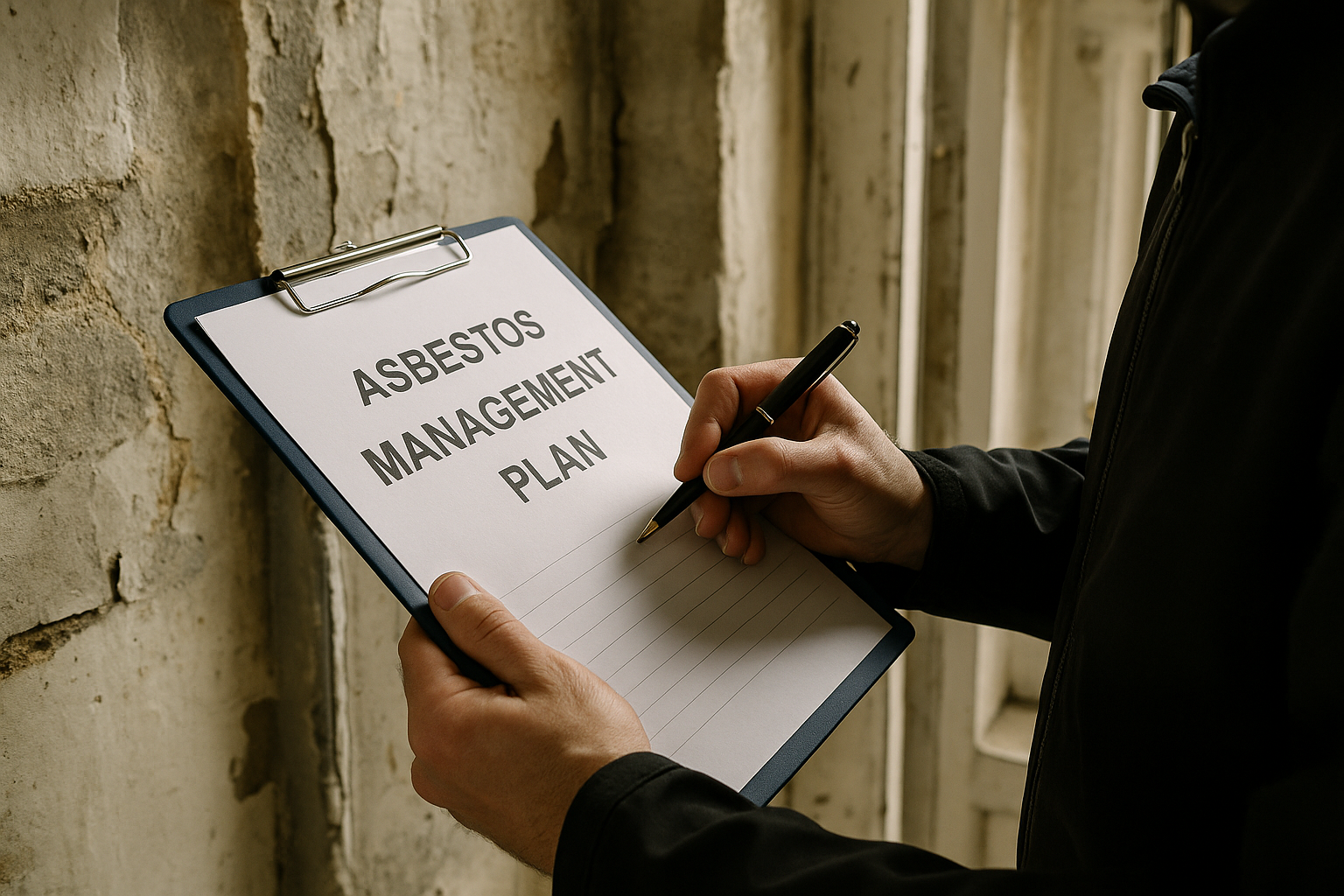
An asbestos management plan is the document that explains how asbestos risks will be controlled in day-to-day practice. It should show what asbestos-containing materials are present or presumed to be present, where they are, what condition they are in, who is responsible, what actions are required, and how the information will be kept current.
Many buildings constructed before 2000 may contain asbestos in materials such as:
- Insulation board
- Pipe lagging
- Ceiling tiles
- Floor tiles and adhesives
- Textured coatings
- Roofing sheets and cement products
- Panels, ducts and service risers
Not all asbestos-containing materials need immediate removal. In many cases, the safest and most proportionate approach is to leave the material in place and manage it properly. Your asbestos management plan is the evidence that you have assessed the risk sensibly and put controls in place.
Who needs an asbestos management plan?
The duty to manage applies widely. If you are responsible for maintenance, access arrangements, repair work or contractor control, you may be the dutyholder or part of a shared dutyholder arrangement.
In practice, an asbestos management plan is relevant across a wide range of sectors and property types, including:
- Offices and commercial premises
- Schools, colleges and universities
- Retail units and shopping centres
- Hospitals, surgeries and clinics
- Factories, warehouses and industrial sites
- Hotels and leisure venues
- Local authority buildings
- Housing association communal areas
- Churches, halls and public buildings
- Transport depots and operational estates
Where responsibilities are split between landlord, tenant, managing agent and contractors, your asbestos management plan must make those responsibilities clear. Confusion over who does what is one of the most common weaknesses in asbestos management.
The foundation of an effective asbestos management plan
A reliable asbestos management plan starts with reliable information. If the underlying survey data is weak, out of date or incomplete, the plan built on top of it will be weak as well.

For occupied premises, the usual starting point is a suitable management survey. This survey is designed to locate, as far as reasonably practicable, the presence and extent of any suspect asbestos-containing materials that could be damaged or disturbed during normal occupation, routine maintenance or foreseeable installation work.
The survey findings should feed directly into your asbestos register. That register then supports the decisions recorded in the asbestos management plan.
What the asbestos register should include
Your asbestos register should be clear enough for someone on site to use quickly. At a minimum, it should normally record:
- The location of each known or presumed asbestos-containing material
- A description of the product or material
- The extent or quantity
- The material type where known
- Its condition at the time of inspection
- Photographs where useful
- Room references, plans or marked-up drawings
- Any areas that were not accessed
If part of the building could not be inspected, that gap needs to be managed. In many cases, those inaccessible areas should be treated as presumed asbestos until there is evidence to show otherwise. That is especially relevant in ceiling voids, risers, service ducts, boxed-in areas and hidden structural spaces.
When a management survey is not enough
A common mistake is assuming the same survey can support every type of work. It cannot. A routine asbestos management plan supports normal occupancy and minor maintenance, but it does not replace the need for a more intrusive survey before major works.
If refurbishment, strip-out or demolition is planned, a demolition survey or the appropriate intrusive survey must be carried out before work starts. Hidden asbestos can sit behind walls, beneath floors, inside plant, or within building fabric that a standard management survey is not designed to open up.
Key components of an asbestos management plan
An effective asbestos management plan should be site-specific. A generic template with a building name dropped in at the top is rarely enough. The plan should reflect the actual materials, actual risks and actual working arrangements on that site.
At minimum, the plan should contain the following elements.
1. Dutyholder details and responsibilities
Name the organisation, site address and key contacts. Set out who holds legal responsibility and who manages asbestos day to day.
If responsibilities are shared, record that clearly. For example:
- Landlord responsible for structure and common parts
- Tenant responsible for internal maintenance
- Managing agent responsible for contractor control
- Facilities team responsible for updating records
Do not leave room for assumption. If a contractor needs asbestos information at short notice, they should know exactly who to contact.
2. Scope of the plan
Your asbestos management plan should state which buildings, floors, rooms, external structures and plant areas it applies to. If any areas are excluded, make that obvious.
This matters on larger estates. A plan that vaguely refers to a whole site without defining boundaries can create dangerous gaps.
3. The asbestos register
The plan should either include the current asbestos register or point clearly to where it is stored. Staff and contractors should be able to access it without delay.
If the register is held digitally, check that site teams can still access it during outages or when working remotely in plant rooms and service areas.
4. Risk assessment for each item
Every identified or presumed asbestos-containing material should be assessed according to its risk. That means looking beyond the material itself and considering the environment around it.
Factors to consider include:
- Material type and friability
- Condition and visible damage
- Surface treatment or sealing
- Accessibility
- Occupancy levels nearby
- Likelihood of disturbance
- Planned maintenance activity in the area
A damaged insulation board panel in a busy corridor needs a different response from intact asbestos cement sheeting on a locked outbuilding.
5. Action plan and timescales
This is the working core of the asbestos management plan. For each relevant item, record what action is required, who is responsible and by when.
Typical actions include:
- Leave in place and monitor
- Label or sign where appropriate
- Encapsulate or seal
- Restrict access
- Arrange repair
- Commission further inspection or sampling
- Arrange licensed removal where required
Without named actions and dates, a plan quickly becomes little more than a reference document.
6. Procedures for contractors and maintenance teams
Anyone carrying out work that could disturb the fabric of the building must have access to asbestos information before starting. Your asbestos management plan should explain how that happens in practice.
Useful controls include:
- Checking the asbestos register before issuing work orders
- Linking asbestos checks to permit-to-work systems
- Briefing contractors on known asbestos locations
- Stopping work if suspect materials are uncovered
- Recording who received asbestos information and when
This is where many organisations are caught out. The plan may be well written, but if contractors are not actually seeing the information, the risk remains.
7. Training and communication
Your asbestos management plan should state how relevant people receive information, instruction and training suitable for their role. That may include maintenance staff, caretakers, engineers, cleaners, fit-out contractors, IT installers and external trades.
Not everyone needs the same level of detail. A caretaker and a licensed contractor have different training needs. What matters is that each person understands the risks relevant to the work they do and knows how to report damage or concerns.
8. Emergency arrangements
If asbestos is accidentally disturbed, the first few minutes matter. Your plan should set out immediate steps so staff are not left improvising.
Emergency arrangements should typically include:
- Stop work immediately
- Keep people away from the area
- Prevent further access
- Report the incident to the responsible person
- Arrange specialist assessment
- Record the incident and any remedial action
Simple, site-specific instructions are far more useful than vague wording copied from a template.
9. Review and reinspection arrangements
An asbestos management plan must be a live document. Buildings change, occupancy changes, materials deteriorate and contractors open up hidden areas.
The plan should explain:
- How often asbestos-containing materials will be reinspected
- Who carries out the review
- How changes are recorded
- How completed actions are signed off
- How the register is updated after removal, repair or discovery
Regular review is supported by HSE guidance and HSG264. Annual review is a common baseline, but higher-risk materials or changing site conditions may justify more frequent checks.
How to prioritise actions in the real world
Not every asbestos item carries the same immediate risk. A practical asbestos management plan helps you direct time and budget where they are most needed.
Start with three straightforward questions:
- How likely is this material to be disturbed?
- If it is disturbed, how serious could the fibre release be?
- What is the most proportionate control measure right now?
That approach helps avoid both extremes: overreacting to low-risk materials and underreacting to serious defects.
Examples of practical prioritisation
Low priority: asbestos cement sheet in good condition on a little-used external store. Usually leave in place, record it properly and inspect periodically.
Medium priority: textured coating in a circulation area where cabling works are planned. Review before works, brief contractors and consider whether further inspection or controls are needed.
High priority: damaged insulating board in a service riser accessed regularly by engineers. Restrict access, arrange urgent specialist advice and take remedial action without delay.
Document the reasoning behind each decision. If the HSE asks how you assessed the risk, you should be able to show a clear thought process rather than a broad assumption.
Keeping your asbestos management plan up to date
An out-of-date asbestos management plan can be as risky as having no plan at all. Asbestos management is not static. Materials deteriorate, repairs happen, layouts change and new work exposes previously hidden areas.
Your records need to keep pace with those changes. Do not wait for a scheduled annual review if something significant has changed on site.
When the plan should be updated
Review and amend the asbestos management plan when:
- Reinspection shows deterioration
- Asbestos is removed, repaired or encapsulated
- New suspect materials are found
- The building layout or use changes
- Maintenance patterns change
- Contractors report damage or restricted access
- Refurbishment or demolition is planned
- Dutyholder responsibilities change
Good record control makes this easier. Link asbestos checks to work order approval, require contractors to report newly exposed suspect materials, and update the register as soon as verified information becomes available.
When sampling may be needed
Sometimes a material is only presumed to contain asbestos because it could not be confirmed during the original inspection. Where it is safe and appropriate to do so, laboratory testing can help refine the record and support proportionate decisions.
If there is uncertainty, arrange sample analysis through a competent process rather than relying on guesswork. A clear result can help you decide whether to monitor, restrict, repair or remove.
Common mistakes that weaken an asbestos management plan
Most asbestos failures are not caused by the absence of paperwork. They happen because the paperwork does not translate into action on site.
Watch for these common problems:
- The survey exists, but the register is hard to access
- The asbestos management plan has no named responsible persons
- Contractors are not checking asbestos information before works
- Inaccessible areas are ignored rather than presumed and managed
- Actions are listed with no timescales
- Reviews are missed after building changes
- Emergency procedures are vague or untested
- Plans are copied across multiple sites without site-specific detail
If any of these sound familiar, the fix is usually practical rather than complicated. Tighten access to information, assign ownership, and make asbestos checks part of routine maintenance control rather than a separate exercise.
Practical steps to improve your asbestos management plan today
If your current arrangements feel patchy, start with the basics. You do not need to rewrite everything at once, but you do need a plan that people can use.
- Check whether your asbestos register is current and easy to access
- Confirm who the dutyholder is and who manages asbestos day to day
- Review whether all buildings and areas are clearly covered
- Make sure contractor control procedures include asbestos checks
- Prioritise damaged or accessible materials for urgent review
- Set review dates and reinspection responsibilities
- Update emergency instructions so staff know exactly what to do
If you manage multiple properties, consistency matters. The core structure of each asbestos management plan can be similar, but each site still needs its own register, risks, contacts and actions.
Local survey support for portfolios and single sites
Whether you manage one building or a national estate, survey quality has a direct impact on the quality of your asbestos management plan. Clear, usable survey data makes it far easier to build a register, brief contractors and prioritise works.
Supernova supports clients across the UK, including those needing an asbestos survey London service for commercial premises, an asbestos survey Manchester appointment for occupied sites, or an asbestos survey Birmingham visit for planned maintenance and compliance work.
If your records are incomplete, your building use has changed, or major works are approaching, now is the time to review your asbestos management plan before a contractor opens up the wrong area.
Get expert help from Supernova
A workable asbestos management plan starts with accurate information and clear action. Supernova Asbestos Surveys has completed more than 50,000 surveys nationwide and helps dutyholders turn survey findings into practical asbestos management.
If you need a management survey, refurbishment or demolition survey, sampling support, or advice on improving your asbestos records, contact Supernova today on 020 4586 0680 or visit asbestos-surveys.org.uk.
Frequently Asked Questions
What is an asbestos management plan?
An asbestos management plan is a site-specific document that explains how known or presumed asbestos-containing materials will be managed. It should identify risks, set out control measures, assign responsibilities, and explain how information will be reviewed and shared.
Who is responsible for an asbestos management plan?
The dutyholder is responsible under the Control of Asbestos Regulations. Depending on the property arrangement, that could be a landlord, managing agent, employer, tenant or another party with maintenance and repair responsibilities. Shared arrangements should be clearly documented.
How often should an asbestos management plan be reviewed?
The plan should be reviewed regularly and whenever there is a material change, such as damage, removal, refurbishment plans or a change in building use. Annual review is common, but higher-risk materials may need more frequent checks.
Does every building need asbestos removed?
No. Asbestos does not always need to be removed. If asbestos-containing materials are in good condition and unlikely to be disturbed, they can often remain in place and be managed safely through inspection, communication and control measures.
What is the difference between an asbestos management survey and a demolition survey?
A management survey is used to help manage asbestos during normal occupation and routine maintenance. A demolition survey is more intrusive and is needed before major structural work or demolition so hidden asbestos can be identified before work begins.