Why Ex Council Houses and Asbestos Go Hand in Hand
If you’re buying or already own an ex council house built before 2000, asbestos is not a remote possibility — it’s a near certainty. Local authorities built millions of homes between the 1940s and 1980s using asbestos-containing materials (ACMs) as standard. Getting an asbestos survey for ex council house properties isn’t overcautious; it’s the single most important step you can take before picking up a drill or signing a mortgage.
This post covers where asbestos hides in former council stock, what the health and legal risks look like, how surveys work, and what to do when ACMs are found. Whether you’re a buyer, a new owner, or planning a renovation, the information below gives you a clear path forward.
Where Asbestos Hides in Ex Council Properties
Council housing from the post-war decades was built at pace and at scale. Asbestos was cheap, fire-resistant, and widely available, so it ended up in almost every part of the building envelope. The problem is that many ACMs look identical to ordinary building materials — you genuinely cannot tell by looking.
Common locations include:
- Textured ceiling coatings such as Artex and similar spray finishes
- Cement soffits, fascia boards, gutters, and downpipes
- Profiled roof sheets on the main house, garages, and outbuildings
- Roofing felt beneath tiles
- External cladding boards and window infill panels
- Cold water tanks and boiler cupboard linings
- Asbestos insulating board (AIB) used as fire panels near boilers and fuse boxes
- Vinyl floor tiles and the bitumen adhesive beneath them
- Pipe lagging on old heating systems
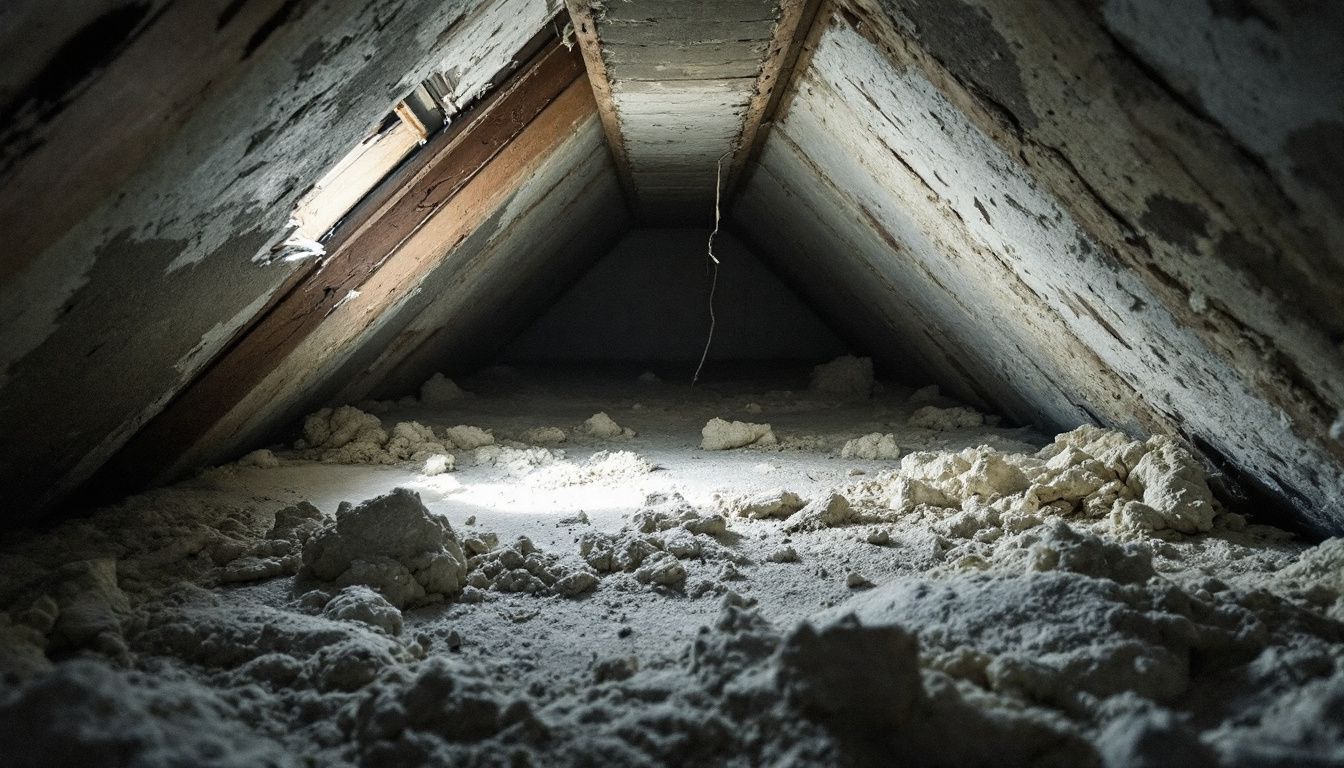
- Loose fill insulation in loft voids or cavity spaces
- Shared areas in flatted blocks — stairwells, bin stores, plant rooms
Prefabricated council homes — Airey houses, BISF houses, Cornish units, and similar non-traditional types — are particularly high-risk. Their structural panels and cement sheets often contain asbestos throughout, not just in isolated spots.
The Three Types of Asbestos You’re Most Likely to Encounter
All three main types — white (chrysotile), brown (amosite), and blue (crocidolite) — were used in UK housing. Blue and brown asbestos are considered the most hazardous because their fibres are especially fine and durable in lung tissue. All three are now banned in the UK, but all three can still be present in pre-2000 buildings.
A laboratory analysis following sampling will confirm exactly which type is present and in what concentration. Visual inspection alone is never sufficient.
Health Risks: Why Disturbing ACMs Is So Dangerous
Asbestos in good condition, left undisturbed, presents a very low risk. The danger begins when fibres become airborne — through drilling, sanding, cutting, or breaking — and are then inhaled. Once in the lungs, asbestos fibres cannot be expelled by the body.
Diseases linked to asbestos exposure include:
- Mesothelioma — a cancer of the lining of the lungs or abdomen, almost exclusively caused by asbestos
- Asbestosis — progressive scarring of lung tissue that reduces breathing capacity
- Lung cancer — risk is significantly elevated by asbestos exposure, especially in smokers
- Pleural thickening — scarring of the membrane around the lungs, causing breathlessness
There is no safe level of exposure, and symptoms can take 20 to 40 years to appear. Homes containing loose fill insulation or visibly damaged ACMs present the highest immediate risk and need urgent professional assessment.
The HSE publishes clear guidance on asbestos health risks, and their advice is consistent: do not disturb suspected ACMs, and always use qualified professionals for any work involving them.
Legal Responsibilities for Homeowners and Buyers
The Control of Asbestos Regulations set out the legal framework for managing asbestos in the UK. While the strictest duties apply to non-domestic premises, homeowners and buyers still have meaningful obligations.
What Sellers Must Disclose
Sellers are required to disclose known hazards, including the existence of any asbestos surveys or reports they hold. Withholding this information can expose a seller to legal action under consumer protection legislation. Estate agents also have duties of accuracy under property misdescription rules.
If you’re buying, always ask whether an asbestos survey has ever been carried out, and request copies of any reports. Don’t assume a clean bill of health just because nothing has been volunteered.
What Owners Are Responsible For
Once you own the property, you are responsible for managing any ACMs within it. In leasehold blocks, the freeholder or managing agent typically holds responsibility for shared areas — but if you buy the freehold, those duties transfer to you from day one.
Your responsibilities include:
- Knowing where ACMs are located and their condition
- Keeping an asbestos register and management plan
- Ensuring tradespeople are warned before any work begins
- Arranging licensed removal for high-risk materials
- Passing records on to future buyers or tenants
Standard home insurance policies rarely cover asbestos removal unless damage arises from an insured event such as a fire. Check your policy wording carefully and disclose any known ACMs to avoid a claim being voided.
Getting an Asbestos Survey for an Ex Council House
There are two main types of asbestos survey, and choosing the right one depends on what you plan to do with the property.
Management Survey
A management survey is the standard option for properties where no major construction or renovation work is planned. The surveyor inspects accessible areas, identifies likely ACMs, takes samples where necessary, and produces a report with risk ratings and monitoring recommendations.
This is the right survey if you’ve just bought an ex council house and want to understand what you’re dealing with before making any decisions. It gives you a register of ACMs, their condition, and a clear action plan.
Refurbishment and Demolition Survey
If you’re planning significant works — knocking through walls, replacing a roof, fitting a new kitchen, or extending — you need a demolition survey before work begins. This is a more intrusive inspection: surveyors lift floors, open wall cavities, and access areas that would not be checked in a routine management survey.
The Control of Asbestos Regulations require this type of survey before any refurbishment or demolition work on buildings where asbestos may be present. Skipping it is not just risky — it’s a legal breach that can result in prosecution.
What a Good Survey Report Should Include
A professional asbestos survey report should contain:
- A full register of identified or suspected ACMs with precise locations
- Photographs of each material and its condition
- Laboratory analysis results confirming fibre type
- Risk ratings for each ACM based on condition and likelihood of disturbance
- Clear recommendations — monitor, encapsulate, or remove
- A management plan outlining next steps
Surveyors should hold BOHS P402 qualification for surveying and sampling. Inspection bodies should be accredited to BS EN ISO/IEC 17020, as recommended by the HSE under HSG264 guidance. Always check credentials before booking.
How to Arrange a Survey
- Find a UKAS-accredited inspection body that covers your area
- Confirm the surveyor holds BOHS P402 (and P405 for management work)
- Request a clear written quote specifying which type of survey is included
- Ask what the report will contain and the expected turnaround time
- Book the appointment — for a two or three-bedroom house, prices typically start from around £250 and rise with property size, age, and complexity
- Ensure the scope covers all high-risk areas: loft insulation, floor tiles, roofing felt, pipe lagging, and wall panels
Supernova Asbestos Surveys operates nationwide. If you’re in the capital, our asbestos survey London service covers all boroughs. We also cover the North West through our asbestos survey Manchester team, and the Midlands through our asbestos survey Birmingham team.
Buying an Ex Council House with Asbestos: Impact on Mortgages and Insurance
Finding ACMs doesn’t have to kill a purchase — but it does change the conversation with your lender and insurer.
Mortgage Implications
Many mortgage lenders will ask for an asbestos survey report before releasing funds on ex council stock, particularly on non-traditional construction types. If ACMs are found in poor condition, some lenders will require remediation before completing. Others will lend but reduce the loan-to-value ratio, affecting how much deposit you need.
Having a professional survey report ready — with clear risk ratings and a management plan — significantly improves your position with underwriters. It shows you understand the risk and have a plan to address it.
Insurance Considerations
You must disclose known asbestos to your insurer. Failing to do so can invalidate your policy. Standard home insurance generally excludes the cost of asbestos removal unless it results directly from an insured event.
Some specialist insurers offer policies that include asbestos-related cover, particularly for landlords. If you’re letting out an ex council property, this is worth investigating before you sign any tenancy agreement.
Negotiating on Price
If a survey reveals ACMs, use the report to negotiate. Get removal or encapsulation quotes from licensed contractors and present these to the seller as part of your renegotiation. Where materials are in good condition and low risk, you may agree a management plan rather than immediate removal — this can keep the deal alive while protecting both parties.
RICS-registered valuers can factor asbestos findings into a formal valuation, giving you an objective basis for price adjustment discussions.
Managing Asbestos Once You Own the Property
An asbestos survey is the start of the process, not the end. Once you have a report, you need a clear plan for each identified ACM.
Monitor, Encapsulate, or Remove
Monitor — ACMs in good condition that won’t be disturbed can often be left in place and checked periodically. Record their condition and update your register after each inspection.
Encapsulate — Some materials can be sealed with specialist coatings to prevent fibre release. This is typically cheaper than removal and appropriate for lower-risk ACMs in stable condition. Typical encapsulation costs run around £25 per square metre, though this varies considerably by material type and location.
Remove — Damaged, friable, or high-risk ACMs (particularly pipe lagging, sprayed coatings, and loose fill insulation) should be removed by a licensed contractor. The HSE maintains a register of licensed asbestos removal contractors. Costs vary but typically start around £150 per square metre for removal work. For larger projects, our asbestos removal service can advise on scope and cost.
The Four-Stage Clearance Process
After any licensed removal, the area must pass a four-stage clearance inspection before it can be reoccupied. This includes a visual check, air testing by an independent UKAS-accredited analyst, and the issue of a reoccupation certificate. Do not accept any removal job as complete without this documentation.
Practical Steps to Reduce Risk Day-to-Day
- Label areas containing ACMs so tradespeople are warned before any work begins
- Never drill, cut, sand, or break suspected ACMs without professional confirmation that it’s safe to do so
- Keep your asbestos register up to date and pass it to any new owners or tenants
- Brief any contractors working on the property about the location of ACMs before they start
- Book follow-up surveys after any building work that may have affected ACM condition
Planning a Renovation? Get the Survey Right First
Renovation is where the risk escalates sharply. A homeowner who drills into an AIB panel or sands an Artex ceiling without knowing what’s in it can release fibres into the living space — and potentially into neighbouring properties in a terrace or flat.
Before any of the following work, a refurbishment or demolition survey is essential:
- Kitchen or bathroom replacement
- Loft conversion or roof work
- Extension or structural alteration
- Rewiring or replumbing
- Removal of internal walls or partitions
- Garage conversion
Contractors working on pre-2000 properties are required under the Control of Asbestos Regulations to check for ACMs before starting work. If you’re the homeowner commissioning the work, ensuring a survey is in place protects you, your contractors, and anyone else in the building.
HSG264, the HSE’s guidance document on asbestos surveys, sets out the standards surveyors must meet and is a useful reference if you want to understand what a compliant survey looks like.
Frequently Asked Questions
Do I legally need an asbestos survey before buying an ex council house?
There is no legal requirement for a buyer to commission an asbestos survey before purchase. However, your mortgage lender may require one, and it is strongly advisable given the age and construction methods used in council housing. Buying without a survey means you could inherit unknown ACMs along with the property.
What type of asbestos survey do I need for an ex council house?
If you’re not planning any renovation work, a management survey is the appropriate starting point. It identifies and risk-rates ACMs throughout the accessible areas of the property. If you’re planning refurbishment, extension, or demolition, you’ll need a refurbishment and demolition survey, which is more intrusive and required by law before such work begins.
Can I still get a mortgage on a house with asbestos?
Yes, in most cases. Many lenders will approve mortgages on properties with asbestos present, provided the ACMs are in good condition and a management plan is in place. Some lenders take a stricter view, particularly with non-traditional construction types or where ACMs are in poor condition. Having a professional survey report ready before you apply strengthens your case considerably.
How much does an asbestos survey for an ex council house cost?
For a standard two or three-bedroom house, management survey costs typically start from around £250. Larger properties, non-traditional construction types, or properties requiring a more intrusive refurbishment survey will cost more. The exact price depends on property size, location, and the scope of the survey required. Supernova Asbestos Surveys provides clear, itemised quotes — get a free quote online or call 020 4586 0680.
Is asbestos in an ex council house dangerous if I leave it alone?
Asbestos in good condition that is not disturbed presents a very low risk. The danger arises when ACMs are damaged, deteriorating, or disturbed by work. The sensible approach is to have a survey carried out, understand exactly what’s present and in what condition, and follow the surveyor’s recommendations. Many properties with ACMs are managed safely for decades without removal.
Get Your Asbestos Survey Booked Today
Supernova Asbestos Surveys has completed over 50,000 surveys across the UK. Our accredited surveyors work with buyers, homeowners, landlords, and property managers to deliver clear, actionable asbestos reports — fast.
Whether you need a management survey before completing on a purchase, a refurbishment survey ahead of building works, or advice on removal options, we’re ready to help. Call us on 020 4586 0680, get a free quote online at asbestos-surveys.org.uk, or use the booking form to arrange a survey at a time that suits you.