Can You Test for Asbestos in a Home? What You Need to Know
Drilling into the wrong ceiling or prising up an old floor tile can turn a routine job into a serious health hazard. Asbestos testing is the only reliable way to confirm whether a suspect material actually contains asbestos — and that matters before any maintenance, refurbishment, property purchase, or tenancy decision moves forward.
You cannot identify asbestos by colour, texture, age, or appearance alone. Many materials that look completely harmless can contain asbestos fibres, while others that appear suspicious may not. If a property was built or altered before asbestos was fully banned in the UK, the safest approach is to treat suspect materials with caution until proper testing has been carried out.
Why Asbestos Testing Matters
Asbestos was used widely across homes, commercial buildings, schools, industrial sites, and communal areas because it offered excellent insulation, fire resistance, and durability. Those same qualities are why it still turns up in older properties today.
The danger comes when asbestos-containing materials are damaged or disturbed. Cutting, sanding, drilling, breaking, or removing the wrong material can release microscopic fibres into the air. Once inhaled, those fibres can cause serious and irreversible diseases — including mesothelioma and asbestosis — that may not become apparent for decades.
Good asbestos testing helps you make practical decisions quickly. It can tell you whether one suspect item needs managing, whether work can proceed safely, or whether you need a wider survey before anything is disturbed.
Common Places Asbestos May Be Found in a Property
Asbestos was incorporated into hundreds of different building products over several decades. Some of the most frequently encountered locations include:
- Textured coatings on ceilings and walls (commonly known as Artex)
- Vinyl floor tiles and bitumen adhesive beneath them
- Asbestos insulating board in partitions, soffits, and service cupboards
- Pipe lagging and boiler insulation
- Cement sheets on garages, sheds, and outbuildings
- Roofing panels, gutters, and downpipes
- Fuse boards and backing panels
- Fire doors and older insulation products
Condition matters as much as location. Intact asbestos cement on a garage roof presents a very different level of risk compared to damaged insulation board or crumbling pipe lagging. That said, all suspect materials should be treated carefully until asbestos testing confirms exactly what is present.
What Asbestos Testing Actually Involves
In most cases, asbestos testing means taking a small bulk sample from a suspect material and sending it to a competent laboratory for analysis. The result confirms whether asbestos is present and usually identifies the specific fibre type found within that sample.
This can be arranged as a standalone service when you need a quick answer on one or two materials. It can also form part of a wider survey where the aim is to understand asbestos risk across an entire property.
What a Laboratory Result Tells You
A bulk sample report will state whether asbestos was detected in the submitted material. It may also record the sample description and the type of asbestos identified — such as chrysotile, amosite, or crocidolite.
What it does not tell you is what may be present elsewhere in the property. One positive sample does not mean everything contains asbestos, and one negative sample does not prove the rest of the building is clear. That distinction is critical when making decisions about wider maintenance or refurbishment plans.
Why Reliable Sample Analysis Matters
Poor sampling technique, contamination, or unclear reporting can lead to the wrong decision being made. If contractors are waiting, a sale is progressing, or maintenance needs to start, you need results you can act on with confidence.
Choosing a laboratory that provides clear, accredited sample analysis is not a minor detail — it is the difference between a result you can rely on and one that leaves doubt. UKAS-accredited laboratories follow recognised analytical methods and provide results that hold up under scrutiny.
How Many Samples Are Needed?
This is one of the most common questions, and the honest answer is: it depends. The number of samples required varies according to the number of suspect materials, how varied they are across the building, and what you plan to do next.
A single sample might be sufficient for one clearly defined, isolated material. A refurbishment project spanning several rooms will almost certainly require more. Materials that look similar are not always the same — two textured coatings in one property may have different compositions, and one floor tile cannot safely represent every floor finish throughout the building.
As a practical guide:
- One sample may be enough for a single, clearly defined material in one location
- Several samples may be needed where similar materials appear in different areas or at different heights
- Different material types should always be considered and sampled separately
- Refurbishment work usually requires more intrusive inspection and more extensive sampling
Where there is any doubt, a competent surveyor should set the sampling strategy. That is especially true in occupied buildings, communal areas, schools, retail units, and properties due for strip-out works.
Asbestos Testing or Asbestos Survey: Which Do You Need?
There is an important difference between testing one suspect item and understanding asbestos risk across an entire building. Asbestos testing answers a specific question about a specific material. A survey is designed to locate and assess asbestos-containing materials more broadly, in line with HSE guidance and HSG264.
When a Management Survey Is the Right Choice
If you manage an occupied non-domestic property, a management survey is used to identify and manage asbestos that could be disturbed during normal occupation and routine maintenance. It supports the duty to manage under the Control of Asbestos Regulations and forms the basis of an asbestos register for the building.
When a Refurbishment Survey Is Required
If major works are planned, a refurbishment survey is needed before work starts. This is a more intrusive inspection because it must identify asbestos in the areas affected by the planned works — including hidden locations where necessary. Relying on ad hoc samples alone before a refurbishment is not adequate and may leave workers exposed to undiscovered asbestos.
Choosing the Right Option
Choose asbestos testing when:
- You have one or two suspect materials only
- The material is accessible and can be sampled safely
- You need a quick yes-or-no answer before minor work
- You are not trying to produce a full asbestos register
Choose a survey when:
- You are responsible for a non-domestic property
- You need to comply with the duty to manage
- You are planning refurbishment, strip-out, or demolition
- There are multiple suspect materials, hidden voids, or complex layouts
- You need a fuller record of asbestos-containing materials for compliance
Can You Use an Asbestos Testing Kit at Home?
An asbestos testing kit can be a practical option when you need to check one specific, accessible material and the sample can be taken without creating unnecessary disturbance. Homeowners and landlords often use kits for stable garage cement sheets, floor tiles, or textured coatings in good condition.
That said, a kit is not a substitute for a professional survey. It gives you a result for the sample you submit — not a full assessment of the property.
What a Testing Kit Usually Includes
- Step-by-step instructions for taking the sample
- Sample bags or sealed containers
- Submission and return details
- Laboratory analysis of the submitted sample
- A written result confirming presence or absence of asbestos
Before ordering a testing kit, check exactly what is included. Some cover one sample only, while others allow multiple submissions or offer faster turnaround as an optional extra.
Points to Check Before You Order
- How many samples are included in the price
- Whether return packaging or postage is provided
- Whether laboratory analysis is included or charged separately
- Whether the instructions are clear and suitable for domestic users
- Whether support is available if you are unsure about safe sampling technique
A cheap kit can end up costing more if you need to reorder, or if the sample is rejected because it was packaged or labelled incorrectly.
How to Approach Sampling Safely
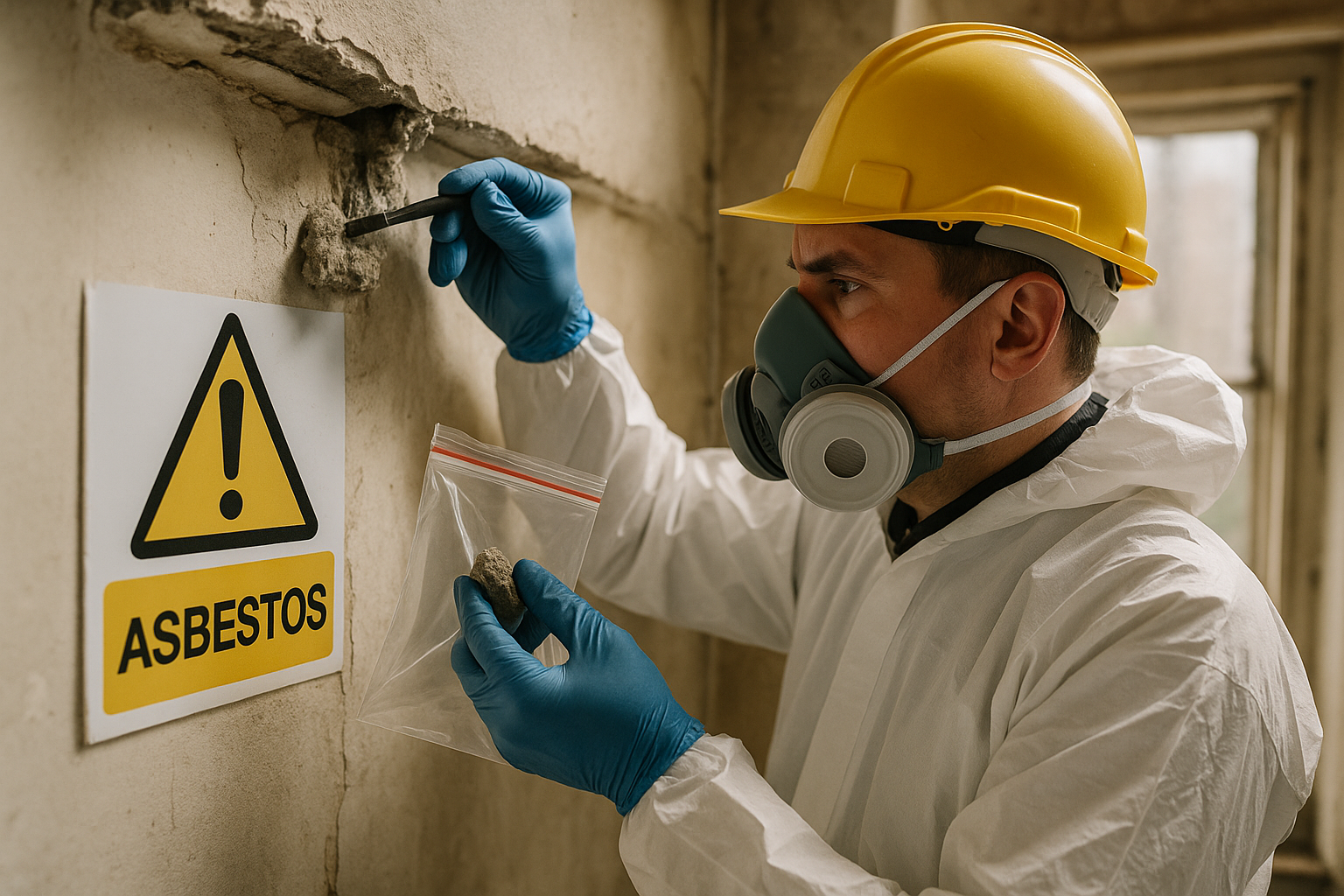
Sampling should always be kept to the absolute minimum necessary. The goal is to take a small, representative piece of material while causing as little disturbance as possible to the surrounding area.
If the material is damaged, crumbly, overhead, difficult to reach, or likely to release fibres during sampling, do not attempt to sample it yourself. In those cases, sampling must be left to trained professionals with the correct procedures, equipment, and respiratory protection.
Basic Precautions for Lower-Risk Sampling
- Dampen the sample area lightly before disturbing it, to reduce airborne dust
- Use suitable disposable gloves throughout
- Wear appropriate respiratory protection where needed
- Double-bag the sample securely and seal it properly
- Clean the immediate area with damp wipes afterwards — not a dry cloth or vacuum
- Label the sample clearly with the material description and location
When Not to Take a Sample Yourself
There are materials where self-sampling is not appropriate under any circumstances:
- Insulation board in poor or deteriorating condition
- Pipe lagging or thermal insulation
- Sprayed coatings on structural steelwork or ceilings
- Loose debris or visibly damaged materials
- Materials hidden behind finishes or in confined spaces
- Any material in an occupied area where contamination could affect others
No sampling method is entirely risk-free. If there is any uncertainty at all, stop and arrange professional help rather than guessing.
The Legal Position in the UK
The legal framework becomes straightforward once you separate domestic situations from non-domestic duties. The Control of Asbestos Regulations place a clear duty on those responsible for non-domestic premises to identify and manage asbestos risk. HSE guidance and HSG264 set out in detail how asbestos surveys should be planned, carried out, and recorded.
For homeowners, the legal position is different — but the practical risk is not. If tradespeople are coming in or refurbishment is planned, suspect materials still need to be considered before work starts. Contractors have their own legal duties, and a homeowner who knowingly allows work to proceed on a suspect material without prior testing may find themselves in a difficult position if something goes wrong.
Key Points Duty Holders Should Remember
- Assume asbestos may be present in older premises unless there is clear evidence to show otherwise
- Take reasonable steps to find out whether asbestos is present and what condition it is in
- Keep an up-to-date record of asbestos-containing materials in an asbestos register
- Assess the risk of exposure and plan how that risk will be managed
- Share relevant information with anyone who may disturb the material — including contractors, maintenance staff, and tenants
This is where a survey often becomes essential. A single asbestos testing result rarely fulfils the wider need to identify and manage asbestos across a non-domestic building in line with the Control of Asbestos Regulations.
Practical Situations Where Asbestos Testing Is the Right First Step
Not every property or situation requires the same approach. The right option depends on what you are trying to achieve and what the next step in the process actually is.
Before Minor Maintenance Work
If a contractor needs to drill one panel, remove a short section of ceiling coating, or lift a small area of flooring, targeted asbestos testing can provide the answer needed before work starts. It is faster and more cost-effective than commissioning a full survey for a genuinely isolated task.
Before Refurbishment
If walls are coming down, bathrooms are being stripped out, or services are being upgraded, do not rely on ad hoc samples alone. A full refurbishment survey is the correct step because hidden asbestos must be identified across the entire work area before any intrusive work begins.
During Ongoing Property Management
Managing agents and landlords often use asbestos testing to investigate isolated suspect materials between planned surveys. It can also help clarify whether a material previously listed as presumed asbestos-containing still needs to be treated as such, or whether it requires rechecking.
For Property Purchases and Due Diligence
Buyers sometimes want quick reassurance about a garage roof, an Artex ceiling, or an old outbuilding before exchange. Asbestos testing can be a sensible first step in that context — provided nobody treats a negative result as evidence that the entire property is asbestos-free.
What Happens After a Positive Asbestos Testing Result?
A positive result does not automatically mean urgent removal. The correct response depends on the material type, its condition, its location, and the realistic likelihood of it being disturbed. In many cases, asbestos-containing materials can remain in place and be managed safely over time.
Typical next steps after a positive result include:
- Confirming exactly which material contains asbestos and recording the finding
- Assessing its current condition — is it intact, damaged, or deteriorating?
- Considering who could disturb it and under what circumstances
- Deciding whether it should be managed in place, repaired, enclosed, or removed by a licensed contractor
- Sharing the information with all relevant people, including maintenance staff and contractors
If the positive material sits within a larger refurbishment area, a wider survey may still be needed even after asbestos testing has confirmed the first sample. One result answers one question — it does not answer all the others.
Supernova Asbestos Surveys: Professional Asbestos Testing Nationwide
Supernova Asbestos Surveys has completed over 50,000 surveys across the UK, working with homeowners, landlords, managing agents, contractors, and commercial property teams. Whether you need targeted asbestos testing on a single suspect material or a full survey across a complex building, our UKAS-accredited surveyors can help.
We cover the full range of property types and locations. If you need an asbestos survey London, an asbestos survey Manchester, or an asbestos survey Birmingham, our regional teams are ready to respond quickly and provide clear, actionable results.
Call us on 020 4586 0680 or visit asbestos-surveys.org.uk to arrange testing, request a quote, or speak to a surveyor about the right approach for your property.
Frequently Asked Questions
How long does asbestos testing take to get results?
Turnaround times vary depending on the laboratory and the service level you choose. Standard analysis typically takes between three and five working days from receipt of the sample. Faster turnaround options are often available for urgent situations. Professional survey services usually include reporting within a few working days of the site visit.
Is asbestos testing a legal requirement for homeowners?
There is no legal obligation on homeowners to test for asbestos before carrying out work on their own property. However, if tradespeople or contractors are involved, they have legal duties under the Control of Asbestos Regulations to assess the risk before starting work. In practice, having suspect materials tested before any work begins protects everyone involved and avoids unnecessary exposure.
Can I take an asbestos sample myself?
For stable, accessible, lower-risk materials such as cement sheets or intact floor tiles, homeowners can take samples using a proper testing kit with care. However, for damaged materials, insulation, pipe lagging, sprayed coatings, or anything in an occupied area, sampling must be carried out by a trained professional. If you are in any doubt, do not attempt to take the sample yourself.
What is the difference between asbestos testing and an asbestos survey?
Asbestos testing refers to the laboratory analysis of a sample taken from one specific material, giving you a yes-or-no result for that item. An asbestos survey is a broader inspection of a building carried out by a qualified surveyor, designed to locate, assess, and record all suspected asbestos-containing materials. A survey produces a formal report and asbestos register, which is required for compliance in non-domestic premises under the Control of Asbestos Regulations.
What types of asbestos might be found in a UK home?
The three main types found in UK buildings are chrysotile (white asbestos), amosite (brown asbestos), and crocidolite (blue asbestos). Chrysotile was the most widely used and is still commonly found in textured coatings, floor tiles, and cement products. Amosite was frequently used in insulating board and thermal insulation. Crocidolite, considered the most hazardous, was used in some spray coatings and insulation products. Laboratory analysis identifies which type is present in any given sample.