Asbestos in Construction Sites: What Every Site Manager Needs to Know
Asbestos in construction sites remains one of the most serious occupational health hazards facing the UK building industry today. It kills more construction workers annually than any other single work-related cause — and the danger is far from historical. Disturb the wrong material on a pre-2000 building and you could be putting your entire workforce at risk before the morning break.
If you manage a construction site, refurbishment project, or demolition programme, understanding your legal duties and practical obligations is not optional. Here is what you need to know.
Why Asbestos Remains a Live Threat on UK Construction Sites
Asbestos was widely used in UK construction from the 1950s through to its full ban in 1999. That means any building constructed or refurbished before the year 2000 could contain asbestos-containing materials (ACMs).
On construction sites, this matters enormously — because renovation, demolition, and structural work are exactly the activities most likely to disturb those materials. When ACMs are disturbed, they release microscopic fibres into the air. Those fibres are invisible to the naked eye, have no smell, and cause no immediate symptoms.
Once inhaled, asbestos fibres lodge permanently in lung tissue and can trigger mesothelioma, asbestosis, and lung cancer — often decades later. The construction trades are disproportionately affected. Plumbers, electricians, joiners, and general labourers working in older buildings face elevated risks compared to the general population.
The critical point for today’s site managers: the risk has not gone away. Workers are still being exposed on sites across the country, and HSE enforcement is active.
Where Asbestos Hides on Construction Sites
One of the biggest challenges with asbestos in construction sites is that the material is not always obvious. It was mixed into hundreds of different building products, and many of them look entirely unremarkable.
Knowing where to look — and what to suspect — is the first step towards managing the risk properly.
Common Locations for ACMs in Older Buildings
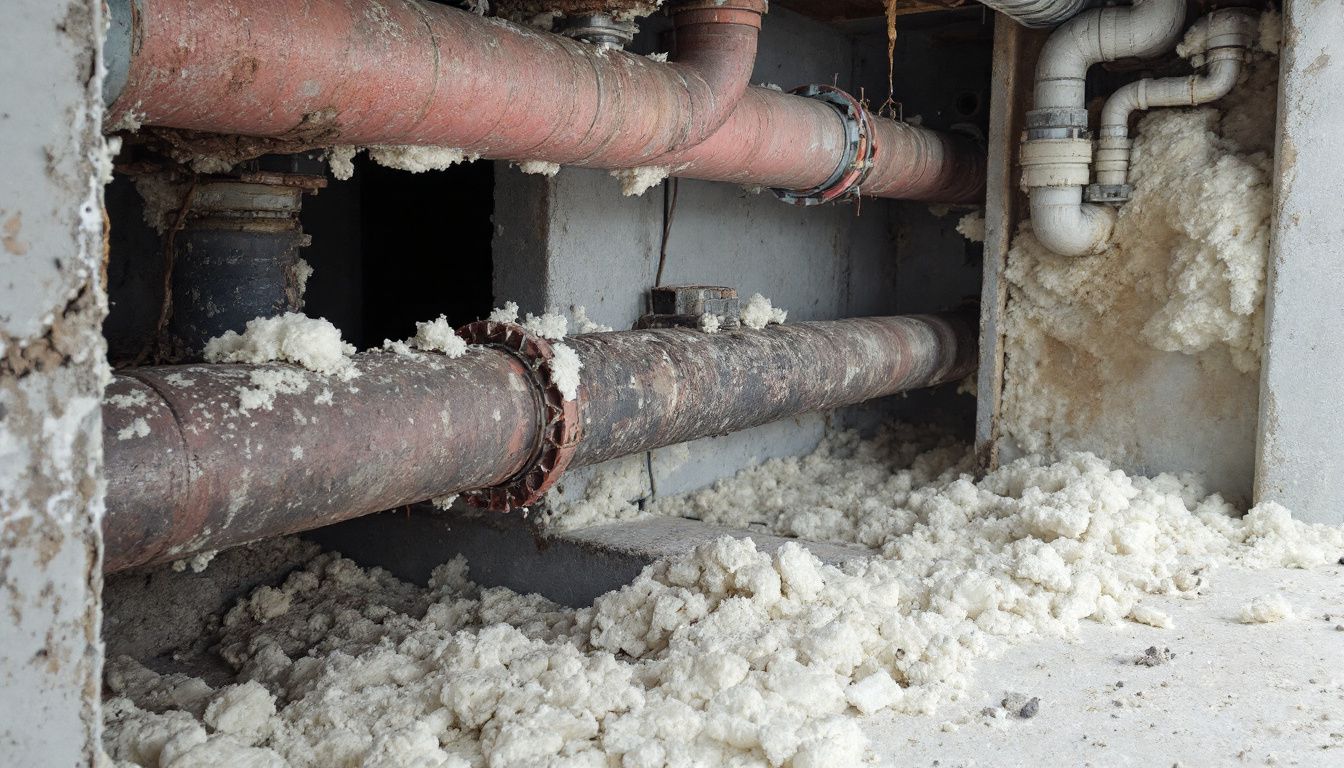
- Pipe lagging and boiler insulation — often one of the highest-risk materials due to its friable nature
- Sprayed coatings on structural steelwork and ceilings, used for fire protection
- Ceiling tiles and floor tiles, including the adhesive used to fix them
- Asbestos cement products — roofing sheets, guttering, downpipes, and external cladding
- Textured coatings such as Artex on ceilings and walls
- Partition walls and ceiling panels in commercial and industrial buildings
- Insulating board around doors, window panels, and service ducts
- Gaskets and rope seals in older heating and ventilation systems
Many of these materials are hidden behind plasterboard, above suspended ceilings, or beneath floor coverings. You cannot manage what you cannot see — which is precisely why a formal asbestos survey is the essential starting point before any intrusive work begins.
Your Legal Duties Under the Control of Asbestos Regulations
The Control of Asbestos Regulations place clear duties on employers, building owners, and those in control of premises. On construction sites, this typically means the principal contractor, the client, and any employer whose workers are present on site.
The Duty to Manage
The regulations require that anyone responsible for a non-domestic building must manage asbestos within it. This means identifying whether ACMs are present, assessing their condition and risk, and putting in place a written asbestos management plan.
On construction sites, this duty extends to ensuring that any refurbishment or demolition work is preceded by a suitable survey. For ongoing premises management where no immediate intrusive work is planned, a management survey is the appropriate starting point — it identifies the location and condition of ACMs so they can be monitored and managed safely.
Survey Requirements Before Intrusive Work
HSE guidance — particularly HSG264 — is clear that a refurbishment and demolition survey must be carried out before any work that could disturb the fabric of a building. A management survey alone is not sufficient for this purpose.
A refurbishment survey is more intrusive, accessing areas that would be disturbed by the planned work, and it must be completed before work starts — not during it. Failure to commission the correct type of survey before breaking into a structure is one of the most common compliance failures on UK construction sites.
Where a building is being fully or partially demolished, a demolition survey is required. This is the most thorough form of survey, designed to locate all ACMs throughout the entire structure before any demolition activity begins.
Asbestos Management Plans
Where ACMs are identified, the regulations require a written plan setting out how they will be managed. On an active construction site, this plan needs to be communicated to all relevant workers and contractors, kept on site, and updated whenever circumstances change — for example, when new materials are discovered or when work programmes are revised.
Penalties for Non-Compliance
The HSE takes asbestos compliance seriously, and enforcement action is not uncommon in the construction sector. Prosecutions can result in substantial fines and, in serious cases, custodial sentences for individuals.
Beyond the legal consequences, the reputational and human cost of a preventable asbestos exposure incident is considerable. Do not treat compliance as a box-ticking exercise — it is the minimum standard, not the goal.
The Role of Regular Asbestos Inspections on Construction Sites
A one-off survey at the start of a project is necessary — but it is rarely sufficient on its own for an active construction site. Buildings change as work progresses. New voids are opened, materials are disturbed, and previously inaccessible areas become accessible.
Regular asbestos inspections are the mechanism that keeps your risk management current throughout the life of a project.
What a Regular Inspection Involves
Regular inspections should check the condition of any known ACMs that are being left in situ, confirm that no previously unidentified materials have been disturbed, and ensure that the asbestos management plan remains accurate and up to date.
Where the condition of a material has deteriorated, or where new materials have been discovered, the inspection triggers a reassessment and — where necessary — remedial action.
Maintaining an Asbestos Risk Register
An asbestos risk register is the living document at the heart of your site’s asbestos management. It records the location, type, condition, and risk rating of every known ACM on site.
It should be reviewed and updated at regular intervals — and certainly after any inspection that identifies changes. Every worker on site should know where the register is and how to access it. It is not a document to be filed away and forgotten; it is an operational tool that informs daily decision-making on site.
Air Monitoring and Detection
In higher-risk environments — for example, where work is ongoing in close proximity to known ACMs — air monitoring may be appropriate to verify that fibre levels remain within safe limits. This involves collecting air samples and analysing them in a UKAS-accredited laboratory.
It provides objective evidence that control measures are working and gives you a defensible record if questions are raised later. Do not treat air monitoring as an optional extra when the risk profile warrants it.
Asbestos Testing and Sampling: Getting the Evidence You Need
Visual inspection alone cannot confirm whether a material contains asbestos. When a surveyor or inspector identifies a suspect material, the only way to confirm its composition is through asbestos testing — collecting a bulk sample and having it analysed in an accredited laboratory.
Samples must be taken by a competent person using appropriate controls to minimise fibre release during the sampling process. The analysis is typically carried out using polarised light microscopy or transmission electron microscopy, depending on the level of detail required.
Results will confirm whether asbestos is present, and if so, which type — which in turn informs the risk assessment and the appropriate management response. The three main types found in UK buildings are:
- Chrysotile (white asbestos)
- Amosite (brown asbestos)
- Crocidolite (blue asbestos) — generally considered to carry the highest risk alongside amosite
Do not rely on assumptions about whether a material contains asbestos based on its appearance or age alone. If you are uncertain whether asbestos testing is required for a specific material on your site, err on the side of caution and get it tested. The only defensible position is one backed by laboratory analysis.
When Asbestos Removal Is Required
Not every ACM needs to be removed. Materials that are in good condition and are not going to be disturbed by the planned work can often be safely managed in situ. However, where work will disturb ACMs — or where materials are in poor condition and pose an ongoing risk — asbestos removal will be necessary before work can safely proceed.
The removal of higher-risk materials — including pipe lagging, sprayed coatings, and asbestos insulating board — must be carried out by a contractor licensed by the HSE. This is a legal requirement, not a recommendation. Using an unlicensed contractor for licensable work is a criminal offence.
Non-Licensed and Notifiable Non-Licensed Work
Even for non-licensable work, specific rules apply. Workers must be trained, appropriate respiratory protective equipment must be worn and face-fit tested, and waste must be correctly segregated, packaged, and disposed of at a licensed facility. The paperwork trail matters: waste transfer notes and consignment notes must be retained.
Some asbestos work falls into a category known as notifiable non-licensed work (NNLW). This includes tasks such as working with asbestos cement products or textured coatings in small quantities. While it does not require a full HSE licence, it must be notified to the relevant enforcing authority before work starts, and workers must receive medical surveillance.
Understanding which category your planned work falls into is essential before any activity begins. If you are uncertain, seek specialist advice — getting this wrong exposes your workforce and your business to serious consequences.
Protecting Workers: Practical Steps for Site Managers
Regulatory compliance is the floor, not the ceiling. The goal is to ensure that no worker on your site is exposed to asbestos fibres — and that requires active management, not just paperwork.
Before Work Starts
- Commission a refurbishment or demolition survey from a UKAS-accredited surveyor before any intrusive work begins
- Ensure the survey covers all areas that will be affected by the planned work
- Review the survey report carefully and update your asbestos management plan accordingly
- Communicate the findings to all contractors and workers who will be on site
- Confirm that any licensed removal work is scheduled and completed before affected areas are opened up
During the Project
- Conduct regular asbestos inspections to check the condition of known ACMs and identify any newly discovered materials
- Ensure that any worker who encounters a suspect material stops work immediately and reports it — do not continue until the material has been assessed
- Keep the asbestos risk register updated as the project progresses
- Ensure that all asbestos-related work is carried out by appropriately trained and, where required, licensed contractors
- Maintain medical surveillance records for workers who have been exposed to asbestos — these must be kept for 40 years under the regulations
Training and Awareness
Every worker on a construction site should have asbestos awareness training as a minimum. This is not optional — the Control of Asbestos Regulations require that anyone liable to disturb asbestos, or who supervises such work, receives appropriate training.
Awareness training does not qualify workers to carry out asbestos work. It teaches them to recognise suspect materials, understand the risks, and know what to do if they encounter something unexpected. That knowledge alone can prevent a serious exposure incident.
Toolbox talks, site inductions, and clear signage around known ACM locations all reinforce the message that asbestos is a live risk on this site, not an abstract historical concern.
Choosing the Right Surveying Partner
The quality of your asbestos management depends heavily on the quality of the survey and inspection work underpinning it. Not all surveyors are equal — and on a construction site, where the stakes are high and the legal exposure is real, using a UKAS-accredited surveyor is essential.
Look for a surveyor who understands the construction environment, can work alongside your programme without causing unnecessary delays, and produces clear, actionable reports that your team can actually use on site. A good survey report should tell you exactly what is present, where it is, what condition it is in, and what you need to do about it — not leave you guessing.
If your project spans multiple locations, it is worth working with a provider who has national reach. Whether you need an asbestos survey in London, an asbestos survey in Manchester, or an asbestos survey in Birmingham, consistent standards and a single point of contact make compliance significantly easier to manage across a portfolio.
Frequently Asked Questions
Do I need an asbestos survey before starting any construction work?
If the building was constructed or refurbished before 2000 and the work involves disturbing the fabric of the structure — including walls, ceilings, floors, or services — then yes, a refurbishment or demolition survey is legally required before work starts. A management survey is not sufficient for intrusive work. HSG264 is clear on this point, and failure to comply is a common reason for HSE enforcement action on construction sites.
What is the difference between a management survey and a refurbishment survey?
A management survey is designed for buildings that are in normal occupation and use. It identifies ACMs that could be disturbed during routine maintenance and monitors their condition. A refurbishment survey is more intrusive — it accesses areas that will be disturbed by planned works and is required before any refurbishment or demolition activity. The two surveys serve different purposes and one cannot substitute for the other.
Can workers continue on site if asbestos is discovered during a project?
If a suspect material is discovered during work, the immediate response should be to stop work in that area, isolate it, and have the material assessed by a competent person. Work should not resume until the material has been sampled and tested, the results are known, and any necessary remedial action — including removal if required — has been completed. Continuing to work in the area before this process is complete puts workers at risk and exposes the site manager and principal contractor to serious legal liability.
Who is responsible for asbestos management on a construction site?
Responsibility sits with multiple duty holders under the Control of Asbestos Regulations. The client has duties as the building owner or controller of premises. The principal contractor has duties as the employer in control of the site. Individual employers also have duties towards their own workers. In practice, asbestos management on a construction site requires a coordinated approach across all parties — and the principal contractor typically takes the lead in ensuring that surveys are commissioned, management plans are in place, and all workers are informed.
Does all asbestos removal require a licensed contractor?
No — but the distinction matters enormously. Removal of higher-risk materials such as pipe lagging, sprayed coatings, and asbestos insulating board must be carried out by an HSE-licensed contractor. Some lower-risk work — such as handling small quantities of asbestos cement — may be carried out without a licence, but may still need to be notified to the enforcing authority as notifiable non-licensed work (NNLW). Getting this categorisation wrong is a criminal offence. If you are unsure which category applies, take specialist advice before any work begins.
Get Expert Support from Supernova Asbestos Surveys
Supernova Asbestos Surveys has completed over 50,000 surveys across the UK, working with principal contractors, developers, facilities managers, and building owners on projects of every scale. Our UKAS-accredited surveyors understand the construction environment and deliver clear, practical reports that keep your project moving and your workforce protected.
Whether you need a pre-works survey, regular site inspections, bulk sampling, or licensed removal coordination, we can support you at every stage. Call us on 020 4586 0680 or visit asbestos-surveys.org.uk to discuss your project and get a quote.