Asbestos in School Buildings: What Every School Needs to Know
Thousands of school buildings across the UK still contain asbestos — and many staff, governors, and facilities managers don’t fully understand the risks or their legal obligations. Asbestos in school buildings isn’t a historical footnote; it’s an active, ongoing duty of care issue that affects millions of pupils and staff every single day.
This isn’t about scaremongering. Asbestos that’s in good condition and left undisturbed poses a low risk. But the moment it’s damaged, drilled into, or disturbed during routine maintenance, the consequences can be severe and irreversible.
Why So Many Schools Contain Asbestos
Asbestos was used extensively in construction from the 1950s through to the late 1990s. It was cheap, fire-resistant, and incredibly durable — making it a favourite material for the large-scale school building programmes that took place across the UK during that era.
The importation and use of all forms of asbestos was finally banned in the UK in 1999. Any school building constructed or significantly refurbished before that date should be treated as potentially containing asbestos-containing materials (ACMs) until a professional survey proves otherwise.
According to the Health and Safety Executive (HSE), the majority of school buildings in England and Wales were built before 1976 — a period when asbestos use was at its peak. That means a significant proportion of the UK’s school estate is likely to contain ACMs in some form.
Common Locations of Asbestos in School Buildings
Asbestos doesn’t appear in one convenient, easy-to-spot location. It was used across a wide range of building materials, and its presence isn’t always obvious to the untrained eye.
Floor and Ceiling Tiles
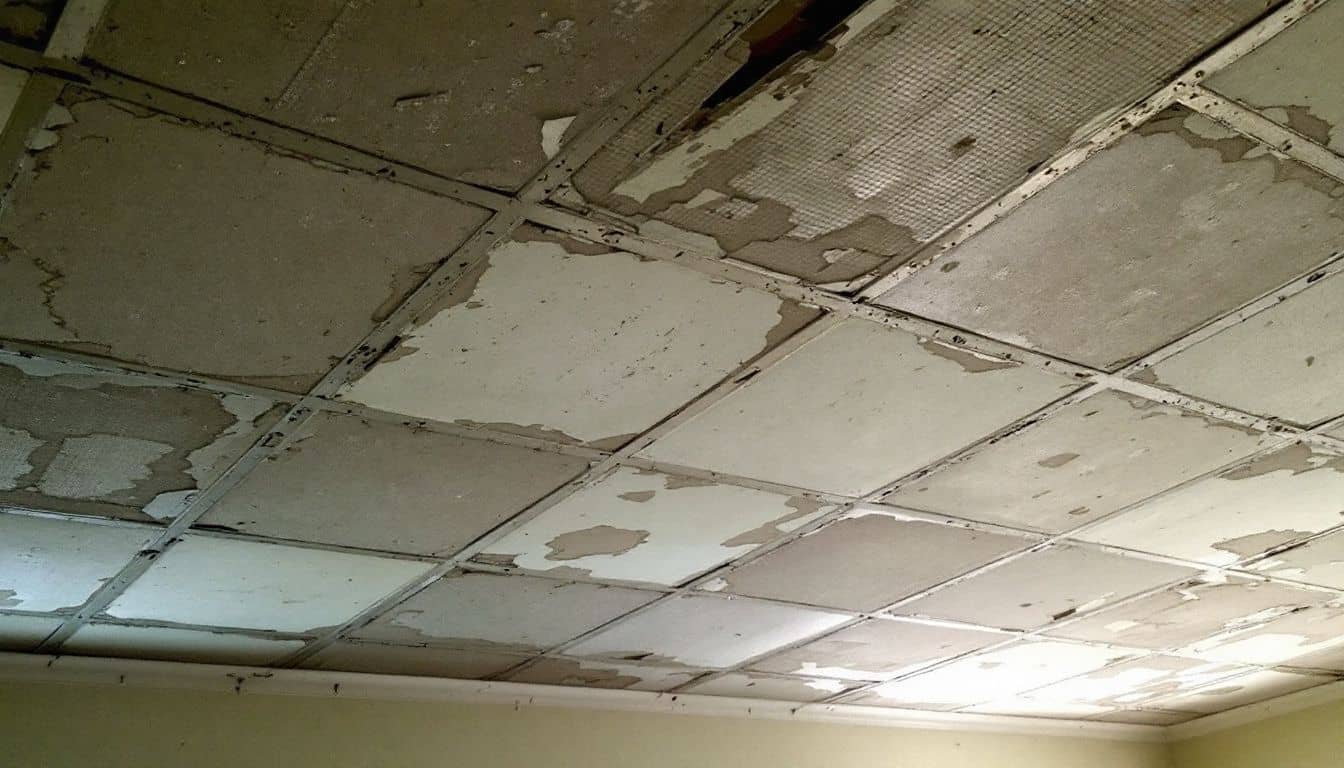
Vinyl floor tiles and ceiling tiles manufactured before the late 1990s frequently contain chrysotile (white asbestos). These tiles were chosen for their durability and fire resistance.
In good condition, they pose minimal risk — but sanding, cutting, or replacing them without proper precautions can release fibres into the air. Textured ceiling coatings such as Artex can also contain asbestos, so any decorative work or repairs to these surfaces must be handled with care.
Pipe and Boiler Insulation
Insulation lagging around pipes, boilers, and heating systems is one of the more hazardous forms of asbestos found in schools. This lagging often contains amosite (brown asbestos) or crocidolite (blue asbestos) — both considered more dangerous than white asbestos due to the shape and size of their fibres.
As this lagging ages, it can become friable — meaning it crumbles easily and releases fibres with minimal disturbance. Boiler rooms and plant rooms require particular attention during any asbestos management programme.
Asbestos Insulating Board (AIB)
AIB was widely used in schools for fire protection around structural elements, in ceiling panels, partition walls, and door linings. It’s a high-risk material because it’s relatively easy to drill into or cut during routine maintenance without realising what it contains.
AIB is considered a licensed asbestos material in most circumstances, meaning any removal or significant disturbance must be carried out by a licensed contractor.
Cement Roofing, Guttering, and Soffits
Asbestos cement was used extensively in school roofing, guttering, downpipes, and external cladding. While generally lower-risk than AIB or lagging when in good condition, weathering and physical damage can cause deterioration over time.
Other ACMs Commonly Found in Schools
- Sprayed asbestos coatings on structural steelwork
- Bitumen-based damp proof courses and roof felts
- Gaskets and seals within heating systems
- Fire doors containing asbestos infill panels
- Laboratory bench tops in older science rooms
How Daily School Activities Can Disturb Asbestos
Normal classroom activity — pupils walking around, teachers writing on boards, doors opening and closing — is very unlikely to disturb ACMs in good condition. The risk increases significantly when physical work is carried out on or near asbestos-containing materials.
Maintenance and Repair Work
This is where the greatest risk lies. Drilling into an AIB ceiling panel to hang a display, cutting through asbestos cement roofing during repairs, or disturbing pipe lagging while fixing a heating fault — these are all realistic scenarios in a busy school environment.
Any contractor working in a school must be informed of the location and condition of all known ACMs before work begins. This is a legal requirement under the Control of Asbestos Regulations, not merely a recommendation.
Pinning and Fixing to Walls
It might seem trivial, but pinning display materials to walls or fixing shelving can damage ACMs if the wall contains asbestos insulating board. Staff should be made aware of which surfaces contain asbestos and should avoid drilling or pinning into them without authorisation.
Moving Furniture and Equipment
Dragging furniture across asbestos floor tiles, or knocking into AIB partition walls, can cause localised damage. In a school environment with high footfall and regular furniture rearrangement, this is a genuine consideration that should be addressed in staff training.
Ceiling Voids and Roof Spaces
Access to ceiling voids and roof spaces for IT cabling, electrical work, or HVAC maintenance is a common trigger for asbestos disturbance. These areas frequently contain asbestos debris from deteriorating materials above, and access should be controlled and documented at all times.
Health Risks: Why Asbestos in Schools Demands Serious Attention
Asbestos-related diseases are caused by inhaling microscopic fibres that become permanently lodged in lung tissue. The diseases they cause are serious, progressive, and in most cases, fatal.
Mesothelioma
Mesothelioma is a cancer of the lining of the lungs or abdomen, almost exclusively caused by asbestos exposure. It has a latency period of 20 to 50 years, meaning someone exposed in a school building today may not develop symptoms until decades later.
There is no cure, and survival following diagnosis is typically very limited. This long latency period is precisely why robust asbestos management in schools cannot be delayed or deprioritised.
Asbestosis
Asbestosis is a chronic scarring of the lung tissue caused by prolonged asbestos exposure. It causes progressive breathlessness, reduces quality of life significantly, and can be fatal. It’s typically associated with heavier, longer-term exposure.
Lung Cancer
Asbestos exposure is a recognised cause of lung cancer, and the risk is significantly multiplied in individuals who also smoke. As with mesothelioma, there is a long latency period between exposure and disease onset.
The Particular Concern for School Staff and Pupils
Teachers and school support staff who work in older buildings over many years face cumulative low-level exposure that, while difficult to quantify, is a recognised occupational health concern. The HSE has acknowledged that teachers have historically appeared in mesothelioma mortality statistics at rates that warrant serious attention.
Children’s lungs are still developing, and their longer life expectancy means a longer window in which asbestos-related disease could develop following exposure. This makes robust asbestos management in schools not just a legal obligation, but a moral one.
Legal Responsibilities for Schools and Dutyholders
The Control of Asbestos Regulations places a clear duty to manage asbestos on anyone who has responsibility for the maintenance or repair of non-domestic premises. In a school context, this means:
- Local authorities hold dutyholder responsibility for community schools, maintained nurseries, and pupil referral units
- Academy Trusts and governing bodies are responsible for academies, free schools, and independent schools
- Headteachers and facilities managers often act as the responsible person on a day-to-day basis
The dutyholder’s core obligations include:
- Identifying whether ACMs are present through a suitable asbestos survey
- Assessing the condition and risk of any ACMs found
- Producing and maintaining an asbestos management plan
- Ensuring the plan is implemented and reviewed regularly
- Providing information about ACM locations to anyone who may disturb them
- Keeping accurate, up-to-date records of all asbestos-related activity
The HSE’s guidance document HSG264 sets out best practice for asbestos surveys and should be the reference point for any school commissioning survey work. Failure to comply with the duty to manage is a criminal offence and can result in prosecution, improvement notices, and significant fines.
Types of Asbestos Survey Required in Schools
Not all asbestos surveys are the same, and choosing the right type matters significantly for compliance and safety.
Management Survey
A management survey is the standard survey required to locate and assess ACMs in a building that is in normal use. It’s designed to inform the asbestos management plan and ensure that routine maintenance doesn’t inadvertently disturb asbestos.
This is the survey most schools will need as a baseline, and it must be carried out by a competent, UKAS-accredited surveyor working to HSG264 standards.
Refurbishment and Demolition Survey
Before any significant building work, refurbishment, or demolition takes place, a demolition survey is legally required. This is a more intrusive survey designed to locate all ACMs in the areas to be worked on, including those that may be hidden within the structure.
Schools undergoing building works — including relatively minor projects like kitchen refits or classroom conversions — must commission this type of survey before work begins. There are no exceptions to this requirement.
Managing Asbestos in Schools: Practical Steps
Having an asbestos management plan isn’t a box-ticking exercise — it’s a living document that needs to reflect the current condition of ACMs and be accessible to anyone who needs it.
Conduct a Baseline Survey
If your school doesn’t have an up-to-date asbestos register based on a professional survey, this is the starting point. A survey carried out to HSG264 standards by a UKAS-accredited surveyor will give you an accurate picture of what’s present, where it is, and what condition it’s in.
Maintain and Update the Asbestos Register
The register must be kept current. Any disturbance, repair, or removal of ACMs should be recorded. If building work takes place, the register must be updated to reflect any changes to the asbestos profile of the building.
Implement a Permit to Work System
Any contractor or maintenance operative working in the school should be required to consult the asbestos register before starting work. A formal permit to work system ensures this happens consistently and creates an audit trail that protects the school in the event of an incident.
Conduct Regular Condition Monitoring
ACMs in good condition don’t need to be removed — but they do need to be monitored. Visual inspections should be carried out at regular intervals (at least annually, or more frequently for high-risk materials) to check for deterioration, damage, or disturbance.
Provide Asbestos Awareness Training
All staff who might encounter ACMs during their work — including caretakers, cleaners, maintenance staff, and teachers — should receive asbestos awareness training. They should know what ACMs look like, where they’re located in the building, and what to do if they suspect damage.
What to Do If Asbestos Is Disturbed
If an accidental disturbance occurs, the response must be immediate and structured. Do not wait to see whether the situation resolves itself.
- Stop all work in the affected area immediately
- Evacuate the area and restrict access to prevent further exposure
- Do not attempt to clean up any debris — this can spread fibres further
- Contact a licensed asbestos contractor to assess and remediate the situation
- Notify the dutyholder and, where required, report the incident under RIDDOR
- Update the asbestos register to reflect what occurred and what action was taken
Speed matters. The longer an area remains accessible after a disturbance, the greater the potential for fibre spread throughout the building.
Asbestos Surveys for Schools Across the UK
Whether your school is in the capital or further afield, access to a qualified, UKAS-accredited surveyor is essential. Schools in the south-east can access specialist support through our asbestos survey London service, while those in the north-west can arrange surveys through our dedicated asbestos survey Manchester team. For schools in the West Midlands, our asbestos survey Birmingham service provides the same rigorous, HSG264-compliant approach.
Supernova Asbestos Surveys operates nationwide, so no matter where your school is located, we can provide the survey and support you need to meet your legal obligations and protect the people in your buildings.
Frequently Asked Questions
Does my school legally have to have an asbestos survey?
Yes. Under the Control of Asbestos Regulations, dutyholders responsible for non-domestic premises — including schools — must identify whether ACMs are present. If the presence of asbestos cannot be confirmed or ruled out through existing records, a professional survey is required. Most schools built before 2000 should have a current, professionally produced asbestos register.
Is asbestos in school buildings dangerous to pupils?
Asbestos that is in good condition and left undisturbed poses a low risk. The danger arises when ACMs are damaged or disturbed, releasing microscopic fibres into the air. Children are considered particularly vulnerable because their lungs are still developing and their longer life expectancy increases the window in which disease could develop following any exposure.
Who is responsible for managing asbestos in a school?
The dutyholder depends on the school type. Local authorities are responsible for community schools and maintained nurseries. Academy Trusts and governing bodies hold responsibility for academies, free schools, and independent schools. In practice, the headteacher or facilities manager often acts as the day-to-day responsible person and must ensure the asbestos management plan is in place and followed.
What type of asbestos survey does a school need?
Most schools in normal operation require a management survey as a baseline. This locates and assesses ACMs to inform the asbestos management plan. If any building work, refurbishment, or demolition is planned, a refurbishment and demolition survey is legally required before work begins — even for relatively minor projects.
What should I do if I think asbestos has been disturbed in my school?
Stop work and evacuate the affected area immediately. Do not attempt to clean up any debris. Contact a licensed asbestos contractor to assess and remediate the situation. Notify the dutyholder, update the asbestos register, and consider whether the incident requires reporting under RIDDOR. Acting quickly limits the potential for fibre spread and reduces risk to staff and pupils.
Get Expert Support for Your School’s Asbestos Obligations
Supernova Asbestos Surveys has completed over 50,000 surveys across the UK, working with schools, academy trusts, local authorities, and facilities managers to meet their legal obligations and protect the people in their buildings.
If your school doesn’t have an up-to-date asbestos register, or you’re planning building work and need a refurbishment or demolition survey, our UKAS-accredited surveyors are ready to help.
Call us on 020 4586 0680 or visit asbestos-surveys.org.uk to arrange a survey or discuss your school’s requirements with our team.