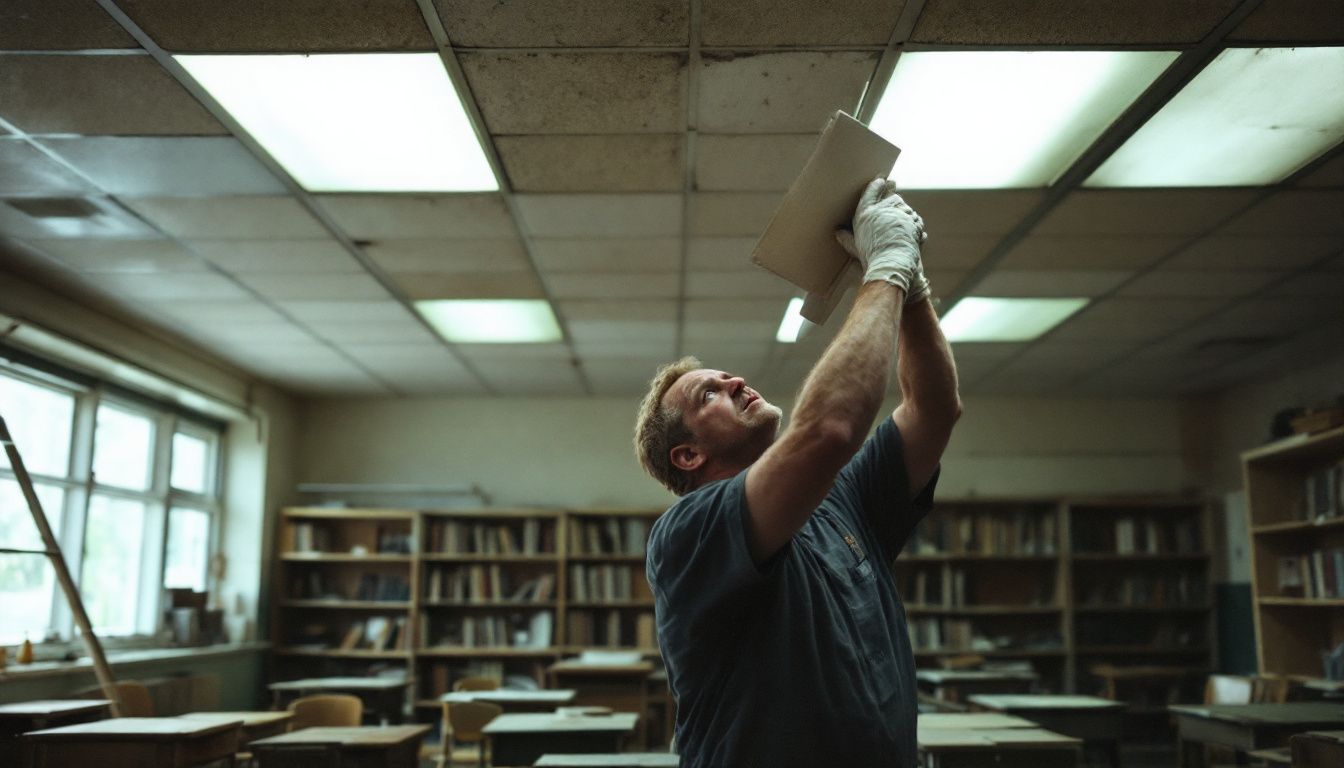
Why Asbestos in UK Schools Represents a Hidden Danger That Demands Regular Inspections
Walk into almost any school built before the year 2000 and you are almost certainly standing in a building that contains asbestos. This hidden danger in asbestos across UK schools is not a relic of a distant industrial past — it is a present, ongoing risk affecting hundreds of thousands of pupils and staff every single day. For anyone responsible for running or maintaining educational premises, understanding that risk and what responsible management looks like is not optional.
How Widespread Is Asbestos in UK Schools?
The scale of the problem is significant. Surveys have indicated that over 80% of state schools in England contain asbestos-containing materials (ACMs). Asbestos was used extensively in construction from the 1920s through to the late 1990s, valued for its fire resistance and insulating properties. A ban on all asbestos types in the UK did not come into full effect until 1999.
That means the vast majority of school buildings constructed during the post-war boom — when rapid expansion of the education estate was a national priority — were built with asbestos as a standard material. Spray coatings, ceiling tiles, pipe lagging, partition boards, floor tiles: asbestos was woven into the fabric of these buildings at every level.
One particularly significant example is the Clasp (Consortium of Local Authorities Special Programme) system of prefabricated school buildings. Approximately 3,000 Clasp-style buildings were still in use as recently as 2016, many containing asbestos in structural and insulating components. These buildings are ageing, and the ACMs within them are deteriorating.
What Asbestos Does to Health
Asbestos fibres are microscopic. When ACMs are disturbed — during maintenance, renovation, or even routine movement through a building — those fibres become airborne and can be inhaled. The consequences can be devastating, and critically, they are often not apparent for decades after exposure.
Mesothelioma and Other Asbestos-Related Diseases
Malignant mesothelioma — a cancer of the lining of the lungs — is the most well-known asbestos-related disease. It carries an extremely poor prognosis and there is no cure. Other conditions linked to asbestos exposure include asbestosis (scarring of the lung tissue), lung cancer, and pleural thickening.
All of these conditions develop over long latency periods. Someone exposed in a school building during childhood may not receive a diagnosis until they are in their fifties or sixties — by which time the damage is irreversible.
Children Face Disproportionate Risk
Children are not simply small adults when it comes to asbestos risk. Research has indicated that a child exposed to asbestos at age five faces a significantly greater risk of developing mesothelioma than an adult exposed at age 30. Children breathe more rapidly, spend more time close to the ground where fibres can settle, and have more years ahead of them during which a disease can develop.
Researchers have estimated that between 200 and 300 former pupils die each year in the UK as a result of asbestos exposure during their school years. Teachers have also paid a devastating price — cases of teachers developing mesothelioma after careers spent in buildings containing ageing, deteriorating ACMs are well documented and serve as a sobering reminder that the duty of care extends to every person who enters a school building.
The Legal Framework: What Schools Must Do
The legal obligations for managing asbestos in schools are clear and non-negotiable. The Control of Asbestos Regulations places a duty to manage on anyone responsible for non-domestic premises — and that includes schools, academies, local authority-maintained buildings, and independent educational establishments.
The Duty to Manage
Regulation 4 of the Control of Asbestos Regulations establishes the duty to manage asbestos in non-domestic premises. Dutyholders are required to:
- Take reasonable steps to find ACMs and assess their condition
- Presume materials contain asbestos unless there is strong evidence they do not
- Record the location and condition of ACMs in an asbestos register
- Assess the risk from identified ACMs
- Produce and implement a written asbestos management plan
- Review and monitor the plan and ACMs regularly
- Provide information about ACM locations to anyone who may disturb them
For schools, this is not a box-ticking exercise. It is a fundamental safeguarding obligation. Failure to comply can result in significant regulatory action from the Health and Safety Executive (HSE) — and, far more seriously, preventable harm to children and staff.
HSG264: The Survey Standard
The HSE’s guidance document HSG264, Asbestos: The Survey Guide, sets out the standards that asbestos surveys must meet. Any survey carried out in a school must comply with HSG264 to be legally defensible and operationally useful. This means surveys must be conducted by competent, qualified surveyors — not by untrained caretaking staff with a clipboard.
Why Regular Inspections Are Not Optional
Identifying asbestos once is not enough. ACMs in schools are subject to daily wear and tear. Cleaning activities, maintenance work, pupils leaning against walls, ceiling tiles being dislodged — all of these can disturb asbestos and release fibres. The condition of ACMs changes over time, and a material that was in good condition three years ago may have deteriorated significantly.
The HSE conducted 400 inspections of schools between September 2022 and March 2023 as part of a targeted enforcement initiative. The findings were deeply concerning: 71% of items inspected were found to be damaged. That is not a minor compliance issue — it represents a widespread failure to maintain safe conditions in buildings used by children every day.
Regular inspections are the mechanism by which that deterioration is caught before it becomes a health risk. Without them, schools are operating blind.
The Different Types of Survey Schools Need
Management Surveys
For schools in normal operation, a management survey is the standard starting point. This type of survey is designed to locate, as far as reasonably practicable, ACMs in a building that could be damaged or disturbed during normal occupancy. The surveyor inspects accessible areas, takes samples from suspect materials, and produces a risk-rated asbestos register.
The management survey forms the foundation of an asbestos management plan. Without it, a school cannot demonstrate compliance with its duty to manage — and cannot protect the people inside the building.
Refurbishment Surveys
If a school is planning any building work — from a full extension to a simple partition removal or a kitchen refit — a refurbishment survey is legally required before work begins. This is a more intrusive survey that examines areas that will be disturbed, including inside walls, above ceiling voids, and beneath floors.
Carrying out refurbishment work without a prior survey is not just a legal breach — it is one of the most common ways that asbestos fibres are released in dangerous concentrations. Contractors, teachers, and pupils can all be exposed when ACMs are disturbed unknowingly.
Demolition Surveys
Where a school building or part of it is to be demolished, a demolition survey is required. This is the most thorough and intrusive type of survey, designed to locate all ACMs throughout the entire structure — including those that are normally inaccessible. No demolition work should proceed without one.
Re-Inspection Surveys
Once an asbestos register is in place, the work does not stop. The Control of Asbestos Regulations requires that ACMs are monitored regularly to check their condition. A re-inspection survey revisits known ACMs, assesses any changes in their condition, and updates the register accordingly.
For schools, annual re-inspections are widely considered best practice, given the high footfall, the nature of the activities taking place, and the vulnerability of the building users. Some higher-risk ACMs may warrant more frequent checks.
Practical Steps Schools Should Take Now
If you are responsible for a school building — whether as a headteacher, business manager, premises manager, or local authority estates officer — here is what needs to happen:
- Check whether a current asbestos register exists. If the building was constructed before 2000 and no survey has been carried out, one must be commissioned immediately.
- Review the condition of known ACMs. When were they last inspected? Has anything changed in the building since the last survey?
- Ensure your asbestos management plan is up to date and accessible. All staff — particularly caretakers, cleaners, and maintenance contractors — must be aware of ACM locations.
- Book a re-inspection if one is overdue. Do not wait for a problem to become visible before acting.
- Commission a refurbishment survey before any building work begins. No exceptions.
- Train relevant staff. Anyone who may disturb ACMs must receive appropriate asbestos awareness training.
- If in doubt about a material, do not disturb it. Professional asbestos testing is the correct route for educational premises where suspect materials need to be confirmed.
For smaller queries or where a single suspect material needs to be checked ahead of minor works, an asbestos testing kit allows a sample to be collected and sent to an accredited laboratory for analysis. However, for a whole-building approach, a professional survey is always the appropriate solution.
Government Action and What It Means for Schools
The government has acknowledged the scale of the problem. Funding has been allocated to support asbestos surveys and removal works in schools, recognising that many local authority-maintained buildings require significant investment to reach an acceptable standard. The RAAC (Reinforced Autoclaved Aerated Concrete) crisis in schools has also brought renewed scrutiny to the wider condition of the education estate — and asbestos is very much part of that picture.
However, government funding does not remove the legal obligation from individual dutyholders. Headteachers, academy trusts, and governing bodies cannot wait for central direction — they must act within the legal framework that already exists. The HSE has demonstrated through its recent enforcement activity that it is actively monitoring compliance in the education sector.
Fire Risk Assessments: The Overlooked Companion to Asbestos Management
Asbestos management and fire safety are closely linked in older school buildings. Many of the same materials that contain asbestos — ceiling tiles, pipe lagging, wall boards — are also relevant to fire compartmentation. A thorough fire risk assessment should be carried out alongside asbestos management to ensure that remediation work on one hazard does not inadvertently compromise protections against another.
Schools are legally required to have a current fire risk assessment under the Regulatory Reform (Fire Safety) Order. Ensuring both obligations are met through coordinated professional assessments is the most efficient and cost-effective approach — and it avoids the risk of one piece of compliance work creating problems for another.
What to Look for in an Asbestos Surveyor for Schools
Not all surveyors are equal. When commissioning an asbestos survey for a school, you should look for the following:
- BOHS P402 qualification — the recognised professional standard for asbestos surveyors in the UK
- UKAS-accredited laboratory analysis — samples must be analysed to an accredited standard
- Experience with occupied buildings — schools present specific logistical challenges around access, safeguarding, and scheduling around term times
- Full compliance with HSG264 — the survey must meet the HSE’s published standard to be legally valid
- A clear, usable register — the output must be practical, not just a document that sits in a filing cabinet
Cheaper is not always better. A survey that does not meet HSG264 requirements, or that is carried out by unqualified personnel, provides no legal protection and may give a false sense of security.
Frequently Asked Questions
Does my school legally need an asbestos survey?
Yes. If your school building was constructed before 2000, the Control of Asbestos Regulations requires you to take reasonable steps to identify any ACMs, assess their condition, and manage the risk. This means commissioning a professional management survey if one does not already exist. Operating without an asbestos register in a pre-2000 building is a breach of your legal duty to manage.
How often should asbestos be re-inspected in a school?
Annual re-inspections are considered best practice for schools, given the high levels of activity, the vulnerability of building users, and the wear and tear that ACMs are subject to. Some higher-risk materials — particularly those in areas of heavy use — may require more frequent monitoring. Your asbestos management plan should specify the re-inspection intervals for each identified ACM.
What happens if asbestos is disturbed in a school?
If ACMs are disturbed and fibres are potentially released, the affected area should be vacated immediately and the incident reported to the responsible person. Depending on the extent of the disturbance, specialist asbestos contractors may need to carry out air monitoring and remediation before the area can be re-occupied. The HSE must be notified of certain licensable asbestos work. This is precisely why knowing where ACMs are located — and ensuring all staff are aware — is so critical.
Do I need a survey before refurbishment work in a school?
Yes, without exception. Before any building work that will disturb the fabric of a pre-2000 building, a refurbishment survey must be carried out on the areas to be affected. This applies to projects of all sizes — from a full extension to a simple partition removal. Proceeding without a survey puts contractors, staff, and pupils at risk and constitutes a serious breach of the Control of Asbestos Regulations.
Can school staff collect asbestos samples themselves?
In most cases, no. Disturbing a suspect material to collect a sample can itself release fibres if the material contains asbestos. For whole-building assessments, a professional survey carried out by a BOHS P402-qualified surveyor is always the correct approach. In limited circumstances where a single suspect material needs to be tested ahead of minor works, a professional asbestos testing service or a correctly used sampling kit may be appropriate — but this should be discussed with a qualified surveyor first.
Speak to Supernova Asbestos Surveys
Supernova Asbestos Surveys has completed over 50,000 surveys across the UK, including a significant number of educational premises. Our BOHS P402-qualified surveyors understand the specific challenges of surveying occupied school buildings — from scheduling around term times to managing access to sensitive areas.
Every survey we carry out complies fully with HSG264 and the Control of Asbestos Regulations. Samples are analysed at our UKAS-accredited laboratory, and you receive a detailed asbestos register and risk-rated management plan, typically within three to five working days.
If your school does not have a current asbestos register, or if a re-inspection is overdue, do not delay. Call us today on 020 4586 0680 or visit asbestos-surveys.org.uk to book a survey or request a quote. Same-week appointments are available in most areas across the UK.