
A single drill hole in the wrong ceiling tile can turn a routine job into a contamination problem. When people ask how long does asbestos stay in the air, they are usually dealing with a real concern: damaged insulation, dust after maintenance, or a room in an older building that no longer feels safe to enter.
The difficult part is that asbestos does not behave like ordinary dust. The fibres are microscopic, they have no smell, and they can stay suspended or be lifted back into the air long after the original disturbance. For landlords, facilities managers, schools, contractors and homeowners, the risk does not end when visible debris settles.
Under the Control of Asbestos Regulations, dutyholders in non-domestic premises must identify and manage asbestos risks. HSG264 and wider HSE guidance set out how asbestos surveys should be planned and carried out, and why the right survey must come before maintenance, refurbishment or demolition work.
If asbestos may have been disturbed, the safest response is simple: stop work, isolate the area, and get competent advice straight away. Guesswork is what turns a localised incident into a wider exposure issue.
How long does asbestos stay in the air?
There is no single timescale that applies in every building. If you are asking how long does asbestos stay in the air, the honest answer is that it depends on the material, the way it was disturbed, the quantity of fibre released, and the air movement in the area.
Some larger particles may settle relatively quickly. The finest respirable fibres can remain airborne for much longer, particularly indoors where doors open, people move around, and ventilation systems continue to circulate air.
Even after fibres settle, they can be re-suspended by foot traffic, cleaning, draughts, or later works. That is why a room should never be treated as safe simply because dust is no longer visible.
What affects how long fibres remain airborne?
- The type of asbestos-containing material and how friable it is
- The type of disturbance, such as drilling, sanding, breaking or demolition
- The condition of the material, including age, damage and surface deterioration
- Ventilation and air currents from windows, fans and HVAC systems
- Room layout, including corridors, risers, voids and adjoining spaces
- Cleaning methods, especially dry sweeping or unsuitable vacuums
- Occupancy and movement, which can lift settled fibres back into the air
In practical terms, if asbestos has been disturbed, assume contamination may still be present until a competent professional has assessed the area. That is the safest and most defensible approach for any property manager or dutyholder.
How long does asbestos stay airborne inside?
Indoor environments are where this question matters most. In enclosed spaces, fibres can linger, settle, and then be recirculated. So when clients ask how long does asbestos stay in the air indoors, the answer is often longer than they expect.
In a still room, some particles will settle over time. In a real building, air is rarely still. Doors open, people walk through, windows create draughts, and mechanical ventilation moves air from one area to another.
Those everyday activities can keep fibres airborne or lift them again from contaminated surfaces. A disturbance that lasted a few minutes can create a contamination issue that lasts much longer if the area is not managed correctly.
Why indoor contamination can continue after work stops
- Dust settles on floors, desks, cable trays and pipework
- Cleaning staff may spread contamination unknowingly
- HVAC systems can move fibres beyond the original room
- Foot traffic can re-suspend settled debris
- Ceiling voids and service risers can retain loose contamination
- Tools, clothing and waste can carry fibres into adjacent areas
This is why reoccupation should never be based on a visual check alone. If asbestos may have been disturbed, the area needs proper assessment and, where appropriate, air monitoring, sampling and specialist cleaning.
What to do immediately indoors
- Stop work at once.
- Keep people out of the area.
- Do not sweep, vacuum or wipe surfaces.
- Limit air movement if it is safe to do so.
- Inform the responsible person or dutyholder.
- Arrange professional inspection and advice.
If the incident happened during planned refurbishment, it may indicate that the wrong survey was used or that the survey scope did not match the work. Routine occupation is one thing. Intrusive work is another.
For occupied non-domestic buildings, an up-to-date management survey is the starting point for identifying asbestos-containing materials that could be disturbed during normal occupation and routine maintenance.
How does asbestos become airborne?
Asbestos is most dangerous when fibres are released from the material that contains them. Intact asbestos-containing materials can often be managed in place, but once they are cut, drilled, abraded, broken or allowed to deteriorate, fibres can escape into the air.
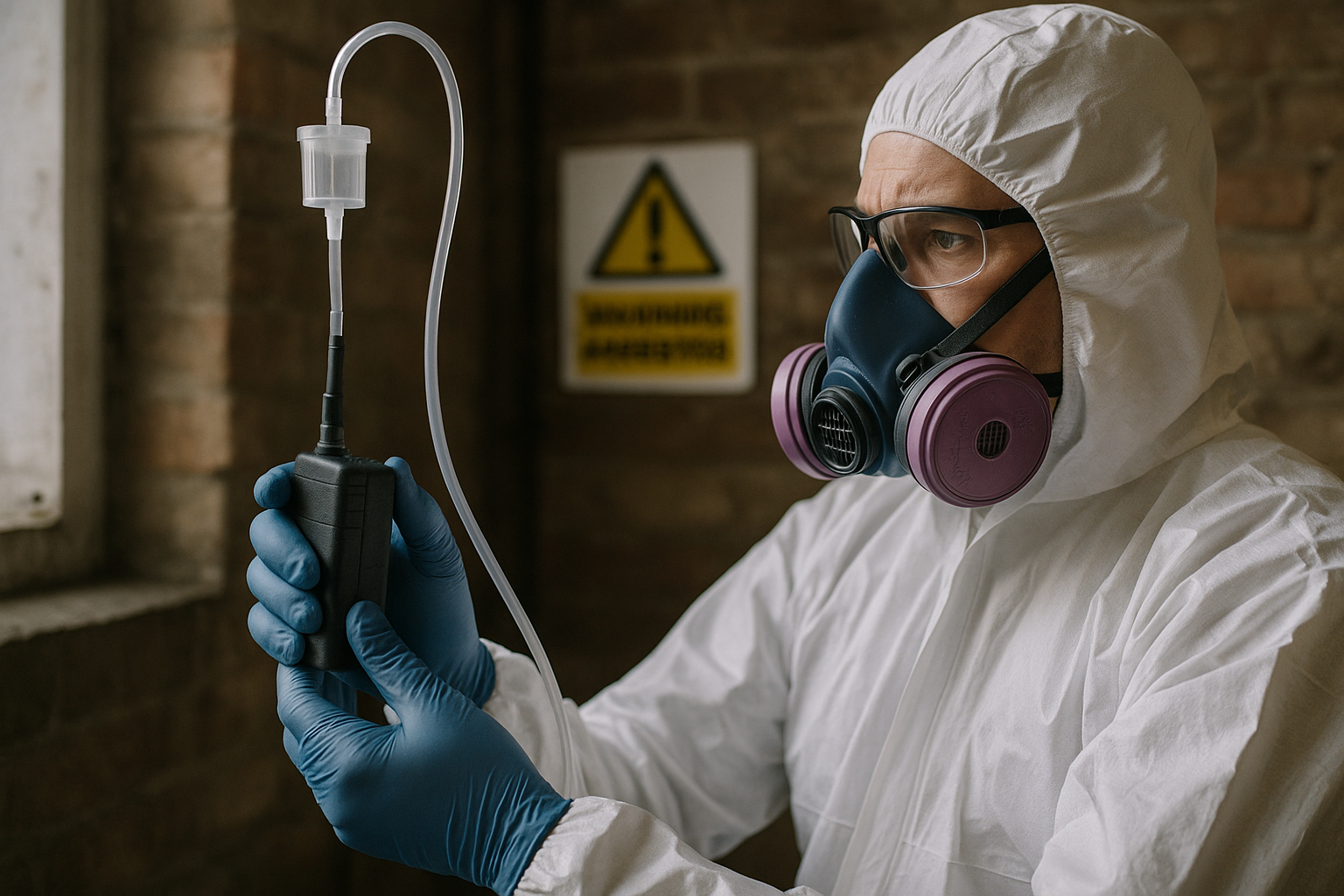
Many incidents happen during ordinary maintenance rather than major demolition. An electrician opening a riser, a contractor fixing signage, or a caretaker replacing damaged panels can disturb asbestos without realising it if the right checks have not been carried out first.
Common ways asbestos becomes airborne
- Drilling walls, ceilings, soffits or service ducts
- Cutting or breaking asbestos insulating board
- Sanding textured coatings
- Removing old floor tiles and bitumen adhesive
- Breaking asbestos cement sheets, panels or garage roofs
- Opening damaged boxing around pipes or columns
- Demolition or strip-out work without the correct survey
- Water damage, impact damage or long-term deterioration
- Cleaning debris with a brush or domestic vacuum
Secondary disturbance matters too. Fibres that have settled on ledges, floors, tools, clothing or ducting can become airborne again later. That is one reason why an area can remain unsafe after the original task has stopped.
Can asbestos also linger in the outside atmosphere?
Yes, asbestos fibres can be present outdoors after disturbance. The way the risk behaves outside is different, but the answer to how long does asbestos stay in the air is not simply “less time” because the release is outdoors.
Open air usually means greater dilution. That can reduce fibre concentration compared with a confined room, but it does not make the release harmless. If asbestos cement sheeting is broken, insulation is damaged, or contaminated waste is mishandled, fibres can still be carried by wind and deposited on nearby surfaces.
Outside releases can be complicated because weather, ground conditions and repeated disturbance all affect what happens next. Debris on a roof, in a yard, or around a plant area can continue to create a problem if it is walked through, driven over or broken up further.
Factors that affect asbestos outdoors
- Wind speed and direction
- Whether the material is friable or bonded
- How much of the material has been damaged
- Whether debris remains exposed on the ground
- Vehicle movement or foot traffic near the release
- Rain, which may suppress some dust but spread contamination across surfaces
One practical point matters more than trying to estimate distance: do not assume contamination is limited to the exact point where the material broke. Adjacent walkways, roofs, gutters, yards and access routes may also need checking.
If an external asbestos incident has happened on a commercial site, isolate the area, prevent access, and arrange competent assessment before any clean-up is attempted.
How far can asbestos travel in the air?
Asbestos fibres can travel further than many people expect. Indoors, they may move beyond the immediate work area through open doors, shared corridors, ceiling voids, ducts and ventilation systems. Outdoors, wind and weather can spread fibres away from the point of release.
The actual distance depends on the amount released, the fibre size, the type of activity, and the surrounding environment. A minor disturbance in a contained room is very different from damaged lagging in a plant area with active air handling, or broken asbestos cement outside on a windy day.
The right question is usually not “how far” in abstract terms, but “which areas could reasonably have been affected?” That is what a competent surveyor or analyst will help you determine.
Can you see or smell asbestos fibres?
No. You cannot reliably see or smell asbestos fibres. This causes a lot of confusion on site because people often assume that if there is no visible dust, there is no risk.
Others assume that any dust from an older building must be asbestos. Neither assumption is safe. The airborne fibres of greatest concern are far too small to identify with the naked eye, and they have no distinctive smell or taste.
What this means in practice
- Visible dust does not confirm asbestos
- No visible dust does not prove the air is safe
- A musty or stale smell is not an indicator of asbestos
- Only sampling, survey work and air monitoring can provide reliable evidence
If a material is suspected to contain asbestos, do not rely on appearance alone. Some asbestos products look harmless, painted over, or very similar to non-asbestos materials.
The right response is to stop the work and get it checked properly. That is faster, safer and usually cheaper than dealing with a wider contamination incident later.
How much asbestos exposure is harmful?
There is no simple exposure level that can be treated as a safe rule of thumb for the public or for workers outside a controlled system of asbestos work. The sensible approach is to treat any avoidable exposure as unacceptable.
Risk depends on several factors, including the concentration of fibres, the duration of exposure, how often exposure happens, and the type of asbestos-containing material involved. A one-off low-level exposure is not the same as repeated occupational exposure over time, but neither should be dismissed casually.
That is why the best practical advice is straightforward:
- Avoid disturbing suspected asbestos materials
- Stop work immediately if damage occurs
- Prevent others from entering the area
- Get competent advice before reoccupation or further work
Property managers should also remember that concern often spreads faster than facts. If staff, tenants, pupils or visitors believe they may have been exposed, clear communication and proper investigation matter just as much as the technical response.
Types of asbestos fibres and their associated risks
Understanding fibre type helps explain why how long does asbestos stay in the air is not a simple question. Different asbestos minerals have different fibre shapes and were used in different products, but all asbestos exposure should be taken seriously.
Chrysotile
Chrysotile, often called white asbestos, was widely used in cement sheets, textured coatings, floor tiles, gaskets and other building materials. Its fibres are curly and flexible, but once released through drilling, sanding or breakage, they can still become airborne and be inhaled.
Because chrysotile was often used in bonded products, people sometimes underestimate the risk. The material may present lower risk when intact, but uncontrolled disturbance can still release hazardous fibres.
Amosite
Amosite, often called brown asbestos, was commonly used in asbestos insulating board, ceiling tiles, fire protection products and thermal insulation materials. It is often associated with more friable products than asbestos cement.
When amosite-containing materials are damaged or cut, they can release significant numbers of respirable fibres. This is one reason why work involving insulating board needs careful planning and strict controls.
Crocidolite
Crocidolite, or blue asbestos, is strongly associated with serious health risks. It was used in some spray coatings, insulation products, pipe lagging and certain cement materials.
Its very fine, needle-like fibres are particularly concerning when inhaled. If crocidolite is suspected, the area should be isolated and assessed by a competent asbestos professional without delay.
Why fibre type is only part of the picture
In buildings, the material type and condition often matter just as much as the asbestos type itself. A damaged lagging system or broken asbestos insulating board can present a far more immediate airborne risk than intact asbestos cement in good condition.
- How friable the material is
- Whether it is sealed, painted, encapsulated or deteriorating
- How much has been disturbed
- How many people may be exposed
- Whether fibres can spread through ventilation or movement
How do we monitor asbestos in the air?
You cannot detect airborne asbestos by sight, smell or guesswork. If you need to know whether asbestos is present in the air, that requires specialist air monitoring and fibre analysis carried out by competent professionals.
For dutyholders, this matters because informal checks often create false reassurance. Looking around the room and seeing no dust is not a test. Smelling the air is not a test. Wiping a finger across a surface is not a test.
How air monitoring works
Air monitoring typically involves drawing a measured volume of air through a filter using calibrated equipment. The filter is then analysed to assess whether asbestos fibres are present at a level relevant to the purpose of the test.
Depending on the situation, air monitoring may be used for:
- Background testing before work starts
- Leak monitoring during asbestos work
- Reassurance monitoring after an incident
- Clearance-related testing following licensed work
The right method depends on the circumstances. Air testing is not a substitute for identifying the material itself, and it should always be interpreted in context.
Can DIY kits detect asbestos in the air?
Not reliably for managing a real exposure concern. Off-the-shelf products do not replace proper asbestos surveying, bulk sampling or professional air monitoring.
If there has been a disturbance incident, the priority is control and assessment, not improvised testing. A poor decision made quickly is usually more expensive than a correct decision made once.
Airborne asbestos in homes, schools and public buildings
The question how long does asbestos stay in the air matters in every type of property, but the practical response changes depending on who uses the building and how it is occupied.
Airborne asbestos in the home
Domestic properties can contain asbestos in ceilings, textured coatings, floor tiles, boxing, cement products, soffits and garages. Most homeowners only discover the issue during renovation, rewiring, bathroom replacement or loft works.
The main mistake in homes is carrying on with the job after a suspicious material has been damaged. If that happens, stop immediately, close the area off as far as possible, and get the material assessed before anyone starts cleaning up.
Schools with airborne asbestos
Schools present a particularly sensitive situation because building wear, maintenance needs and daily occupation all overlap. If asbestos-containing materials are in poor condition or are disturbed during repair works, there is obvious concern from staff, parents and governors.
The right response in schools is disciplined and calm:
- Stop access to the affected area
- Inform the responsible person
- Check the asbestos records and previous survey information
- Arrange competent inspection, sampling or air monitoring as needed
- Do not reopen the area based on visual judgement alone
Communication matters here. Vague reassurances create distrust. Clear facts, proper controls and written records are far better.
Asbestos in the air of public buildings
Public buildings often have complex layouts, shared services and high footfall. Offices, libraries, healthcare premises, civic buildings and leisure centres can all present added challenges if fibres are released into occupied space.
In these settings, contamination may spread through corridors, plant areas, ceiling voids or ventilation routes. Dutyholders need to think beyond the room where the damage happened and consider who may have accessed adjacent spaces.
If you manage a city property portfolio, arranging location-specific support can save time when urgent attendance is needed, whether you need an asbestos survey London service, an asbestos survey Manchester appointment, or an asbestos survey Birmingham inspection.
What to do if asbestos is disturbed
If asbestos is accidentally disturbed, the first few minutes matter. The aim is to stop further fibre release, prevent spread, and make sure the right people are involved before the situation gets worse.
- Stop the task immediately.
- Keep everyone out of the area.
- Do not sweep, brush or use a domestic vacuum.
- If safe, switch off systems that may spread fibres.
- Close doors and restrict access.
- Report the incident to the dutyholder, site manager or responsible person.
- Arrange competent assessment, sampling or air monitoring.
Do not bag waste casually, wipe surfaces with standard cloths, or ask general maintenance staff to “sort it out”. That approach often spreads contamination and complicates the clean-up.
What information to record
- Where the incident happened
- What material was disturbed
- What activity was taking place
- Who was present
- Whether ventilation or doors were open
- What immediate controls were put in place
Good records help surveyors, analysts and contractors decide what needs to happen next. They also support your wider compliance duties.
What you will learn about before any asbestos work starts
Before maintenance, refurbishment or demolition begins, the key issue is not just whether asbestos exists in the building. It is whether the planned work could disturb it.
That is why survey scope matters. A management survey supports normal occupation and routine maintenance. More intrusive work needs a survey that matches the planned activity, otherwise hidden asbestos can be missed until it is too late.
As a dutyholder or property manager, you should make sure you know:
- What type of survey is needed for the work
- Which areas are included in the survey scope
- Whether the asbestos register is current
- What controls contractors must follow
- How incidents will be reported and managed
This is where many avoidable asbestos incidents start. The job is booked, the building is occupied, someone assumes the paperwork is enough, and intrusive work begins without the right information.
Regional office support and South Wales enquiries
Fast response matters when asbestos may have become airborne. Multi-site organisations often need practical support across different regions, especially when maintenance teams, managing agents and contractors are working to tight timescales.
Regional office
If your organisation manages properties across several towns or cities, keep asbestos contacts and escalation routes centralised. One clear reporting line helps incidents get assessed quickly and reduces the risk of mixed messages between site teams and head office.
For regional portfolios, it is sensible to review survey coverage site by site rather than assuming one standard approach fits every building. Older schools, offices, retail units and industrial premises can all present very different asbestos risks.
South Wales
South Wales has a wide mix of older housing stock, public buildings, schools and commercial premises where asbestos may still be present. The same principles apply: identify materials before work starts, keep records up to date, and act quickly if damage occurs.
If you are responsible for a mixed estate in South Wales, plan surveys and reinspection work before maintenance programmes begin. That is far easier than dealing with an emergency after accidental disturbance.
Request an asbestos services quotation
If you are dealing with suspected airborne asbestos, time matters. The right next step is not guesswork or delay. It is competent advice from a surveyor who understands how asbestos behaves in real buildings.
When requesting a quotation, have the following ready:
- The property address and building type
- The area affected
- What activity was taking place
- Whether the material has already been sampled
- Whether the building is occupied
- Any deadlines for maintenance, refurbishment or reoccupation
The clearer the brief, the faster the response. If there has been an incident, say so immediately rather than describing it as a routine survey request.
Practical tips to reduce the risk of airborne asbestos
The best way to deal with the question how long does asbestos stay in the air is to avoid releasing fibres in the first place. That means planning work properly, using the correct survey information, and making sure contractors know what they are working around.
- Check asbestos information before any intrusive work starts
- Make sure the survey type matches the planned works
- Keep asbestos records accessible to those who need them
- Brief contractors before they begin
- Do not rely on assumptions based on building age or appearance
- Act immediately if any suspect material is damaged
Most asbestos incidents are preventable. They usually happen because someone did not have the right information at the right time.
Frequently Asked Questions
How long does asbestos stay in the air after it has been disturbed?
It depends on the material, the level of disturbance, and the airflow in the area. Fine fibres can remain airborne for a prolonged period indoors, and settled fibres may become airborne again if the area is disturbed or cleaned improperly.
Can asbestos fibres linger outside?
Yes. Outdoor releases are usually more diluted than indoor releases, but fibres can still be carried by wind and deposited on nearby surfaces. External debris can also be disturbed again later if it is not dealt with properly.
Can you see or smell asbestos in the air?
No. Asbestos fibres are microscopic and have no distinctive smell. You cannot confirm safety by looking for dust or by smell. Proper sampling and air monitoring are the reliable options.
How much asbestos exposure is harmful?
Any avoidable exposure should be treated seriously. The level of risk depends on the concentration of fibres, the duration and frequency of exposure, and the type and condition of the material involved.
What should I do if I think asbestos has become airborne?
Stop work, isolate the area, keep people out, avoid sweeping or vacuuming, and arrange competent professional advice. Do not restart work or reoccupy the area until it has been properly assessed.
If you need clear advice on suspected airborne asbestos, Supernova Asbestos Surveys can help with surveys, sampling and practical support across the UK. Call 020 4586 0680 or visit asbestos-surveys.org.uk to arrange a quotation.