Why Asbestos and DIY Renovations Are a Dangerous Combination
Picking up a sledgehammer to knock through an old wall feels satisfying — until you realise the dust cloud you’ve just created might contain asbestos fibres. Homes built before 2000 are highly likely to contain asbestos in some form, and disturbing it without the right precautions can have life-changing consequences.
If your property was built or refurbished before the turn of the millennium, read every word of this before you touch a single tile, ceiling panel, or pipe fitting. The stakes are higher than most people realise.
Asbestos was used extensively throughout UK construction for decades. It was cheap, fire-resistant, and incredibly versatile — which is exactly why it ended up in so many building materials. The ban on its use came into force in 1999, but that still leaves an enormous number of properties across the country containing materials that could be hazardous if disturbed.
Where Asbestos Hides in Older Properties
One of the most unsettling things about asbestos is how unremarkable it looks. You won’t find a warning label on an old ceiling tile. The materials that contain it look perfectly ordinary, which is precisely why so many DIY renovators inadvertently disturb it.
Asbestos-containing materials (ACMs) can turn up almost anywhere in a pre-2000 property. Common locations include:
- Artex and textured ceiling coatings — the swirled, patterned plaster finish popular from the 1960s through to the 1980s frequently contained asbestos as a strengthening agent
- Floor tiles and adhesive — vinyl floor tiles, particularly the 9-inch square variety, along with the black bitumen adhesive used to fix them
- Pipe lagging and insulation — grey or white wrapping around old boiler pipes and hot water cylinders
- Insulating board panels — used in partition walls, ceiling tiles, and fire doors throughout commercial and domestic properties
- Roof sheets and garage roofing — corrugated cement sheets used on outbuildings, garages, and extensions
- Water tanks and cisterns — older cold water storage tanks were sometimes manufactured with asbestos cement
- Soffit boards and fascias — flat cement boards used on the exterior of properties under the roofline
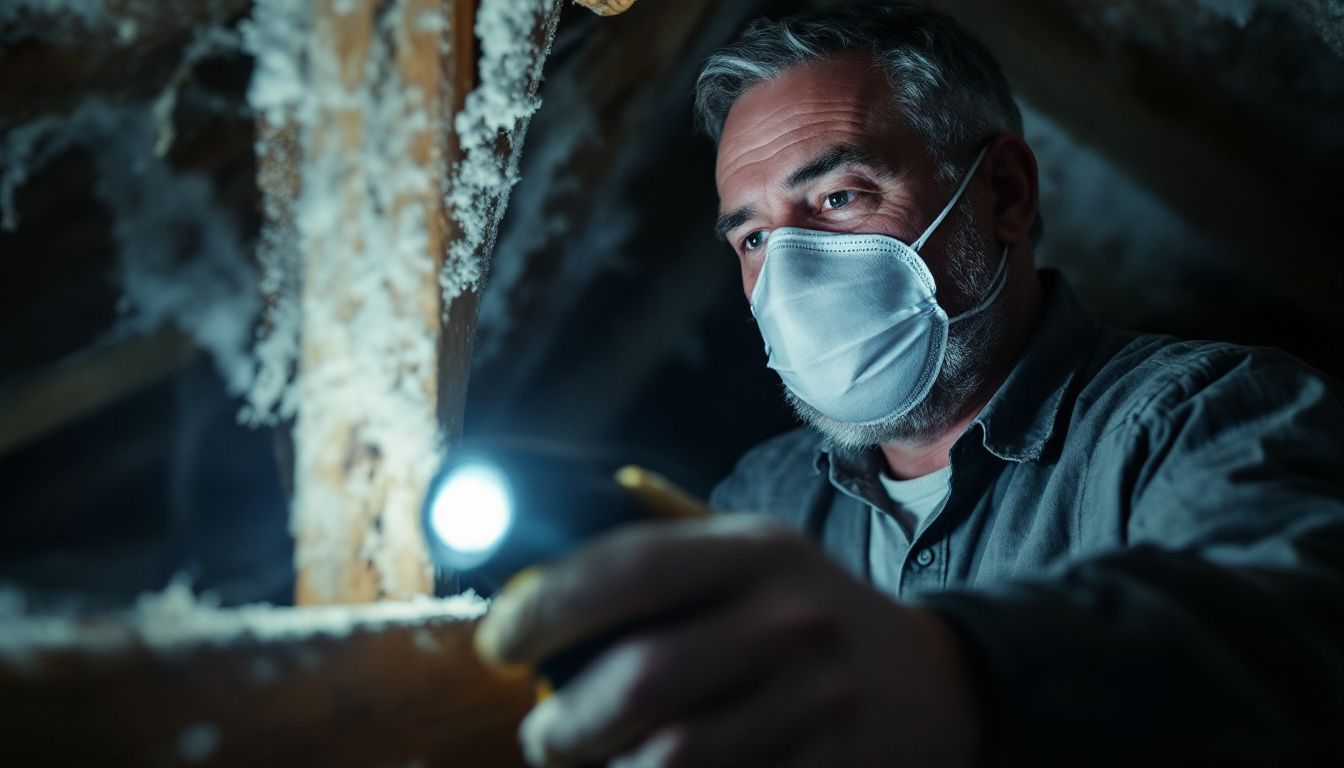
- Loose fill loft insulation — some properties from the 1960s and 1970s used loose fill insulation that may contain asbestos
This is not an exhaustive list. Asbestos was incorporated into thousands of different products during its peak use. The safest assumption, if your property dates from before 2000, is that ACMs may be present until a professional survey proves otherwise.
The Health Risks You Cannot Afford to Ignore
Asbestos fibres are microscopic. When materials containing asbestos are cut, drilled, sanded, or broken apart, those fibres become airborne and can be inhaled deep into the lungs. The body cannot expel them, and they remain lodged in lung tissue indefinitely.
The diseases caused by asbestos exposure include:
- Mesothelioma — a rare and aggressive cancer of the lining of the lungs or abdomen, almost exclusively caused by asbestos exposure. It is incurable and typically fatal within months of diagnosis.
- Asbestosis — a chronic scarring of the lung tissue that causes progressive breathlessness and significantly reduces quality of life
- Lung cancer — asbestos exposure substantially increases the risk of developing lung cancer, particularly in those who also smoke
- Pleural thickening — a non-malignant condition where the lining of the lungs thickens and restricts breathing
What makes asbestos particularly cruel is the latency period. Symptoms of asbestos-related disease typically do not appear for 20 to 40 years after exposure. Someone who disturbs asbestos during a weekend renovation project in their 30s may not develop symptoms until their 60s or 70s — by which point the disease is well established.
The UK has one of the highest rates of mesothelioma in the world, a direct legacy of widespread asbestos use in construction and industry throughout the 20th century. This is not a historical problem — it is an ongoing public health crisis, and DIY home renovation is a significant contributor to ongoing exposure.
Who Is Most at Risk?
Tradespeople — plumbers, electricians, carpenters, plasterers — face the highest occupational risk because they regularly work in older buildings. But homeowners undertaking DIY projects are also significantly exposed, often without realising it.
Family members can be affected too. Asbestos fibres can cling to clothing and be carried into living areas, putting others in the household at risk even if they never set foot in the room where work took place.
What to Do Before Any Renovation Work Begins
The single most important step before any renovation, refurbishment, or demolition work on a pre-2000 property is to commission a professional asbestos survey. This is not optional — it is the responsible baseline for any property work, and in commercial or non-domestic premises, it is a legal requirement under the Control of Asbestos Regulations.
Understanding the Two Main Survey Types
There are two principal types of survey, each suited to different circumstances.
A management survey is designed for properties that are occupied and in normal use. It identifies the location, condition, and extent of any ACMs that could be disturbed during routine maintenance or occupancy. This type of survey forms the foundation of an asbestos management plan and is the starting point for any duty holder managing a commercial property.
A refurbishment survey is required before any significant renovation, refurbishment, or demolition work. It is more intrusive — surveyors will access areas that would normally be undisturbed, including behind walls, above ceilings, and beneath floors. This survey must be completed before any contractor or DIY enthusiast picks up a tool.
Both survey types are governed by the HSE guidance document HSG264, which sets out the standards that accredited surveyors must follow. Always use a UKAS-accredited surveying company to ensure the work meets the required standard.
What a Survey Involves
A qualified surveyor will carry out a thorough inspection of the property, taking small bulk samples from materials suspected to contain asbestos. These samples are sent to an accredited laboratory for analysis, and you receive a detailed written report identifying the location, type, and condition of any ACMs found, along with a risk assessment and recommended actions.
The survey report gives you — and any contractors you employ — the information needed to work safely. Without it, you are working blind, and the consequences of that can be severe.
What to Do If Asbestos Is Found
Discovering asbestos in your property is not automatically cause for panic. Asbestos in good condition that is not being disturbed poses a low risk. The danger arises when it is damaged, deteriorating, or about to be disturbed by renovation work.
Your survey report will categorise the risk and advise on the appropriate course of action. In many cases, the recommendation will be to manage the material in situ rather than remove it immediately. In others — particularly where refurbishment is planned — removal will be the right course.
Immediate Steps If You Suspect You’ve Disturbed Asbestos
If you are already mid-renovation and suspect you may have disturbed ACMs, stop work immediately. Do not attempt to clean up dust or debris with a standard vacuum cleaner — this will spread fibres further and make the situation significantly worse.
Follow these steps without delay:
- Stop all work and leave the area immediately
- Do not use a domestic vacuum cleaner on any debris
- Seal off the area using heavy-duty plastic sheeting and tape where safe to do so
- Switch off any fans, air conditioning, or heating systems that could circulate fibres
- Double-bag any waste materials in sealed polythene bags — red bags inside clear outer bags, clearly labelled as asbestos waste
- Contact a licensed asbestos contractor for advice and remediation
Legal Requirements for Asbestos Removal
The Control of Asbestos Regulations set out clear legal requirements for how asbestos must be managed and removed. Licensed removal work — which covers the most hazardous types of asbestos, including sprayed coatings, insulation, and asbestos insulating board — must only be carried out by a contractor holding a licence issued by the HSE.
Even for non-licensed work, there are strict requirements. Notifiable Non-Licensed Work (NNLW) must be notified to the relevant enforcing authority before it begins, and workers must receive health surveillance.
Homeowners who attempt to remove asbestos themselves without the appropriate knowledge and controls are not only putting themselves at serious risk — they may also be committing a criminal offence. Professional asbestos removal contractors will handle all regulatory requirements, including notification, safe removal, correct disposal at a licensed waste facility, and provision of a clearance certificate.
That clearance certificate is important documentation — it proves the work was done correctly and will be required if you ever sell the property.
Safe Working Practices If You Must Work Near Asbestos
In some limited circumstances — for example, drilling a single fixing hole in a material that has been assessed as low risk — it may be acceptable to carry out minor work near ACMs. However, this should only ever be done following professional advice and with appropriate controls in place. It is never appropriate for a homeowner to attempt this without guidance.
If a professional has assessed that minor work can proceed, the following controls are the minimum required:
- Wear a properly fitted FFP3 disposable respirator — not a paper dust mask, which offers no protection against asbestos fibres
- Wear disposable coveralls (Type 5/6) and boot covers
- Wet the material before working on it to suppress fibre release
- Do not use power tools on ACMs — hand tools only, and only where absolutely necessary
- Clean up using damp cloths, not dry sweeping or a standard vacuum cleaner
- Double-bag all waste and dispose of it correctly as hazardous waste
- Shower and change clothing before leaving the work area
These precautions are the minimum — not a guarantee of safety. The only truly safe approach is to have ACMs professionally removed before any renovation work begins.
Choosing the Right Asbestos Professional
Not all asbestos contractors are equal. When selecting a surveyor or removal contractor, check the following:
- UKAS accreditation — surveyors should be accredited by UKAS (United Kingdom Accreditation Service) to carry out asbestos surveys in line with HSG264
- HSE licence — removal contractors carrying out licensable work must hold a current HSE licence, which you can verify on the HSE website
- Experience and track record — ask how many surveys or removals they have completed, and request references or case studies
- Clear written reports — a professional survey should produce a detailed written report with photographic evidence, not a verbal summary
- Transparent pricing — get at least two or three quotes and be wary of unusually low prices, which may reflect a lack of proper accreditation or corners being cut on safety
Supernova Asbestos Surveys operates nationwide, with local teams covering major cities and regions. Whether you need an asbestos survey London residents and businesses can rely on, an asbestos survey Manchester properties require before renovation, or an asbestos survey Birmingham building owners trust, our accredited surveyors can respond quickly and deliver clear, actionable results.
The Cost of Getting It Wrong
Some homeowners baulk at the cost of a professional asbestos survey. It is worth putting that cost in perspective.
The consequences of disturbing asbestos without proper controls include potential criminal prosecution, significant remediation costs if fibres have been spread through a property, and — most seriously — the risk of a fatal disease developing decades later. No renovation project is worth that.
A professional survey is a modest investment relative to the value of your property and, more importantly, your health. It also gives you a clear picture of what you are dealing with before work begins, which makes project planning more straightforward and avoids costly surprises mid-renovation.
If you are planning to sell the property at any stage, a documented asbestos management history — including survey reports and any clearance certificates — is increasingly expected by solicitors and buyers. Getting the survey done now protects your position both now and in the future.
Asbestos in Different Property Types
The risk profile varies depending on the type of property you own or manage. Residential properties built between the 1950s and 1999 are the most likely to contain ACMs, with properties from the 1960s and 1970s typically having the highest concentration of asbestos-containing materials due to peak construction activity during that period.
Commercial properties — offices, warehouses, schools, hospitals — face additional legal obligations. The duty to manage asbestos under the Control of Asbestos Regulations applies to non-domestic premises, meaning the responsible person must arrange a management survey, keep records, and ensure that anyone who might disturb ACMs is informed of their location and condition.
Mixed-use buildings, converted properties, and older extensions all add complexity. If you are unsure about any part of your building’s history, treat it as potentially containing asbestos until a survey confirms otherwise.
Frequently Asked Questions
How do I know if my home contains asbestos?
You cannot tell by looking. Asbestos-containing materials look identical to non-asbestos versions. The only way to know for certain is to have a professional asbestos survey carried out by a UKAS-accredited surveyor, who will take samples and have them analysed by an accredited laboratory.
Is asbestos dangerous if I leave it alone?
Asbestos that is in good condition and is not being disturbed poses a low risk. The danger arises when fibres become airborne — which happens when ACMs are cut, drilled, sanded, broken, or damaged. If you have asbestos in your property that is intact and undamaged, the standard advice is to manage it in place and monitor its condition regularly.
Can I remove asbestos myself?
For the most hazardous types of asbestos — including sprayed coatings, asbestos insulating board, and pipe lagging — removal must be carried out by an HSE-licensed contractor. Attempting to remove these materials yourself is illegal and extremely dangerous. Even for lower-risk materials, professional removal is strongly recommended. DIY removal risks spreading fibres throughout your property and exposing you and your family to serious health risks.
What is the difference between a management survey and a refurbishment survey?
A management survey is suitable for occupied properties in normal use — it identifies ACMs that could be disturbed during routine maintenance. A refurbishment survey is required before any renovation, refurbishment, or demolition work — it is more intrusive and must be completed before any work begins. Both are governed by the HSE’s HSG264 guidance.
How much does an asbestos survey cost?
Survey costs vary depending on the size and type of property, the survey type required, and the location. The cost of a professional survey is modest compared to the potential cost of remediation if asbestos is disturbed without proper controls — and far less than the human cost of an asbestos-related illness. Contact Supernova Asbestos Surveys on 020 4586 0680 or visit asbestos-surveys.org.uk for a quote tailored to your property.
Get Expert Asbestos Advice From Supernova
Supernova Asbestos Surveys has completed over 50,000 surveys across the UK. Our UKAS-accredited surveyors work with homeowners, landlords, property managers, and contractors to identify asbestos risks before they become serious problems.
Whether you are planning a kitchen renovation, a full-scale refurbishment, or simply want to understand what is in your building, we can help. Call us on 020 4586 0680 or visit asbestos-surveys.org.uk to book a survey or speak to one of our team.