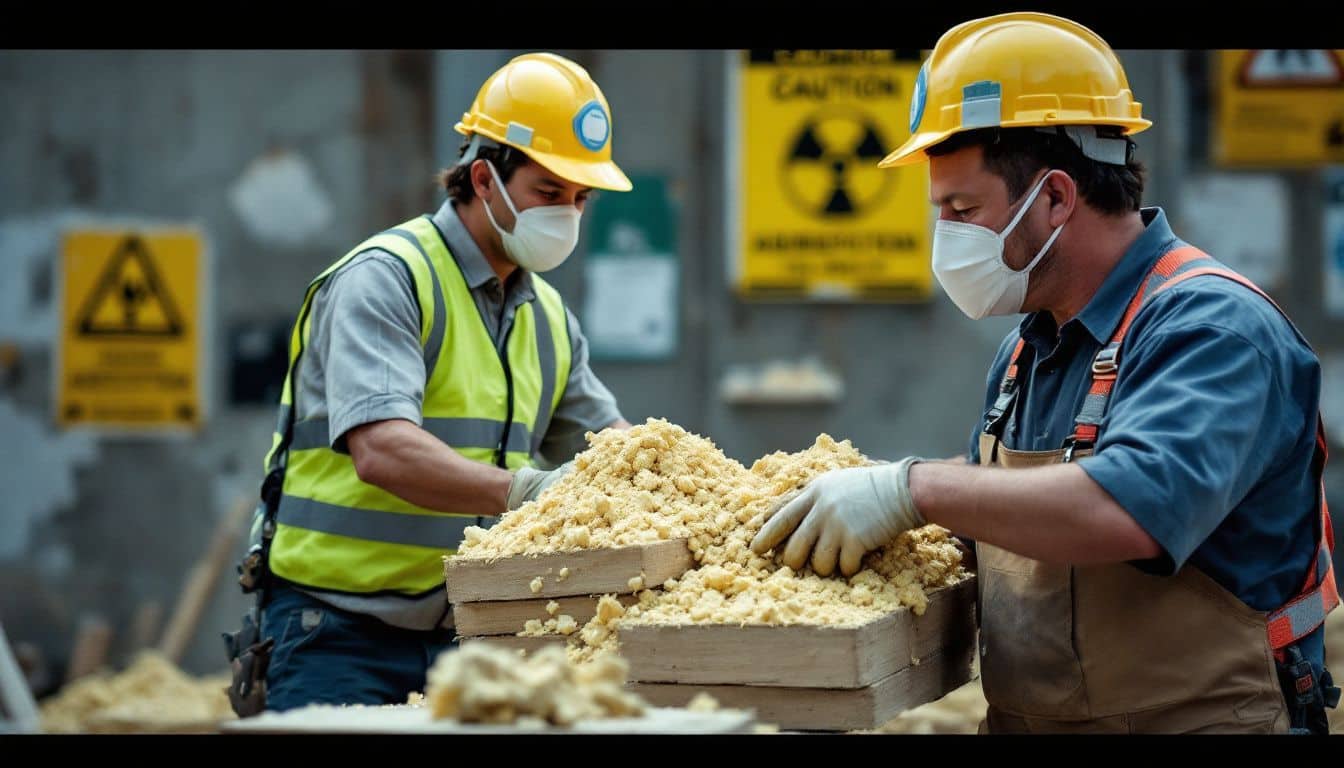
Asbestos Control Measures Every Construction Professional Must Know
Construction workers face a higher risk of asbestos exposure than almost any other profession in the UK. Older buildings contain asbestos-containing materials (ACMs) in places you might never expect — insulation, floor tiles, roofing sheets, pipe lagging — and disturbing them without proper asbestos control measures in place puts lives at serious risk.
Asbestos-related diseases, including mesothelioma and asbestosis, remain among the leading causes of occupational death in this country. These conditions develop decades after exposure, which means the decisions made on site today determine health outcomes years from now.
Whether you are a site manager, contractor, or facilities professional, here is what you genuinely need to know — from identifying risk to meeting your legal obligations and protecting your workforce.
Where Asbestos Hides in Construction Materials
Any building constructed or refurbished before 2000 could contain ACMs. Asbestos was used extensively because it was cheap, durable, fire-resistant, and an excellent insulator. The problem is that it can be almost anywhere in the building fabric.
Common ACMs Found on Construction Sites
- Insulation boards and lagging — around boilers, pipes, and heating systems
- Ceiling tiles and textured coatings — including Artex and similar spray-applied finishes
- Roofing sheets and roof tiles — particularly corrugated asbestos cement
- Floor tiles and adhesive backing — vinyl and thermoplastic floor coverings
- Asbestos cement panels and soffits — common in commercial and industrial buildings
- Pipe insulation and gaskets — throughout older mechanical and plumbing systems
- Partition walls and fireproofing materials
- Bitumen and mastics — used in waterproofing and expansion joints
Not all of these materials carry the same level of risk. Friable asbestos — the kind that crumbles easily and releases fibres into the air — poses the greatest immediate danger. Asbestos cement is more stable but still requires careful management when drilled, cut, or broken.
High-Risk Trades and Occupations
Certain construction trades encounter ACMs more frequently simply because of the nature of their work. If your role involves disturbing older building fabric, you are in a higher-risk category.
- Demolition workers
- Bricklayers and stonemasons
- Carpenters and joiners
- Plasterers
- Roofers
- Plumbers and pipefitters
- Electricians — especially when chasing walls or working in ceiling voids
- HVAC and insulation engineers
- Painters and decorators working on older surfaces
The risk is not always visible. An electrician drilling into a partition wall may not realise it contains asbestos insulation board until fibres are already airborne. That is precisely why pre-work survey data and proper planning are non-negotiable.
The Legal Framework Underpinning Asbestos Control Measures
Asbestos management in the UK is governed by the Control of Asbestos Regulations, enforced by the Health and Safety Executive (HSE). These regulations apply to all non-domestic premises and impose clear duties on employers, building owners, and anyone responsible for maintaining a property.
The Duty to Manage
The duty to manage asbestos falls on anyone responsible for maintaining non-domestic premises — including commercial landlords, facilities managers, and employers with responsibility for the building. This duty requires you to:
- Assess whether asbestos is present — or likely to be present — in the premises
- Record the location, type, and condition of any ACMs in an asbestos register
- Assess the risk those materials pose
- Produce a written asbestos management plan and act on it
- Make this information available to anyone who may disturb the materials
Before any refurbishment or demolition work begins, a demolition survey or refurbishment survey must be carried out. A standard management survey is not sufficient for intrusive work — you need a more thorough investigation of all areas to be disturbed.
Licensing Requirements for Removal Work
The Control of Asbestos Regulations establish three categories of asbestos work, each with different requirements:
- Licensed work — required for high-risk ACMs such as asbestos insulation, asbestos insulating board (AIB), and sprayed coatings. Only contractors holding an HSE licence may carry out this work.
- Notifiable non-licensed work (NNLW) — lower-risk work that must still be notified to the HSE, with medical surveillance required for workers involved.
- Non-licensed work — limited, lower-risk activities that follow strict controls but do not require a licence.
If you are unsure which category applies to a specific task, consult a qualified asbestos professional before proceeding. Getting this wrong carries serious legal and health consequences.
Employer Obligations
Employers carrying out construction work must ensure a suitable survey has been completed before work starts and provide adequate asbestos awareness training to all employees who could encounter ACMs. They must also supply appropriate PPE and respiratory protective equipment (RPE), maintain health surveillance records for workers involved in notifiable non-licensed or licensed work, and have a clear written plan of work identifying how asbestos risks will be managed.
Failure to comply can result in HSE enforcement action, prohibition notices, significant fines, and — in serious cases — criminal prosecution.
Practical Asbestos Control Measures That Make a Real Difference
Regulation sets the minimum standard. Good practice goes further. These are the control measures that genuinely protect workers on site.
1. Commission the Right Survey Before Work Begins
This is the single most important step you can take. You cannot manage a risk you have not identified. Before any refurbishment or demolition project, commission the appropriate survey from a competent, accredited surveying company.
A management survey is suitable for routine occupation and maintenance — it is not appropriate before intrusive work. Using the wrong survey type is a common and potentially fatal mistake. The survey report will tell you exactly where ACMs are located, their condition, and the risk they pose. This information must be shared with every contractor and worker on site before any work begins.
2. Keep an Up-to-Date Asbestos Register
The asbestos register is a live document, not a one-off exercise. Every time ACMs are disturbed, removed, or their condition changes, the register must be updated accordingly. It should be readily accessible to all relevant parties — contractors, facilities managers, and emergency services.
An out-of-date or incomplete register is almost as dangerous as having no register at all. Ensure re-inspection survey visits are carried out at least every 12 months to check the condition of any ACMs left in place. This keeps your register accurate and your duty to manage compliant.
3. Apply Engineering Controls First
Before reaching for PPE, apply engineering controls to reduce fibre levels in the air at source. These are the most effective asbestos control measures available and should always be the first line of defence.
- Wet methods — dampen ACMs before disturbing them to suppress fibre release
- Local exhaust ventilation (LEV) — extract fibres at source using tools fitted with HEPA-filtered extraction
- Enclosure and containment — for licensed work, erect a sealed work enclosure with negative pressure units to prevent fibre migration
- Careful work techniques — avoid cutting, grinding, or drilling ACMs where possible; use hand tools rather than power tools to minimise fibre generation
4. Use Appropriate Personal Protective Equipment
PPE is a last line of defence, not the first. It must be used alongside other controls, never instead of them. When working with or near ACMs, workers need:
- Respiratory protective equipment (RPE) — the type and class of respirator must match the level of exposure. For licensed asbestos work, a full-face powered air-purifying respirator (PAPR) or positive-pressure full-face mask is typically required. All respirators must pass a face-fit test for the individual wearer.
- Disposable coveralls (Type 5) — single-use suits that prevent fibre contamination on clothing. Workers must change out of these before leaving the work area and bag the coveralls as asbestos waste.
- Gloves and boot covers — to prevent fibre transfer via hands and footwear
PPE must be inspected before every use, stored correctly, and replaced as soon as it shows signs of wear or damage. Employers must provide all PPE at no cost to the worker — this is a legal requirement, not a courtesy.
5. Follow Strict Waste Disposal Procedures
Asbestos waste is classified as hazardous waste under UK legislation. There are no shortcuts in how it must be handled and disposed of.
- Double-bag all waste in heavy-duty polythene sacks, clearly labelled as asbestos waste
- Transport only via licensed waste carriers
- Dispose of only at a licensed hazardous waste facility
- Retain all waste transfer documentation
Improper disposal is a criminal offence. The paperwork, labelling, and approved disposal route are all mandatory — not optional extras.
6. Ensure All Workers Receive Appropriate Training
The Control of Asbestos Regulations require asbestos awareness training for all workers who could be exposed to asbestos as part of their normal work. A five-minute toolbox talk does not fulfil this requirement.
Training must cover:
- What asbestos is, where it is found, and how to recognise potential ACMs
- The health risks associated with asbestos exposure
- What to do if asbestos is discovered or accidentally disturbed
- How to use PPE and RPE correctly
- Site-specific procedures and emergency protocols
Workers involved in notifiable non-licensed or licensed work require additional, more specialist training. Refresher training should be provided regularly — at minimum annually.
Health Surveillance and Worker Monitoring
For workers involved in notifiable non-licensed work or asbestos removal, regular health surveillance is a legal requirement. This involves medical examinations carried out by a doctor or occupational health professional, with records maintained throughout the worker’s employment and for a minimum of 40 years.
The reason for the extended record-keeping period is the long latency of asbestos-related diseases. Mesothelioma can take 20 to 50 years to develop after initial exposure. Early detection through regular medical monitoring gives workers the best possible chance of timely diagnosis and treatment.
Even for workers not covered by the formal health surveillance requirement, access to occupational health support is good practice. Employers should make it straightforward for workers to raise health concerns without fear of penalisation.
What to Do If Asbestos Is Discovered Unexpectedly
Despite the best planning, construction workers sometimes encounter suspected ACMs they were not expecting. If this happens, the steps are clear and must be followed immediately.
- Stop work immediately in the affected area
- Clear the area and prevent anyone else from entering
- Do not disturb the material further — leave it exactly as found
- Inform your supervisor or site manager immediately
- Arrange for a sample to be taken and tested by an accredited laboratory before work resumes
Continuing to work around suspected asbestos without testing and proper assessment is both a serious health risk and a legal breach. The cost of stopping work temporarily is far outweighed by the potential consequences.
Supernova Asbestos Surveys offers rapid asbestos testing services for exactly this situation. If you discover suspicious material on site, contact us on 020 4586 0680 and we can arrange fast, accurate results from a UKAS-accredited laboratory.
Testing Options: From Site Sampling to Bulk Analysis
Not every asbestos control situation requires a full survey. Sometimes you simply need to know whether a specific material contains asbestos before deciding how to proceed. In these cases, targeted sampling and laboratory analysis is the most efficient route.
A qualified surveyor will take a small sample of the suspect material, which is then analysed under a microscope at a UKAS-accredited laboratory. Results can often be turned around within 24 to 48 hours, allowing work to resume quickly where no asbestos is found — or enabling you to implement the appropriate controls where it is.
You can find out more about the full range of options available through our dedicated asbestos testing page, which covers everything from bulk sample analysis to air monitoring.
Asbestos Control Measures Across Different Project Types
The specific asbestos control measures you need depend heavily on the type of project you are undertaking. A minor maintenance task in an occupied office carries very different risks to a full strip-out before major refurbishment.
Routine Maintenance and Minor Works
For routine maintenance in occupied buildings, the priority is knowing where ACMs are before any work begins. The asbestos register should be consulted before every task that involves disturbing the building fabric — even something as simple as fixing a ceiling tile or running a cable through a void.
If the register does not cover the area in question, or if the building has no register at all, a management survey should be commissioned before proceeding. Guessing is not an acceptable substitute.
Refurbishment Projects
Refurbishment work almost always involves disturbing building fabric to a degree that a management survey cannot adequately cover. Before any strip-out, fit-out, or structural alteration, a full refurbishment survey must be completed for all areas to be affected.
This survey is more intrusive than a management survey — it involves accessing voids, lifting floors, and sampling materials that would not be disturbed under normal occupation. The results directly inform your plan of work and determine which licensed or non-licensed controls apply.
Demolition Projects
Demolition represents the highest-risk scenario for asbestos exposure. A full demolition survey is required before any structural demolition begins — this must cover the entire building, including all areas that will be affected by the works.
HSG264, the HSE’s guidance on asbestos surveys, is clear that a demolition survey must be completed before the building is demolished or before a major refurbishment is carried out. All ACMs must be removed by a licensed contractor before demolition proceeds where required by the nature of the materials involved.
Asbestos Surveys Nationwide: London, Manchester, Birmingham and Beyond
Supernova Asbestos Surveys operates across the UK, providing accredited surveys, testing, and management support to construction professionals, facilities managers, and property owners in every region.
If you are based in the capital, our team provides a full range of services through our dedicated asbestos survey London service. We also cover the north-west through our asbestos survey Manchester team, and the Midlands via our asbestos survey Birmingham operation.
Wherever your project is located, we can mobilise quickly and provide the survey, testing, or management support you need to keep your site compliant and your workers safe.
Get the Right Asbestos Control Measures in Place Today
Asbestos control is not an area where cutting corners is ever acceptable. The legal framework is clear, the health consequences are severe, and the practical steps required are well established. What matters is whether those steps are actually followed on your site, on every project, every time.
Supernova Asbestos Surveys has completed over 50,000 surveys across the UK. Our UKAS-accredited surveyors work with construction companies, facilities managers, and property owners to identify risk, produce accurate registers, and ensure the right controls are in place before work begins.
Call us on 020 4586 0680 or visit asbestos-surveys.org.uk to book a survey, arrange testing, or speak with one of our specialists about your project requirements.
Frequently Asked Questions
What are the most important asbestos control measures for construction sites?
The most critical asbestos control measures are: commissioning the correct type of survey before work begins, maintaining an up-to-date asbestos register, applying engineering controls such as wet methods and local exhaust ventilation, using appropriate RPE and PPE, ensuring all workers receive proper asbestos awareness training, and following strict procedures for waste disposal. PPE should always be used as a last line of defence alongside engineering controls, never as a substitute for them.
Who is legally responsible for asbestos control measures on a construction site?
Under the Control of Asbestos Regulations, responsibility is shared. The duty to manage asbestos in non-domestic premises falls on whoever is responsible for maintaining the building — typically the owner, landlord, or facilities manager. Employers carrying out construction work are responsible for ensuring their workers are protected, which includes providing training, PPE, and ensuring appropriate surveys have been completed before work starts. Principal contractors also have responsibilities under CDM regulations to coordinate asbestos risk management across the site.
Do I need a licensed contractor for all asbestos removal work?
No — the Control of Asbestos Regulations divide asbestos work into three categories. Licensed work is required for high-risk materials such as asbestos insulation, asbestos insulating board, and sprayed coatings. Notifiable non-licensed work covers lower-risk tasks that must still be reported to the HSE and require medical surveillance. Non-licensed work covers limited, lower-risk activities with strict controls but no licensing requirement. If you are unsure which category applies, consult a qualified asbestos professional before proceeding.
What should I do if workers discover unexpected asbestos during construction?
Stop work in the affected area immediately and prevent anyone else from entering. Do not disturb the material further. Inform your site manager and arrange for a sample to be taken and tested by a UKAS-accredited laboratory before any work resumes. Continuing to work around suspected asbestos without testing is both a serious health risk and a breach of the Control of Asbestos Regulations. Supernova Asbestos Surveys can arrange rapid testing — call 020 4586 0680 for fast turnaround results.
How often should asbestos re-inspections be carried out?
Where ACMs are left in place and managed rather than removed, the condition of those materials should be re-inspected at least every 12 months. This is a requirement under the duty to manage asbestos in non-domestic premises. The re-inspection ensures the asbestos register remains accurate and that any deterioration in the condition of ACMs is identified and acted upon promptly. If conditions change — for example, following building works or accidental damage — an additional re-inspection should be carried out sooner.