Asbestos on Ships: A Risk That Refuses to Retire
Asbestos on ships is not a closed chapter. It is a live, practical hazard that continues to affect marine engineers, refurbishment contractors, heritage preservation teams, demolition crews, and facilities managers responsible for dockside buildings and former naval estates.
If a vessel was built during the decades when asbestos was the default choice for heat resistance and fire protection, it may still contain asbestos in insulation, gaskets, lagging, deck tiles, panels, and machinery components. The material sitting undisturbed is not the danger. The danger is what happens when it is cut, drilled, abraded, or broken open — fibres become airborne, they are inhaled, and disease can follow years or even decades later.
For anyone with responsibility over a marine asset, the question is straightforward: where is the asbestos, what condition is it in, and how do you manage it safely and legally?
Why Asbestos on Ships Was Used So Widely
Shipbuilders specified asbestos because it solved genuine engineering problems. Vessels needed materials that could handle sustained heat, friction, vibration, and the ever-present fire risk of a working ship at sea. Asbestos was cheap, adaptable, and effective — which is why it ended up built into the fabric of both commercial and naval fleets across the world for decades.
It was rarely confined to one area. On many ships, asbestos was present from the engine room to the crew quarters, from the boiler casing to the electrical switchgear. Understanding where it was typically used helps surveyors and dutyholders prioritise inspection and sampling.
Where Asbestos Was Commonly Specified on Ships
- Thermal insulation on hot pipes, boilers, and exhaust systems
- Fire protection in bulkheads, doors, decks, and partitions
- Friction materials in brakes, clutches, and winches
- Gaskets and seals in pumps, valves, flanges, and engines
- Electrical insulation around cables and switchgear
- Sprayed coatings and insulating boards for heat and fire resistance
- Deck tiles and adhesives in accommodation and working spaces
- Fire blankets, curtains, and rope seals
The practical problem today is that these legacy materials can remain hidden until maintenance, refit, or dismantling work disturbs them. Without a current asbestos register, workers can walk straight into an exposure event that nobody anticipated.
Asbestos on Navy Ships: A Particularly Heavy Legacy
Naval vessels were among the heaviest users of asbestos because they demanded exceptional levels of fire protection, mechanical durability, and compact engineering. Warships packed engine rooms, boiler rooms, machinery spaces, weapons systems, and electrical installations into relatively small hulls — and all of that heat-generating equipment needed insulation.
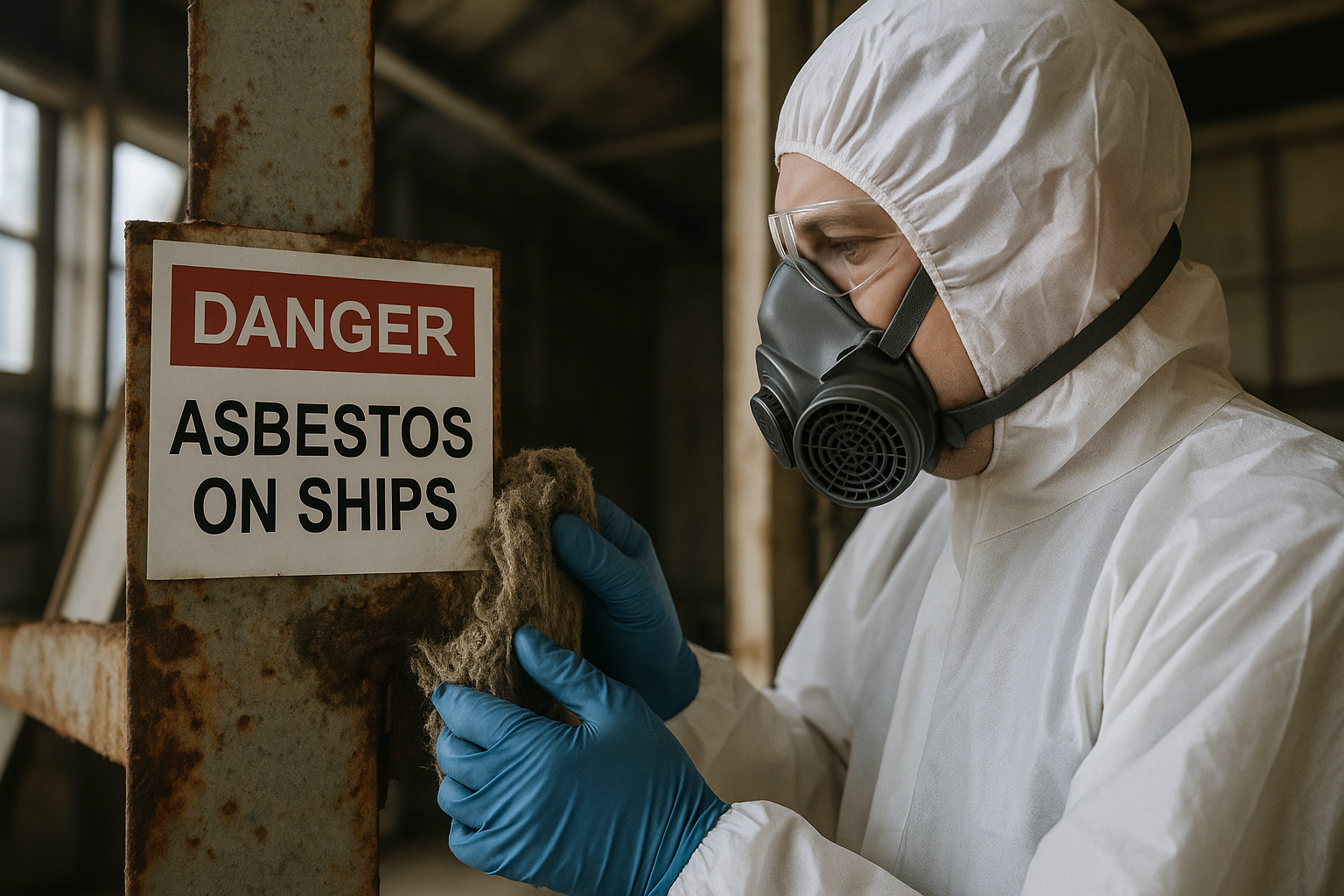
Asbestos on navy ships was not a specialist trade concern. Engineers, stokers, maintenance crews, electricians, fitters, welders, and even crew members in adjacent compartments could be exposed when asbestos materials deteriorated or were disturbed during routine repairs. Exposure was often a consequence of ordinary working life, not dramatic demolition.
High-Risk Areas on Naval Vessels
- Engine rooms: heavy use of lagging, gaskets, insulation, and heat-resistant products throughout
- Boiler rooms: historically one of the highest-risk spaces for asbestos exposure on any vessel
- Pipe tunnels and service voids: extensive insulated pipework in confined, poorly ventilated spaces
- Workshops: cutting, grinding, and repair tasks regularly disturbed asbestos materials
- Sleeping quarters and communal spaces: asbestos boards, tiles, and fireproof panels were commonly installed
- Electrical rooms: switchgear, backing boards, and arc chutes often contained asbestos
Where vessels have changed hands, been refitted multiple times, or served across different fleets, records are frequently incomplete or absent entirely. A proper asbestos survey and register are not optional extras — they are the foundation of any safe working plan.
Items on Navy Ships Containing Asbestos
The range of asbestos-containing materials found on naval vessels is broader than many people expect. Some were friable and likely to release fibres when damaged. Others were more firmly bound but still hazardous if cut, drilled, or sanded during maintenance.
- Pipe lagging and thermal insulation
- Boiler and turbine insulation
- Gaskets, packing, and rope seals
- Pump and valve components
- Cement sheets and asbestos insulating board
- Deck tiles and adhesive
- Wall panels and partition boards
- Fire blankets and fire curtains
- Electrical backing boards and arc chutes
- Brake linings and clutch facings
- Exhaust wraps and heat shields
- Dormitory and mess area finishes
Materials that look unremarkable may still contain asbestos, particularly on older vessels or in dockside support buildings that served those ships over many years. Assumptions are a liability.
Aircraft Carriers, Battleships, and Submarines: Specific Risks
Different vessel types carried different risk profiles depending on their engineering complexity, size, and operational purpose. Three vessel types deserve particular attention.
Asbestos on Aircraft Carriers
Aircraft carriers were effectively floating industrial cities. They combined aviation support, accommodation for large crews, extensive engineering plant, weapons systems, fuel handling, and complex electrical infrastructure — all of which created multiple opportunities for asbestos to be specified and installed.
Asbestos on aircraft carriers was commonly found in boiler and engine spaces, pipe insulation runs throughout the vessel, hangar deck service areas, fireproof doors and bulkhead systems, pump rooms, electrical systems, cable penetrations, and deck coverings. Because carriers underwent frequent maintenance cycles and upgrades throughout their service lives, asbestos-containing materials were regularly disturbed, and later refurbishments may have concealed rather than removed original materials.
Large marine projects also tend to involve multiple trades working simultaneously and at speed. That creates a well-known failure point: one contractor disturbs a suspect material and everyone nearby is exposed before anyone realises what has happened. Before any refurbishment or strip-out, dutyholders must insist on clear asbestos information, permit-to-work controls, and task-specific risk assessments.
Asbestos on Battleships
Battleships followed the same broad pattern but with heavy emphasis on heat management, blast protection, and machinery resilience. They contained extensive pipework, propulsion systems, armoured compartments, and auxiliary plant — all of which historically drew on asbestos products.
Spaces around gun turrets, power systems, and engineering plant could include insulation, seals, and fire-resistant boards. During refit or decommissioning, these materials may be hidden behind later upgrades, replacement coatings, or newer components.
For heritage projects, surveys need careful scoping. Historic vessels often contain inaccessible voids, layered refurbishments, and fragile materials. A desktop review alone is not adequate where intrusive works are planned.
Submarines and Confined-Space Risk
Submarines present a particularly serious asbestos challenge because they combine confined spaces, dense mechanical systems, and extensive thermal insulation in an environment where there is very little room to work safely. Asbestos on ships is dangerous in general — in submarines, it can be even harder to manage because access is restricted and disturbance in one area can affect adjacent compartments quickly.
Submarines historically used asbestos in pipe insulation, machinery gaskets, electrical components, and fire-resistant linings. Maintenance crews working in cramped conditions often had little physical separation from disturbed materials, and ventilation routes could spread fibres beyond the immediate task area.
Where a submarine is being decommissioned, preserved, or stripped for parts, asbestos planning should start long before any physical work begins — covering sampling strategy, enclosure design, waste routes, and emergency arrangements.
The U.S. Navy Experience and What It Tells UK Dutyholders
Searches around asbestos on ships frequently reference asbestos exposure on U.S. Navy ships, and for good reason. The scale of documented cases among veterans and shipyard workers has generated significant research and legal activity. The broad pattern, however, is not unique to American fleets — it is consistent across many navies and commercial shipping industries worldwide.

On U.S. Navy ships, exposure was commonly linked to engine and boiler spaces, routine maintenance tasks, and shipyard overhauls. The same risk profile applies to other fleets where asbestos-containing materials were fitted as standard during construction or refit.
The lesson for UK compliance is direct: historical use in naval environments means any older marine structure, vessel, or dockside support facility should be treated with caution until asbestos has been properly identified through survey and sampling.
Typical Exposure Pathways on Any Naval Vessel
- Removing or replacing pipe lagging
- Opening flanged joints with asbestos gaskets
- Cutting insulation boards during repairs
- Cleaning machinery spaces where debris had accumulated
- Working near others who were disturbing asbestos materials
- Refit and overhaul periods in dock, often with multiple trades present
Exposure did not always come from dramatic demolition work. Routine maintenance in confined, poorly ventilated spaces was often enough to release significant quantities of fibre.
Ships Built Before 1 July 2002: What Owners and Operators Must Do
For any vessel built before 1 July 2002, asbestos on ships is a realistic possibility and should never be ruled out without evidence. Older vessels may still contain original asbestos materials, and even where some products were replaced during refits, residues or concealed items may remain behind later finishes or within inaccessible voids.
Age is one of the first screening questions to ask. If a vessel predates that threshold, the working assumption should be that asbestos may be present until a suitable survey, inspection, and sampling programme proves otherwise. This is not overcaution — it is the approach expected under the Control of Asbestos Regulations and HSE guidance, which require dutyholders to identify asbestos-containing materials so they can be managed and people protected from exposure.
Practical Steps for Owners and Operators
- Review the build date, refit records, and maintenance history in full
- Check whether any asbestos register or previous survey already exists
- Inspect known high-risk areas such as engine rooms, boiler spaces, and service voids
- Arrange representative sampling by a competent asbestos surveyor where needed
- Update the asbestos register and management plan before any intrusive work starts
- Brief all contractors clearly and keep records accessible on site
- Where demolition or major strip-out is planned, commission a demolition survey to identify all asbestos-containing materials before any physical work begins
Asbestos on Ships Today: Where the Risk Still Appears
Asbestos on ships is not confined to museum pieces or scrapyards. It continues to appear during vessel refurbishment, marine conversions, port redevelopments, and work on shore-side buildings associated with former shipyards and naval facilities.
A vessel may have been partly modernised, but legacy asbestos can remain in hidden areas or within systems that were never touched during earlier upgrades. The current risk is often created by poor information rather than the material alone. If survey data is missing, outdated, or too general, maintenance teams can encounter asbestos without any warning or preparation.
That is an avoidable outcome — but only if the right groundwork has been done before work starts.
Shore-Side Buildings and Dockside Facilities
The risk does not stop at the waterline. Dockside workshops, maintenance sheds, stores, offices, and former naval estate buildings can all contain asbestos if they were constructed or refurbished during the decades when asbestos products were in common use. These structures are subject to the same regulatory requirements as any other non-domestic premises.
Port redevelopments and conversions of former naval land into residential or commercial use are particularly high-risk scenarios. Survey data must be obtained and acted upon before any demolition, strip-out, or structural alteration begins.
Heritage Vessels and Museum Ships
Heritage vessels present a specific management challenge. They are typically open to the public, staffed by volunteers, and maintained on limited budgets — yet they may contain significant quantities of asbestos in deteriorating condition.
Dutyholders responsible for heritage vessels have the same legal obligations as any other employer or building owner. An asbestos management survey should be in place, the register should be kept up to date, and any maintenance or conservation work should be risk-assessed against that register before it begins.
Asbestos Surveys for Marine Assets Across the UK
Whether you are managing a vessel, a former naval facility, or a dockside building, the starting point is always the same: a competent asbestos survey carried out by a qualified surveyor working to HSG264 and the Control of Asbestos Regulations.
Supernova Asbestos Surveys works with clients across the UK on marine and port-related projects. For clients in the capital managing former dock buildings or riverside conversions, our asbestos survey London service covers the full range of survey types. In the north-west, where former shipbuilding communities and industrial waterfront sites are common, our asbestos survey Manchester team is available for both management and refurbishment surveys. For clients in the Midlands managing industrial or port-adjacent properties, our asbestos survey Birmingham service provides the same standard of professional assessment.
Every survey we carry out is backed by over 50,000 surveys completed nationwide, with qualified surveyors who understand the specific challenges of complex, multi-layered structures — including vessels, industrial buildings, and heritage sites.
Frequently Asked Questions
Is asbestos still found on ships today?
Yes. Any vessel built before 1 July 2002 may contain asbestos-containing materials, and many older ships have never been fully surveyed or had their asbestos fully removed. Asbestos can be found in insulation, gaskets, deck tiles, fire-resistant panels, and many other components. It remains present until a proper survey and sampling programme confirms otherwise.
What regulations apply to asbestos on ships in the UK?
The Control of Asbestos Regulations applies to non-domestic premises, including vessels used as workplaces and shore-side buildings. Dutyholders are required to manage asbestos-containing materials, maintain an asbestos register, and ensure that anyone likely to disturb asbestos is informed and protected. HSE guidance, including HSG264, sets out the standards for asbestos surveys and the management of asbestos in non-domestic settings.
What type of asbestos survey is needed for a ship?
The type of survey depends on the intended work. A management survey is appropriate for ongoing maintenance and day-to-day management of a vessel or dockside building. A refurbishment and demolition survey is required before any intrusive work, strip-out, or major maintenance that could disturb the fabric of the vessel. Where full demolition or breaking is planned, a demolition survey must be completed before work starts.
Were submarines and aircraft carriers at particular risk from asbestos?
Yes. Both vessel types used asbestos extensively due to their complex engineering, high heat loads, and strict fire protection requirements. Submarines are particularly challenging because confined spaces, restricted access, and limited ventilation make asbestos management more difficult. Aircraft carriers had asbestos distributed throughout large, complex structures and underwent frequent maintenance cycles that disturbed materials repeatedly over many years.
How do I arrange an asbestos survey for a vessel or marine facility?
Contact a competent asbestos surveying company with experience in complex structures. The surveyor should be qualified, working to HSG264, and able to carry out both sampling and a full written report with a register of findings. Supernova Asbestos Surveys can be reached on 020 4586 0680 or through asbestos-surveys.org.uk to discuss survey requirements for any marine or port-related asset.