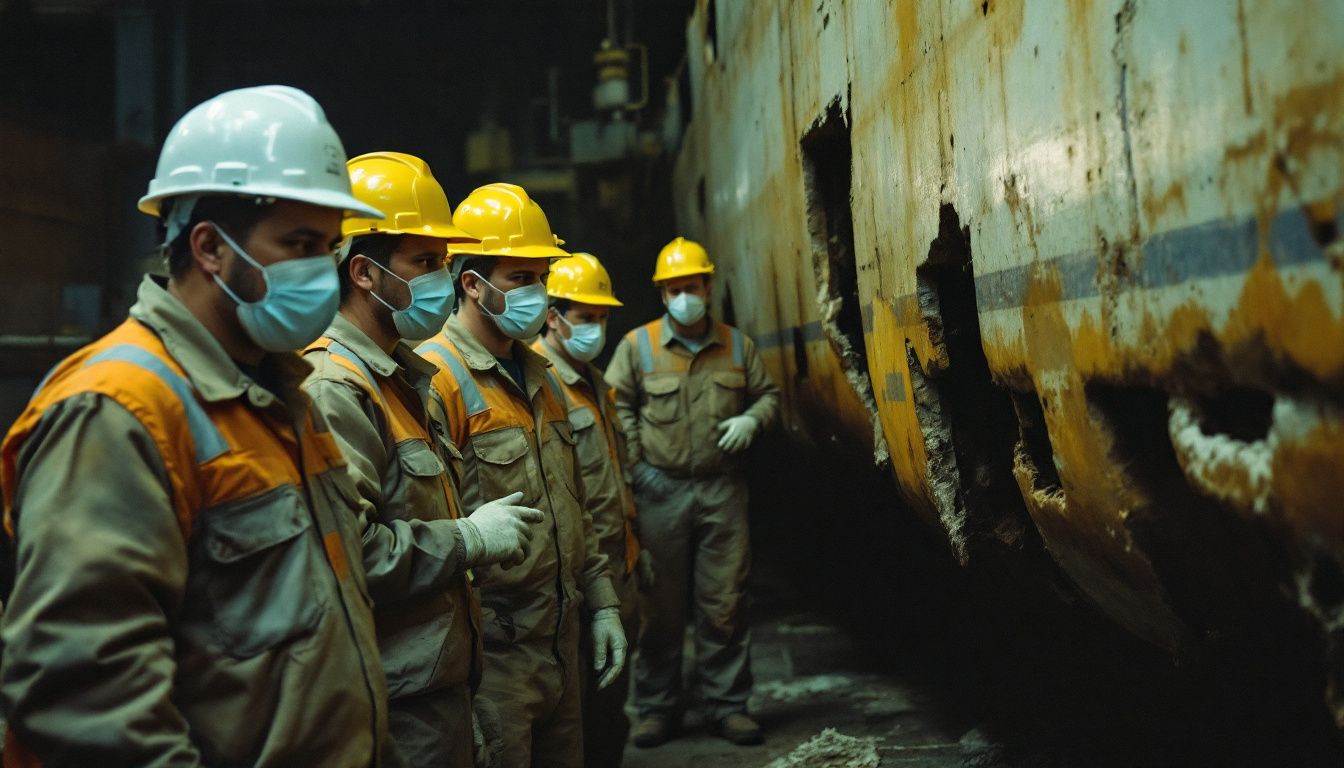
Asbestos on Ships: A Legacy of Hidden Danger That Has Not Gone Away
For decades, asbestos on ships was treated as an engineering triumph. Fire-resistant, heat-tolerant, and cheap — it appeared to solve every problem a naval architect could face. What nobody appreciated was the devastating human cost that would follow, measured in generations of illness, compensation claims, and preventable deaths.
This is not ancient history. Many vessels built before the 1980s remain in service, in dry dock, or in the process of being broken up. Workers handling those ships today face the same fibres that caused catastrophic harm fifty years ago. Understanding where asbestos was used, who is most at risk, and what UK law now requires is not optional — it is a matter of life and death.
Why Asbestos Was So Widely Used on Ships
The maritime industry adopted asbestos enthusiastically from the 1930s onwards. Ships are floating environments where fire, heat, and saltwater corrosion are constant threats, and asbestos appeared to address all three simultaneously.
It was used in extraordinary quantities across military vessels, merchant ships, passenger liners, and fishing boats alike. The Royal Navy continued specifying asbestos-containing materials well into the post-war period before switching to alternatives such as glass fibre and calcium silicate. Commercial shipyards took considerably longer to change course.
Insulation in Engine Rooms and Boiler Areas
Engine rooms and boiler spaces are brutally hot environments. Asbestos lagging was applied to pipework, boilers, turbines, and bulkheads to manage heat and protect crew working in those spaces.
Workers wrapped asbestos rope and blanket materials around steam pipes by hand and mixed asbestos paste directly onto surfaces. In confined, poorly ventilated spaces below deck, fibre concentrations during this work would have been extraordinarily high.
Fireproofing Across the Vessel
Fire at sea is one of the most dangerous emergencies a crew can face. After the Second World War, fire protection became a central concern in naval and commercial ship construction, and asbestos-based materials were considered state-of-the-art.
Sprayed asbestos coatings were applied to steel structures throughout vessels. Asbestos-containing boards lined accommodation spaces, galleys, and engine rooms. These materials can now be found in a deteriorated, friable condition on older vessels still in service or undergoing decommissioning.
Gaskets, Seals, and Mechanical Components
Beyond insulation and fireproofing, asbestos featured in a vast range of mechanical components. Gaskets in steam systems, valve packings, brake linings, clutch plates, and electrical insulation all commonly contained asbestos.
These components were subject to regular maintenance and replacement. Every time an engineer removed an old gasket or repacked a valve, asbestos fibres were released. Many ships built before 1980 still contain these components in their original condition, waiting to be disturbed during repair or decommissioning work.
Deck Tiles, Textiles, and Other Uses
The presence of asbestos on ships extended well beyond the engine room. Vinyl floor tiles in accommodation areas frequently contained asbestos as a binder. Asbestos textiles were used in fire curtains and protective clothing, and some paints and adhesives used in shipbuilding also contained asbestos fibres.
This widespread distribution means that when an older vessel is surveyed today, asbestos-containing materials can be found almost anywhere aboard. A thorough professional survey is the only reliable way to establish the full picture.
The Occupations Carrying the Highest Risk
Not all shipyard workers faced equal exposure. The nature of the work determined how much asbestos fibre a person breathed in, and therefore how great their risk of developing an asbestos-related disease became.
Insulation Installers and Laggers
Laggers — the workers who applied insulation to pipes and machinery — had among the highest asbestos exposures of any occupation. They worked directly with raw asbestos materials, often in confined spaces with no ventilation, at fibre concentrations that would vastly exceed any modern safety threshold.
Removing old lagging during refit or repair work was equally dangerous, often more so. Aged, friable asbestos insulation breaks apart readily, releasing enormous quantities of fine fibres into the air.
Pipefitters and Plumbers
Pipefitters worked constantly alongside insulated pipework. Cutting, joining, and repositioning pipes disturbed the asbestos lagging around them. Even when pipefitters were not directly handling asbestos, they worked in the same confined spaces as laggers and breathed the same contaminated air.
Welders and Burners
Welding and burning operations on asbestos-lagged structures are particularly hazardous. Heat from welding torches and cutting equipment breaks down asbestos materials into fine particles that become airborne immediately.
Welders frequently worked in poorly ventilated holds and compartments where fibres had nowhere to disperse. The combination of heat, confinement, and high fibre concentrations made this one of the most dangerous working environments in the entire shipbuilding industry.
Shipbreakers and Decommissioning Workers
Workers involved in scrapping older vessels face significant asbestos risks today. Breaking up a ship built before the 1980s means encountering decades-old asbestos materials in a deteriorated, friable condition.
Without proper surveying, planning, and control measures, this work is extremely hazardous. The same risks apply to engineers and contractors carrying out major refits on heritage vessels, museum ships, or older commercial craft still in service.
Health Consequences of Asbestos Exposure at Sea
The diseases caused by asbestos exposure are well-documented, serious, and in most cases fatal. What makes them particularly cruel is the latency period — it can take between 20 and 50 years from first exposure for symptoms to appear. By the time a diagnosis is made, the disease is often advanced.
Mesothelioma
Mesothelioma is a cancer of the lining of the lungs, abdomen, or heart, caused almost exclusively by asbestos exposure. It is aggressive, has a poor prognosis, and is invariably fatal. Shipyard workers and naval veterans are significantly over-represented among mesothelioma cases, reflecting the scale of asbestos use in the maritime industry.
There is no safe level of asbestos exposure when it comes to mesothelioma risk. Even relatively brief or low-level exposure can, in some individuals, lead to the disease decades later.
Lung Cancer and Asbestosis
Asbestos is an established cause of lung cancer, and the risk is substantially increased when combined with smoking. Shipyard workers who smoked and were exposed to asbestos faced a dramatically elevated risk compared to either factor in isolation.
Asbestosis is a chronic scarring of the lung tissue caused by prolonged inhalation of asbestos fibres. It causes progressive breathlessness, a persistent cough, and chest tightness, and there is no cure. The condition tends to worsen over time, even after exposure has ceased.
Secondary and Para-Occupational Exposure
Research from the 1960s onwards identified asbestosis not just in workers themselves, but in their family members. Wives and children of shipyard workers developed asbestosis from fibres carried home on work clothing — a phenomenon known as secondary or para-occupational exposure.
Asbestos exposure is also associated with cancers of the larynx and ovary, as well as peritoneal mesothelioma — affecting the lining of the abdomen — another documented consequence of heavy asbestos exposure in shipyard workers.
The Regulatory Framework Protecting Workers Today
The regulatory position on asbestos in the UK is clear and well-established. The Control of Asbestos Regulations set out the legal duties on employers and those responsible for non-domestic premises. These regulations apply equally to shipyards, dry docks, and vessels undergoing repair or decommissioning in UK waters.
The HSE’s guidance document HSG264 provides detailed practical advice on asbestos surveying, which is the essential first step before any work begins on a structure or vessel that may contain asbestos-containing materials.
The Duty to Manage
Anyone responsible for maintaining or managing a non-domestic vessel or premises has a legal duty to manage the risk from asbestos. This means identifying whether asbestos is present, assessing its condition, and putting in place a plan to manage it safely.
For older vessels, this almost certainly means commissioning a professional asbestos survey before any maintenance, repair, or decommissioning work begins. Assumptions about what is or is not present are not a legal defence — and they are not a safe basis for planning work.
Licensed and Non-Licensed Work
Some asbestos work requires a licence from the HSE. Work on certain types of asbestos insulation, asbestos insulating board, and sprayed asbestos coatings — all materials commonly found on older ships — falls into the licensed category. This work must only be carried out by contractors holding a current HSE licence.
Even non-licensed asbestos work must be carried out in accordance with the Control of Asbestos Regulations, using appropriate controls, personal protective equipment, and air monitoring where required.
Asbestos Surveys for Maritime and Shipyard Settings
Before any work begins on a vessel or shipyard facility that might contain asbestos, a professional survey is not just good practice — it is a legal requirement. The type of survey required depends on the nature of the planned work.
A management survey identifies the location and condition of asbestos-containing materials that could be disturbed during normal operation and maintenance. This is the appropriate starting point for vessels or facilities that remain in active use.
A demolition survey is required before any significant structural work, refit, or decommissioning, and involves more intrusive investigation to locate all asbestos that might be disturbed during the planned works. For shipbreaking or major refits of older vessels, this level of survey is essential.
Supernova Asbestos Surveys carries out professional surveys across the UK, including major maritime and industrial centres. For operations based in or around the capital, our asbestos survey London service covers the full range of commercial, industrial, and specialist premises. For operations in the north-west, our asbestos survey Manchester team works across the region’s industrial and commercial sites. And for clients in the Midlands, our asbestos survey Birmingham service provides the same expert, accredited approach.
Practical Safety Measures for Working with Asbestos on Ships
Where asbestos-containing materials must be worked on or around, strict control measures are not optional extras — they are legal requirements under the Control of Asbestos Regulations. The following measures apply to any work involving asbestos on ships or in shipyard environments:
- Survey first. Never begin work on an older vessel without a current asbestos survey and register. Assumptions are dangerous and legally indefensible.
- Use wet methods. Wetting asbestos materials before disturbance dramatically reduces fibre release into the air.
- Select appropriate RPE. Respiratory protective equipment must be correctly selected for the type and concentration of asbestos fibre present. A standard dust mask is wholly inadequate for asbestos work.
- Wear full-body protective suits. Disposable coveralls prevent fibres being carried out of the work area on clothing — a direct lesson from the secondary exposure cases documented in shipbuilding communities.
- Establish controlled work areas. Enclosures, decontamination units, and clearly demarcated exclusion zones prevent the spread of contamination to other areas of the vessel or facility.
- Conduct air monitoring. Personal and background air sampling during and after work confirms that fibre levels are within safe limits and provides a documented record of compliance.
- Dispose of waste correctly. All asbestos waste must be double-bagged in clearly labelled, UN-approved containers and disposed of at a licensed facility.
- Arrange health surveillance. Workers regularly exposed to asbestos must receive appropriate health surveillance under the Control of Asbestos Regulations.
No amount of protective equipment eliminates the risk entirely. This is why identifying and managing asbestos before work begins is always preferable to trying to control exposure after the fact.
What Owners and Operators of Older Vessels Should Do Now
If you own, operate, manage, or are responsible for the maintenance of any vessel built before the mid-1980s, the starting point is straightforward: commission a professional asbestos survey if you do not already have a current one.
An asbestos register and management plan are not bureaucratic formalities. They are the practical tools that allow you to plan maintenance safely, brief contractors accurately, and demonstrate legal compliance to the HSE, insurers, and anyone else who needs to know.
If your vessel is approaching the end of its working life and decommissioning or breaking is being planned, a refurbishment and demolition survey must be completed before that work begins. There are no exceptions, and the consequences of getting this wrong — for workers’ health and for your legal liability — are severe.
For vessels and shipyard facilities that remain in active use, a management survey provides the foundation for an ongoing asbestos management programme. Regular re-inspection of known asbestos-containing materials ensures that any deterioration is identified and addressed before it becomes a hazard.
Frequently Asked Questions
Is asbestos still found on ships in service today?
Yes. Many vessels built before the mid-1980s remain in active service and contain asbestos-containing materials in varying conditions. Asbestos was used so extensively in shipbuilding — in insulation, fireproofing, gaskets, floor tiles, and more — that older vessels are highly likely to contain it somewhere aboard. A professional survey is the only reliable way to establish what is present and where.
What types of asbestos survey are required for ships and shipyard facilities?
The type of survey required depends on what work is planned. A management survey is appropriate for vessels and facilities in active use where the aim is to identify and manage asbestos-containing materials that could be disturbed during routine maintenance. A demolition survey is required before any significant structural work, refit, or decommissioning, and involves more intrusive sampling to locate all asbestos that might be disturbed.
Who is legally responsible for managing asbestos on a vessel?
Under the Control of Asbestos Regulations, the duty to manage asbestos falls on the person or organisation responsible for maintaining or managing the non-domestic premises or vessel. This could be the owner, the operator, or a managing agent, depending on the contractual arrangements in place. The duty includes identifying asbestos, assessing its condition, and maintaining a written management plan.
Can any contractor carry out asbestos removal work on ships?
No. Certain categories of asbestos work — including work on asbestos insulation, asbestos insulating board, and sprayed asbestos coatings, all of which are commonly found on older ships — are classified as licensed work under the Control of Asbestos Regulations. This work must only be carried out by contractors holding a current HSE licence. Using an unlicensed contractor for licensed work is a criminal offence.
What health conditions are associated with asbestos exposure in shipbuilding?
The main asbestos-related diseases are mesothelioma (a cancer of the lining of the lungs, abdomen, or heart), lung cancer, asbestosis (chronic scarring of the lung tissue), and cancers of the larynx and ovary. All of these conditions have a long latency period — symptoms may not appear until 20 to 50 years after first exposure. Shipyard workers and naval veterans are significantly over-represented among those diagnosed with mesothelioma in the UK.
Get Expert Help Today
If you need professional advice on asbestos in your property, our team of qualified surveyors is ready to help. With over 50,000 surveys completed across the UK, Supernova Asbestos Surveys delivers clear, actionable reports you can rely on.
Call us on 020 4586 0680 or visit asbestos-surveys.org.uk for a free, no-obligation quote.