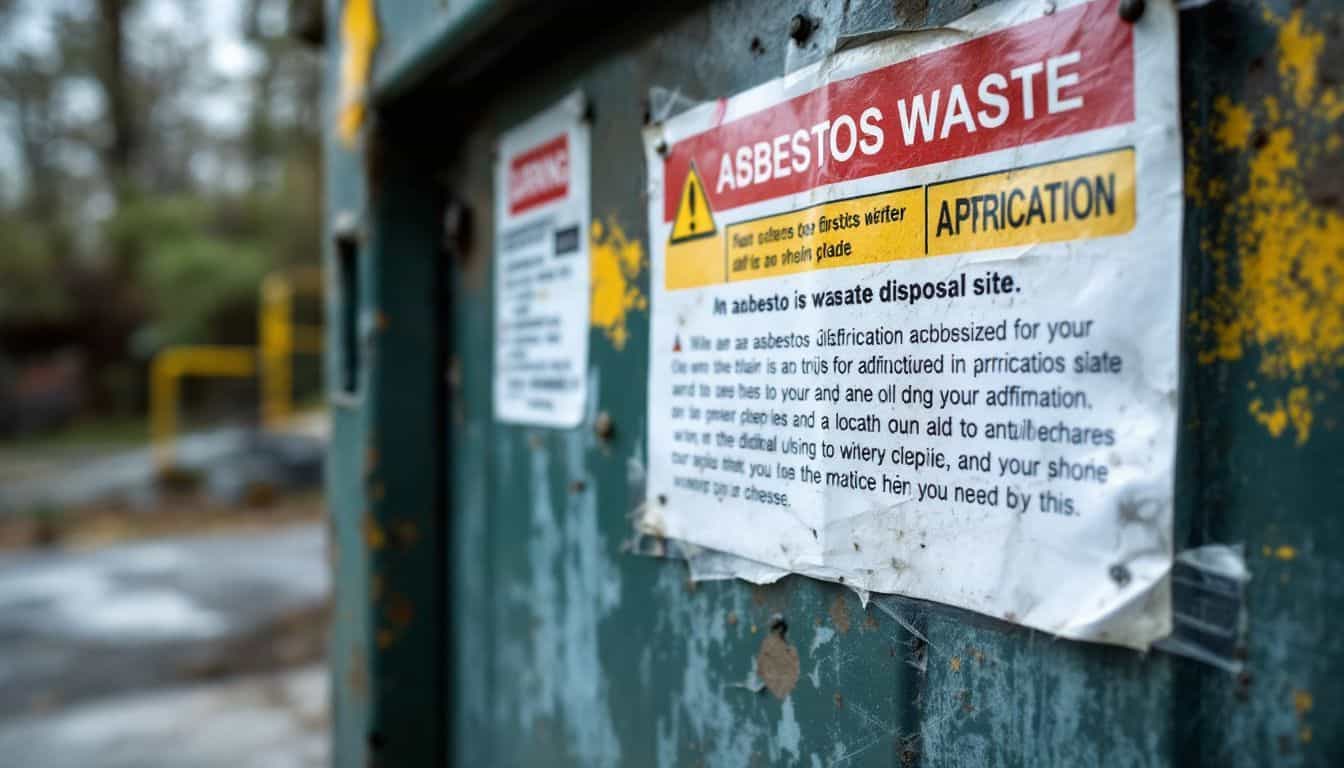
Get asbestos labels wrong and you are not just risking a fine — you are potentially endangering every person who handles that waste after it leaves your site. Whether you are a property manager overseeing a refurbishment, a contractor removing asbestos-containing materials (ACMs), or a building owner dealing with legacy materials, understanding exactly what UK law requires is non-negotiable.
Asbestos waste is classified as hazardous waste under UK law, and the labelling requirements reflect that seriousness. This is not bureaucratic box-ticking — it is the system that prevents unsuspecting workers from opening an unmarked bag and releasing carcinogenic fibres into the air.
Why Asbestos Labels Matter More Than You Might Think
Asbestos-related diseases remain one of the leading causes of occupational death in the UK. The fibres are invisible, odourless, and can remain airborne for hours after disturbance. The labelling system exists precisely because you cannot see the danger.
When waste is correctly labelled, everyone in the chain — from the removal contractor to the licensed waste site operative — knows exactly what they are dealing with and can take appropriate precautions. When labelling fails, that chain of protection breaks down entirely.
Enforcement agencies take this seriously. The Health and Safety Executive (HSE) and the Environment Agency both have powers to investigate, prosecute, and impose substantial financial penalties on those who get it wrong. Neither body treats poor labelling as a minor administrative oversight.
The Legal Framework Governing Asbestos Labels in the UK
The primary legislation is the Control of Asbestos Regulations, which sets out the duties for anyone managing, removing, or disposing of ACMs. These regulations are supported by HSE guidance document HSG264, which covers asbestos surveying and management in detail.
Asbestos waste also falls under the Hazardous Waste Regulations, enforced by the Environment Agency in England, the Scottish Environment Protection Agency (SEPA) in Scotland, and Natural Resources Wales (NRW) in Wales. Each of these bodies can take enforcement action independently of the HSE.
The key principle across all of this legislation is straightforward: hazardous waste must be identifiable at every stage of its journey from removal to final disposal. Asbestos labels are the mechanism that makes that identification possible.
Buildings Built Before 2000
If your property was constructed before 2000, there is a strong likelihood it contains asbestos somewhere. Under the Control of Asbestos Regulations, the duty holder for any non-domestic premises must manage ACMs — and that starts with knowing where they are.
Before any disposal can happen, you need a valid asbestos survey to identify what materials are present, their condition, and their location. An management survey from a UKAS-accredited surveyor will give you the documentation you need to manage and ultimately dispose of any ACMs legally.
What Asbestos Labels Must Show
The labelling requirements for asbestos waste are specific. A label that simply says “hazardous” is not sufficient. Every container, bag, or wrapped package of asbestos waste must display the following information:
- The word “ASBESTOS” prominently displayed — clearly legible and not obscured by tape, dirt, or damage
- “Asbestos-Containing Material” or the specific type — for example, chrysotile, amosite, or crocidolite where known
- The asbestos hazard warning symbol — the standard hazard diamond indicating the material is dangerous
- Safe handling instructions — brief but clear guidance on how the package should be handled
- The name and contact details of the waste carrier — the licensed contractor responsible for transport
- Date of packaging — when the waste was sealed
- A warning not to mix with other waste — asbestos waste must remain segregated throughout its journey
Labels must be durable enough to remain legible throughout transport and handling. A label that peels off or becomes unreadable in transit is as useless as no label at all — and just as likely to attract enforcement attention.
The Hazard Symbol Requirement
The specific asbestos hazard symbol — showing the stylised ‘a’ within a warning diamond — must appear on all packaging. This symbol is internationally recognised and immediately communicates the nature of the hazard to anyone handling the material, regardless of whether they have read the accompanying text.
Do not substitute generic hazard symbols. The asbestos-specific symbol is required, and using an incorrect symbol could be treated as non-compliant labelling by enforcement officers. When in doubt, use a label produced specifically for asbestos waste from a reputable supplier.
Packaging Requirements: What Goes Alongside the Label
Labels are only part of the story. The packaging itself must meet specific standards, because even the most perfectly labelled bag is useless if it tears and releases fibres during transport.
Double-Bagging Protocol
Asbestos waste must be double-wrapped. The standard approach uses two layers of heavy-duty polythene sheeting, typically 1000 gauge or above. The inner bag should be red — this colour coding is widely used across the industry to immediately identify asbestos waste — and must carry its own warning label.
The outer bag or wrapping then provides a second barrier against fibre release and must also carry the full set of required labels. Both layers need to be sealed securely, with no gaps or loose ends that could allow fibres to escape during handling or transit.
Large Sheets and Rigid ACMs
Not all asbestos waste comes in small pieces. Large asbestos cement sheets, insulating board panels, or pipe lagging sections cannot simply be dropped into a bag. These materials must be wrapped in polythene sheeting — again, double-layered — without being broken or cut, as this would release fibres into the surrounding environment.
The polythene wrapping must be sealed with heavy-duty tape and labelled on the outside so the hazard is immediately apparent. Never break large ACMs to make them easier to package — this is both dangerous and illegal.
Tools, PPE, and Contaminated Materials
The packaging and labelling requirements do not just apply to the asbestos material itself. Any items that have come into contact with ACMs during removal — disposable overalls, gloves, face masks, cleaning rags, and tools that cannot be decontaminated — must also be treated as asbestos waste.
These items go into the same double-bagged packaging system and carry the same labels. They cannot be disposed of in general waste, regardless of how small the amount of contamination appears to be. There are no exceptions to this rule.
When a Refurbishment Survey Is Required Before Disposal
If you are planning any demolition or significant refurbishment work, a management survey alone will not be sufficient. A refurbishment survey is required before any structural work begins, and it is this survey that will reveal the full extent of ACMs that need to be removed and disposed of correctly.
This type of survey is intrusive by design — it involves accessing areas that would be disturbed during the works, including behind walls, above ceilings, and beneath floors. Without it, you risk disturbing unlabelled, unidentified asbestos during the refurbishment itself, which creates a far more serious compliance and safety problem than the labelling requirements alone.
Getting the survey done before work begins means you know exactly what needs to be removed, how much waste to expect, and what labelling and disposal arrangements need to be in place before a single tool is picked up.
Transportation: Keeping the Chain of Compliance Intact
Correctly labelled asbestos waste still has to get from the removal site to a licensed disposal facility. The transportation stage has its own requirements that sit alongside the labelling rules.
Only registered waste carriers can transport asbestos waste. You can verify a carrier’s registration through the Environment Agency’s public register. Using an unregistered carrier — even if the waste itself is perfectly packaged and labelled — is a criminal offence.
The vehicle used must be appropriate for hazardous waste transport, and the driver must carry consignment notes documenting the waste throughout the journey. These consignment notes form part of the paper trail that must be maintained for a minimum of two years.
If you are managing a project in the capital, arranging an asbestos survey London before any removal work begins will ensure you have the documentation needed to support a fully compliant disposal process from start to finish.
Consignment Notes and Record Keeping
Every movement of asbestos waste must be documented using a hazardous waste consignment note. This document travels with the waste and must record the following information:
- The origin of the waste — where it was removed from
- A description of the waste — type of ACM, quantity, and packaging details
- The name and registration details of the waste carrier
- The destination — the name and permit number of the licensed disposal site
- Confirmation of receipt by the disposal facility
Copies of consignment notes must be kept by the waste producer, the carrier, and the disposal site. The minimum retention period is two years, though keeping records for longer is advisable in case of any future dispute or investigation.
Where Asbestos Waste Can Be Disposed Of
Asbestos waste cannot go to a standard landfill or household waste site. It must be taken to a facility that holds the appropriate environmental permit to accept hazardous waste — specifically asbestos. Your licensed waste carrier should be able to direct you to appropriate facilities in your area.
Local councils can sometimes provide guidance on approved sites, particularly for smaller quantities of asbestos waste from domestic properties. For commercial quantities, however, the responsibility sits firmly with the duty holder to ensure the disposal route is fully compliant.
Property owners in the North West should arrange an asbestos survey Manchester to identify and document any ACMs before planning a disposal route. In the West Midlands, an asbestos survey Birmingham provides the same essential groundwork for any compliant removal project.
The Consequences of Getting Asbestos Labels Wrong
Non-compliance with asbestos labelling requirements is treated seriously by UK enforcement bodies. The consequences can include:
- Unlimited fines — magistrates’ courts can impose significant penalties, and Crown Court prosecutions can result in fines with no upper limit
- Custodial sentences — in serious cases, individuals responsible for non-compliance can face imprisonment
- Improvement and prohibition notices — the HSE can issue notices that stop work immediately until compliance is achieved
- Civil liability — if someone is harmed as a result of improper labelling, the responsible party may face civil claims in addition to regulatory penalties
- Reputational damage — enforcement actions are publicly recorded and can seriously damage a company’s ability to win future contracts
Enforcement cases are not rare. The HSE and Environment Agency regularly prosecute both individuals and companies for asbestos-related offences, including improper labelling and disposal. The penalties handed down make clear that enforcement agencies are not treating these as minor administrative failures.
Common Asbestos Labelling Failures — and How to Avoid Them
The most frequently seen labelling failures are largely avoidable. Understanding where others go wrong is the most straightforward way to ensure your own compliance.
- Using generic hazard labels rather than asbestos-specific ones
- Failing to label the inner bag as well as the outer packaging
- Omitting contact details or waste carrier information from the label
- Using packaging that is not fit for purpose, causing labels to detach or become illegible before the waste reaches its destination
- Failing to date the packaging at the time of sealing
- Mixing asbestos waste with general site waste rather than keeping it segregated
- Assuming that small quantities of waste are exempt from labelling requirements — they are not
Working with a licensed asbestos removal contractor who understands the full requirements is the most reliable way to ensure nothing is missed. When you commission asbestos removal through a reputable, licensed contractor, correct labelling and packaging should be built into their standard working procedures — not treated as an afterthought.
Domestic Properties: Are the Rules Different?
Homeowners sometimes assume that the rules around asbestos labels are less stringent for domestic properties. They are not. Asbestos waste from a residential property is still classified as hazardous waste and must be packaged, labelled, and disposed of in exactly the same way as commercial asbestos waste.
The volume of waste may be smaller, but the legal obligations are identical. A homeowner who bags up asbestos tiles and puts them in a general skip is committing an offence — as is the skip hire company if it knowingly accepts hazardous waste.
If you are a homeowner dealing with a small quantity of asbestos waste, contact your local council’s waste team for guidance on approved disposal routes in your area. Do not attempt to dispose of it through general waste channels.
Choosing the Right Contractor for Compliant Disposal
Not every contractor who offers to remove asbestos is licensed to do so. For most asbestos removal work — particularly friable or high-risk materials — you need a contractor licensed by the HSE. Checking a contractor’s licence status takes minutes via the HSE’s online register, and it is a step that should never be skipped.
A properly licensed contractor will handle the full compliance chain: correct survey documentation, licensed removal, appropriate packaging, compliant asbestos labels, registered waste carrier transport, and disposal at a permitted facility. They will also provide you with copies of all consignment notes for your records.
If a contractor cannot demonstrate their licensing credentials or seems vague about the labelling and disposal process, that is a significant warning sign. The compliance burden ultimately rests with the duty holder — which means you, as the property owner or manager, are responsible if something goes wrong.
Frequently Asked Questions
What must an asbestos label include?
An asbestos label must include the word “ASBESTOS” prominently displayed, the type of asbestos-containing material where known, the asbestos-specific hazard warning symbol, safe handling instructions, the waste carrier’s name and contact details, the date of packaging, and a warning against mixing the waste with other materials. Generic hazard labels are not sufficient — the label must be specific to asbestos.
Do both the inner and outer bags need asbestos labels?
Yes. Both the inner and outer layers of packaging must carry the required asbestos labels. The inner bag — typically red — must be labelled, and the outer bag or polythene wrapping must also display the full set of required information. Labelling only the outer packaging is a common compliance failure.
Can I dispose of asbestos waste at a standard landfill or skip?
No. Asbestos waste is classified as hazardous waste under UK law and must be taken to a facility that holds the appropriate environmental permit to accept it. It cannot be placed in general skips, taken to household waste recycling centres that do not hold the correct permits, or disposed of through any standard waste route. Your licensed waste carrier should direct you to an approved facility.
Do I need a survey before disposing of asbestos?
Yes. Before any asbestos can be removed and disposed of, you need a valid asbestos survey to identify what materials are present, their type, condition, and location. For refurbishment or demolition work, a refurbishment survey is required rather than a standard management survey. Attempting to remove and dispose of asbestos without prior survey documentation is a serious compliance failure.
What happens if asbestos waste is not labelled correctly?
Non-compliant asbestos labelling can result in unlimited fines, prohibition notices halting all work on site, and in serious cases, custodial sentences for the individuals responsible. The HSE and Environment Agency actively prosecute labelling failures. Civil liability claims may also arise if someone is harmed as a result of unlabelled or improperly labelled asbestos waste.
Get Expert Help from Supernova Asbestos Surveys
Supernova Asbestos Surveys has completed over 50,000 surveys across the UK, working with property managers, contractors, local authorities, and building owners to ensure full compliance at every stage — from initial survey through to disposal documentation.
Whether you need a survey, removal support, or simply need to understand your obligations around asbestos labels and hazardous waste disposal, our team of UKAS-accredited surveyors is ready to help. We operate nationwide, with specialist teams covering London, Manchester, Birmingham, and every region in between.
Call us on 020 4586 0680 or visit asbestos-surveys.org.uk to arrange a survey or speak to one of our experts today.