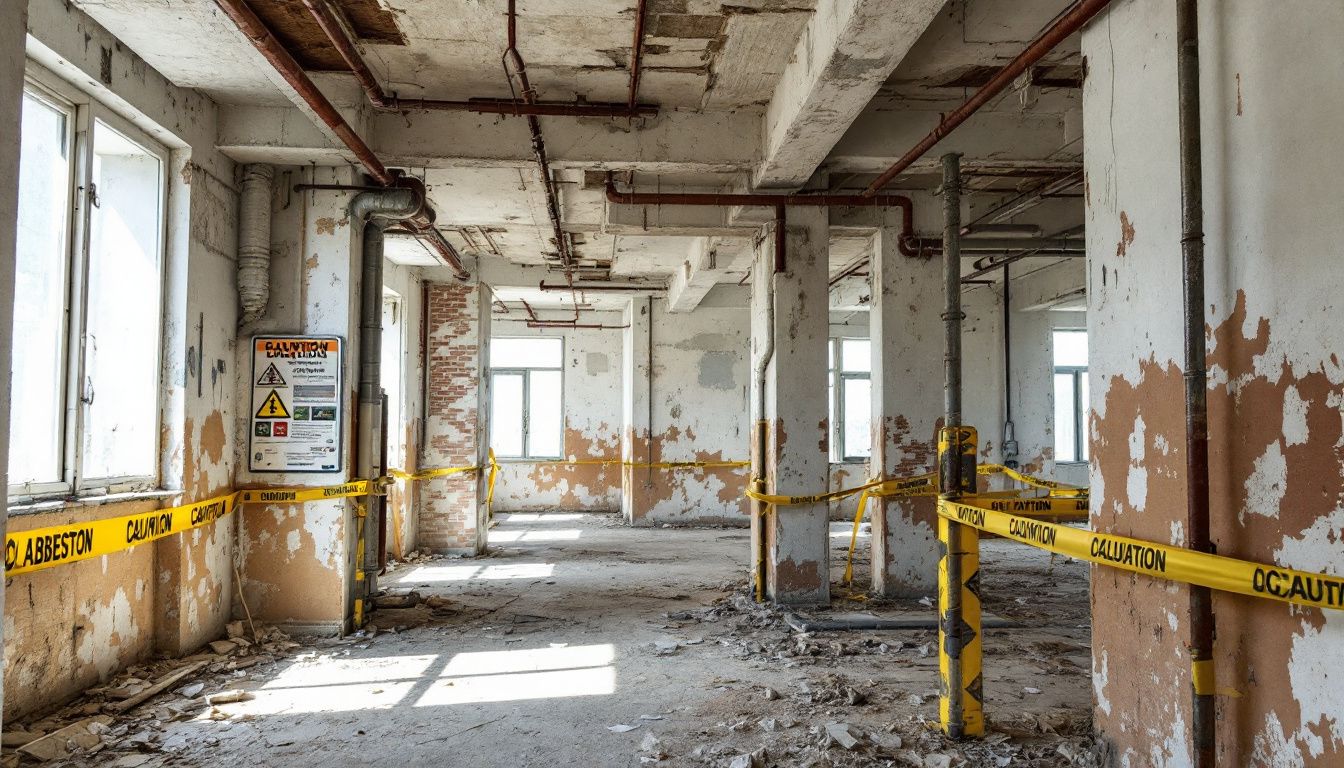
Asbestos in Planning Conditions: What Developers and Property Owners Must Know
If you’re preparing a planning application for a pre-2000 building, or you’ve just received planning permission with conditions attached, asbestos in planning conditions may already be sitting in your paperwork — whether you’ve noticed it yet or not. Local planning authorities across the UK are increasingly attaching asbestos-related requirements to permissions for demolition, refurbishment, and change-of-use projects. Ignore them, and you risk enforcement action, project delays, and serious liability.
This isn’t a niche concern. The UK’s built environment contains millions of buildings where asbestos-containing materials (ACMs) were installed before the 1999 ban. When those buildings are developed, extended, or demolished, asbestos becomes a planning issue as well as a health and safety one.
Why Asbestos Appears in Planning Conditions
Planning authorities have a responsibility to protect public health and the environment. When a development proposal involves an older building, asbestos is a foreseeable risk — and local authorities can attach pre-commencement conditions requiring developers to demonstrate how that risk will be managed.
These conditions typically sit alongside environmental and contaminated land requirements. Asbestos in soil, for example, is a well-documented issue on brownfield sites where fly-tipping or previous demolition work has left ACMs buried in the ground. Planning conditions in these cases may require a site investigation, a remediation strategy, and a verification report before construction can begin.
For building refurbishment or demolition projects, conditions more commonly require a pre-demolition or pre-refurbishment asbestos survey, sometimes called a Type 3 or demolition survey under HSG264, the HSE’s guidance document on asbestos surveying. The condition may also require the survey results to be submitted to the local authority before any works commence on site.
What Planning Conditions Typically Require
The exact wording varies between local planning authorities, but asbestos-related planning conditions generally fall into one of three categories:
Pre-Commencement Survey Requirements
The most common condition requires a refurbishment and demolition (R&D) asbestos survey to be carried out and submitted before any groundworks or demolition begins. This survey must be intrusive — surveyors need access to areas that will be disturbed by the works, including voids, ceiling spaces, and structural elements that a standard management survey would not access.
The condition will often specify that the survey must be carried out by a UKAS-accredited laboratory and that sampling must follow the methodology set out in HSG264. Some conditions also require the surveyor to hold BOHS P402 qualification.
Remediation Strategy Conditions
Where asbestos is found — either in the building fabric or in ground contamination — a remediation strategy condition requires the developer to submit a written plan for how the ACMs will be managed, removed, and disposed of. This plan must be approved by the local authority before works proceed.
The remediation strategy will typically reference the Control of Asbestos Regulations, which set out the legal framework for asbestos work in Great Britain, including licensing requirements, notification obligations, and waste disposal procedures.
Verification and Completion Conditions
Some planning conditions require a verification report to be submitted once remediation is complete. This confirms that all identified ACMs have been removed or treated in accordance with the approved strategy, and that the site is safe to proceed with construction. Air monitoring results and waste transfer documentation are typically included.
The Legal Framework Behind the Conditions
Planning conditions relating to asbestos don’t exist in isolation — they sit within a broader legal framework that developers must understand.
The Control of Asbestos Regulations are the primary piece of legislation governing work with asbestos in Great Britain. They impose a duty to manage asbestos on those responsible for non-domestic premises, and they set out the requirements for licensed and non-licensed asbestos work, including notification to the relevant enforcing authority.
The HSE’s HSG264 guidance provides the technical framework for asbestos surveys, defining the different survey types and setting out the competency requirements for surveyors. Planning authorities frequently reference HSG264 in their conditions, which means your surveyor must be working to this standard.
Where asbestos is present in soil or made ground, the Environment Agency’s guidance on the assessment and management of risks from land contamination is also relevant. Asbestos in soil is classified as a contaminant, and its presence can trigger requirements under both planning law and environmental legislation.
Developers working in London, Manchester, Birmingham, and other major cities should also be aware that local planning authorities in those areas have developed their own supplementary planning documents on contaminated land, which may set out more specific requirements than national guidance.
Common Mistakes That Cause Project Delays
Asbestos-related planning conditions are a frequent cause of project delays — usually because they haven’t been properly read, or because the wrong type of survey has been commissioned.
Commissioning the Wrong Survey Type
A management survey is not sufficient to discharge a pre-demolition planning condition. Management surveys are designed to locate and assess ACMs that could be disturbed during normal occupation and routine maintenance — they are not intrusive enough to identify all materials that will be encountered during demolition or major refurbishment. If your planning condition specifies an R&D survey, that is what you must provide.
Submitting Incomplete Documentation
Planning conditions often require specific documentation to be submitted alongside the survey report — including the surveyor’s qualifications, the laboratory’s UKAS accreditation certificate, and a schedule of all identified ACMs. Missing any of these elements can result in the condition being rejected, adding weeks to your programme.
Starting Works Before Discharge
Pre-commencement conditions must be discharged before any works begin — including enabling works, demolition, and groundworks. Starting on site before the condition is formally discharged by the local authority puts the developer in breach of planning permission, which can have serious consequences including enforcement notices and stop notices.
Using an Unaccredited Surveyor
Some planning conditions specifically require surveys to be carried out by UKAS-accredited bodies or by surveyors holding recognised qualifications. Using an unaccredited surveyor — however experienced they may be — can result in the survey being rejected by the local authority entirely.
Asbestos in Ground Contamination: A Specific Challenge
Brownfield development sites present particular challenges when it comes to asbestos in planning conditions. Asbestos-containing materials can be present in made ground as a result of previous demolition, fly-tipping, or historic industrial processes. Chrysotile (white asbestos), amosite (brown asbestos), and crocidolite (blue asbestos) have all been found in soil on UK development sites.
The assessment of asbestos in soil requires specialist sampling and analysis, and the risk assessment methodology differs from that used for asbestos in buildings. Planning conditions on brownfield sites will often require a phased approach: a preliminary risk assessment (Phase 1), followed by an intrusive site investigation (Phase 2), and then a remediation strategy if ACMs are found.
Developers should be aware that the threshold for asbestos in soil that triggers remediation is not a simple numerical limit — it depends on the proposed end use of the site, the nature and condition of the asbestos found, and the exposure pathways that exist. A residential development will require a more stringent risk assessment than a commercial or industrial use.
Working With Your Planning Consultant and Asbestos Surveyor
The best outcomes come from early collaboration between your planning consultant, your asbestos surveyor, and your demolition or construction contractor. Asbestos surveys take time — particularly R&D surveys on large or complex buildings — and laboratory analysis adds further programme time. Building these requirements into your pre-application programme, rather than treating them as an afterthought, will save significant time and cost.
If you’re applying for planning permission on a pre-2000 building, it’s worth raising the likelihood of asbestos conditions with your planning consultant at the pre-application stage. Some local authorities will accept a preliminary asbestos management survey at application stage, with the full R&D survey required as a pre-commencement condition. This approach can help demonstrate to the planning authority that asbestos has been considered, which may smooth the application process.
For demolition projects in particular, your asbestos surveyor and your demolition contractor need to work closely together. The R&D survey informs the demolition method statement, and the asbestos removal programme needs to be sequenced correctly within the overall demolition programme. Trying to manage this coordination retrospectively — after planning permission has been granted and a start date has been fixed — is a recipe for delays and cost overruns.
Asbestos Removal as Part of the Planning Process
Once your planning condition has been discharged and your remediation strategy approved, the physical work of asbestos removal can begin. This work must be carried out by licensed contractors for high-risk materials — including asbestos insulating board, sprayed coatings, and pipe lagging — and must comply with the notification requirements set out in the Control of Asbestos Regulations.
All asbestos waste must be double-bagged, clearly labelled, transported by a registered waste carrier, and disposed of at a licensed landfill site. A consignment note must be completed for each load, and copies must be retained. These records will be required when you submit your verification report to the local authority.
Air monitoring must be carried out during and after removal work to confirm that fibre levels in the working area are within acceptable limits. Clearance air testing — carried out by an independent analyst — is required before the enclosure is dismantled and the area returned to use.
Regional Considerations for Major Cities
Asbestos in planning conditions is a national issue, but the way it’s handled varies between local planning authorities. If you’re developing in the capital, our team regularly supports clients navigating the specific requirements of London boroughs — you can find out more about our asbestos survey London services. For projects in the North West, our asbestos survey Manchester team has extensive experience working with Greater Manchester local authorities. And for developments in the West Midlands, our asbestos survey Birmingham team can guide you through local planning requirements and deliver the surveys you need to discharge your conditions on time.
Frequently Asked Questions
What is an asbestos planning condition?
An asbestos planning condition is a requirement attached to a planning permission that obliges the developer to carry out specific asbestos-related actions — such as commissioning a survey, submitting a remediation strategy, or providing a verification report — before or during the development works. These conditions are most commonly attached to permissions for demolition, refurbishment, and brownfield development involving pre-2000 buildings.
Do I need a specialist asbestos survey to discharge a planning condition?
In most cases, yes. Planning conditions relating to demolition or major refurbishment typically require a refurbishment and demolition (R&D) asbestos survey, which is more intrusive than a standard management survey. The condition may also specify that the survey must be carried out by a UKAS-accredited body and that the surveyor must hold BOHS P402 qualification. Always read the exact wording of your condition carefully before commissioning any work.
Can I start demolition before my asbestos planning condition is discharged?
No. Pre-commencement planning conditions must be formally discharged by the local planning authority before any works begin. Starting on site before discharge puts you in breach of your planning permission, which can lead to enforcement action. Allow adequate time in your programme for the survey, laboratory analysis, report preparation, and the local authority’s decision-making period.
What happens if asbestos is found in the ground on a brownfield site?
If asbestos is found in soil during a site investigation, you will typically be required to submit a remediation strategy to the local planning authority for approval. The strategy must set out how the asbestos will be removed, treated, or managed, and a verification report will usually be required once remediation is complete. The approach will depend on the nature and condition of the asbestos found and the proposed end use of the site.
Who is responsible for managing asbestos conditions on a development project?
Responsibility sits with the developer as the holder of the planning permission, but in practice it involves the planning consultant, the principal designer (under CDM regulations), the asbestos surveyor, and the licensed asbestos removal contractor. Early coordination between all parties is essential to avoid programme delays. The developer remains legally responsible for ensuring that all conditions are discharged correctly and that all asbestos work complies with the Control of Asbestos Regulations.
Get Expert Support From Supernova Asbestos Surveys
Supernova Asbestos Surveys has completed over 50,000 surveys across the UK, working with developers, planning consultants, and principal contractors to deliver the surveys and reports needed to discharge asbestos planning conditions on time. Our BOHS P402-qualified surveyors work to HSG264 standards, and our samples are analysed by a UKAS-accredited laboratory.
Whether you need a refurbishment and demolition survey, a remediation strategy, or a verification report, we can help you meet your planning obligations without disrupting your programme. Call us on 020 4586 0680 or visit asbestos-surveys.org.uk to discuss your project and get a quote.