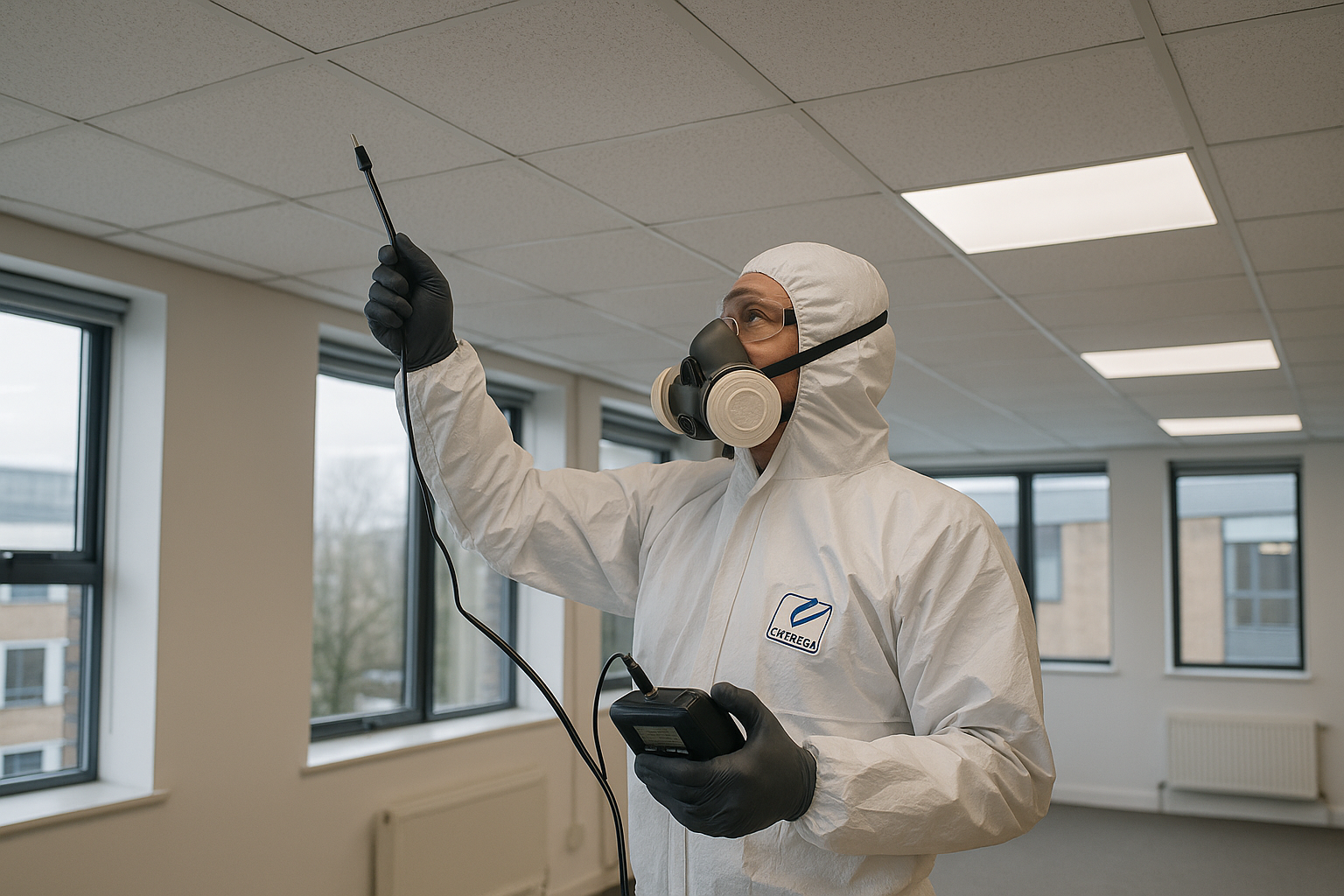
Hospital Asbestos Surveys: What Every Healthcare Estates Team Needs to Know
One damaged ceiling tile above a ward corridor. One unplanned drill hole into a service riser. Either can turn a manageable situation into a major incident — and in a live healthcare environment, the consequences are far more serious than in an empty office block.
Hospital asbestos surveys are what prevent that from happening. They give estates teams, facilities managers and compliance leads the information they need before maintenance, refurbishment or emergency repairs put patients and staff at risk.
Healthcare buildings are rarely straightforward. Hospitals, clinics, GP surgeries, dental practices and specialist treatment centres typically combine ageing fabric, continuous occupation and critical services that cannot simply be switched off for the day. Asbestos management in these settings has to be practical, current and closely tied to how each building actually operates.
If you are responsible for a healthcare estate, the duty is clear even when the building is not. You need to know where asbestos is located, assess its condition, control the risk of disturbance and make sure anyone working on the premises has the right information before they start. Handled properly, hospital asbestos surveys support legal compliance under the Control of Asbestos Regulations, align with HSG264 and help you apply HSE guidance in a way that works on live, occupied sites.
Why Healthcare Buildings Present Unique Asbestos Challenges
Many NHS and private healthcare premises were constructed or significantly altered during the decades when asbestos-containing materials were in widespread use. Even where those materials remain in good condition, they still need to be identified, recorded and regularly reviewed.
The challenge with hospital asbestos surveys is not simply finding asbestos. It is finding it in buildings that are busy, sensitive and often operating around the clock. A hospital estate may include operating theatres, imaging suites, plant rooms, wards, laboratories, outpatient areas and back-of-house service routes — all with different access rules, infection control requirements and security arrangements.
Each of these areas demands a tailored approach that a standard commercial survey simply cannot deliver. Surveyors who lack experience of live clinical environments will miss things — not through incompetence, but because they do not understand how the building is actually used and maintained.
Common Asbestos-Containing Materials in Healthcare Settings
Asbestos was used extensively in construction and building services. In healthcare premises, surveyors commonly encounter:
- Pipe lagging and thermal insulation on heating and hot water systems
- Asbestos insulating board in partitions, risers and ceiling voids
- Floor tiles and bitumen adhesives beneath them
- Textured coatings on walls and ceilings
- Ceiling tiles and suspended ceiling panels
- Fire doors and fire protection products
- Roof sheets, soffits and external cladding panels
- Gaskets, rope seals and plant room components
The risk is not the presence of these materials in itself. The risk is disturbance. That can happen during routine maintenance, reactive repairs, IT installations, medical equipment upgrades, fire stopping works or capital projects — often without anyone realising asbestos is involved until it is too late.
Emergency Works Are a Particular Weak Point
A burst pipe, failed fan unit or electrical fault creates pressure to act quickly. But urgency does not remove the duty to check asbestos records before intrusive work begins.
A straightforward estates rule makes a significant difference: no intrusive work starts until the asbestos register has been checked. If records are unclear or incomplete, the correct response is to pause and seek competent advice — not to proceed on the assumption that the area is probably safe. That assumption is where avoidable exposures occur.
Choosing the Right Type of Hospital Asbestos Survey
Hospital asbestos surveys are not all the same, and selecting the wrong type can leave serious gaps in your knowledge of the estate. The correct survey depends on what you are trying to achieve, how the building is currently used and what works are planned.
Before instructing a surveyor, it is worth asking a few practical questions:
- Is the building in normal use and does it need an asbestos register for ongoing management?
- Are you planning intrusive works such as rewiring, plant replacement or ward refurbishment?
- Is part of the estate being demolished or stripped back completely?
- Are there access restrictions due to infection control, patient privacy or clinical schedules?
- Who needs the findings and how will they use them day to day?
Those answers determine which survey type is appropriate for the situation.
Management Surveys
A management survey is the standard starting point for occupied healthcare premises. It identifies the location and condition of asbestos-containing materials that could be disturbed during normal occupation and routine maintenance.
It supports the asbestos register and forms the foundation of your management plan across wards, offices, circulation routes and plant spaces that remain in active use. For most live healthcare sites, this is where the process begins.
Refurbishment Surveys
A refurbishment survey is intrusive and is required before any planned works that will disturb the building fabric. If you are upgrading theatres, replacing air handling plant, rewiring a department or altering washrooms, this is the correct route.
A management survey does not cover intrusive refurbishment — using one in place of the other leaves significant risk unaddressed. This is one of the most common and costly errors on live healthcare projects.
Demolition Surveys
A demolition survey is the most intrusive option and is required before any structure is demolished. On healthcare estates, this may apply to old boiler houses, vacant outbuildings, redundant clinical blocks or garages.
It must be completed before demolition contracts are awarded or work begins. This is not optional — it is a legal requirement under the Control of Asbestos Regulations.
Planning Hospital Asbestos Surveys Around Clinical Operations
Survey planning in healthcare settings requires more coordination than in most other property types. Out-of-hours access, permits, clinical escorts, infection prevention controls and engineering constraints all need to be agreed in advance.
Failing to do this properly leads to incomplete inspections, repeat visits and gaps in the asbestos register. A practical approach to hospital asbestos surveys typically involves the following steps:
- Define the scope clearly. Identify the exact areas, their current use and the purpose of the survey.
- Confirm the correct survey type. Match the inspection to management, refurbishment or demolition needs.
- Coordinate access in advance. Agree times, escorts, permits and infection control arrangements with clinical and estates teams.
- Inspect and sample where required. Surveyors assess accessible materials and take representative samples in line with HSG264 guidance.
- Report in plain, usable language. Findings should be straightforward for estates teams and contractors to interpret and act on.
- Update the asbestos register. Survey results must feed directly into the live management system, not sit in a separate folder.
- Brief anyone likely to disturb asbestos. Information must reach maintenance teams, project managers and contractors before any work begins.
This final step is where many healthcare organisations fall short. The survey itself may be technically sound, but the findings do not make it into permits, contractor briefings or work authorisation procedures. At that point, risk remains even though a report exists.
Phased Projects Need Careful Scope Management
Phased refurbishment projects create particular problems if the survey scope is too narrow. A ward may be included in the survey, but linked risers, ceiling voids or service cupboards may not be. Contractors then move outside the surveyed area and the control system breaks down.
Make sure survey scopes reflect how contractors will actually access the work area — not just the rooms shown on a floor plan. Ceiling voids, risers, plant enclosures and back-of-house routes are often where asbestos risks catch people out.
What a Compliant Asbestos Register Should Include
Under the Control of Asbestos Regulations, dutyholders must take reasonable steps to find asbestos, assess its condition, presume materials contain asbestos unless there is clear evidence otherwise, and provide information to anyone liable to disturb it.
Compliance is not just about having paperwork — it is about having paperwork that is current, accurate and actively used. A compliant asbestos register for a healthcare premises should record:
- Location of all known or presumed asbestos-containing materials
- Product type and asbestos type where identified through sampling
- Extent or quantity of the material
- Condition assessment and surface treatment
- Accessibility and likelihood of disturbance
- Risk information and recommended management actions
- Inspection and reinspection dates
- Details of any remedial works completed
An asbestos management plan should sit alongside the register, explaining who is responsible for each element, how work is authorised, when the register is checked, what training is required and what happens if accidental disturbance occurs. That is the difference between a survey report and a working control system.
Common Mistakes to Avoid on Healthcare Estates
Across healthcare estates, the same avoidable problems appear repeatedly. Spotting them early can prevent an otherwise well-managed asbestos programme from breaking down at the point where it matters most.
Using an Old Survey to Cover New Works
A historic management survey does not automatically cover planned refurbishment. If works involve opening up the building fabric — even in a small area — the correct intrusive survey is needed for that specific location.
Always verify what the existing survey actually covers before authorising any intrusive work. The age of the report matters, but so does the scope. An older survey that covered the relevant area in detail may still be valid; a recent survey that excluded a specific zone is not.
Maintaining the Register but Not Using It
An asbestos register only helps if contractors and in-house teams actually check it before starting work. If the information is difficult to access, poorly formatted or hard to interpret in the field, people will work around it.
Accessibility and clarity are not optional extras — they are part of what makes a management system effective. Consider how the register is presented and whether it can be accessed quickly by those who need it most.
Overlooking Hidden Service Areas
Ceiling voids, service risers, plant enclosures and back-of-house routes are frequently where asbestos risks are missed. Survey scopes must reflect where contractors will actually be working, not just the visible surfaces in occupied rooms.
A surveyor who does not understand how the building is maintained will miss areas that matter. Always appoint surveyors with demonstrable experience of live healthcare environments.
Assuming Emergency Work Is Exempt
Urgency does not remove the legal duty to manage asbestos. If records are missing, incomplete or unclear, the safest and legally correct response is to pause and verify before disturbing the building fabric.
A short delay to check is far preferable to an uncontrolled asbestos release in a clinical environment. Estates teams should have a clear protocol for emergency works that includes an asbestos check as a mandatory first step.
Failing to Keep the Register Current
The asbestos register is a live document, not a one-off exercise. Every time works are completed, materials are removed or new areas are accessed, the register should be updated.
An outdated register gives contractors false confidence and undermines the entire management system. Assign clear responsibility for register maintenance and build updates into project close-out procedures.
Hospital Asbestos Surveys Across the UK
Healthcare estates are spread across the country, and the regulatory obligations are the same whether your premises are in the capital or a regional town. What varies is local surveying capacity and the ability to respond quickly when reactive inspections are needed.
For healthcare estates teams in the capital, asbestos survey London services need to be able to work around the particular complexity of large urban hospital sites, including restricted access, busy clinical schedules and multi-building campuses.
In the North West, asbestos survey Manchester provision covers a significant concentration of NHS and private healthcare premises, many of which include buildings from the mid-twentieth century where asbestos use was most prevalent.
Across the Midlands, asbestos survey Birmingham teams regularly work on healthcare estates ranging from large acute hospitals to smaller community health centres and GP-led facilities.
Wherever your premises are located, the key is instructing surveyors who understand healthcare environments specifically — not just surveyors who can turn up and tick boxes.
What to Look for When Instructing a Healthcare Asbestos Surveyor
Not every asbestos surveying company has the experience or protocols needed for live clinical environments. When evaluating potential surveyors, consider the following:
- UKAS-accredited laboratory analysis. Samples should be analysed by a laboratory accredited under UKAS for asbestos identification.
- P402-qualified surveyors. The British Occupational Hygiene Society P402 qualification is the recognised standard for asbestos surveying in the UK.
- Demonstrable healthcare experience. Ask specifically about previous work in NHS or private healthcare settings, including the types of sites and survey types completed.
- Understanding of infection control requirements. Surveyors must be able to work within clinical environments without compromising infection prevention protocols.
- Clear, actionable reporting. Reports should be formatted for use by estates teams and contractors, not written purely to satisfy a checklist.
- Ability to phase and schedule around clinical activity. Flexibility to work out of hours, in sections and around clinical priorities is essential on live healthcare sites.
A surveyor who ticks all of these boxes will produce a report that is genuinely useful — one that supports your management plan, satisfies your legal obligations and gives your estates team confidence when authorising work.
Keeping Your Healthcare Estate Compliant Over Time
Asbestos compliance on a healthcare estate is not a project with a defined end date. It is an ongoing responsibility that requires regular review, consistent processes and clear lines of accountability.
Condition reinspections should be scheduled at intervals appropriate to the risk level of each material. Materials in good condition in low-disturbance areas may require less frequent review; damaged or deteriorating materials in active work zones need more regular attention.
When capital projects are planned, the asbestos management process should be built into the project timeline from the outset — not added as an afterthought once contractors are mobilised. Leaving the survey to the last minute creates programme delays, cost pressure and the temptation to cut corners.
Staff and contractor training is also part of the picture. Anyone who could disturb asbestos-containing materials in the course of their work should understand the basics: what asbestos looks like, how to check the register, when to stop and who to call. This does not require lengthy formal training for every individual, but it does require a structured approach to awareness across the estate.
The estates teams that manage asbestos well in healthcare settings are those that treat it as a core part of how the building is operated — not a compliance exercise that happens once every few years and then gets filed away.
Frequently Asked Questions
Are hospital asbestos surveys a legal requirement?
Yes. Under the Control of Asbestos Regulations, dutyholders — including those responsible for healthcare premises — must take reasonable steps to identify asbestos-containing materials, assess their condition and manage the risk. This applies to all non-domestic premises, including NHS and private healthcare buildings. Failing to comply can result in enforcement action, prohibition notices and prosecution by the HSE.
How often should a healthcare premises be resurveyed for asbestos?
There is no fixed legal interval for resurveying, but the asbestos register must be kept current. Condition reinspections are typically carried out annually for higher-risk materials, though the frequency should reflect the specific risk profile of each material and area. A new survey is required before any refurbishment or demolition works, regardless of when the last survey was completed.
Can a management survey be used before refurbishment works on a ward?
No. A management survey is designed for occupied premises under normal use and is not intrusive enough to identify all asbestos-containing materials that may be disturbed during refurbishment. Before any works that will open up the building fabric — including rewiring, partition removal, ceiling alterations or plant replacement — a refurbishment survey is required for the specific area involved.
What happens if asbestos is disturbed accidentally during maintenance work?
Work should stop immediately and the area should be vacated. The incident must be reported to the responsible person for asbestos management on the estate, and competent advice should be sought before the area is re-entered. Depending on the nature and extent of the disturbance, air monitoring, decontamination and licensed remediation may be required. The HSE may also need to be notified depending on the circumstances.
Do GP surgeries and dental practices need asbestos surveys?
Yes. The duty to manage asbestos applies to all non-domestic premises, including GP surgeries, dental practices, community health centres and any other healthcare facility where patients or staff are present. The survey type and scope will depend on the age of the building, its construction and what works are planned, but the legal obligation to identify and manage asbestos applies equally to smaller premises as it does to large acute hospitals.
Speak to Supernova Asbestos Surveys
Supernova Asbestos Surveys has completed over 50,000 surveys across the UK, including healthcare premises ranging from large NHS hospital sites to smaller community health facilities. Our surveyors understand the specific demands of live clinical environments and can plan and deliver hospital asbestos surveys that work around your operational constraints.
Whether you need a management survey to underpin your asbestos register, a refurbishment survey ahead of a capital project, or a demolition survey before a structure comes down, we can help you get it right.
Call us on 020 4586 0680 or visit asbestos-surveys.org.uk to discuss your requirements with a member of our team.