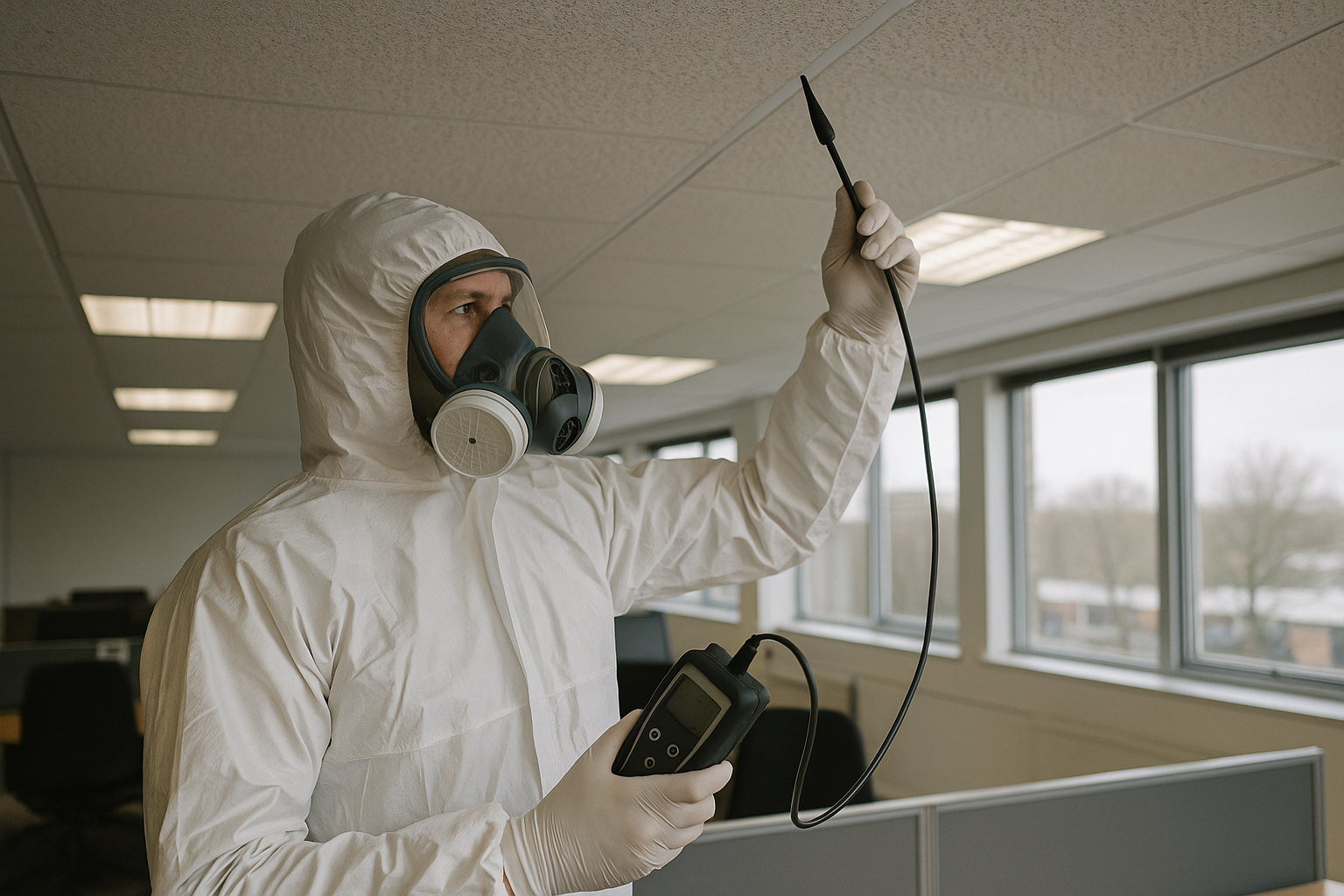
That textured ceiling in the hallway might look dated rather than dangerous, but artex changes category the moment somebody drills, scrapes or sands it. Across the UK, artex is still found in homes, offices, schools and managed blocks, and the key question is always the same: is it an older textured coating that may contain asbestos, or a modern decorative product that does not?
For property managers, landlords, contractors and homeowners, guesswork is where problems start. Older artex can contain chrysotile asbestos, and while textured coatings are generally lower risk than more friable asbestos materials, they can still release fibres when disturbed. The safest approach is practical and straightforward: identify it properly, assess the condition, and plan any work before tools go anywhere near the surface.
There is also a lot of confusion around the word artex itself. It began as a brand name, but over time it became a catch-all description for textured decorative coatings on ceilings and walls. That matters because modern Artex-branded products sold through merchants, decorating suppliers and business catalogues are not the same thing as older artex already installed in a pre-2000 property.
If you are responsible for a building, the sensible rule is simple. Treat suspect artex as potentially asbestos-containing until survey information or laboratory analysis says otherwise.
What artex actually is
Artex is a textured finish applied to ceilings and sometimes walls to create decorative patterns and hide uneven plaster. It became popular because it was quick to apply, helped cover imperfections and gave a room a distinctive look without the cost of a perfect skim finish.
Common patterns include swirl, stipple, fan, medusa, broken leather and basket effects. You will still see artex in domestic properties, communal areas, offices, schools, shops and public buildings throughout the UK.
Description of artex coatings
From an asbestos perspective, the description matters. Artex and similar textured coatings are not the same as asbestos insulation board, pipe lagging or sprayed coatings. Where asbestos is present, the fibres are usually bound into the decorative coating, which often makes the material lower risk when it is intact and left alone.
Lower risk does not mean no risk. Once artex is drilled, cut, scraped, sanded or stripped, fibres can be released. That is why appearance alone is never enough to make a safe decision.
Where artex is commonly found
- Ceilings in houses and flats
- Walls in hallways, bedrooms and living rooms
- Communal areas in residential blocks
- Office ceilings and partitions
- Schools, surgeries and public buildings
- Patch repairs where textured finishes were used to blend surfaces
Painted-over artex can be harder to recognise, especially where repeated redecoration has softened the pattern. If the property is older and records are missing, do not rely on a quick visual judgement.
Why older artex can contain asbestos
The concern with older artex is historical use, not current retail stock. Some textured coatings were manufactured with asbestos because it improved strength, durability and workability, and helped the finish keep its pattern.
Modern products sold under the Artex brand do not contain asbestos. That is why online product pages, decorating categories and merchant listings can be misleading if you are trying to assess an existing ceiling. A current product range tells you nothing about the artex already fixed to a ceiling in an older property.
In practice, suspect artex is most likely to need checking where:
- The building was constructed or refurbished before 2000
- There are textured ceilings or walls with no asbestos records
- Maintenance or refurbishment is planned
- Contractors need to drill, fit lights, overboard or remove finishes
- The premises are rented, managed or non-domestic
For non-domestic premises, the Control of Asbestos Regulations place duties on those responsible for managing the building. Survey work should follow HSG264 Asbestos: The Survey Guide, and decisions should align with current HSE guidance.
Artex health risks: when a decorative finish becomes a hazard
Undamaged artex in good condition is often considered lower risk because the fibres are bound into the coating. The health risk changes when the material is disturbed and asbestos fibres become airborne.

These fibres cannot be seen or smelt. Once inhaled, they can lodge in the lungs, and asbestos-related disease may develop many years after exposure.
Health risks linked to asbestos exposure
- Mesothelioma
- Asbestos-related lung cancer
- Asbestosis
- Pleural thickening and pleural plaques
The practical point is this: the danger from artex usually comes from work on the surface, not from simply being in the room beneath it. That is why maintenance planning matters so much.
Who is most at risk from disturbed artex
People most at risk are usually those carrying out the work. Typical examples include electricians fitting lights, plumbers opening access points, decorators preparing surfaces, builders altering ceilings, joiners fixing battens and DIY renovators trying to remove old finishes.
If there is any possibility that artex will be disturbed, stop and test first. That one decision prevents a large share of avoidable exposure incidents.
How to identify artex properly
You cannot confirm asbestos in artex by looking at it. Pattern, colour, thickness, age and finish can make a coating suspicious, but none of those features proves whether asbestos is present.
The only reliable way to identify asbestos in artex is sampling and laboratory analysis. For occupied buildings, that may sit within a wider survey strategy. For a single room or one suspect ceiling, it may simply mean targeted testing before any work starts.
Signs that testing is sensible
- The property dates from a period when asbestos may have been used
- Textured coatings are present on ceilings or walls
- There is no current asbestos information
- Refurbishment, repairs or installations are planned
- The surface is cracked, flaking or previously damaged
- Tenants, staff or contractors need access to the area
For day-to-day occupation and routine maintenance in non-domestic premises, a professional management survey helps identify accessible asbestos-containing materials and supports compliance. Where intrusive work is planned, a refurbishment survey is the correct step before the work begins.
Applied filters that actually matter
Competitor pages often organise products with categories and applied filters. For artex risk, the useful filters are different. Surveyors assess practical questions such as:
- Age: was the artex applied during a period when asbestos may have been used?
- Condition: is the surface intact, sealed and stable, or cracked and damaged?
- Work type: will anyone drill, sand, scrape, remove or overboard it?
- Occupancy: is the area domestic, tenanted, commercial or public-facing?
- Access: is the artex in a bedroom, corridor, office, stairwell or service area?
Those are the filters that shape the right response. They determine whether artex should be monitored, encapsulated, sampled or removed.
Testing artex: practical options for clear answers
If you need certainty, laboratory testing is what matters. A sample of the artex is analysed by a UKAS-accredited laboratory to confirm whether asbestos is present.
Where sampling needs to be carried out safely as part of a wider inspection, professional asbestos testing is often the best route. If you already have a sample taken safely and only need laboratory confirmation, sample analysis can be a practical option.
For smaller domestic decisions, an asbestos testing kit can provide a straightforward way to submit suspect artex for analysis. Some clients simply want a packaged testing kit they can order quickly before a decorator or electrician starts work.
Where broader project support is needed, Supernova also provides local and regional asbestos testing as part of compliance planning and pre-works assessments.
When artex testing is urgent
- A contractor is booked to start shortly
- A ceiling has already been drilled or scraped
- Damage has exposed the coating underneath paint
- A tenant has reported crumbling material
- Refurbishment dates are already fixed
Do not leave testing until the day work starts. If suspect artex may be disturbed, get the answer first and plan the job properly.
Categories of artex situations property managers face
Not every artex issue leads straight to removal. Most real-world cases fall into a few clear categories, and once you know which category applies, the next step becomes much easier.
1. Artex in good condition with no planned work
If the artex is sound, painted and unlikely to be disturbed, leaving it in place is often the safest and most proportionate option. Record the location, note the condition and make sure anyone carrying out future work is informed.
2. Artex with minor damage
Small cracks, dents or local surface damage need assessment. In some cases, sealing or encapsulation may be suitable if the artex can be stabilised and there is no need to disturb it again.
3. Artex in refurbishment areas
This is one of the most common scenarios. If ceilings or walls are due to be altered, opened up, skimmed, stripped or demolished, identify asbestos before work starts. Refurbishment planning should never assume old artex is harmless.
4. Artex already disturbed
If someone has already drilled, sanded or scraped the artex, stop work immediately. Restrict access, avoid further disturbance and seek professional advice on testing, cleaning and remedial action.
5. Artex across a wider property portfolio
For landlords, managing agents, schools and office operators, artex may appear in multiple units. A planned survey and sampling programme is usually faster, cheaper and safer than reacting to each ceiling separately.
Business, products and why retail listings can confuse artex decisions
Search online for artex and you will quickly land on business supply pages, decorating merchants and product catalogues. You will see categories for plastering supplies, repair products, interior fillers, services, partner sites and account support. All useful if you are buying materials. None of it confirms whether old artex already on your ceiling contains asbestos.
This is where many people go wrong. They see modern Artex-branded products being sold openly and assume the existing textured coating in an older property must be asbestos-free too. It does not work like that.
Modern products are modern products. Existing artex in an older building is an on-site material that needs its own assessment.
Business use of the Artex name
Artex is still a recognised business brand in decorating and surface preparation. That brand association means the word appears in trade accounts, merchant categories and product descriptions far beyond the original textured ceiling finish.
For asbestos decisions, the distinction is simple:
- New stock from a supplier: current product, no asbestos issue in manufacture
- Old textured coating in a property: site material that may contain asbestos and must be assessed on its own merits
That distinction should be passed on to maintenance teams and contractors. It prevents assumptions based on online shopping results rather than building evidence.
Categories, contents and special finishes linked to artex
Competitor content often groups artex into broad categories. For a property manager, those categories are useful only if they help with identification and risk control.
Common categories related to artex
- Textured decorative coatings
- Ceiling finishes
- Wall finishes
- Repair and patch products
- Interior fillers
- Special finishes
Where asbestos risk is concerned, the category that matters most is textured coating already applied to the building fabric. Interior fillers and special finishes sold today are separate products and should not be confused with old artex in place.
Contents of older artex
When people ask about the contents of artex, they usually mean one thing: does it contain asbestos? In some older textured coatings, chrysotile asbestos was added in small amounts. That is why the coating must be treated cautiously until testing confirms otherwise.
The contents of an individual artex ceiling cannot be verified from memory, photographs or pattern style alone. Even where one room tests negative, another area patched or decorated at a different time may not be identical.
Special finishes and decorative variants
Special finishes are part of why artex became so popular. Decorative patterns could be created quickly, often disguising poor plaster beneath. Swirl, stipple, fan, basket and broken leather effects all fall into the broad world of textured coatings people often call artex.
From an asbestos standpoint, the exact decorative style matters far less than the age, condition and planned disturbance. A dramatic pattern is not automatically more dangerous than a subtle one. The issue is whether asbestos is present and whether the coating will be disturbed.
Interior fillers, repairs and what to do after artex is assessed
Once artex has been tested and the risk is understood, repair products may become relevant. This is where interior fillers, skim products and finishing materials come back into the picture.
If the artex is confirmed not to contain asbestos, standard repair or replacement options can usually be considered in the normal way. If the artex does contain asbestos, the right approach depends on condition and future plans.
Practical options after artex assessment
- Leave in place and manage: suitable where the artex is in good condition and unlikely to be disturbed.
- Encapsulate: suitable in some cases where the artex is stable but needs protection.
- Overboard: sometimes used where planned works allow the coating to remain sealed behind new material.
- Remove: appropriate where the artex is damaged, refurbishment requires disturbance, or the long-term plan makes retention impractical.
Do not decide on fillers, skimming or decorative finishes until you know what the existing artex contains. A plasterer preparing the surface without that information can turn a manageable issue into an exposure incident.
Free next day delivery will not solve an asbestos problem
Retail pages often highlight free next day delivery for decorating materials. That is useful if you need tools, fillers or finishing products in a hurry. It is irrelevant to whether old artex in your property contains asbestos.
This sounds obvious, but it catches people out. A fast delivery promise can create a false sense that the solution is simply to order materials and start the job. With suspect artex, speed should apply to testing and planning, not to rushing into removal or surface preparation.
If the job is time-sensitive:
- Arrange testing immediately
- Pause contractors until results are back
- Choose the correct survey type for the work
- Use competent professionals for any removal
That saves delays later, especially where contamination, re-cleaning or contractor downtime would cost more than doing it properly in the first place.
Help and support for landlords, homeowners and contractors dealing with artex
When artex turns up unexpectedly, people usually need help and support rather than theory. The right response depends on what stage you are at.
If you are a homeowner
- Do not scrape or sand the artex to see what is underneath
- Avoid drilling until the material is assessed
- Use testing before refurbishment, rewiring or ceiling replacement
- Keep children and others away from damaged areas
If you are a landlord or managing agent
- Check whether your asbestos records mention textured coatings
- Review contractor control procedures before minor works
- Flag suspect artex during void inspections and maintenance planning
- Use surveys and testing to avoid reactive decisions
If you are a contractor
- Do not rely on the client saying the artex is probably fine
- Ask for survey information before intrusive work
- Stop work if the ceiling or wall looks like suspect textured coating and no information is available
- Report damage immediately if artex is disturbed accidentally
Good help and support is practical. It gives people a route to a decision, not just a warning.
When artex removal is needed
Not all artex has to be removed, but some situations make removal the sensible option. This is usually driven by condition, planned refurbishment or repeated future disturbance.
Where removal is required, it should be planned and carried out safely. Textured coating removal can fall under non-licensed work, notifiable non-licensed work or, depending on the wider circumstances and associated materials, a more controlled removal approach. The exact requirements depend on the material, method and likely fibre release.
That is why removal decisions should be based on survey findings, testing and a proper risk assessment rather than a general assumption.
If removal is the right route, professional asbestos removal support helps ensure the work is planned, controlled and documented correctly.
Safe steps before any artex removal
- Confirm whether asbestos is present
- Assess the condition and extent of the artex
- Review the planned works and occupancy
- Choose the correct removal method and controls
- Ensure waste is handled and disposed of correctly
Trying to strip artex with steamers, scrapers or power tools before testing is one of the most common mistakes seen on renovation jobs.
References and guidance that matter for artex
When making decisions about artex in the UK, the key references are established guidance and legal duties, not forum opinions or product listings.
- Control of Asbestos Regulations for duty to manage and work with asbestos responsibilities
- HSG264 for asbestos survey standards and expectations
- HSE guidance for identification, risk management and safe working practices
These references matter because they shape what a competent surveyor, property manager or contractor is expected to do. If suspect artex may be disturbed, the process should be evidence-led and proportionate.
Where local support is needed, Supernova can assist with projects ranging from an asbestos survey London booking to regional work such as an asbestos survey Manchester instruction.
See also: issues often linked to artex
People researching artex often end up needing answers on related topics as well. These are the issues most commonly connected to textured coatings during property works:
- Asbestos in ceiling tiles and boards
- Asbestos in partition walls and service risers
- Sampling before rewiring or lighting upgrades
- Refurbishment surveys before kitchen and bathroom projects
- Waste handling after removal of asbestos-containing materials
- Contractor controls for minor works in older buildings
Looking at artex in isolation can miss the wider picture. If one older finish is present, other asbestos-containing materials may also exist elsewhere in the property.
Practical checklist before anyone touches artex
If you need a fast decision path, use this checklist:
- Assume suspect artex may contain asbestos if the property is older and records are unclear.
- Do not drill, sand, scrape, strip or cut the surface.
- Check whether there is an existing asbestos survey or register.
- Arrange testing or the correct survey before work starts.
- Assess whether the artex can remain in place, be encapsulated or needs removal.
- Brief contractors so nobody disturbs the material by accident.
- Keep records of findings, actions and locations.
That process is simple, but it prevents most avoidable mistakes.
Why professional assessment beats assumptions every time
Artex is one of the most misunderstood materials in older UK properties. Some people assume all artex contains asbestos. Others assume none of it does because modern products are asbestos-free. Both assumptions can lead to poor decisions.
The right answer comes from evidence. Professional assessment tells you whether the artex contains asbestos, whether it is in a condition that presents risk, and what should happen next. That protects occupants, contractors and the people responsible for compliance.
If you need help with suspect artex, Supernova Asbestos Surveys can arrange surveys, testing and removal support nationwide. Call 020 4586 0680 or visit asbestos-surveys.org.uk to book the right service for your property.
Frequently Asked Questions
Does all artex contain asbestos?
No. Not all artex contains asbestos. Some older textured coatings do, while modern Artex-branded products do not. The only reliable way to confirm whether a specific artex coating contains asbestos is through sampling and laboratory analysis.
Is artex dangerous if left alone?
Artex in good condition is often lower risk when left undisturbed because any asbestos fibres are usually bound into the coating. The main risk arises when the artex is drilled, sanded, scraped, cut or removed.
Can I plaster over artex without testing it first?
You should not assume that is safe. Even if the plan is to skim or overboard, preparation work can disturb the artex. Testing first is the sensible step, especially in older properties or where no asbestos records exist.
Do I need a survey or just a sample test for artex?
That depends on the situation. A sample test may be enough for a single suspect ceiling in a domestic property. In non-domestic premises, tenanted buildings or larger projects, a management survey or refurbishment survey is often the correct route.
What should I do if artex has already been damaged?
Stop work immediately, keep people out of the area and avoid any further disturbance. Then arrange professional advice, testing and any necessary cleaning or remedial action before work resumes.