Historic buildings have a habit of hiding problems in plain sight. Behind decorative panelling, within service risers, under old floor layers and above ceilings added long after the original build, asbestos can sit quietly until routine work disturbs it. In that setting, asbestos certifications are not just paperwork. They are one of the clearest ways to judge whether the people advising you, surveying your premises or carrying out work are actually competent.
If you manage a listed property, an older school, a converted civic building or a commercial site with heritage features, your margin for error is small. You need to protect occupants, contractors and the building itself while meeting your duties under the Control of Asbestos Regulations. That means understanding which asbestos certifications matter, who needs them, and where a certificate alone is not enough.
Why asbestos certifications matter in older and historic buildings
Older properties rarely contain materials from just one period. A Victorian structure may include mid-century insulation board, asbestos cement in later extensions, textured coatings from a refurbishment phase and lagging around plant installed decades after the original construction.
That mix makes asbestos harder to predict. It also makes asbestos certifications more valuable, because the right training helps people recognise likely asbestos-containing materials, understand the limits of their role and avoid disturbing hidden risks.
For dutyholders and property managers, the practical benefits are straightforward:
- They help you verify whether a surveyor, analyst or contractor is suitably trained for the work
- They support compliance with the Control of Asbestos Regulations and relevant HSE guidance
- They reduce poor decisions before maintenance, refurbishment or demolition starts
- They improve communication between surveyors, contractors and building managers
- They help protect historic fabric by making sure intrusive work is properly planned
There is a catch, though. Asbestos certifications do not equal competence by themselves. Competence comes from training, experience, supervision, quality procedures and an understanding of the task in front of the person doing it.
That distinction matters in every property, but especially in heritage settings. Hidden voids, fragile finishes, patchy records and conservation constraints can all turn a routine job into a high-risk one very quickly.
Who needs asbestos certifications and who only needs asbestos awareness?
Not everyone involved with a building needs the same level of training. The right asbestos certifications depend on the role, the level of risk and whether the person is managing asbestos, working near it or directly handling asbestos-containing materials.
Dutyholders and property managers
If you are responsible for non-domestic premises, you need enough knowledge to discharge the duty to manage asbestos properly. That includes understanding survey reports, asbestos registers, management plans, reinspection requirements and contractor controls.
You may not need a technical surveying qualification yourself. You do need enough training and practical understanding to appoint competent people, challenge weak advice and make sure survey findings are acted on.
Maintenance teams and tradespeople
Electricians, plumbers, decorators, alarm engineers, IT installers, caretakers and general maintenance staff often work in areas where asbestos may be present. For many of these roles, asbestos awareness training is the minimum expectation.
Awareness training teaches people how to recognise likely asbestos risks, understand the health hazards and stop work if suspect materials are found. It does not qualify anyone to remove asbestos, drill through suspect materials or carry out intrusive work on asbestos-containing materials.
Surveyors and sampling professionals
People carrying out asbestos surveys and bulk sampling need specialist training supported by practical experience. In the UK, recognised BOHS qualifications are commonly used to support competence, alongside quality systems and survey work aligned with HSG264.
This matters even more in older buildings. Surveyors need to understand not only asbestos risk, but also the realities of inspecting buildings with concealed materials, restricted access and delicate finishes.
Contractors carrying out asbestos work
Anyone undertaking asbestos work needs training matched to the category of work. Depending on the material, condition and method, that could mean non-licensable work, notifiable non-licensed work or licensable work.
If removal is needed, use a competent specialist and make sure the scope has been properly assessed first. Where projects move beyond identification and management, professional support for asbestos removal should be arranged through the correct process.
What asbestos certifications are commonly seen in the UK?
When people talk about asbestos certifications, they often mean a mixture of awareness courses, role-based training and formal qualifications. Each serves a different purpose. The key is matching the training to the work being done.
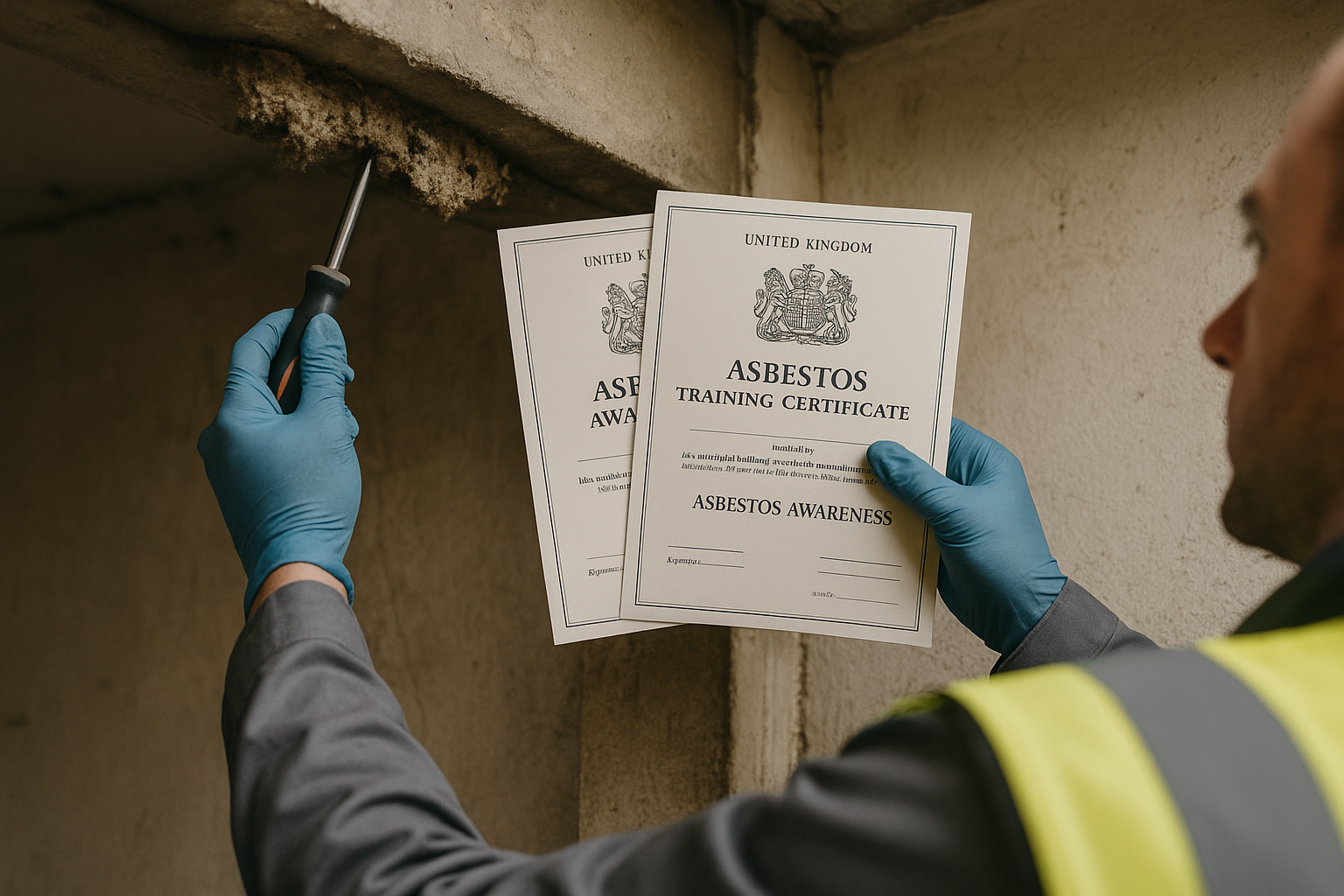
Asbestos awareness training
This is the baseline for people who may encounter asbestos but are not expected to work on it. It should cover:
- The properties of asbestos and the health risks linked to exposure
- The common types of asbestos-containing materials and where they may be found
- Emergency procedures if asbestos is accidentally disturbed
- How to avoid exposure during day-to-day work
- The limits of awareness training
In older and historic buildings, good awareness training should also deal with concealed asbestos. Decorative finishes, service routes, old heating systems and later refurbishments can hide asbestos in places tradespeople do not expect.
Training for non-licensable work
Some lower-risk tasks involving asbestos-containing materials are classed as non-licensable work. That does not mean untrained work. Workers still need task-specific training covering the materials involved, the control measures to be used and the safe method of work.
Examples may include certain short-duration tasks involving asbestos cement or textured coatings where the work falls within HSE guidance. Historic properties can complicate this because poor condition, awkward access and fragile backgrounds may increase the overall risk.
Training for notifiable non-licensed work
Some tasks fall into the category of notifiable non-licensed work, often shortened to NNLW. This requires suitable task-specific training, and employers must meet the additional duties that apply to that work category.
Misclassifying work is a common failure point. If there is any uncertainty, get competent advice before work begins rather than trying to interpret borderline cases on site.
Training for licensable work
Higher-risk asbestos work must be carried out by a licensed contractor. People doing licensable work need advanced job-specific training, close supervision and robust procedures covering control measures, decontamination, waste handling and emergency response.
That is especially relevant in heritage settings. Tight access, sensitive finishes and unusual layouts demand careful planning before any enclosure, removal or making-safe work starts.
BOHS P402
P402 is widely recognised for asbestos surveying. It is relevant to those carrying out inspections and surveys, helping support competence in identifying asbestos-containing materials, applying appropriate survey methods and producing suitable records.
Even so, a qualification on its own is not enough. Surveyors should work within a quality system, follow HSG264 and have practical experience of the types of buildings they inspect.
BOHS P405
P405 is associated with asbestos management. It is particularly useful for those developing, implementing or overseeing asbestos management systems across property portfolios.
For dutyholders responsible for older estates, this is one of the more useful asbestos certifications because it strengthens understanding of management plans, risk prioritisation, communication and legal duties.
Other BOHS qualifications you may come across
Depending on the role, you may also see:
- P401 for identification of asbestos in bulk samples
- P403 for fibre counting
- P404 for air sampling and clearance testing procedures
These are more specialist qualifications and are usually relevant to laboratory analysts and air monitoring professionals rather than general property managers.
What the law and guidance actually expect
When assessing asbestos certifications, the legal question is not whether someone has attended the most courses. The real issue is whether they are competent for the work they are doing.
Under the Control of Asbestos Regulations, employers and dutyholders must make sure that anyone liable to be exposed to asbestos, or anyone supervising such employees, receives adequate information, instruction and training. That sits alongside the duty to manage asbestos in non-domestic premises.
For survey work, HSG264 remains the key guidance document. It sets out expectations for planning, inspection, sampling, material assessment and reporting. If a surveyor cannot show that their work aligns with HSG264, that should raise concerns about the quality and reliability of the survey.
HSE guidance also draws clear distinctions between:
- Awareness training
- Training for non-licensable work
- Training for licensable work
Those distinctions matter on site. A worker with awareness training only should not be carrying out removal work or intrusive work on asbestos-containing materials.
If you manage property, use this quick compliance check before appointing anyone:
- Ask what category of work is being undertaken
- Request evidence of role-specific training
- Check whether the provider follows HSE guidance and HSG264 where relevant
- Confirm suitable supervision, insurance and practical experience
- Review whether reports and management plans are site-specific and usable
Choosing the right survey before work starts
One of the biggest mistakes in asbestos management is commissioning the wrong survey. No amount of training will fix a poor scope.
If a building is occupied and the aim is to manage asbestos during normal use, a management survey is usually the starting point. It helps locate, as far as reasonably practicable, the presence and condition of asbestos-containing materials that could be disturbed during normal occupation or foreseeable maintenance.
If refurbishment or structural work is planned, a more intrusive survey is needed in the affected areas. For major strip-out or redevelopment, a demolition survey is required before work begins.
Historic buildings often make this more complicated. There may be pressure to minimise opening-up because of conservation concerns, but if intrusive works are planned, hidden asbestos still needs to be identified. Protecting decorative finishes does not remove the legal duty to manage asbestos risk.
Practical steps before commissioning a survey
- Define exactly what works are planned and where
- Share all available plans, asbestos records and maintenance history
- Flag any listed status or conservation restrictions early
- Make sure the survey scope matches the planned works, not just the building type
- Allow access to plant rooms, risers, voids and secondary spaces
If your property is in the capital, arranging an asbestos survey London service with local knowledge can help when access, programme pressure and mixed-use occupation make planning more difficult.
For regional portfolios, the same principle applies. Whether you need an asbestos survey Manchester appointment for an older commercial block or an asbestos survey Birmingham visit for a school or municipal site, the survey type must match the work planned.
How to tell whether someone is genuinely competent
A certificate is useful, but it is not the whole picture. The safest way to judge competence is to look at training, experience, systems and the quality of previous work together.
This matters even more with historic buildings, where someone may understand asbestos generally but have little experience of concealed voids, ornate finishes, phased refurbishment or conservation restrictions.
Questions to ask a surveyor or consultant
- What asbestos training and qualifications do you hold?
- How much experience do you have with older or listed buildings?
- Do your survey methods follow HSG264?
- How do you plan intrusive inspection where access is limited?
- How will findings be recorded and communicated to the dutyholder?
Questions to ask a contractor
- What training is held by the people doing the work?
- Is the task non-licensable, notifiable non-licensed or licensable?
- What controls will be used to prevent fibre release?
- How will waste be handled and removed?
- What happens if additional suspect materials are found during the works?
Warning signs that should make you pause
- The provider relies on a single training certificate as proof of competence
- No one can explain how the work category has been assessed
- The survey scope is vague or too generic
- Reports are copied from templates with little site-specific detail
- Historic building constraints are treated as a reason to avoid proper inspection
Good providers can explain their reasoning clearly. They should be able to tell you what they know, what they do not know yet, and what further inspection may be needed.
Where asbestos certifications help most in day-to-day property management
For many dutyholders, the most valuable use of asbestos certifications is not during major projects. It is in the everyday decisions that stop small jobs from becoming incidents.
Think about the tasks that happen regularly in older buildings: replacing lights, installing cabling, opening ceiling voids, repairing leaks, fitting alarms, upgrading heating controls or patching damaged wall finishes. These are exactly the jobs where asbestos is often disturbed by accident.
Use training to improve contractor control
Before any contractor starts, make sure they have seen the relevant asbestos information for the area they will work in. Do not assume a generic induction is enough.
Ask them to confirm:
- They have reviewed the asbestos register
- They understand any access restrictions
- They know what to do if they uncover suspect materials
- Their staff have suitable training for the work planned
Keep your asbestos records usable
Even well-trained people make poor decisions if the information they receive is unclear. Survey reports and asbestos registers should be easy to understand, up to date and available to those who need them.
If your records are buried in an email trail or stored in a system contractors cannot access, your management arrangements need attention.
Review changes in building use
Historic properties often change use over time. A former office may become a school annex, a civic building may be partly let to commercial tenants, or a warehouse may be adapted for events.
Any change in use can alter who may be exposed, how often maintenance is needed and whether your current asbestos management arrangements still make sense. Training helps people spot those changes early, but it needs to be backed by regular review.
Common misunderstandings about asbestos certifications
There are a few myths that cause repeat problems for property managers. Clearing these up can save time, money and avoidable risk.
“If someone has asbestos awareness, they can deal with small amounts”
No. Awareness training is about recognising asbestos and avoiding disturbance. It does not qualify someone to work on asbestos-containing materials.
“A survey qualification means the person can manage all asbestos issues”
Not necessarily. Surveying, asbestos management, laboratory analysis, air monitoring and removal are different disciplines. Some professionals have overlapping skills, but the roles are not interchangeable.
“Historic buildings are exempt because access is limited”
No. Access constraints and conservation concerns affect how work is planned, but they do not remove legal duties. If intrusive work is planned, asbestos risk still has to be identified and managed properly.
“A previous survey means we are covered for any future works”
Only if the survey type, scope and access match the work now proposed. A management survey is not a substitute for a refurbishment or demolition survey when intrusive works are planned.
Practical steps for property managers responsible for older buildings
If you want to use asbestos certifications properly rather than just collecting paperwork, focus on process as much as proof of training.
- Check your asbestos records
Make sure your survey information, asbestos register and management plan are current and accessible. - Match training to role
Do not ask for the same evidence from a caretaker, a surveyor and a licensed contractor. The right training depends on the task. - Scope surveys properly
Before maintenance, refurbishment or demolition, confirm that the survey type matches the planned work. - Ask about experience with older buildings
Historic and complex properties need people who understand hidden voids, mixed construction periods and delicate finishes. - Control contractors tightly
Share asbestos information before work starts and stop any job where the scope changes unexpectedly. - Review after incidents and near misses
If suspect material is disturbed, investigate why. The answer is often a gap in communication, planning or competence.
These steps are simple, but they are where asbestos management usually succeeds or fails.
Frequently Asked Questions
Are asbestos certifications legally required for everyone working in an older building?
No. The law requires adequate information, instruction and training for anyone liable to be exposed to asbestos, or anyone supervising such employees. The level of training depends on the role. Many tradespeople need asbestos awareness, while surveyors and those carrying out asbestos work need more specialist training.
Is asbestos awareness training enough for maintenance staff?
Only if their work does not involve disturbing asbestos-containing materials. Awareness training helps staff recognise risk and stop work, but it does not qualify them to remove asbestos or carry out intrusive work on suspect materials.
Which asbestos certifications should a surveyor have?
Surveyors commonly hold BOHS qualifications such as P402, but qualifications should be supported by practical experience, suitable supervision, quality systems and work carried out in line with HSG264.
Do listed buildings need a different type of asbestos survey?
The survey types remain the same, but the planning is often more complex. A management survey is used for normal occupation and routine maintenance, while refurbishment or demolition work requires the appropriate intrusive survey in the affected areas.
How can I check if a contractor is competent to work around asbestos?
Ask what category of work they believe applies, what training their staff hold, how they will control fibre release, what happens if additional suspect materials are found and whether they have experience in similar buildings. Do not rely on a single certificate without checking the wider picture.
Need clear advice on surveys, management and next steps? Supernova Asbestos Surveys supports property managers, schools, commercial premises and heritage buildings across the UK. For expert help with asbestos surveys, reporting and project planning, call 020 4586 0680 or visit asbestos-surveys.org.uk.