What UK Environmental Regulations Actually Say About Asbestos Use and Disposal
Asbestos kills around 5,000 people in the UK every year — more than any other single work-related cause of death. Yet despite a full ban on its use, millions of buildings still contain it. Understanding the environmental regulations asbestos use disposal framework is not optional for anyone managing, owning, or working on UK property built before 2000.
Get it wrong and you face serious legal consequences, significant fines, and — far worse — the risk of causing irreversible harm to human health. This post sets out exactly what the law requires, what you must never do, and how to stay fully compliant.
The Legal Framework Governing Asbestos in the UK
The primary piece of legislation is the Control of Asbestos Regulations. These regulations set out the duties on employers, building owners, and anyone responsible for premises to manage asbestos-containing materials (ACMs) safely.
The UK banned asbestos in construction and most other applications in 1999. Prior to that, all six types — including the most hazardous, crocidolite (blue) and amosite (brown) — were widely used in insulation, ceiling tiles, floor tiles, roofing, pipe lagging, and hundreds of other building products.
The Health and Safety Executive (HSE) is the primary enforcement body. Its guidance document HSG264 sets the standards surveyors and duty holders must follow when conducting asbestos surveys. Failure to comply with the Control of Asbestos Regulations can result in prosecution, unlimited fines, and in serious cases, custodial sentences.
Who Has a Legal Duty Under These Regulations?
The duty to manage asbestos falls on the dutyholder — typically the owner or person responsible for maintaining non-domestic premises. This is not limited to large commercial landlords or corporate bodies.
The duty applies to:
- Commercial landlords and property managers
- Local authorities and housing associations managing communal areas
- Employers responsible for their workplace buildings
- Managing agents acting on behalf of building owners
If you manage a building constructed before 2000, you are legally required to either confirm that asbestos is not present or to locate, record, and manage any ACMs that are found. There is no middle ground — the duty is absolute.
Environmental Regulations Asbestos Use Disposal: The Core Requirements
The environmental regulations around asbestos use and disposal are layered across several pieces of legislation. Compliance requires understanding how they interact, not just being aware of one set of rules in isolation.
Airborne Fibre Control Limits
The Control of Asbestos Regulations set legally enforceable control limits for airborne asbestos fibres. These are not targets — they are absolute maximum levels that must never be exceeded.
- Licensed asbestos work: Airborne fibre levels must remain below 0.1 fibres per cubic centimetre (f/cm³), measured over a continuous four-hour period.
- Non-licensed asbestos work: Levels must remain below 0.6 f/cm³, measured over a ten-minute period.
Air monitoring is required during licensed work, and records must be kept. These limits exist because asbestos fibres, once inhaled, cannot be expelled from the lungs. They cause mesothelioma, asbestosis, and lung cancer — diseases that typically emerge decades after exposure.
Risk Assessments and Method Statements
Before any work that might disturb asbestos, a written risk assessment must be completed. This is a legal requirement, not a recommendation.
The risk assessment must identify:
- The type and condition of the ACM
- The likelihood of fibre release during the work
- The controls needed to keep exposure below legal limits
- The appropriate personal protective equipment (PPE) and respiratory protective equipment (RPE)
- The waste disposal plan
A method statement — sometimes called a plan of work — must accompany all licensed asbestos work. This document describes step by step how the work will be carried out safely and must be prepared before work begins.
Training Requirements
Anyone liable to disturb asbestos during their work must receive appropriate asbestos awareness training. This includes not just specialist asbestos contractors but also electricians, plumbers, carpenters, and other tradespeople working in buildings that may contain ACMs.
Licensed asbestos removal contractors must hold a licence issued by the HSE and must ensure their operatives hold the relevant qualifications. Training must be refreshed regularly — typically every year for those working with asbestos directly.
Classifying and Handling Asbestos Waste
Asbestos waste is classified as hazardous waste under UK environmental law. This classification triggers a specific set of legal obligations that go beyond the Control of Asbestos Regulations and extend into waste management legislation.
What Counts as Asbestos Waste?
Any material containing more than 0.1% asbestos by weight is classified as hazardous waste. This includes:
- Removed asbestos insulation board, ceiling tiles, and floor tiles
- Pipe lagging and thermal insulation
- Contaminated PPE, tools, and sheeting used during removal works
- Soil or rubble contaminated with asbestos fibres
- Water used during wet removal methods, which must be treated before disposal
Even materials that appear clean but have been in contact with asbestos during removal must be treated as hazardous waste. There are no exceptions.
Packaging and Labelling Requirements
The packaging requirements for asbestos waste are strict and non-negotiable. All asbestos waste must be:
- Double-bagged in heavy-duty polythene bags (minimum 500 gauge)
- Clearly labelled with the appropriate hazardous waste label identifying the contents as asbestos
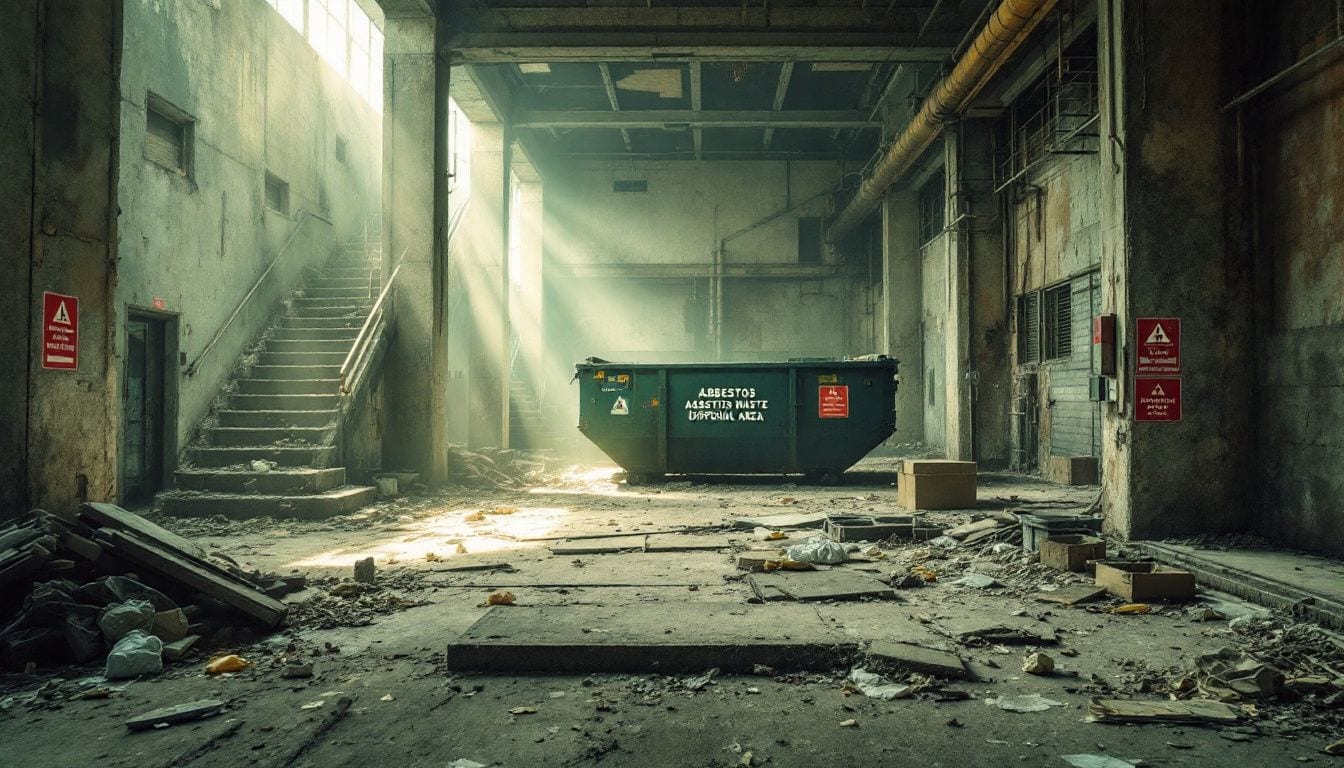
- Stored in a locked, covered skip or secure container to prevent unauthorised access
- Kept separate from all other waste — mixing asbestos waste with general refuse is a criminal offence
Large sheets of asbestos cement or other rigid ACMs that cannot be bagged must be wrapped in polythene sheeting without breaking them. Breaking asbestos materials releases fibres — this is precisely the risk the regulations are designed to prevent.
Transportation of Asbestos Waste
Moving asbestos waste from site to a disposal facility is governed by the Carriage of Dangerous Goods Regulations. Only registered waste carriers can transport asbestos waste.
Before engaging any contractor to remove and transport asbestos, verify that they hold a valid waste carrier licence from the Environment Agency. A consignment note must accompany every movement of hazardous asbestos waste, recording the producer, the carrier, the quantity, and the receiving disposal site. Copies must be retained for a minimum of two years.
Asbestos Disposal: Where the Waste Must Go
Asbestos waste cannot go to a standard landfill. It must be disposed of at a site that holds the relevant environmental permit to accept hazardous waste, specifically asbestos.
The Environment Agency maintains a register of permitted sites. Your licensed asbestos removal contractor will arrange disposal at an approved facility as part of their service. Ensure you receive the completed consignment note confirming disposal — this is your proof of compliance and must be kept on file.
Disposal at Civic Amenity Sites
Some local authority household waste sites accept small quantities of asbestos from domestic properties. This is subject to local authority policy and strict quantity limits.
Contact your local authority in advance to confirm whether this option is available in your area and what the requirements are. Never assume a civic amenity site will accept asbestos without prior confirmation — turning up unannounced is likely to result in refusal and potential enforcement action.
Prohibited Asbestos Disposal Practices
The law is explicit about what you must never do with asbestos waste. These prohibitions exist because the consequences of getting it wrong are severe — for public health, for the environment, and for you personally.
You must never:
- Mix asbestos waste with general refuse or any other type of waste
- Place asbestos in standard wheelie bins or skip bins not designated for hazardous waste
- Store asbestos waste in uncertified or unsecured locations
- Sell, give away, or transfer any item that contains asbestos
- Attempt DIY asbestos removal without the required licences and training
- Dump soil or rubble contaminated with asbestos as ordinary construction waste
- Dispose of asbestos at a landfill site that does not hold the appropriate environmental permit
Fly-tipping asbestos is a criminal offence that carries an unlimited fine and up to 12 months’ imprisonment on summary conviction. Enforcement agencies have significantly improved their detection capabilities in recent years, and prosecution rates for illegal asbestos disposal have risen accordingly.
The Asbestos Survey: Your Starting Point for Compliance
Before any refurbishment, demolition, or significant maintenance work on a pre-2000 building, an asbestos survey is legally required. There are two main types, and choosing the correct one matters.
Management Survey
A management survey is required to manage ACMs in a building during normal occupation. It locates and assesses the condition of ACMs that could be disturbed during routine maintenance, and the results feed into an asbestos register and management plan that must be kept up to date.
This type of survey is the foundation of your ongoing duty to manage. Without it, you have no reliable basis for making decisions about maintenance work, and you cannot demonstrate compliance if the HSE comes calling.
Refurbishment and Demolition Survey
A demolition survey is required before any work that will disturb the building fabric. It is more intrusive than a management survey and must be completed before any contractor begins work.
This survey identifies all ACMs in the areas to be affected so they can be removed by a licensed contractor before other trades move in. Commissioning a demolition survey after work has started — or skipping it entirely — is one of the most common and costly compliance failures seen on UK construction sites.
Record-Keeping: The Paper Trail That Protects You
Compliance with environmental regulations governing asbestos use and disposal is not just about what you do — it is about being able to prove what you did. Robust record-keeping is essential and legally required.
You must retain:
- The asbestos survey report and register
- The asbestos management plan, updated regularly
- Risk assessments and method statements for all asbestos work
- Air monitoring records from licensed removal works
- Hazardous waste consignment notes for a minimum of two years
- Training records for anyone who works with or near asbestos
- Clearance certificates issued after licensed removal works
If your building is inspected by the HSE or local authority, these records are the first thing they will ask for. Inability to produce them is itself an offence and will likely trigger a more detailed investigation.
Penalties for Non-Compliance
The penalties for breaching asbestos regulations reflect the seriousness with which the law treats this hazard. The HSE can issue improvement notices, prohibition notices, and prosecute offenders in either the Magistrates’ Court or the Crown Court.
In the Magistrates’ Court, fines are unlimited. In the Crown Court, there is no upper limit on fines, and custodial sentences of up to two years are available. The HSE publishes details of prosecutions on its website — named individuals and organisations appear in those records, and the reputational damage is lasting.
Beyond criminal penalties, duty holders who fail to manage asbestos correctly face civil liability if workers, occupants, or visitors are subsequently diagnosed with an asbestos-related disease. The financial exposure in such cases can be substantial.
Where Supernova Asbestos Surveys Operates
Supernova Asbestos Surveys carries out both management and demolition surveys across the UK. Whether you are managing a single commercial unit or a portfolio of properties, our UKAS-accredited surveyors work to HSG264 standards on every instruction.
If your property is in the capital, our team provides asbestos survey London services covering all boroughs. For properties in the north-west, we offer asbestos survey Manchester coverage across the region, and across the Midlands our asbestos survey Birmingham team is available to survey commercial and residential properties of all sizes.
Frequently Asked Questions
What are the main environmental regulations covering asbestos use and disposal in the UK?
The primary legislation is the Control of Asbestos Regulations, which governs the management, handling, and removal of asbestos-containing materials. Asbestos waste is also subject to hazardous waste legislation, and its transportation is regulated under the Carriage of Dangerous Goods Regulations. The HSE’s guidance document HSG264 sets the standards for asbestos surveys. These frameworks work together — compliance requires understanding all of them, not just one.
Can I dispose of asbestos in a standard skip or bin?
No. Asbestos waste is classified as hazardous waste and must never be placed in standard skips, wheelie bins, or any container not designated for hazardous materials. It must be double-bagged in heavy-duty polythene, clearly labelled, and transported by a registered waste carrier to a permitted hazardous waste disposal facility. Mixing asbestos waste with general refuse is a criminal offence.
Do I need a survey before refurbishing a building that might contain asbestos?
Yes. Before any refurbishment or demolition work on a building constructed before 2000, a refurbishment and demolition survey is a legal requirement. This survey must be completed before work starts — not during or after. It identifies all asbestos-containing materials in the affected areas so they can be safely removed by a licensed contractor before other trades begin work.
Who is legally responsible for managing asbestos in a commercial building?
The legal duty falls on the dutyholder — usually the owner or the person responsible for maintaining the premises. This includes commercial landlords, managing agents, local authorities, and employers who control their own workplace buildings. If you are responsible for a non-domestic building built before 2000, you must either confirm asbestos is not present or have a current asbestos register and management plan in place.
What records do I need to keep to demonstrate compliance with asbestos regulations?
You must retain the asbestos survey report and register, the asbestos management plan, risk assessments and method statements for any asbestos work carried out, air monitoring records from licensed removals, hazardous waste consignment notes (minimum two years), training records for relevant personnel, and clearance certificates following licensed removal works. These documents are the first thing the HSE will request during an inspection, and failure to produce them is itself a breach of the regulations.
Get Your Asbestos Compliance Right — Talk to Supernova Today
Navigating the environmental regulations around asbestos use and disposal is not something to approach without expert support. A missed survey, an improperly disposed bag of waste, or an out-of-date management plan can all result in enforcement action, prosecution, and — most critically — harm to the people in your building.
Supernova Asbestos Surveys has completed over 50,000 surveys nationwide. Our surveyors are fully qualified, our reports meet HSG264 standards, and we support clients from initial survey through to licensed removal and final clearance.
Call us on 020 4586 0680 or visit asbestos-surveys.org.uk to book a survey or speak to our team about your compliance obligations.