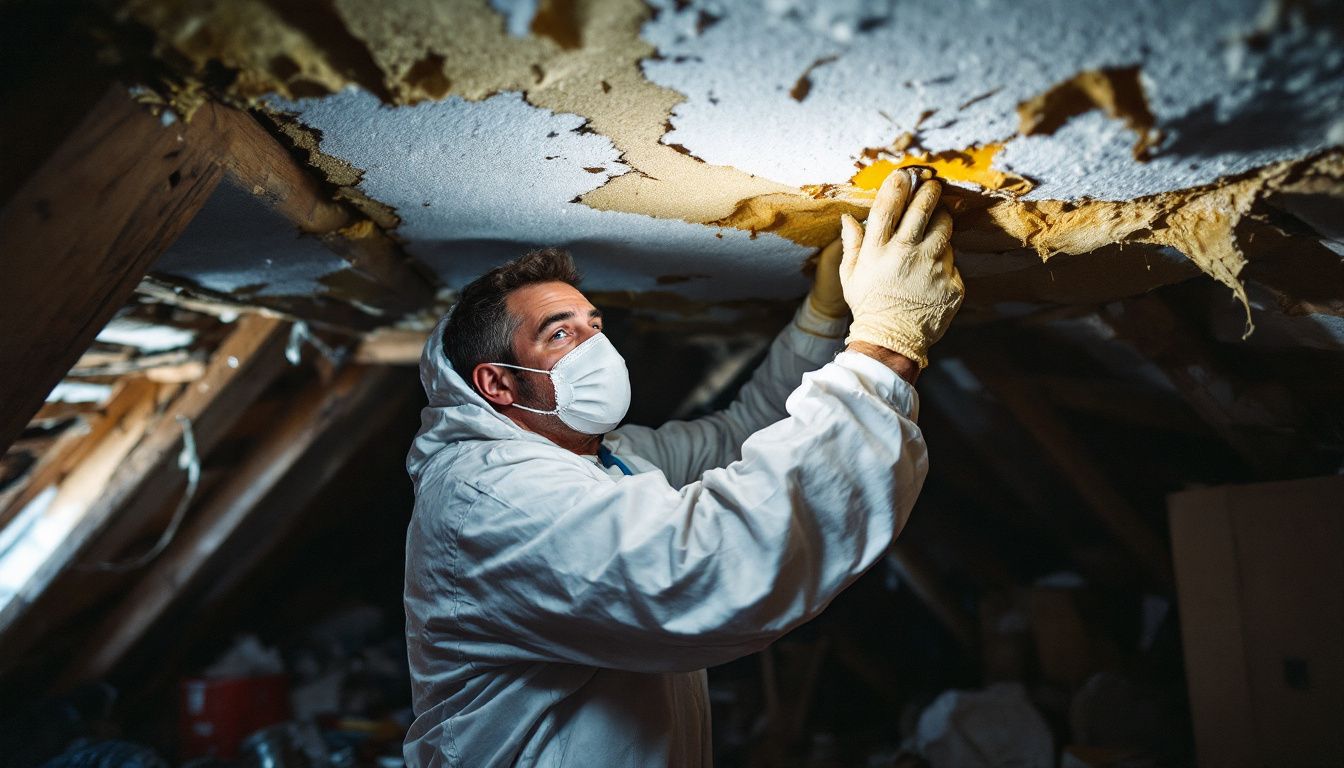
What Proper Asbestos Removal Actually Involves — And Why Getting It Wrong Is Catastrophic
Asbestos is still present in millions of UK buildings, and disturbing it without following the correct procedures can release microscopic fibres that cause fatal diseases decades later. Proper asbestos removal is not simply a matter of putting on gloves and pulling material off a wall — it is a tightly regulated, methodical process governed by some of the strictest health and safety legislation in the country.
Whether you own a pre-2000 commercial property, manage a block of flats, or are planning a renovation, understanding what correct removal looks like is essential. This post covers the health risks, the legal framework, the step-by-step removal process, and what you need to do before any work begins.
The Health Risks That Make Proper Asbestos Removal Non-Negotiable
Asbestos fibres are invisible to the naked eye. When asbestos-containing materials (ACMs) are disturbed — whether during demolition, refurbishment, or accidental damage — those fibres become airborne and can be inhaled deep into the lungs.
The diseases caused by asbestos exposure include:
- Mesothelioma — an aggressive and incurable cancer of the lining of the lungs or abdomen, almost exclusively caused by asbestos exposure
- Asbestos-related lung cancer — directly linked to fibre inhalation and functionally identical to lung cancer from other causes
- Asbestosis — a chronic scarring of lung tissue that causes progressive breathlessness and has no cure
- Pleural thickening — a non-malignant condition that nonetheless causes significant breathing difficulties
None of these conditions develop immediately. Symptoms typically emerge 20 to 40 years after exposure, which is part of what makes asbestos so insidious — by the time a diagnosis is made, the exposure that caused it happened a generation ago.
There is no known safe level of asbestos exposure. Even a single significant exposure event carries risk, which is why proper asbestos removal procedures exist and why shortcuts are never acceptable.
Identifying Asbestos Before Any Removal Work Begins
You cannot carry out proper asbestos removal if you do not know exactly what you are dealing with. Before any work starts — whether that is a minor refurbishment or a full demolition — asbestos must be identified, located, and assessed.
Management Surveys
A management survey is the starting point for any building owner or manager with a duty to manage asbestos. It identifies the location and condition of ACMs that could be disturbed during normal occupation or routine maintenance.
The survey produces an asbestos register and a risk-rated management plan, which must be kept up to date. Without this baseline, you have no way of knowing what your contractors might disturb.
Refurbishment Surveys
If you are planning any building work — even relatively minor alterations — you need a refurbishment survey before work begins. This is a more intrusive survey that accesses all areas likely to be disturbed, including voids, ceiling spaces, and floor cavities.
It is a legal requirement under the Control of Asbestos Regulations. Commissioning one is not optional — it is your legal obligation as the dutyholder.
Bulk Sample Testing
If you have a specific material you suspect contains asbestos, a testing kit allows samples to be collected and sent to a UKAS-accredited laboratory for analysis under polarised light microscopy. This gives you a definitive answer without commissioning a full survey, though a survey is still required before any disturbance work begins.
Re-Inspection Surveys
Where ACMs are being managed in situ rather than removed, they must be monitored regularly. A re-inspection survey checks the condition of known ACMs on an annual basis and updates the risk assessment accordingly.
Deteriorating materials that were previously safe to leave in place may need to be removed if their condition worsens. Skipping re-inspections means you could be unaware of a rapidly deteriorating ACM until someone is already at risk.
The Legal Framework Governing Asbestos Removal in the UK
Proper asbestos removal in the UK is governed primarily by the Control of Asbestos Regulations. These regulations set out who can carry out removal work, what training and licensing is required, and what procedures must be followed.
The HSE’s HSG264 guidance document provides the definitive technical standard for survey work, while separate HSE guidance covers licensed and non-licensed removal work. Both are essential reading for anyone with responsibilities in this area.
Licensed vs Non-Licensed Work
Not all asbestos removal requires a licensed contractor, but the majority of significant removal work does. The key distinction is as follows:
- Licensed work — required for the removal of asbestos insulation, asbestos insulation board (AIB), and most sprayed coatings. Only contractors holding a licence issued by the HSE can carry out this work. The licence must be displayed on site.
- Notifiable non-licensed work (NNLW) — some tasks involving lower-risk ACMs do not require a licence but must still be notified to the relevant enforcing authority. Workers must receive appropriate training, and health surveillance is required.
- Non-licensed work — the lowest risk category, covering incidental contact with ACMs such as textured coatings in good condition. Specific conditions apply and risk assessments are still mandatory.
If you are in any doubt about which category applies to your situation, the answer is always to seek professional advice before proceeding. Misclassifying work and using unlicensed contractors where a licence is required is a serious criminal offence.
Penalties for Non-Compliance
The HSE enforces asbestos regulations rigorously. Breaches can result in improvement notices, prohibition notices, unlimited fines in the Crown Court, and custodial sentences of up to two years.
Beyond the legal consequences, the human cost of improper asbestos removal — to workers, building occupants, and the public — is immeasurable. No commercial pressure or budget constraint justifies cutting corners.
What Proper Asbestos Removal Looks Like: Step by Step
When a licensed contractor carries out proper asbestos removal, the process follows a strict sequence. Here is what that looks like in practice.
Step 1 — Pre-Work Planning and Notification
Before any removal begins, the contractor must prepare a written plan of work. This document details the scope of the work, the ACMs to be removed, the removal methods to be used, the PPE and RPE requirements, the decontamination procedures, and the waste disposal arrangements.
For licensed work, the contractor must also notify the relevant enforcing authority — typically the HSE — at least 14 days before work starts. This notification requirement exists so that the HSE can plan inspections if necessary.
Step 2 — Enclosure and Containment
The work area must be physically isolated from the rest of the building. Licensed contractors erect a full enclosure — typically constructed from heavy-duty polythene sheeting on a scaffolding frame — that completely seals the work area.
The enclosure is maintained under negative air pressure using a High Efficiency Particulate Air (HEPA) filtered unit. This means air flows into the enclosure rather than out of it, so any fibres released during work cannot escape into the wider building.
Step 3 — Decontamination Facilities
Workers must decontaminate themselves every time they leave the enclosure. A three-stage decontamination unit — comprising a dirty end, a shower, and a clean end — is set up adjacent to the enclosure.
Workers remove their disposable coveralls in the dirty end, shower thoroughly, and dress in clean clothing before re-entering the building. This decontamination process is not optional — it is a fundamental safeguard against carrying fibres out of the work area on clothing or skin.
Step 4 — Removal Using Wet Methods
Asbestos materials must be kept wet during removal. Water, often with a wetting agent added, is applied to the ACM before and during removal. This suppresses fibre release by preventing dry material from fragmenting and releasing dust.
Workers wear appropriate respiratory protective equipment (RPE) throughout. The type and class of RPE is determined by the nature of the work and the fibre levels expected — full-face powered air-purifying respirators or supplied air respirators are typically required for licensed work.
Step 5 — Waste Packaging and Removal
All asbestos waste — including the removed ACMs, contaminated PPE, polythene sheeting, and any other materials that have come into contact with asbestos — must be double-bagged in UN-approved asbestos waste sacks, clearly labelled with the appropriate hazard warning.
Asbestos waste is classified as hazardous waste under UK legislation. It must be transported by a registered waste carrier and disposed of at a licensed hazardous waste disposal facility. Fly-tipping asbestos waste is a serious criminal offence that carries severe penalties.
Step 6 — Air Testing and Clearance
Once removal is complete, the enclosure is thoroughly cleaned using industrial vacuum cleaners fitted with HEPA filters, followed by a final visual inspection. Air testing is then carried out by an independent analyst — not the removal contractor — to verify that fibre levels inside the enclosure have returned to background levels.
Only when the clearance certificate has been issued can the enclosure be dismantled and the area returned to use. This independent verification step is a critical safeguard and must not be bypassed under any circumstances.
The Duty to Manage: What Property Owners Must Do
If you own or manage a non-domestic building, you have a legal duty under the Control of Asbestos Regulations to manage asbestos on your premises. This duty applies regardless of whether you intend to carry out any building work.
In practice, the duty to manage requires you to:
- Identify whether your building contains ACMs — through a management survey or by assuming ACMs are present in materials that have not been tested
- Assess the condition and risk posed by any ACMs identified
- Produce and maintain an asbestos register and management plan
- Ensure the information in the register is made available to anyone who might disturb ACMs — including maintenance contractors, electricians, and plumbers
- Review and update the management plan regularly, and commission re-inspection surveys to monitor ACM condition
Failing to discharge the duty to manage is a criminal offence. More practically, it puts everyone who works in or visits your building at risk. The duty exists because the consequences of ignorance are fatal.
Asbestos Removal and Other Safety Obligations
Asbestos management rarely exists in isolation. Buildings that require asbestos surveys often have other safety obligations running alongside them.
A fire risk assessment is a legal requirement for all non-domestic premises and many residential buildings. It is often sensible to address both obligations at the same time, and Supernova can assist with both.
If you are planning a project that involves asbestos removal, it is essential that the removal work is completed and the clearance certificate issued before any subsequent building work begins. Starting construction before clearance is granted risks contaminating the wider site and exposing other workers to fibres.
Common Mistakes That Undermine Proper Asbestos Removal
Even with the best intentions, property owners and managers sometimes make avoidable errors that compromise the safety of a removal project. The most common mistakes include:
- Failing to commission a refurbishment survey before building work starts — this is one of the most frequent regulatory breaches and one of the most dangerous
- Assuming a material does not contain asbestos without testing it — visual identification is not reliable; laboratory analysis is the only way to be certain
- Using an unlicensed contractor to save money — if the work requires a licence and you use an unlicensed contractor, you are committing a criminal offence, not just the contractor
- Allowing building work to start before the clearance certificate is issued — the certificate is the only evidence that the area is safe; without it, you are guessing
- Failing to update the asbestos register after removal — the register must reflect the current state of the building at all times
- Not informing maintenance contractors about known ACMs — a plumber who does not know there is asbestos insulation board behind a panel cannot protect themselves
Each of these mistakes has the potential to expose people to fibres and expose you to serious legal liability. The cost of doing things properly is always lower than the cost of getting it wrong.
Where Supernova Asbestos Surveys Operates
Supernova Asbestos Surveys operates across the UK, with specialist teams covering every major region. If you need an asbestos survey in London, an asbestos survey in Manchester, or an asbestos survey in Birmingham, our qualified surveyors can typically attend within the same week.
We cover England, Scotland, and Wales — wherever your property is located, we can help. With over 50,000 surveys completed nationwide, we have the experience and accreditation to handle projects of any size or complexity.
Get Proper Asbestos Removal Right — Talk to Supernova
Proper asbestos removal is not something to approach without expert guidance. The regulatory requirements are strict, the health consequences of getting it wrong are severe, and the legal liability for dutyholders who cut corners is significant.
Supernova Asbestos Surveys provides management surveys, refurbishment surveys, re-inspection surveys, and specialist asbestos removal services across the UK. Our surveyors are fully qualified, our laboratory partners are UKAS-accredited, and our advice is always based on current HSE guidance.
Call us on 020 4586 0680 or visit asbestos-surveys.org.uk to book a survey or discuss your requirements with a member of our team.
Frequently Asked Questions
Do I need a licensed contractor for all asbestos removal work?
Not always, but in most cases involving significant ACMs — particularly asbestos insulation, insulation board, or sprayed coatings — a licensed contractor is legally required. For lower-risk materials, notifiable non-licensed work rules may apply, but these still carry strict training, notification, and health surveillance requirements. If you are unsure, always seek professional advice before proceeding.
Can I remove asbestos myself if it is in my own home?
The Control of Asbestos Regulations apply to domestic properties in certain circumstances, and some types of asbestos removal are restricted to licensed contractors regardless of the property type. Even where DIY removal is not explicitly prohibited, it carries serious health risks and practical challenges around waste disposal. Professional removal is strongly recommended in all cases.
How long does proper asbestos removal take?
The duration depends on the quantity and type of ACMs being removed, the complexity of the enclosure required, and the results of air testing. Small-scale removals may be completed in a day or two; larger projects involving significant quantities of licensed materials can take several weeks. The 14-day notification period for licensed work must also be factored into your project timeline.
What happens to asbestos waste after removal?
All asbestos waste is classified as hazardous waste under UK legislation. It must be double-bagged in UN-approved, clearly labelled sacks, transported by a registered waste carrier, and disposed of at a licensed hazardous waste disposal facility. Your removal contractor is responsible for arranging this, but as the dutyholder you should confirm that proper waste transfer documentation — known as a consignment note — is provided.
Do I need a new survey if I already have an asbestos register?
It depends on the type of work you are planning. An existing management survey is sufficient for routine maintenance and occupation, but if you are planning any building work that will disturb the fabric of the building, a refurbishment survey is required regardless of whether a management survey already exists. The two surveys serve different purposes and one does not replace the other.