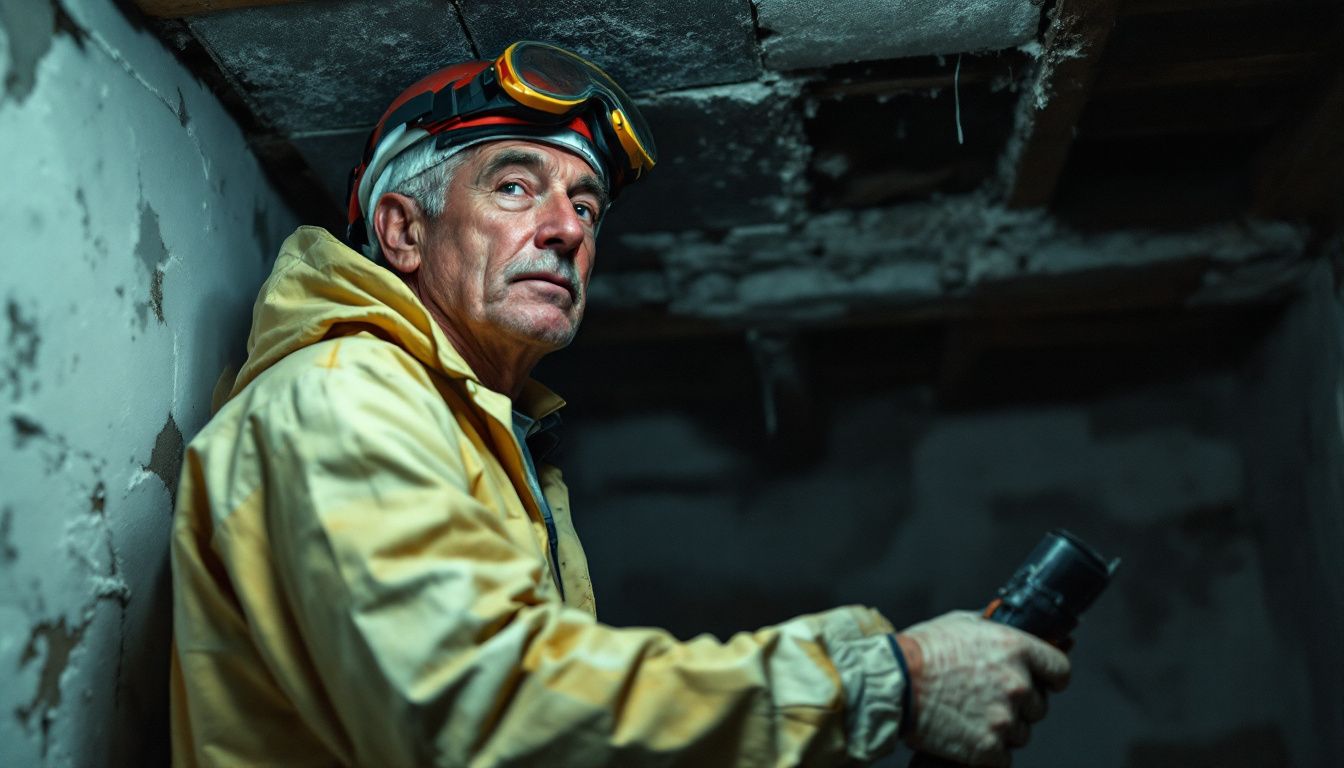
Asbestos Contamination: What It Is, Why It Spreads, and How to Stop It
Asbestos contamination is one of the most serious hidden hazards in UK buildings — and one of the most consistently misunderstood. The fibres are invisible to the naked eye, have no smell, and cause no immediate symptoms, yet inhaling them can lead to mesothelioma, asbestosis, and lung cancer decades later.
If you own, manage, or work in a building constructed before 2000, understanding how contamination occurs and how to prevent it from spreading is not optional — it is a legal and moral responsibility.
What Is Asbestos Contamination?
Asbestos contamination occurs when asbestos-containing materials (ACMs) release fibres into the surrounding environment — whether that is the air inside a building, soil around a demolition site, or surfaces within a room. This can happen gradually through wear and deterioration, or suddenly through disturbance during maintenance, renovation, or demolition work.
The fibres themselves are microscopic. A single asbestos fibre is many times thinner than a human hair, which means it can remain suspended in the air for hours and travel considerable distances before settling. Once disturbed, fibres can spread rapidly through ventilation systems, on clothing, or simply through air movement — contaminating areas far beyond the original source.
Three types of asbestos were widely used in UK construction: chrysotile (white), amosite (brown), and crocidolite (blue). All three are hazardous. Crocidolite and amosite are considered particularly dangerous due to the shape and durability of their fibres, but no form of asbestos should ever be treated as safe.
How Does Asbestos Contamination Spread Through a Building?
Understanding how asbestos contamination spreads is the first step to preventing it. Fibres do not stay put once released — they move, and they do so in ways that are easy to overlook.
Air Movement and Ventilation
Once fibres become airborne, standard ventilation systems can distribute them throughout an entire building. HVAC ducts, open doors, and even foot traffic can carry fibres from a disturbed ACM into areas that were never directly affected. This is why proper containment during any asbestos-related work is so critical.
Clothing and Equipment
Workers who handle or work near ACMs without proper protective equipment can carry fibres on their clothing, hair, tools, and footwear. This is known as secondary contamination, and it accounts for a number of domestic asbestos exposures — including family members of workers who unknowingly brought fibres home after a shift.
Sweeping and Dry Cleaning
Using a standard vacuum cleaner or dry sweeping a contaminated area is one of the most common mistakes made during asbestos cleanup. Ordinary vacuums cannot trap asbestos fibres — they simply redistribute them back into the air. The same applies to dry sweeping patios, floors, or surfaces where asbestos debris may have settled.
Uncontrolled Demolition and Renovation
Breaking, drilling, cutting, or sanding materials that contain asbestos releases fibres in large quantities. Without proper containment — sealed enclosures, negative pressure units, and licensed operatives — contamination can spread rapidly across an entire site and beyond. This is precisely why survey requirements exist before any significant building work begins.
Practical Steps to Prevent the Spread of Asbestos Fibres
Whether you are a property manager, a contractor, or a homeowner, there are concrete actions you can take to reduce the risk of asbestos contamination spreading. These steps are not just best practice — many are legally required under the Control of Asbestos Regulations.
- Use HEPA-filtered vacuums: Standard vacuum cleaners cannot capture asbestos fibres. Only H-class HEPA vacuums designed specifically for hazardous dust should be used in any area where asbestos contamination is suspected.
- Apply wet cleaning methods: Dampening surfaces before cleaning helps to suppress fibres and prevent them from becoming airborne. Wet wiping is far safer than dry sweeping or dusting.
- Seal off the affected area: Use polythene sheeting and adhesive tape to isolate any area where asbestos work is taking place. Keep doors and windows closed to prevent cross-contamination.
- Avoid sweeping outdoors on windy days: If you suspect asbestos debris on external surfaces, do not sweep or pressure-wash. Wet-wipe where possible and seek professional advice immediately.
- Provide correct PPE: Workers in any area with suspected or confirmed asbestos contamination must wear fitted respiratory protective equipment (RPE) — specifically FFP3 masks or powered air-purifying respirators — along with disposable coveralls, gloves, and boot covers.
- Never use compressed air: Blowing air across a contaminated surface is one of the quickest ways to spread fibres. It should never be used as a cleaning method around ACMs.
- Double-bag all asbestos waste: All contaminated materials must be placed in clearly labelled, double-sealed polythene bags and disposed of at a licensed hazardous waste facility. Asbestos waste cannot go into standard skips or general waste bins.
- Hire licensed contractors for high-risk work: Certain types of asbestos work — including work with pipe lagging, sprayed coatings, and loose-fill insulation — are classified as licensable work under the Control of Asbestos Regulations. Only contractors holding an HSE licence may carry out this work legally.
When to Commission a Professional Asbestos Survey
If you manage a non-domestic property built before 2000, you have a legal duty to manage asbestos under Regulation 4 of the Control of Asbestos Regulations. That duty begins with knowing what ACMs are present, where they are, and what condition they are in. A professional asbestos survey is the only reliable way to establish this.
There are several types of survey, each suited to different circumstances.
Management Survey
A management survey is the standard survey for occupied, non-domestic premises. It identifies ACMs that could be disturbed during normal occupancy and maintenance, and provides the information needed to compile an asbestos register and management plan. This is the survey most duty holders need to satisfy their legal obligations under the Control of Asbestos Regulations.
Refurbishment Survey
Before any renovation, extension, or fit-out work begins, a refurbishment survey is required. This is a more intrusive inspection that accesses areas likely to be disturbed during the works. It ensures that contractors are not unknowingly cutting into ACMs and causing widespread asbestos contamination on site.
Demolition Survey
A demolition survey is the most thorough type of inspection and is required before any structure is demolished. It is fully destructive in nature — every part of the building is inspected and sampled. All ACMs must be identified and removed before demolition can begin, as required by the Control of Asbestos Regulations and supporting HSE guidance in HSG264.
Re-Inspection Survey
Once an asbestos register is in place, ACMs must be monitored regularly to ensure their condition has not deteriorated. A re-inspection survey — typically conducted every six to twelve months — updates the register and flags any materials that may require remediation. This ongoing monitoring is a legal requirement for duty holders, not an optional extra.
Asbestos Testing: Confirming Contamination
Surveys identify suspected ACMs, but confirmation requires laboratory analysis. If you discover a material you believe may contain asbestos — whether during maintenance, a refurbishment project, or routine inspection — professional asbestos testing will confirm whether fibres are present and identify the fibre type.
Samples are analysed under polarised light microscopy (PLM) at a UKAS-accredited laboratory, providing results that are legally defensible and scientifically reliable. This is the standard required by HSE guidance and accepted by enforcing authorities.
For property owners who want to carry out initial sampling themselves where appropriate, Supernova also offers a postal testing kit — a cost-effective way to get professional lab analysis from samples you collect yourself. For a broader overview of what the process involves and when it is appropriate, our asbestos testing guidance covers the full process in detail.
If you are unsure whether a material contains asbestos, do not disturb it. Treat it as suspect until testing confirms otherwise.
What Happens When Asbestos Contamination Is Confirmed?
Once contamination is confirmed, the appropriate response depends on the condition of the material, the level of risk it poses, and the planned use of the building. Not all ACMs need to be removed immediately — in many cases, managing them in situ is the safer and legally compliant approach.
Management in Place
If an ACM is in good condition and unlikely to be disturbed, it can often be left in place, monitored through regular re-inspections, and recorded in the asbestos register. Encapsulation — sealing the surface to prevent fibre release — may also be appropriate in certain situations and should be assessed by a qualified professional.
Remediation and Removal
Where an ACM is damaged, deteriorating, or in an area where disturbance is unavoidable, professional asbestos removal is required. Licensed removal contractors follow strict procedures: erecting sealed enclosures, using negative pressure units, decontaminating personnel and equipment, and disposing of all waste at licensed facilities.
Attempting to remove licensable asbestos materials without the appropriate HSE licence is illegal and extremely dangerous. This is not a grey area — the law is clear, and the health consequences of getting it wrong are severe and irreversible.
The Legal Framework Around Asbestos Contamination in the UK
Asbestos management in the UK is governed by the Control of Asbestos Regulations, supported by HSE guidance documents including HSG264 — the definitive guide to asbestos surveying. The regulations impose clear duties on employers, building owners, and those in control of premises.
Key legal obligations include:
- Duty holders in non-domestic premises must identify ACMs, assess their condition, and produce an asbestos management plan.
- Licensable asbestos work must only be carried out by HSE-licensed contractors.
- Certain non-licensable work still requires notification to the relevant enforcing authority and must be carried out using correct controls.
- Asbestos waste must be classified as hazardous waste and disposed of at an authorised facility.
- Workers who may encounter asbestos must receive appropriate asbestos awareness training.
Failure to comply with these regulations can result in substantial fines, prosecution, and — most critically — serious harm to the people who live and work in your building. Ignorance of the law is not a defence, and the HSE takes enforcement in this area seriously.
Other Property Risks to Consider Alongside Asbestos
Asbestos contamination rarely exists in isolation. Older buildings that contain ACMs often have other legacy safety issues that require professional assessment. A fire risk assessment is a legal requirement for most non-domestic premises and should be carried out alongside asbestos management as part of a broader property safety strategy.
The two disciplines complement each other — both are about identifying hidden hazards before they cause harm. Addressing them together is efficient, cost-effective, and demonstrates the kind of proactive duty of care that regulators and insurers expect from responsible property managers.
What to Expect From a Supernova Asbestos Survey
When you book a survey with Supernova Asbestos Surveys, you are engaging a team with over 50,000 surveys completed across the UK. Every survey is carried out by qualified, experienced surveyors working to the standards set out in HSG264 and the Control of Asbestos Regulations.
You receive a clear, detailed report identifying any ACMs found, their condition, their risk rating, and recommended actions. If asbestos contamination is identified, we will advise you on the most appropriate next steps — whether that is management in place, encapsulation, or removal — without pushing you towards unnecessary remediation work.
We cover the whole of the UK, with fast turnaround times and straightforward pricing. Whether you need a routine management survey for a single commercial unit or a full demolition survey for a large site, we have the capacity and expertise to deliver.
Call us on 020 4586 0680 or visit asbestos-surveys.org.uk to get a quote today.
Frequently Asked Questions
What is asbestos contamination and how does it occur?
Asbestos contamination occurs when asbestos-containing materials release microscopic fibres into the air, onto surfaces, or into soil. It can happen gradually as materials deteriorate with age, or suddenly when ACMs are disturbed by drilling, cutting, breaking, or renovation work. Once airborne, fibres can travel through ventilation systems and on clothing, spreading contamination well beyond the original source.
How do I know if my building has asbestos contamination?
You cannot identify asbestos contamination by sight, smell, or feel. The only reliable way to confirm whether a material contains asbestos is through professional laboratory testing or a formal asbestos survey carried out by a qualified surveyor. If your building was constructed before 2000, you should assume ACMs may be present until a survey confirms otherwise.
Can I clean up asbestos contamination myself?
For minor, non-licensable situations, certain controlled cleaning methods — such as wet wiping and the use of H-class HEPA vacuums — may be appropriate. However, any significant asbestos contamination, or work involving licensable materials such as pipe lagging or sprayed coatings, must be handled by HSE-licensed contractors. Attempting unlicensed removal of licensable materials is illegal and puts you and others at serious risk.
What are the health risks of asbestos contamination?
Inhaling asbestos fibres can cause mesothelioma (a cancer of the lining of the lungs and other organs), asbestosis (scarring of the lung tissue), and lung cancer. These conditions typically develop decades after exposure, which means people are often unaware of the damage being done at the time. There is no safe level of asbestos exposure — all types of asbestos fibre are classified as carcinogenic.
Is asbestos contamination a legal issue for property managers?
Yes. Under Regulation 4 of the Control of Asbestos Regulations, duty holders responsible for non-domestic premises have a legal obligation to manage asbestos. This includes identifying ACMs, assessing their condition, producing a management plan, and ensuring that anyone who may work on or near ACMs is informed. Failure to comply can result in prosecution, substantial fines, and — in the most serious cases — criminal liability.