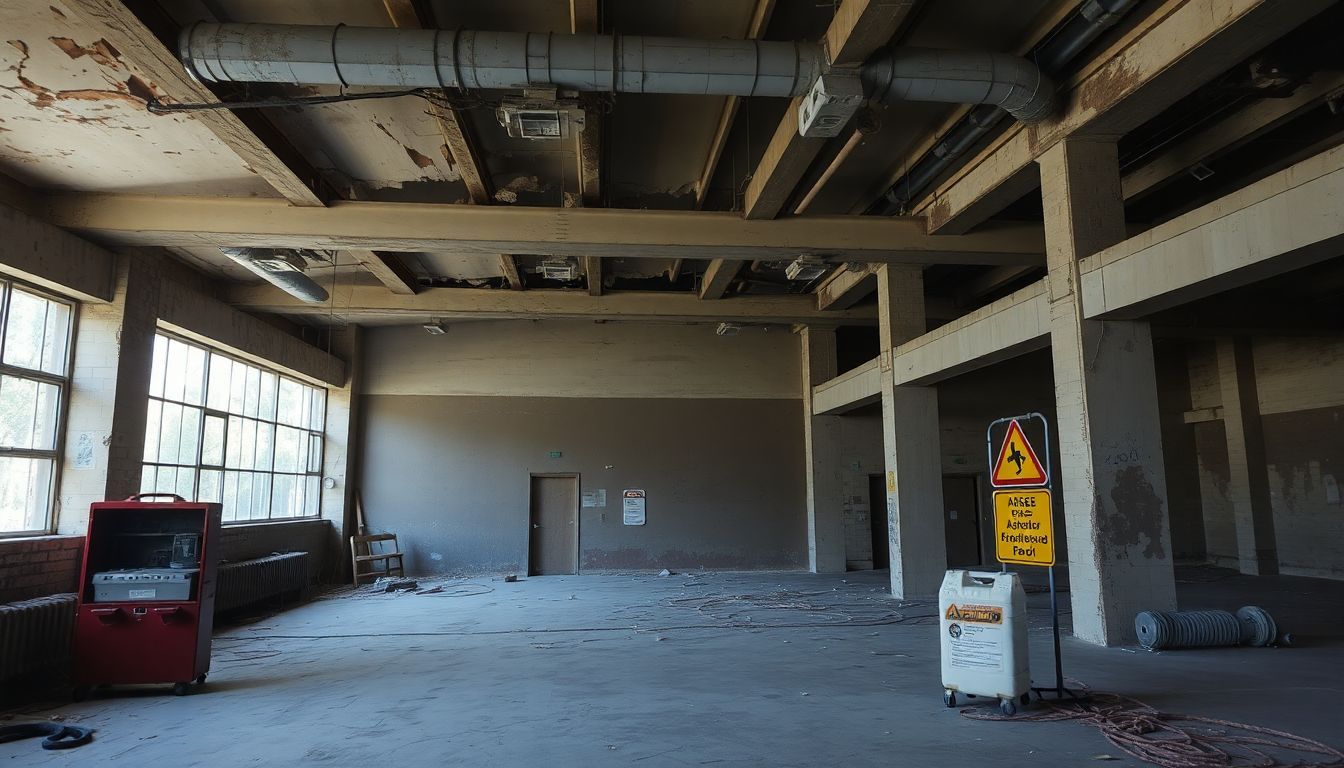
Why Every School Duty Holder Needs an Asbestos Survey
If your school was built or refurbished before 2000, the chances are high that it contains asbestos-containing materials (ACMs). Ceiling tiles, pipe lagging, insulation boards, textured coatings — these were standard building materials for decades. An asbestos survey for school buildings is the only reliable way to find out exactly what you’re dealing with, where it sits, and what condition it’s in.
Without that information, you’re managing a risk you can’t see. In an environment where children and staff are present every single day, that’s not a position any duty holder should be in.
Why Asbestos Remains a Serious Concern in Schools
The construction boom from the 1950s through to the 1980s relied heavily on asbestos. It was cheap, fire-resistant, and easy to work with. Schools, colleges, and universities built or refurbished during that period are likely to contain ACMs in multiple locations — often in areas that staff and pupils use daily.
As long as ACMs are in good condition and left undisturbed, the risk is relatively low. The problem starts when materials are damaged, deteriorate with age, or get disturbed during routine maintenance. Something as simple as drilling into a partition wall or pinning a display board to the wrong surface can release microscopic asbestos fibres into the air.
Those fibres are invisible to the naked eye. Once inhaled, they can cause serious and potentially fatal diseases — including mesothelioma, asbestosis, and lung cancer. These conditions can take decades to develop, which is precisely why asbestos exposure is so often underestimated at the time it occurs.
Caretakers, maintenance staff, and contractors are particularly at risk, but teaching staff and pupils can also be affected if ACMs are disturbed in occupied spaces.
Common Locations for ACMs in Education Buildings
Asbestos doesn’t just hide in plant rooms and service cupboards. In school buildings, it can turn up in areas that see daily footfall, regular maintenance activity, or routine building work.
Common locations include:
- Ceiling tiles and suspended ceiling systems
- Pipe lagging and boiler insulation
- Insulation boards in plant rooms and service cupboards
- Sprayed coatings on structural steelwork and ceilings
- Floor tiles and the adhesive beneath them
- Textured coatings such as Artex on walls and ceilings
- Asbestos cement roofing sheets and guttering
- Partition walls and fire doors in older buildings
Many of these materials are in areas that see regular footfall and maintenance activity. That’s precisely why a thorough asbestos survey for school premises is not optional — it’s a legal duty and a practical necessity.
The Two Types of Asbestos Survey Schools Need to Know About
Not all surveys are the same. Understanding which type you need — and when — is fundamental to staying compliant and keeping people safe.
Management Survey
A management survey is the standard survey for buildings in normal use. It’s designed to locate ACMs that could be disturbed during everyday activities — maintenance, cleaning, minor repairs — and to assess the risk they pose.
The surveyor inspects accessible areas, takes samples of suspect materials, and sends them to a UKAS-accredited laboratory for analysis. The result is a detailed report and asbestos register that tells you where ACMs are, what type of asbestos is present, what condition they’re in, and what action — if any — is required.
This is the survey most schools need as a baseline and for ongoing compliance. If you don’t already have one, commissioning it should be your first priority.
Refurbishment and Demolition Survey
Before any significant building work, you need a demolition survey — formally known as a refurbishment and demolition survey. This is a more intrusive inspection that aims to locate all ACMs in the areas affected by planned works, including inside walls, above ceilings, and within structural elements.
This type of survey is legally required before any refurbishment or demolition work on buildings constructed before 2000. It cannot be carried out while the affected areas are occupied, so planning ahead is essential in a school environment where disruption to teaching must be minimised.
What Does an Asbestos Survey for School Buildings Actually Involve?
An asbestos survey is a structured inspection carried out by a qualified surveyor. Surveys in schools must follow the HSE’s HSG264 guidance, which sets out the methodology for identifying and recording ACMs. This guidance is the industry standard and is what all competent surveyors work to.
Here’s how the process typically unfolds:
- Scope planning: The surveyor maps the buildings, identifies areas to be inspected, and agrees access arrangements with the school.
- Site inspection: All accessible areas are checked systematically. The surveyor notes the location, type, and condition of any suspect materials.
- Sampling: Small samples are taken from materials suspected to contain asbestos. This is done safely using appropriate controls to prevent fibre release.
- Laboratory analysis: Samples go to a UKAS-accredited lab for analysis. UKAS accreditation means the lab meets rigorous quality standards — this matters for the validity of your results.
- Report and register: You receive a written report detailing every ACM found, its location, condition, risk rating, and recommended action. This forms the basis of your asbestos register.
- Management plan: Based on the survey findings, you build or update your asbestos management plan, setting out how each ACM will be monitored, controlled, or removed.
In a school setting, surveyors also need to navigate safeguarding requirements, restricted access during teaching hours, and the need to minimise disruption. An experienced surveyor will plan around these constraints — not treat them as an afterthought.
The Legal Framework: What Schools Must Do
The legal duty to manage asbestos in non-domestic buildings — which includes all educational premises — comes from the Control of Asbestos Regulations. Regulation 4 places a clear duty on the person or organisation responsible for maintenance and repair of the building to manage the risk from ACMs.
In schools, the duty holder may be the local authority, the governing body, an academy trust, or a multi-academy trust — depending on who controls the building. Whoever holds that responsibility must:
- Take reasonable steps to identify ACMs in the premises
- Assess the condition of any ACMs found and the risk they present
- Prepare and implement a written asbestos management plan
- Maintain an up-to-date asbestos register
- Ensure that anyone who may disturb ACMs — including contractors — is informed of their location and condition before work begins
- Provide appropriate asbestos awareness training to relevant staff
- Review and update the plan and register regularly, and after any changes to the building
The Health and Safety at Work etc. Act also applies, placing a general duty on employers to protect staff and others from risks to their health and safety.
Failing to manage asbestos properly can result in HSE enforcement action, improvement notices, prohibition notices, and significant financial penalties. More importantly, it puts real people at risk of serious, life-limiting illness.
Asbestos Management Plans: Keeping Your School Compliant
A survey gives you the information. An asbestos management plan tells you — and everyone else — what to do with it. The plan is a live document, not something you file away and forget. It needs to be accessible, kept up to date, and shared with anyone who could disturb ACMs.
A robust management plan for a school should include:
- A clear record of who the duty holder is and their responsibilities
- The full asbestos register, cross-referenced with building plans
- Risk assessments for each ACM, including priority ratings
- A schedule for periodic re-inspection of ACMs in situ
- Procedures for informing and managing contractors
- Emergency procedures in the event of accidental disturbance
- A training record showing which staff have received asbestos awareness training
- A timetable for reviewing and updating the plan
The plan should be reviewed at least annually and whenever there is a change to the building, a new survey, or an incident involving ACMs. It’s also good practice to review it when key staff change, so that the incoming duty holder is properly briefed from day one.
What Happens If Asbestos Is Disturbed?
If there’s an incident — a ceiling tile is broken, pipe lagging is damaged, or a contractor disturbs an unidentified ACM — you need to act quickly. Isolate the area, prevent access, and arrange for air monitoring to assess whether fibres have been released. The area should not be reoccupied until monitoring confirms it is safe.
Record the incident in detail: what happened, who was present, what materials were involved, and what steps were taken. If staff or pupils may have been exposed, they should be advised to inform their GP.
Unions including the National Education Union provide documentation to support incident recording, which is useful for occupational health purposes.
Contractor Management: A Critical Gap in Many Schools
One of the most common failures in school asbestos management is not informing contractors properly before work begins. Contractors — plumbers, electricians, IT installers, decorators — regularly work in school buildings and may have no idea that the area they’re working in contains ACMs.
The duty holder is legally required to provide contractors with relevant information from the asbestos register before any work starts. This should be a formal process, not an informal conversation.
- Require contractors to sign to confirm they have received and understood the information
- Make sure your permit-to-work system flags ACMs in the relevant areas
- Don’t assume contractors have checked — make it a condition of them being on site
This is one area where good administration genuinely saves lives. A few minutes of due diligence before work starts is far preferable to managing the aftermath of an accidental disturbance in a school corridor.
When Is Asbestos Removal the Right Decision?
Not every ACM needs to be removed. In good condition and left undisturbed, many materials can be safely managed in place. Removal is sometimes the right decision, but it’s not always the best one — poorly managed removal can release more fibres than leaving a stable material alone.
Removal should be considered when:
- An ACM is in poor condition and deteriorating
- The material is in a high-traffic area where disturbance is likely
- Refurbishment or demolition work is planned in the area
- Ongoing management is impractical or too costly
- The risk assessment indicates that removal is the safest long-term option
Any asbestos removal work in a school must be carried out by a licensed contractor. For most ACM types, the work must be notified to the HSE in advance. The area must be properly enclosed, and air monitoring must be carried out before the enclosure is removed and the space returned to use.
This is not work for a general builder. It requires specialist training, equipment, and licensing — and cutting corners here puts everyone at risk.
Choosing the Right Asbestos Surveyor for Your School
Not all surveyors are equal. When commissioning an asbestos survey for school buildings, here’s what to look for:
- BOHS P402 qualification: This is the recognised qualification for asbestos surveyors in the UK. Any surveyor working on your site should hold this as a minimum.
- UKAS-accredited laboratory: Samples should be analysed by a lab with UKAS accreditation. This ensures results are accurate and legally defensible.
- Experience in educational settings: Schools present specific logistical challenges — occupied buildings, safeguarding requirements, limited access windows. An experienced surveyor will understand how to work around these constraints.
- Clear, actionable reports: The report should be easy to understand and give you a clear picture of what’s present, where it is, what risk it poses, and what to do next.
- Transparent pricing: You should know exactly what you’re paying for before the surveyor sets foot on site.
Don’t select a surveyor on price alone. The quality of the survey and the report it produces will shape your asbestos management for years to come.
Asbestos Surveys Across the UK: Where We Work
Supernova Asbestos Surveys carries out asbestos surveys for schools and education buildings nationwide. Whether you need an asbestos survey in London, an asbestos survey in Manchester, or an asbestos survey in Birmingham, our qualified surveyors are available to mobilise quickly and work around your school’s schedule.
We understand the unique demands of surveying occupied educational buildings — from safeguarding protocols to minimising disruption during term time. Our reports are clear, detailed, and built to support your ongoing compliance obligations.
Frequently Asked Questions
Is an asbestos survey a legal requirement for schools?
Yes. Under the Control of Asbestos Regulations, duty holders for non-domestic premises — including schools — are legally required to manage the risk from asbestos. This means taking reasonable steps to identify ACMs, which in practice requires commissioning a professional asbestos survey. The duty applies whether the school is run by a local authority, a governing body, or an academy trust.
What type of asbestos survey does my school need?
Most schools need a management survey as a baseline — this covers the building in normal use and identifies ACMs that could be disturbed during day-to-day activities. If you’re planning any refurbishment or demolition work, you’ll also need a refurbishment and demolition survey for the affected areas before work begins. The two surveys serve different purposes and are both required in different circumstances.
How long does an asbestos survey take in a school?
The duration depends on the size and complexity of the site. A single-building primary school might be surveyed in a day or two; a large secondary school or further education college with multiple buildings could take several days. Your surveyor should provide a clear programme of works before starting, so you can plan access and minimise disruption to teaching.
What should I do if I think asbestos has been disturbed in my school?
Act immediately. Isolate the affected area, prevent access, and contact a specialist to arrange air monitoring. Do not allow the space to be reoccupied until monitoring confirms it is safe. Record the incident in full — what happened, who was present, and what action was taken. If there is any possibility that staff or pupils were exposed, they should be advised to speak to their GP and the incident should be reported through the appropriate channels.
Can asbestos be left in place rather than removed?
Yes — and in many cases, managing ACMs in place is the correct approach. If materials are in good condition and not at risk of disturbance, removal can actually create more risk than it eliminates. The decision should be based on a proper risk assessment carried out by a qualified professional. Where removal is necessary, it must be carried out by a licensed contractor following HSE-approved procedures.
Get Expert Help Today
If you need professional advice on asbestos in your property, our team of qualified surveyors is ready to help. With over 50,000 surveys completed across the UK, Supernova Asbestos Surveys delivers clear, actionable reports you can rely on.
Call us on 020 4586 0680 or visit asbestos-surveys.org.uk for a free, no-obligation quote.