Can I Sue My Landlord for Asbestos Exposure in the UK? Your Rights Explained
If you’ve been exposed to asbestos in a rented property and are now facing a diagnosis, the question of whether you can sue your landlord for asbestos exposure in the UK is one of the most pressing you’ll ever ask. The honest answer is yes — in many cases you can. But the strength of your claim depends on what your landlord knew, when they knew it, and what they failed to do about it.
Asbestos-related diseases are devastating. They often take decades to develop, meaning you may only receive a diagnosis long after the original exposure occurred. If your landlord breached their legal duty of care and that failure contributed to your illness, UK law provides real routes to justice and compensation.
What Are a Landlord’s Legal Duties Around Asbestos?
UK landlords are not simply expected to act responsibly — they are legally required to. Several pieces of legislation place firm duties on landlords and property managers when it comes to asbestos in rented properties.
The Control of Asbestos Regulations
The Control of Asbestos Regulations require dutyholders — which includes landlords and managing agents — to identify, assess, and manage asbestos-containing materials (ACMs) in non-domestic premises and in the common parts of residential buildings. Shared stairwells, corridors, lift shafts, boiler rooms, and communal areas all fall within their legal remit.
Landlords must maintain an up-to-date asbestos register, produce a written asbestos management plan, and ensure that anyone likely to disturb ACMs is made aware of their location. Failure to do any of this is a breach of the regulations — and that breach can form the basis of a legal claim.
A management survey is the standard starting point for landlords to understand what ACMs are present in their building and whether those materials require action.
The Landlord and Tenant Act 1985
Section 11 of the Landlord and Tenant Act 1985 places a duty on landlords to keep the structure and exterior of a rented property in good repair. Where ACMs are present and deteriorating, this duty extends to addressing those materials. A landlord who ignores damaged asbestos that poses a risk to tenants may be in breach of this Act.
The Homes (Fitness for Human Habitation) Act
All rented homes in England must be free from Category 1 hazards under the Homes (Fitness for Human Habitation) Act. Damaged or disturbed asbestos fibres qualify as a Category 1 hazard under the Housing Health and Safety Rating System (HHSRS).
If your landlord knew about dangerous ACMs and failed to act, your home may have been legally unfit for habitation from the moment you moved in.
The Health and Safety at Work etc. Act 1974
This broader piece of legislation imposes a general duty of care on those in control of premises. Both social and private landlords must ensure that people using or visiting a property are not exposed to unnecessary risk. Asbestos exposure resulting from negligent management falls squarely within the scope of this Act.
Grounds for Suing Your Landlord for Asbestos Exposure in the UK
To bring a successful claim against a landlord for asbestos exposure in the UK, you generally need to demonstrate four things. A solicitor specialising in personal injury or housing law will assess your case against these criteria.
- Duty of care: Your landlord owed you a legal duty to manage asbestos safely. This is well established under UK law.
- Breach of duty: Your landlord failed to meet that duty — for example, by not commissioning an asbestos survey, ignoring known damage, or failing to share information about ACMs with you.
- Causation: Your exposure to asbestos fibres was caused, or significantly contributed to, by that breach.
- Harm: You have suffered a recognised asbestos-related illness, such as mesothelioma, asbestosis, pleural thickening, or lung cancer.
If all four elements are present, you have the foundation for a personal injury claim. The burden of proof rests with you, which is why gathering evidence as early as possible is critical.
What Evidence Do You Need to Build Your Case?
A strong claim requires documentation. The more evidence you can gather, the better positioned you will be when working with a solicitor.
Medical Records and Diagnosis
Your medical diagnosis is central to any claim. A confirmed diagnosis of an asbestos-related disease from a specialist consultant provides the foundation for linking your illness to your exposure. Keep all letters, test results, and consultant reports in a safe place.
Proof of Tenancy and Residency
Tenancy agreements, rent receipts, correspondence with your landlord, and utility bills all help to establish where you lived and for how long. The longer the period of potential exposure, the more relevant this becomes to your claim.
Asbestos Survey Reports and Registers
Ask your landlord or managing agent for any asbestos surveys, asbestos registers, or management plans that exist for the property. If they cannot produce one — or if one was never commissioned — that itself may constitute evidence of a breach of duty.
Under the Control of Asbestos Regulations, this documentation should exist for the common parts of any residential block. If your landlord is in London, Manchester, or Birmingham, the obligations are the same regardless of location — the law applies nationally.
Records of Complaints and Correspondence
Did you report concerns about damaged materials to your landlord in writing? Did they fail to respond or dismiss your concerns? Emails, letters, and text messages showing that your landlord was aware of a problem and did nothing are powerful evidence of negligence.
Witness Statements
Neighbours, maintenance workers, or other residents who can confirm the presence of damaged ACMs — or confirm that no safety measures were in place — can strengthen your case considerably. Gather these statements as soon as possible, while memories are fresh.
Time Limits for Making a Claim
This is where many people run into difficulty, and it is vital to understand how the rules work for asbestos-related claims specifically.
Asbestos-related diseases have a latency period that can span 20 to 40 years, meaning the illness may develop long after the original exposure. UK law recognises this through specific limitation rules designed to protect claimants.
For personal injury claims related to asbestos diseases, you generally have three years from the date of knowledge — meaning three years from when you were diagnosed or first became aware that your illness was linked to asbestos exposure. This is not three years from the original exposure, which would make claims almost impossible given the latency period involved.
For claims based on breach of contract — such as a landlord’s failure to repair under the Landlord and Tenant Act 1985 — the limitation period is typically six years from the breach.
Do not delay seeking legal advice. Even if you are unsure whether you have a viable claim, speaking to a specialist solicitor early ensures you do not inadvertently miss a deadline.
What Compensation Can You Claim?
If your claim is successful, compensation can cover a wide range of losses and impacts. The amount will depend on the severity of your illness and the specific circumstances of your case.
- General damages: For pain, suffering, and loss of quality of life caused by the asbestos-related disease.
- Special damages: For financial losses including lost earnings, medical expenses, care costs, and travel to medical appointments.
- Future losses: If your illness will affect your ability to work or require ongoing care, these future costs can be factored into your claim.
- Dependency claims: If a loved one has died from an asbestos-related disease, family members may be able to bring a claim on their behalf under the Fatal Accidents Act.
Mesothelioma claims are treated with particular urgency by the courts, given the aggressive nature of the disease. The Mesothelioma Act also provides a government compensation scheme for those who cannot trace a liable employer or landlord — so even if your landlord is no longer traceable, options may still exist.
What If Your Landlord No Longer Exists or Is Uninsured?
In cases where the responsible landlord has died, a company has been dissolved, or insurance cannot be traced, there are still avenues available to you. The Employers’ Liability Tracing Office (ELTO) holds records of historic employer liability insurance policies.
For residential tenancy situations, a solicitor experienced in asbestos claims will know how to navigate these more complex scenarios. Do not assume that the absence of a traceable landlord means your case is unwinnable — specialist legal advice is essential.
Where Is Asbestos Commonly Found in Rented Properties?
Understanding where ACMs are typically located helps you assess whether you may have been exposed. Properties built before 2000 — and particularly those constructed between the 1950s and late 1980s — are most likely to contain asbestos.
Common locations in flats and rented homes include:
- Textured coatings on ceilings and walls (commonly known as Artex)
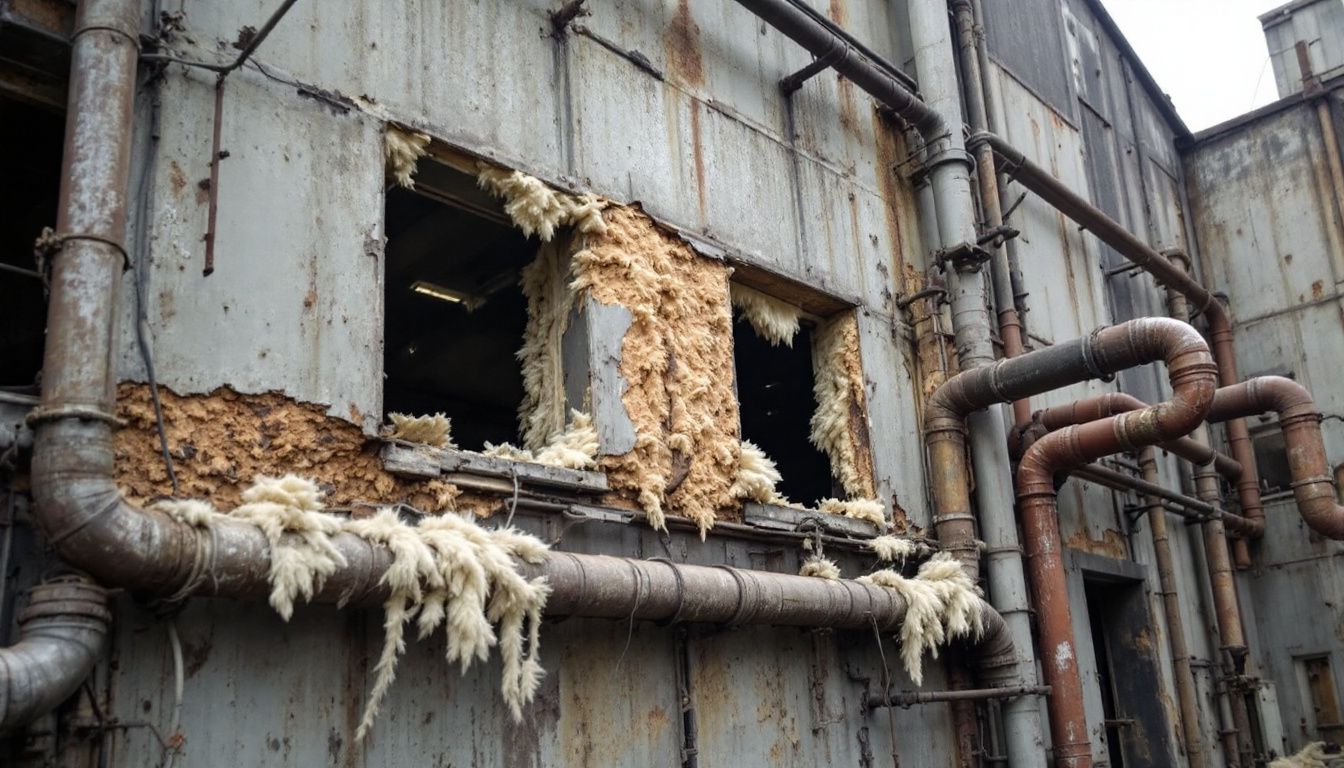
- Pipe lagging in boiler cupboards and airing cupboards
- Ceiling tiles and insulation boards
- Old vinyl floor tiles and the adhesive used beneath them
- Corrugated cement roof sheets and external panels
- Fire doors in older residential blocks
- Storage heaters manufactured before 1985
- Service ducts, lift motor rooms, and communal plant rooms
In blocks of flats, shared areas such as corridors, stairwells, and entrance halls are particularly likely to contain older finishes or panels that include ACMs. These are precisely the areas that fall under a landlord’s duty to manage under the Control of Asbestos Regulations.
Steps to Take If You Suspect Asbestos Exposure in Your Rented Home
If you believe you have been exposed to asbestos in a rented property, acting quickly can protect both your health and your legal position.
- Stop any work that may be disturbing the material. Do not drill, sand, or break materials you suspect contain asbestos.
- Report the issue to your landlord in writing. Email is ideal — it creates a time-stamped record of your concern and their response, or lack of one.
- Request the asbestos register and any survey reports for the property or building.
- Contact your GP if you have symptoms or concerns about your health following potential exposure.
- Report to the local authority’s environmental health team if your landlord does not respond appropriately. They have enforcement powers under the Housing Act 2004.
- Seek legal advice from a solicitor who specialises in asbestos-related personal injury claims.
- Commission an independent asbestos survey if your landlord refuses to act. A qualified surveyor can confirm whether ACMs are present and assess their condition.
If your landlord is not fulfilling their obligations, an independent survey provides documented evidence that can support both a complaint to the local authority and any subsequent legal action.
The Role of Asbestos Surveys and Removal
An asbestos survey is the starting point for understanding what ACMs are present in a building, where they are located, and what condition they are in. For properties where significant refurbishment or demolition is planned, a demolition survey is required to ensure all ACMs are identified before any intrusive work begins.
Where ACMs are found to be damaged, deteriorating, or at risk of disturbance, professional asbestos removal by a licensed contractor is often the safest long-term solution. Licensed removal is legally required for the highest-risk materials, including asbestos insulation, lagging, and sprayed coatings. Only contractors licensed by the HSE are permitted to carry out this work.
For landlords, commissioning surveys and acting on the findings is not just good practice — it is a legal obligation. For tenants, knowing that a survey has been carried out and that its findings have been acted upon provides genuine reassurance that the property is being managed responsibly.
Asbestos Surveys for Landlords and Tenants Across the UK
Whether you are a landlord seeking to fulfil your legal obligations or a tenant who needs independent confirmation of what ACMs are present in your home, professional surveying is the essential first step.
Supernova Asbestos Surveys provides accredited asbestos surveys across the UK. If you are based in the capital, our asbestos survey London service covers all property types, from residential blocks to commercial premises. Our asbestos survey Manchester team and our asbestos survey Birmingham team offer the same accredited, impartial service across the Midlands and the North.
With over 50,000 surveys completed nationwide, our surveyors work to HSG264 standards and provide detailed, actionable reports that hold up to legal scrutiny.
Frequently Asked Questions
Can I sue my landlord for asbestos exposure in the UK even if the exposure happened years ago?
Yes, in many cases. The three-year limitation period for personal injury claims runs from your date of knowledge — the date you were diagnosed or first became aware your illness was linked to asbestos — not from the date of the original exposure. Given that asbestos diseases can take 20 to 40 years to develop, this rule exists specifically to protect people in your situation. Speak to a specialist solicitor as soon as possible after diagnosis.
What if my landlord says they didn’t know there was asbestos in the property?
This is not necessarily a defence. Under the Control of Asbestos Regulations, landlords and managing agents have a legal duty to identify ACMs in the common parts of residential buildings. Claiming ignorance of asbestos that a proper survey would have revealed is unlikely to absolve a landlord of liability. The duty to know — and to act on that knowledge — is built into the law.
Can I make a claim if my landlord’s company no longer exists?
Potentially, yes. Historic insurance policies may still provide a route to compensation even if the landlord or their company is no longer trading. The Employers’ Liability Tracing Office (ELTO) and specialist legal advice can help identify whether an insurance policy can be traced. Do not assume a dissolved company means the end of your options.
Do I need an asbestos survey report to make a claim against my landlord?
A survey report is not a legal requirement to begin a claim, but it is powerful supporting evidence. If your landlord cannot produce a survey — or if one was never commissioned — that absence can itself indicate a breach of duty. An independent survey commissioned after the fact can also confirm the presence and condition of ACMs, which helps establish causation in your claim.
What asbestos-related illnesses can form the basis of a claim?
UK courts recognise several asbestos-related conditions as grounds for a personal injury claim. These include mesothelioma, asbestosis, pleural thickening, pleural plaques (in certain circumstances), and asbestos-related lung cancer. The severity of the condition will affect the level of compensation, but all of these diseases can form the basis of a legitimate legal claim where negligence can be established.
Need an asbestos survey or independent assessment of your property? Supernova Asbestos Surveys has completed over 50,000 surveys across the UK. Our accredited surveyors provide reports that meet HSG264 standards and can be used to support legal proceedings where required. Call us on 020 4586 0680 or visit asbestos-surveys.org.uk to book a survey or speak to our team.