Does Your Home Contain Asbestos? What Every UK Homeowner Needs to Know
Millions of UK homes were built during the decades when asbestos was the default choice for insulation, fireproofing, and general construction. If your property dates from before 2000, there is a genuine chance that asbestos-containing materials (ACMs) are present somewhere inside it.
Asking is there asbestos in the home is not just a question for peace of mind — it is about protecting your health, your family, and every tradesperson who sets foot on your property. Whether you are planning renovations, preparing to sell, or simply want to understand what might be lurking behind your walls, this homeowner’s inspection guide covers where asbestos hides, how it is identified, what a professional survey involves, and exactly what to do if ACMs are found.
What Is Asbestos and Why Was It Used in UK Homes?
Asbestos is a naturally occurring silicate mineral that was mined extensively throughout the twentieth century. Its appeal to builders and manufacturers was straightforward: it is highly resistant to heat, fire, and chemical damage, and it was remarkably cheap to produce at scale.
From the 1930s through to the late 1990s, asbestos was woven into the fabric of British construction — quite literally in some cases, as it was spun into insulating textiles and lagging materials. The UK banned the import and use of all forms of asbestos by 1999, making it one of the later European countries to do so.
The Three Main Types of Asbestos Found in UK Homes
- Chrysotile (white asbestos) — the most commonly used type, found in roof sheets, floor tiles, and textured coatings
- Amosite (brown asbestos) — frequently used in insulation boards and ceiling tiles
- Crocidolite (blue asbestos) — considered the most hazardous; used in pipe lagging and spray coatings
All three types are dangerous when fibres become airborne. Any property built or significantly refurbished before 1999 may contain ACMs, regardless of how well-maintained it appears.
Why Is Asbestos Dangerous?
Asbestos fibres are microscopic. When ACMs are disturbed — by drilling, cutting, sanding, or simply deteriorating over time — they release tiny fibres into the air that are invisible to the naked eye. When inhaled, these fibres embed themselves in lung tissue and cannot be expelled by the body.
The resulting diseases are serious and often fatal. They include:
- Mesothelioma — a cancer of the lining of the lungs with no cure
- Asbestosis — progressive scarring of lung tissue
- Lung cancer — significantly increased risk with asbestos exposure
- Pleural thickening — thickening of the lung lining that restricts breathing
These diseases typically take between 20 and 50 years to develop after initial exposure, which is precisely why asbestos remained in widespread use for so long. By the time the scale of the public health crisis became clear, it was already embedded in buildings across the country.
The UK has one of the highest rates of mesothelioma in the world — a direct legacy of decades of asbestos use in industry and construction. This is not a historical footnote. It is an ongoing public health issue that affects homeowners today.
Is There Asbestos in the Home? Where to Look
One of the most important things to understand is that asbestos is not always obviously visible. It was mixed into dozens of different building products, many of which look completely ordinary. Knowing where to look is the first step in any homeowner’s inspection.
High-Risk Areas and Materials to Check
- Textured coatings — Artex and similar textured wall and ceiling finishes applied before the late 1980s frequently contain chrysotile asbestos
- Insulation boards — found around boilers, in airing cupboards, as ceiling tiles, and as partition panels
- Pipe lagging — the insulating wrap around older heating pipes and boilers
- Floor tiles — vinyl floor tiles and the adhesive used to fix them often contain asbestos
- Roof sheets and panels — corrugated asbestos cement roofing is common in garages, outbuildings, and extensions
- Soffit boards — the boards underneath roof overhangs were frequently made from asbestos cement
- Guttering and downpipes — older properties may have asbestos cement rainwater goods
- Rope seals and gaskets — found around older stoves and boilers
- Loose fill loft insulation — some properties contain asbestos in loose fill form between joists
If your home was built between 1930 and 1999, treat any of these materials with caution until they have been properly assessed. Age alone is not sufficient to confirm the presence of asbestos — and equally, the absence of obvious damage does not mean materials are safe.
Can You Identify Asbestos Just by Looking at It?
No — and this is perhaps the most critical point in any homeowner’s inspection guide. Asbestos cannot be identified by sight, smell, or touch. It has no distinctive colour, texture, or odour that sets it apart from non-asbestos materials.
The only reliable way to confirm whether a material contains asbestos is through laboratory analysis of a sample. This is why professional asbestos testing is the only credible method of establishing what is actually in your home.
Some homeowners attempt to identify asbestos based on the age or appearance of materials. While age is a useful indicator of risk, it is not proof. A material that looks identical to an ACM may be asbestos-free, and vice versa. Making assumptions can be dangerous — particularly before renovation or demolition work.
Do I Have Asbestos in My Home? How to Assess Your Risk
Start with the basics. Ask yourself these questions:
- Was the property built before 2000?
- Has it been significantly extended or refurbished without a prior asbestos survey?
- Are there textured ceilings, older floor tiles, or visible lagging on pipes?
- Is there a garage or outbuilding with a corrugated roof?
- Have previous owners carried out DIY work that may have disturbed older materials?
If you answered yes to any of these, a professional inspection is strongly advisable. This is especially true if you are planning any building work — even something as straightforward as fitting a new kitchen or bathroom.
The Danger of DIY Inspections
The temptation to investigate yourself is understandable, but attempting to remove or sample suspected ACMs without proper training and equipment is not only ineffective — it is potentially illegal and certainly dangerous. Disturbing asbestos-containing materials without proper controls can release fibres into the air of your home, creating a hazard for your family and neighbours.
The Health and Safety Executive (HSE) provides clear guidance on this, and the Control of Asbestos Regulations set out strict requirements for how asbestos work must be managed. Leave the sampling to a qualified professional — it is genuinely not worth the risk.
What Happens During a Professional Asbestos Survey?
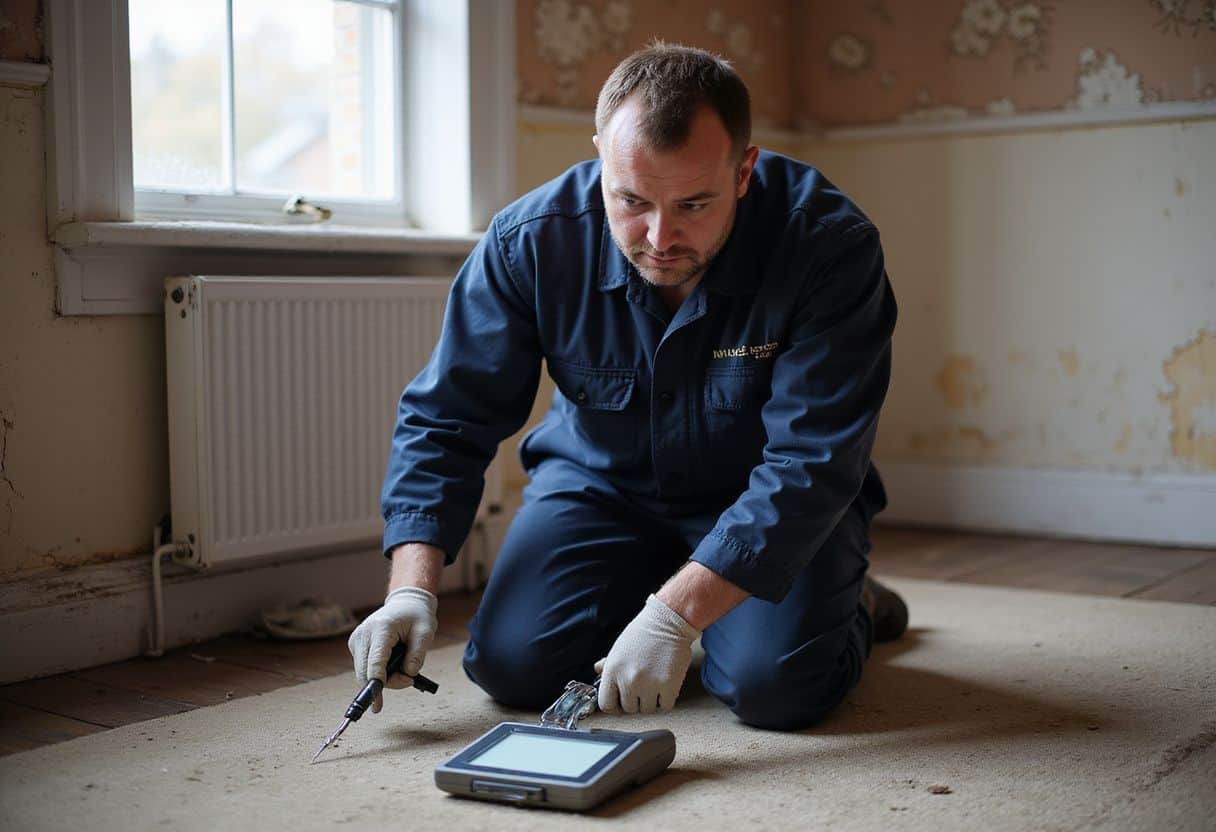
A professional asbestos survey is a systematic inspection of your property carried out by a trained and qualified surveyor. There are two main types relevant to homeowners, and understanding the difference will help you commission the right one.
Management Survey
This is the standard survey for a property that is occupied and not undergoing major works. The surveyor will inspect all accessible areas, identify materials that may contain asbestos, assess their condition, and recommend a management plan. An management survey is the type most homeowners need as a starting point — it gives you a clear picture of what is present and how to manage it safely going forward.
Both types of survey follow the guidance set out in HSG264, the HSE’s definitive document on asbestos surveying. Reputable surveyors will be UKAS-accredited and will provide you with a detailed written report following the inspection.
Refurbishment and Demolition Survey
If you are planning significant building work, a demolition survey is required. This is a more intrusive inspection that involves accessing areas that would normally remain sealed — above ceilings, inside wall cavities, and beneath floors. It is designed to identify all ACMs before work begins so they can be safely managed or removed.
You can also arrange standalone asbestos testing if you have a specific material you want analysed rather than commissioning a full property survey. This can be a cost-effective first step if you have a particular area of concern.
Why Testing Before Renovation or Sale Is Essential
If you are planning to renovate your home, testing for asbestos is not optional — it is a legal and moral obligation. The Control of Asbestos Regulations make clear that anyone commissioning construction or refurbishment work has a duty to identify the presence of asbestos before work begins.
Even well-intentioned DIY work can cause serious harm. Drilling into an asbestos insulation board to hang a shelf, or sanding down an Artex ceiling before redecorating, can release dangerous quantities of fibre into the air of your home. Tradespeople working on your property are also at risk — and as the homeowner, you may have responsibilities towards their safety.
Asbestos and Property Sales
If you are selling your home, having a current asbestos survey on record is increasingly expected by informed buyers and their solicitors. While there is no universal legal requirement to provide one in every transaction, failing to disclose known asbestos risks can create serious legal complications further down the line.
A clean survey report — or one that clearly identifies ACMs and sets out a management plan — demonstrates that you have acted responsibly. A buyer who discovers undisclosed asbestos after completion may have grounds for a claim against you, so commissioning a survey before you list is a straightforward way to protect yourself.
What to Do If Asbestos Is Found in Your Home
Finding asbestos in your home is not automatically a crisis. The presence of ACMs does not mean your home is unsafe to live in — it depends entirely on the condition of the material and whether it is likely to be disturbed.
Asbestos that is in good condition, sealed behind walls or above ceilings, and unlikely to be disturbed is generally best left in place and managed. This is the approach recommended by the HSE for many domestic situations. Your surveyor will assess the condition of any identified ACMs and provide a risk rating.
Where materials are damaged, deteriorating, or in locations where they are likely to be disturbed, asbestos removal or encapsulation may be recommended. Professional removal must be carried out by a licensed contractor in most cases — particularly for higher-risk materials such as sprayed coatings, pipe lagging, and insulation boards.
What to Expect During Asbestos Removal
- Licensed contractors will set up a controlled work area with appropriate containment
- Workers wear full personal protective equipment (PPE) including respirators
- Asbestos waste is classified as hazardous and must be disposed of at licensed sites
- Air monitoring may be carried out during and after removal to confirm clearance
- A clearance certificate is issued once the area is confirmed safe
Do not attempt to remove asbestos yourself. Beyond the health risks, unlicensed removal of notifiable ACMs is a criminal offence under the Control of Asbestos Regulations.
Managing Asbestos Long-Term: Your Responsibilities as a Homeowner
If ACMs are identified in your home but left in place, you have an ongoing responsibility to monitor their condition. Your surveyor will typically recommend a reinspection schedule — usually every 12 months — to check that materials have not deteriorated.
Keep a copy of your asbestos survey report somewhere accessible. If you have tradespeople in to carry out work, share the relevant sections of the report with them before they start. A plumber, electrician, or builder who is unaware of ACMs in your property could inadvertently disturb them — and the consequences can be serious for everyone involved.
If you carry out any work that affects materials listed in your survey, update your records accordingly. Treating your asbestos register as a living document — rather than something you file away and forget — is the responsible approach.
Getting a Survey: What to Look for in a Qualified Surveyor
Not all asbestos surveys are equal. When commissioning a survey for your home, look for the following:
- UKAS accreditation — the surveying company’s laboratory should be accredited by the United Kingdom Accreditation Service
- Qualified surveyors — individual surveyors should hold relevant qualifications such as the RSPH or BOHS P402 certificate
- A written report — the survey should produce a detailed written report identifying the location, type, condition, and risk rating of any ACMs found
- Clear recommendations — the report should tell you what action, if any, is required
- No conflict of interest — be cautious of surveyors who also carry out removal work, as this can create an incentive to overstate risk
Supernova Asbestos Surveys operates nationwide, with specialist teams covering major cities and regions. Whether you need an asbestos survey in London, an asbestos survey in Manchester, or an asbestos survey in Birmingham, our UKAS-accredited surveyors are ready to help.
A Practical Homeowner’s Checklist
Use this checklist as a starting point for managing asbestos risk in your home:
- Establish whether your property was built or refurbished before 2000
- Identify any materials that could potentially contain asbestos — use the list above as a reference
- Do not disturb suspected materials — leave them alone until they have been assessed
- Commission a management survey if you want a baseline picture of what is in your home
- Commission a refurbishment or demolition survey before any significant building work begins
- Share your survey report with any tradespeople working on the property
- Arrange annual reinspections of any ACMs left in place
- Use a licensed contractor for any removal work involving notifiable materials
- Keep your asbestos records up to date and store them safely
Frequently Asked Questions
How do I know if my home has asbestos?
The only reliable way to confirm whether asbestos is present in your home is through professional testing and a formal survey. Visual inspection alone is not sufficient — asbestos cannot be identified by sight, smell, or touch. If your property was built or refurbished before 2000, there is a realistic possibility that ACMs are present, and a professional survey will give you a definitive answer.
Is it safe to live in a house with asbestos?
In many cases, yes — provided the asbestos-containing materials are in good condition and are not being disturbed. Asbestos that is sealed, undamaged, and unlikely to be interfered with poses a low risk in everyday living. The danger arises when materials are disturbed, damaged, or deteriorating, which can release fibres into the air. Your surveyor will assess the condition of any ACMs found and advise on the appropriate course of action.
Do I need an asbestos survey before I renovate my home?
Yes. If your property was built before 2000, you should commission a refurbishment or demolition survey before any significant building work begins. The Control of Asbestos Regulations place a duty on those commissioning construction or refurbishment work to identify asbestos before work starts. Even minor work such as drilling, sanding, or removing flooring can disturb ACMs if their presence is not known in advance.
Can I remove asbestos from my home myself?
In limited circumstances, certain non-licensed work can be carried out by a competent person — but this is a narrow category, and for the vast majority of domestic situations, professional removal by a licensed contractor is required. Attempting to remove notifiable ACMs without a licence is a criminal offence under the Control of Asbestos Regulations. The health risks are also severe. Always engage a licensed contractor and do not attempt DIY removal.
How much does an asbestos survey cost for a home?
The cost of a domestic asbestos survey varies depending on the size of the property, its location, and the type of survey required. A management survey for an average-sized home is generally the most affordable option. A refurbishment or demolition survey, which is more intrusive, will typically cost more. Contact Supernova Asbestos Surveys directly for an accurate quote tailored to your property — call us on 020 4586 0680 or visit asbestos-surveys.org.uk.
Get a Professional Asbestos Survey for Your Home
If you are asking whether there is asbestos in your home, the only way to get a definitive answer is to commission a professional survey. Supernova Asbestos Surveys has completed over 50,000 surveys across the UK, and our UKAS-accredited team has the expertise and equipment to give you a clear, accurate picture of your property’s asbestos status.
Do not leave it to chance — particularly if you are planning building work, preparing to sell, or have concerns about materials in your home. Call us today on 020 4586 0680 or visit asbestos-surveys.org.uk to book your survey or request a quote.
Leave a Reply