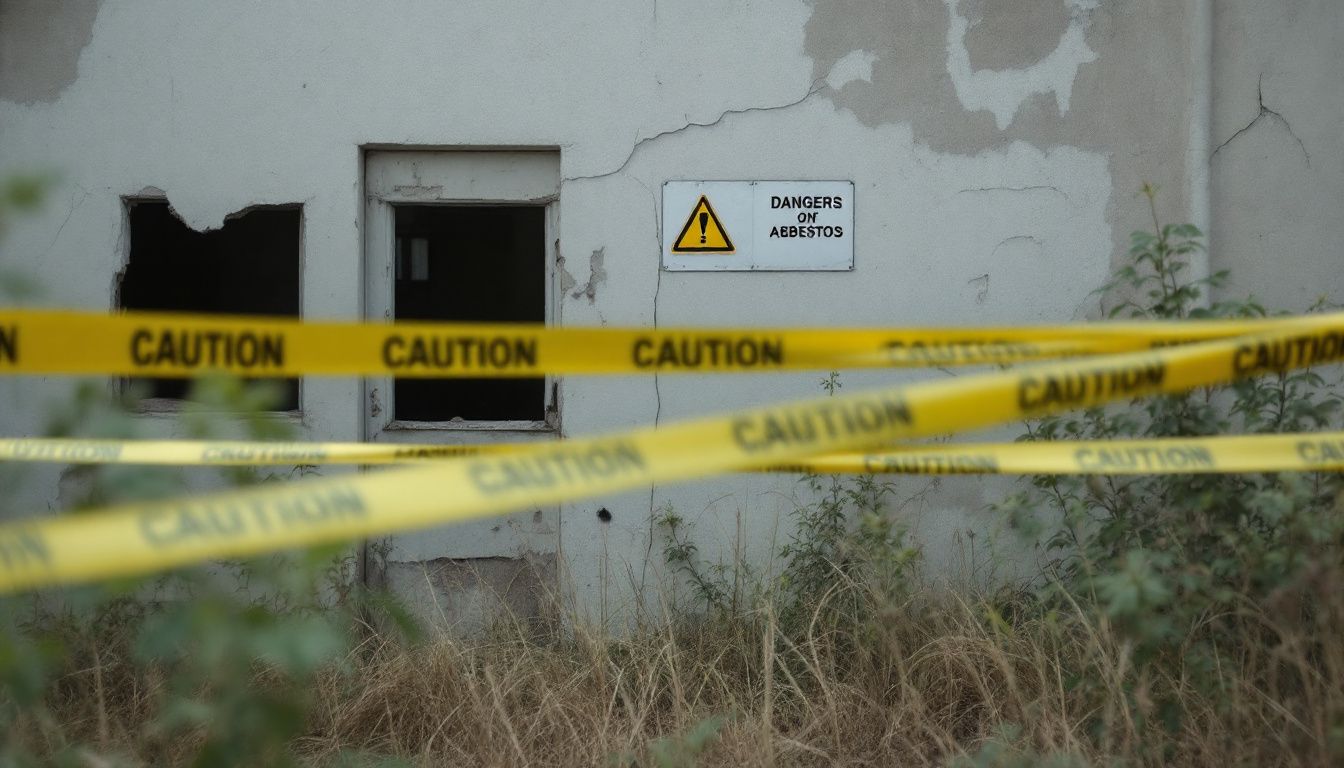
Asbestos Demolition: What the Law Requires and What Actually Happens on Site
Demolishing a building without first understanding what’s inside it isn’t just reckless — it’s illegal. If your property was built before 2000, asbestos demolition rules apply to you, and the consequences of ignoring them range from hefty fines to criminal prosecution. More importantly, disturbing asbestos without proper controls puts workers and the public at serious risk of life-threatening disease.
This post covers what the law says, what a demolition survey actually involves, how to prepare, and what happens to asbestos once it’s found.
Why Asbestos and Demolition Are a High-Risk Combination
Asbestos was used extensively in UK construction right up until its full ban in 1999. It appears in insulation, floor tiles, ceiling tiles, pipe lagging, roofing felt, textured coatings, and dozens of other materials. In an intact, undisturbed state, it poses a lower risk.
Demolition is the opposite of undisturbed. When a building is torn down, any asbestos-containing materials (ACMs) present are broken apart, releasing microscopic fibres into the air. Those fibres, when inhaled, can cause mesothelioma, asbestosis, and lung cancer — diseases that may not appear for decades after exposure.
This is why asbestos demolition planning is taken so seriously under UK law. Demolition workers are among the highest-risk groups for asbestos exposure precisely because the work is inherently destructive. Without a proper survey completed beforehand, no one on site knows where the ACMs are — or that they’re being disturbed at all.
The Legal Framework: What UK Regulations Actually Say
The Control of Asbestos Regulations set out clear legal duties for anyone involved in demolition work on non-domestic premises. The duty to manage asbestos and the requirement to survey before any intrusive work are not optional — they are statutory obligations.
The HSE’s guidance document HSG264 provides the technical framework for how asbestos surveys should be carried out. It defines two main survey types relevant to demolition work: the management survey and the refurbishment and demolition survey. For any planned demolition, only the refurbishment and demolition survey satisfies the legal requirement.
Under the regulations, workers must not be exposed to asbestos above the control limit of 0.1 fibres per cubic centimetre of air, averaged over a four-hour period. A short-term limit also applies. Exceeding these limits — or failing to survey before work begins — is a criminal offence that can result in prosecution by the HSE.
Domestic properties are not exempt from risk, but the legal duty to manage sits differently. If you’re demolishing a domestic building as a contractor or developer, the duty still applies to you. Property owners commissioning demolition work should always seek professional advice before proceeding.
What Is an Asbestos Demolition Survey?
An asbestos demolition survey is a fully intrusive inspection of a building carried out before demolition begins. Unlike a management survey, which checks accessible areas to manage ACMs in an occupied building, a demolition survey is designed to locate every single piece of asbestos-containing material in the structure — including those hidden inside walls, floors, ceilings, roof spaces, and service ducts.
The surveyor will physically break into the fabric of the building to access concealed areas. This is necessary because demolition will expose those areas regardless. The goal is to find everything before the wrecking ball or excavator does.
How It Differs from a Refurbishment Survey
A refurbishment survey is carried out before renovation or refurbishment work in specific areas of a building. It’s intrusive within the scope of the planned works, but it doesn’t need to cover the entire structure.
A demolition survey goes further — it covers the entire structure, because the entire structure is coming down. Both survey types fall under the same HSG264 category of “refurbishment and demolition survey”, but the scope for a demolition is necessarily broader. If you’re planning a full knock-down, a partial refurbishment survey will not be sufficient.
Who Can Carry Out a Demolition Survey?
The surveyor must be competent — in practice, this means holding the BOHS P402 qualification or equivalent, and working for a company with UKAS accreditation. All samples collected during the survey must be analysed by a UKAS-accredited laboratory.
Using an unaccredited surveyor or lab is not only legally risky — it may mean the survey is not accepted by the HSE or local authority. Always ask to see evidence of qualifications and accreditation before appointing a surveyor. A reputable firm will provide this without hesitation.
What Happens During an Asbestos Demolition Survey
Understanding what the survey process involves helps you prepare properly and avoid delays to your demolition programme.
Pre-Survey Preparation
Before the surveyor arrives, gather any existing information about the building: original construction records, previous asbestos surveys, maintenance logs, and any records of past refurbishment work. This context helps the surveyor prioritise areas and identify materials that may have been disturbed or partially removed previously.
The building should be accessible throughout. If certain areas are locked, obstructed, or hazardous for reasons unrelated to asbestos, let the surveyor know in advance. Any areas that cannot be accessed must be noted in the survey report and treated as presumed to contain asbestos.
The Physical Inspection
The surveyor will carry out a systematic, room-by-room inspection of the entire building. This involves physically probing the structure — lifting floor tiles, opening ceiling voids, cutting into partition walls, inspecting pipe runs and ductwork, and checking roof spaces and plant rooms.
Every material that could potentially contain asbestos is identified and noted. The surveyor will assess its condition, location, extent, and accessibility. Materials in poor condition — friable, damaged, or likely to be disturbed — are flagged as higher priority.
Sample Collection and Laboratory Analysis
Samples are taken from suspected ACMs and placed in sealed, labelled containers. These are sent to a UKAS-accredited laboratory for analysis, typically using polarised light microscopy to identify asbestos fibre type and confirm presence. Results are usually returned within a few working days, though faster turnaround is available.
The type of asbestos matters. Crocidolite (blue) and amosite (brown) are considered more dangerous than chrysotile (white), and this affects how removal is planned and licensed.
The Survey Report
Once laboratory results are received, the surveyor produces a detailed written report. This document is central to everything that follows. It should include:
- A full register of all ACMs identified, with location, type, extent, and condition
- Photographs of each material and its location
- Floor plans marking the position of every ACM
- A risk assessment for each material
- Laboratory certificates confirming fibre identification
- Recommendations for removal, encapsulation, or management
This report becomes the asbestos management plan for the demolition project. It must be shared with the principal contractor, demolition team, and anyone else involved in planning or executing the works.
Asbestos Removal Before Demolition
Once the survey is complete and ACMs are identified, the next step is removal — and this must happen before demolition begins, not during it. Attempting to demolish around asbestos-containing materials is not an acceptable approach under UK regulations.
Some asbestos removal work can be carried out by trained non-licensed workers, but most materials encountered in demolition scenarios — particularly pipe lagging, sprayed coatings, and insulating board — require a licensed contractor. The HSE maintains a register of licensed asbestos removal contractors, and you should only use contractors on that register for licensable work.
Professional asbestos removal involves setting up controlled enclosures, using negative pressure units and air filtration equipment, wetting materials to suppress fibre release, and disposing of all waste as hazardous material in double-sealed, labelled bags. After removal, air clearance testing is carried out to confirm the area is safe before the enclosure is dismantled.
Notifying the HSE
For licensable asbestos removal work, the contractor must notify the HSE at least 14 days before work begins. This is a legal requirement, not a courtesy. The notification includes details of the work location, materials involved, methods to be used, and the contractor’s licence number.
As the client commissioning the work, you should confirm that notification has been submitted before work starts. Keep a copy of the notification for your own records.
Waste Disposal
Asbestos waste is classified as hazardous waste under UK regulations. It must be transported by a registered waste carrier and disposed of at a licensed hazardous waste facility. Double-bagging in clearly labelled, UN-approved packaging is required.
Fly-tipping asbestos waste is a serious criminal offence — and it does happen, so choose your removal contractor carefully and request waste transfer documentation for every load removed from site.
Risk Assessment and Air Monitoring During Demolition
Even after a thorough survey and professional removal, residual risk management continues throughout the demolition phase. The principal contractor is responsible for maintaining a safe working environment, and this includes ongoing air monitoring to check that fibre levels remain below the control limit.
Air monitoring should be carried out by a competent analyst — ideally one holding the BOHS P403 or P404 qualification. Monitoring positions should be chosen to reflect where workers are most likely to be exposed, not just at the perimeter of the site.
If unexpected ACMs are encountered during demolition — and this does happen, even after thorough surveys — work must stop immediately. The area must be isolated, and a surveyor called back to assess the material before work resumes. This is not a delay you can afford to skip. Pressing on regardless exposes workers to serious harm and exposes you to criminal liability.
Common Mistakes That Delay Demolition Projects
Most asbestos-related delays to demolition projects are entirely avoidable. Here are the most common errors and how to sidestep them:
- Booking the survey too late. The survey, lab analysis, report, and removal all need to happen before demolition starts. Build at least four to six weeks into your programme for this process — more for larger or more complex buildings.
- Using an unaccredited surveyor. If the surveyor isn’t UKAS-accredited, the survey may not be legally valid. Check credentials before appointing.
- Assuming a previous survey is sufficient. An old management survey is not a substitute for a demolition survey. If the building has never had a full intrusive survey, you need one now.
- Failing to share the survey report with contractors. The demolition team, principal contractor, and any specialist subcontractors need access to the asbestos register before they set foot on site.
- Not having a plan for unexpected finds. Even the best surveys can miss materials hidden behind previous repairs or in areas that weren’t accessible. Have a clear protocol in place before work starts — who gets called, who stops work, and who authorises resumption.
- Underestimating the removal programme. Large quantities of licensable ACMs take time to remove safely. A single large industrial building can require weeks of removal work. Factor this into your programme from the outset.
Asbestos Demolition Surveys Across the UK
Supernova Asbestos Surveys carries out demolition surveys nationwide, with BOHS-qualified surveyors and a UKAS-accredited laboratory delivering accurate, legally compliant reports — typically within 24 hours of survey completion.
Whether you need an asbestos survey London, an asbestos survey Manchester, or an asbestos survey Birmingham, our surveyors work around your demolition programme, provide clear reports that contractors can act on immediately, and offer direct support if unexpected findings arise on site.
With over 50,000 surveys completed across the UK, we understand the pressures of demolition timelines. We’re not here to slow your project down — we’re here to make sure it proceeds legally and safely.
Frequently Asked Questions
Do I need an asbestos survey before demolition?
Yes. Under the Control of Asbestos Regulations, a refurbishment and demolition survey is a legal requirement before any demolition work begins on a building that may contain asbestos. This applies to all non-domestic premises and to contractors and developers working on domestic buildings. The survey must be carried out by a competent, UKAS-accredited surveyor before demolition commences.
What is the difference between a management survey and a demolition survey?
A management survey is designed to manage asbestos in an occupied building. It covers accessible areas and is used to produce an ongoing asbestos management plan. A demolition survey is fully intrusive — the surveyor physically breaks into the fabric of the building to locate all ACMs, including those hidden in concealed voids and structural elements. For demolition work, only the fully intrusive survey meets the legal requirement.
Can demolition start before all asbestos is removed?
No. All identified asbestos-containing materials must be removed by a competent contractor — and in most cases a licensed contractor — before demolition begins. Attempting to demolish a structure while ACMs remain in place is a breach of the Control of Asbestos Regulations and places workers at serious risk. If unexpected ACMs are found during demolition, work must stop until they have been properly assessed and removed.
How long does an asbestos demolition survey take?
The time on site depends on the size and complexity of the building. A small commercial unit might take half a day; a large industrial facility could take several days. Laboratory analysis typically adds a few working days before the final report is issued. In total, you should allow at least one to two weeks from survey to report for most properties, and factor in additional time for removal before demolition can start.
Who is responsible for asbestos during a demolition project?
Responsibility sits with multiple parties. The building owner or developer has a duty to commission a survey and ensure ACMs are removed before work begins. The principal contractor is responsible for managing health and safety on site, including asbestos risks during demolition. Licensed removal contractors are responsible for safe removal and disposal of licensable ACMs. If unexpected asbestos is found on site, the principal contractor must stop work and arrange for assessment before proceeding.
Ready to Book Your Asbestos Demolition Survey?
Don’t let asbestos become the reason your demolition programme stalls. Supernova Asbestos Surveys provides fully intrusive demolition surveys carried out by BOHS-qualified surveyors, with UKAS-accredited laboratory analysis and reports delivered fast.
Call us on 020 4586 0680 or visit asbestos-surveys.org.uk to get a quote and book your survey today. We cover the whole of the UK and can typically mobilise within 24 to 48 hours of instruction.