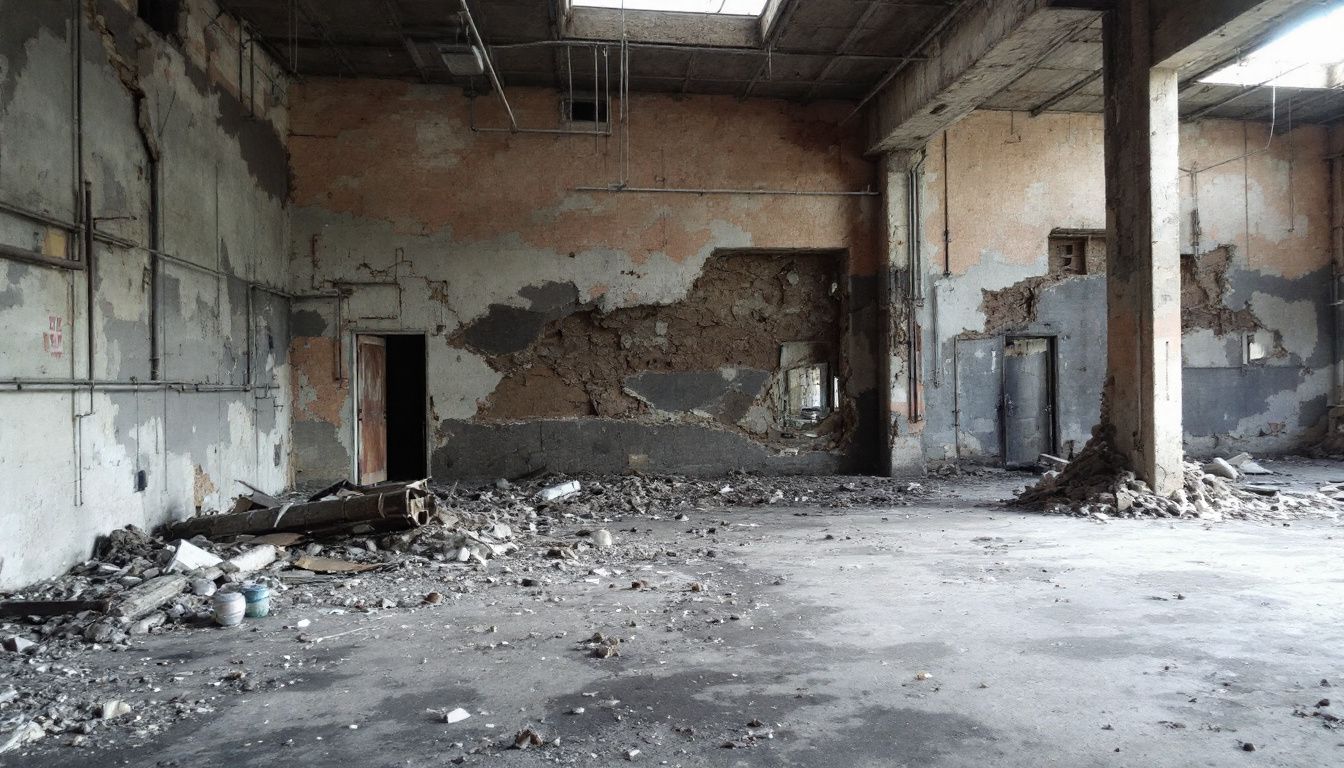
Pre Demolition Asbestos Survey: What You Need to Know Before You Break Ground
Demolishing a building without first commissioning a pre demolition asbestos survey is not just dangerous — it is illegal. Any structure built before the year 2000 may contain asbestos-containing materials (ACMs), and disturbing them without proper identification puts workers, the public, and the environment at serious risk. Getting this right from the start is not optional.
Whether you are a property owner, developer, or principal contractor, this post covers what you need to understand about demolition asbestos surveys — from your legal obligations and the correct survey type, to what happens on the day and how to act on the results.
Why a Pre Demolition Asbestos Survey Is a Legal Requirement
The Control of Asbestos Regulations places a clear duty on those responsible for demolition projects to identify asbestos before any structural work begins. This applies to commercial properties, industrial sites, and residential buildings alike.
If your building was constructed before 2000, you must assume asbestos is present until a survey proves otherwise. Asbestos was used extensively in UK construction throughout the twentieth century — in insulation boards, floor tiles, roof sheeting, pipe lagging, textured coatings, and dozens of other building products.
When these materials are disturbed during demolition, microscopic fibres become airborne. Once inhaled, they can cause mesothelioma, asbestosis, and lung cancer — often decades after exposure. These are not theoretical risks. They are the reason the law is so specific about what must happen before demolition begins.
Failing to commission a survey before demolition is a criminal offence. The Health and Safety Executive (HSE) can issue improvement notices, prohibition notices, and prosecute dutyholders. Fines are unlimited in the Crown Court, and custodial sentences are possible in serious cases.
Choosing the Right Survey Type for a Demolition Project
Not all asbestos surveys are the same, and using the wrong type for a demolition project will leave you legally exposed and your workers at risk. HSG264 guidance sets out the different survey types — but for demolition work, only one is fully appropriate.
Management Survey
A management survey is designed for buildings that remain in normal use. It identifies ACMs in accessible areas to help the dutyholder manage them safely over time. It is not intrusive — surveyors do not break into walls, floors, or ceiling voids.
This type of survey is entirely unsuitable for demolition. It will not locate ACMs hidden behind plasterboard, beneath floor screeds, or above suspended ceilings. Relying on a management survey for a demolition project leaves dangerous materials undiscovered and your project legally compromised.
Refurbishment Survey
A refurbishment survey is required before any work that will disturb the building fabric — extensions, loft conversions, kitchen and bathroom refits, and similar projects. It is intrusive and covers the specific areas where work will take place.
If only part of a building is being demolished as part of a wider refurbishment, a refurbishment survey scoped to the affected areas may be appropriate. However, for full demolition, you need to go further.
Demolition Survey
A full demolition survey is the most thorough type of asbestos survey available. It covers the entire building — every room, every void, every structural element. Surveyors will break into walls, lift floor coverings, access roof spaces, and inspect all service runs to locate every ACM present.
This is the survey you need before demolition. It provides the complete picture required to plan safe asbestos removal ahead of any structural work. Without it, you cannot legally proceed.
What Happens During a Pre Demolition Asbestos Survey
Understanding the survey process helps you prepare the site properly and get the most accurate results. A well-prepared site means a more efficient survey and a more reliable report.
Site Preparation and Access
Before the survey team arrives, the building should be made fully accessible. Surveyors need unrestricted access to all areas — including roof spaces, basements, plant rooms, service ducts, and any areas that have been boarded up or sealed. Restricted access means incomplete results.
The survey team will carry out an initial walk-through to assess the building’s layout, age, construction type, and any visible signs of damage or previous works. This informs the sampling strategy and helps prioritise high-risk areas.
Sampling and Testing
Surveyors collect physical samples from suspect materials throughout the building. Each sample is taken using controlled methods — wetting the material where possible to suppress dust, sealing samples immediately in labelled containers, and recording the exact location of every sample taken.
Samples are sent to a UKAS-accredited laboratory for sample analysis. The lab uses techniques including polarised light microscopy to identify asbestos fibre types and confirm whether materials contain asbestos. Results are typically returned within 24 hours for standard turnaround.
If you need a preliminary indication before a full survey is commissioned, an asbestos testing kit can be used to collect a sample for laboratory analysis — though this is not a substitute for a full demolition survey.
The Survey Report and Asbestos Register
Once analysis is complete, the surveyor produces a detailed written report. This document forms the foundation of your demolition asbestos management plan and must include:
- A full list of all ACMs identified, with their location, extent, and condition
- Photographs of each ACM and sampling point
- Laboratory analysis results for every sample taken
- A risk assessment for each material based on its type, condition, and likelihood of disturbance
- Recommendations for removal, encapsulation, or management prior to demolition
- Scaled floor plans showing ACM locations
This report must be made available to the demolition contractor, the principal contractor under CDM regulations, and any licensed asbestos removal contractor engaged to clear the site. It is not an internal document — it is a legal requirement that feeds directly into the pre-demolition works programme.
Common Locations for Asbestos in Buildings Facing Demolition
Experienced surveyors know where asbestos is most likely to be found — and in demolition projects, nowhere can be assumed safe without sampling. Common locations include:
- Roof and wall cladding: Asbestos cement was used extensively in industrial and agricultural buildings from the 1950s onwards
- Pipe and boiler lagging: Amosite and chrysotile insulation around heating systems, particularly in older commercial and public buildings
- Floor tiles and adhesives: Vinyl floor tiles and the black bitumen adhesive beneath them frequently contain chrysotile
- Textured coatings: Artex and similar products applied to ceilings and walls before the mid-1980s often contain chrysotile
- Insulating board: Partition walls, ceiling tiles, fire doors, and boxing around structural steelwork in buildings from the 1950s to 1980s
- Sprayed coatings: Applied to structural steelwork for fire protection in commercial and industrial buildings
- Gaskets and rope seals: Found in boiler houses, plant rooms, and around industrial equipment
- Soffit boards and fascias: Particularly in domestic properties built between the 1960s and 1990s
This list is not exhaustive. A thorough demolition survey will check all of these areas and more — including any materials that cannot be identified visually and require laboratory confirmation. Professional asbestos testing is the only way to confirm what is and is not present.
Asbestos Removal Before Demolition: The Next Step
The survey report tells you what is present. What happens next depends on the type and condition of the ACMs identified.
Licensed Removal
Certain asbestos materials — including sprayed coatings, lagging, and asbestos insulating board (AIB) — must be removed by a contractor holding a licence issued by the HSE. Licensed removal requires advance notification to the HSE, a detailed written plan of work, and air monitoring throughout the removal process.
Workers on licensed removal projects must hold certificates of medical surveillance and receive specific asbestos training. The work is carried out under controlled conditions, typically within sealed enclosures with negative pressure units to prevent fibre release.
Non-Licensed and Notifiable Non-Licensed Work
Some lower-risk ACMs — such as asbestos cement sheets, floor tiles in good condition, and textured coatings — may be removed under non-licensed or notifiable non-licensed work (NNLW) arrangements, depending on their condition and the scope of disturbance involved.
Even for non-licensed work, the correct personal protective equipment must be worn, appropriate disposal procedures must be followed, and workers must have received suitable training. Asbestos waste cannot go into general skips — it must be double-bagged in sealed, labelled bags and disposed of at a licensed waste facility.
If you need to arrange asbestos removal following your survey, ensure the contractor you appoint holds the correct HSE licence for the materials being removed and can evidence their compliance procedures.
Clearance Certification
Once asbestos removal is complete, a four-stage clearance procedure is required before the area can be handed back. This includes a thorough visual inspection, air testing, and the issue of a clearance certificate by a competent person. Only once clearance certification is in place can demolition proceed safely in that area.
Who Can Carry Out a Pre Demolition Asbestos Survey?
HSG264 guidance is clear: demolition surveys must be carried out by competent surveyors with the appropriate qualifications, training, and experience. In practice, this means looking for surveyors who hold the British Occupational Hygiene Society (BOHS) P402 qualification — the recognised standard for asbestos surveying in the UK.
Surveyors should work for a company that uses a UKAS-accredited laboratory for sample analysis. UKAS accreditation provides independent verification that the laboratory meets the required technical standards. Without this, the reliability of your survey results cannot be guaranteed.
Always ask to see evidence of qualifications and laboratory accreditation before appointing a surveyor. A reputable company will provide this without hesitation. If you are based in the capital, a qualified asbestos survey London provider can mobilise quickly and is familiar with the range of building types and construction eras found across the city.
Pre Demolition Asbestos Survey Costs and Timescales
Survey costs vary depending on the size of the building, its complexity, the number of samples required, and the level of access available. A small domestic property will cost considerably less than a large industrial complex with multiple buildings and extensive service infrastructure.
As a general principle, the cost of a survey is always a fraction of the cost of dealing with an unplanned asbestos discovery mid-demolition. Stopping work, isolating the area, arranging emergency removal, and managing the resulting programme delays is far more expensive — and far more disruptive — than getting the survey right upfront.
Turnaround times for survey reports typically range from 24 to 72 hours after the site visit, depending on the complexity of the project and laboratory capacity. Factor this into your demolition programme — the survey and any subsequent removal works must be completed before structural demolition begins.
If you are unsure whether you need a full demolition survey or whether a targeted asbestos testing approach is appropriate for your project, speaking to a qualified surveyor at the earliest opportunity will save both time and money.
What Happens If Asbestos Is Discovered During Demolition?
If asbestos is unexpectedly encountered during demolition — because no survey was carried out, or because the survey was inadequate — work must stop immediately. The area must be cordoned off, workers must withdraw, and a competent person must assess the situation before any further activity can take place.
This scenario is entirely avoidable. A thorough pre demolition asbestos survey eliminates the risk of unplanned discoveries by identifying all ACMs before a single brick is touched. The cost and disruption of an emergency stop-work situation dwarfs the investment in a proper survey every single time.
Beyond the immediate disruption, an unplanned asbestos discovery triggers a chain of consequences: HSE notification, potential enforcement action, programme delays, and the reputational damage that comes with a notifiable incident on site. None of this is recoverable quickly or cheaply.
Putting It All Together: Your Pre-Demolition Checklist
Before any demolition work begins on a building constructed before 2000, work through the following steps:
- Commission a full demolition survey from a BOHS P402-qualified surveyor working with a UKAS-accredited laboratory
- Review the survey report carefully and ensure all ACMs are listed with their location, condition, and risk rating
- Share the report with the principal contractor, demolition contractor, and any removal contractors under your CDM obligations
- Appoint a licensed removal contractor for any licensable ACMs — confirm their HSE licence is current before work begins
- Obtain clearance certificates for all areas where removal has taken place before allowing demolition to proceed
- Keep records — the survey report, waste transfer notes, and clearance certificates must all be retained
Following this sequence protects your workers, your project programme, and your legal position. Cutting corners at any stage creates risks that are difficult and costly to manage once work is underway.
Frequently Asked Questions
Do I need a pre demolition asbestos survey for a residential property?
Yes. The legal requirement applies to all buildings constructed before 2000, including domestic properties. A house, flat, or bungalow built before that date must be surveyed before demolition begins. The survey type required is a full demolition survey, not a management survey or a basic visual inspection.
Can I use a refurbishment survey instead of a demolition survey?
Only in limited circumstances. If a small section of a building is being demolished as part of a broader refurbishment project, a refurbishment survey scoped to the affected areas may be acceptable. For full building demolition, a complete demolition survey is required. HSG264 guidance is clear on this distinction.
How long does a pre demolition asbestos survey take?
The site visit itself can range from a few hours for a small property to several days for a large commercial or industrial building. Laboratory results are typically returned within 24 hours for standard turnaround. The full written report is usually available within 24 to 72 hours of the site visit completing, depending on the complexity of the project.
What qualifications should my asbestos surveyor hold?
Look for surveyors holding the BOHS P402 qualification, which is the recognised industry standard for asbestos surveying in the UK. The company should also use a UKAS-accredited laboratory for all sample analysis. Ask to see evidence of both before appointing anyone to carry out a demolition survey.
What happens to asbestos waste once it has been removed?
Asbestos waste is classified as hazardous waste and cannot be disposed of in general skips or at standard waste facilities. It must be double-bagged in sealed, clearly labelled bags and transported to a licensed hazardous waste facility. A waste transfer note must be completed and retained. Your removal contractor is responsible for arranging compliant disposal, but you should confirm this before work begins.
Book Your Pre Demolition Asbestos Survey with Supernova
Supernova Asbestos Surveys has completed over 50,000 surveys across the UK, working with developers, contractors, local authorities, and property owners on projects of every scale. Our surveyors hold the BOHS P402 qualification, and all samples are analysed by a UKAS-accredited laboratory — so you can rely on the results.
We provide fast turnaround, clear reports, and straightforward advice on what your results mean and what needs to happen next. Whether you are demolishing a single domestic property or a large commercial site, we have the experience and capacity to deliver.
Call us on 020 4586 0680 or visit asbestos-surveys.org.uk to book your survey or request a quote. Do not leave this to chance — get the survey done before you break ground.