Brexit, Asbestos and UK Schools: What Every Duty Holder Needs to Know
Millions of children sit in classrooms every day surrounded by a hazard most of their teachers, parents, and governors cannot see. The link between Brexit and asbestos exposure in UK schools is not a political talking point — it is a practical, pressing concern that has made an already serious problem harder to manage, more expensive to address, and less consistently enforced.
If you are responsible for a school building constructed before 2000, the combination of regulatory divergence, workforce shortages, and rising costs created by Brexit has directly affected your ability to fulfil your legal duties. Understanding how — and what to do about it — is not optional.
The Scale of Asbestos in UK School Buildings
Before examining how Brexit has complicated the picture, it helps to understand just how widespread asbestos is in UK schools. Many duty holders assume the problem has largely been dealt with. It has not.
More than 21,000 UK school buildings are estimated to contain asbestos-containing materials (ACMs). Asbestos was used extensively in school construction from the 1950s through to the late 1990s — in ceiling tiles, floor tiles, pipe lagging, roof panels, spray coatings, and partition walls. It was cheap, fire-resistant, and widely available, making it a staple of post-war public building programmes.
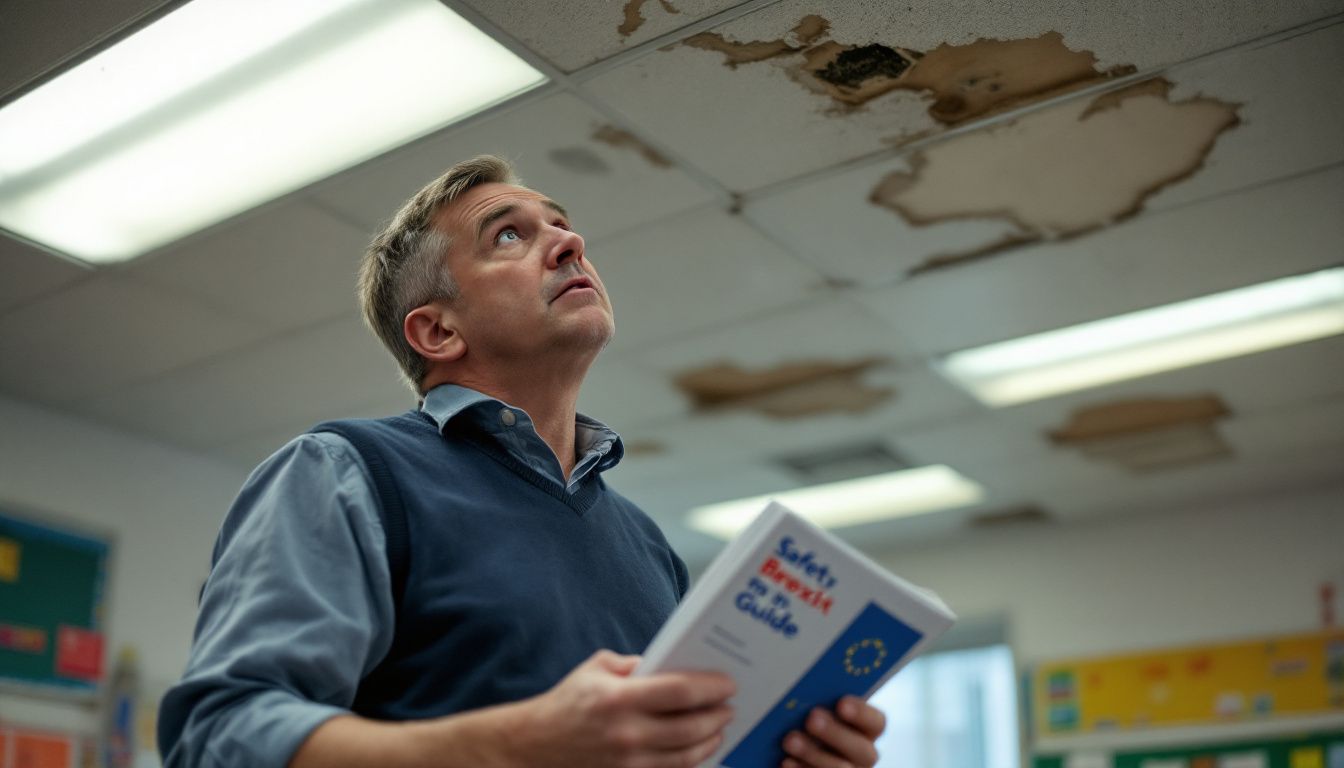
Those buildings are now ageing. As the fabric of a building deteriorates, the risk of ACMs becoming damaged or disturbed increases significantly. Crumbling ceiling tiles, degraded pipe insulation, and worn floor coverings can all release asbestos fibres into the air — fibres that are invisible to the naked eye and undetectable without proper surveying and testing.
Who Is Most at Risk?
Children are particularly vulnerable to asbestos exposure. Their lung tissue is still developing, and they are likely to spend many years in the same building — accumulating exposure over time. Even low-level, repeated exposure carries genuine risk if fibres are regularly released into occupied spaces.
Asbestos-related diseases — including mesothelioma, asbestosis, and asbestos-related lung cancer — kill around 5,000 people in the UK every year. These conditions have long latency periods, meaning symptoms can take decades to appear after initial exposure.
Teachers who worked in poorly managed school buildings in the 1970s and 1980s are still developing these diseases today. This is not a hazard that can be safely deferred indefinitely. The consequences are real, irreversible, and still unfolding.
The Link Between Brexit and Asbestos Exposure in UK Schools
The link between Brexit and asbestos exposure in UK schools operates across several interconnected areas: regulatory divergence, workforce shortages, increased costs, and reduced inspection capacity. These factors do not operate in isolation — together, they compound the risk for school buildings that were already struggling with asbestos management before the UK left the EU.
Regulatory Divergence from EU Standards
Prior to Brexit, the UK’s asbestos regulations were shaped in part by EU directives, which set minimum standards for worker protection and occupational exposure limits across member states. Since leaving the EU, the UK has retained its existing domestic legislation — primarily the Control of Asbestos Regulations — but is no longer automatically aligned with updates made at EU level.
The EU has moved to tighten its occupational exposure limit for asbestos fibres significantly. The UK’s Health and Safety Executive has been reviewing its own guidance and regulatory position, but updating standards independently takes time. In the interim, there is a meaningful divergence between the protections afforded to workers in EU member states and those that currently apply in the UK.
For schools, this means the regulatory floor may be lower than it would have been had the UK remained in the EU. Duty holders cannot rely on automatic alignment with best practice — they need to stay actively informed about HSE guidance updates and not assume that existing arrangements remain adequate simply because they have not been formally challenged.
The End of Free Movement and the Workforce Shortage
One of the most immediate and practical consequences of Brexit for asbestos management in schools has been the loss of skilled workers from EU countries. The asbestos surveying, testing, and removal sector relied heavily on experienced operatives from across Europe — many of whom returned home or chose not to relocate to the UK after freedom of movement ended.
The result has been a tightening of the available workforce at exactly the time when demand for asbestos management services is increasing. Surveys take longer to book. Removal projects face delays. Specialist contractors who can work safely in occupied educational buildings are harder to find and more expensive to engage.
This is not simply an inconvenience. Delays in asbestos removal mean that damaged or deteriorating ACMs remain in place for longer — in spaces used by children and staff every single day. The workforce shortage created by Brexit has a direct and measurable impact on how quickly schools can respond to identified risks.
HSE Capacity and Inspection Frequency
The Health and Safety Executive has faced significant budget reductions over the past decade. Fewer inspectors mean fewer proactive visits to schools and less external pressure on duty holders to maintain rigorous asbestos management practices.
While the legal obligations on schools remain unchanged, the practical enforcement environment has become less intensive — which can create a false sense of security. Brexit has not directly caused HSE budget constraints, but it has added considerable administrative burden to the regulator at a time when resources are already stretched.
Developing new guidance, reviewing exposure limits, and managing the consequences of regulatory divergence all require resource that could otherwise be directed towards inspection and enforcement. The net effect is a less visible regulatory presence in school buildings — and a greater onus on duty holders to self-regulate and maintain standards proactively.
Legal Duties for Schools: What the Regulations Actually Require
Whatever the political and economic context, the legal obligations on schools are clear and have not changed as a result of Brexit. The Control of Asbestos Regulations place specific duties on those who manage non-domestic premises — including schools — to identify, assess, and manage any asbestos present in their buildings.
Who Is the Duty Holder?
The duty holder is the person or organisation with responsibility for maintaining or repairing the building. In practice, this means:
- Local authorities — for maintained schools where they hold the freehold
- Academy trusts — for academies and free schools
- Governing bodies — where they hold responsibility for the premises
- Independent school proprietors — for private and independent schools
The duty holder must ensure that a suitable and sufficient asbestos management survey has been carried out, that an asbestos register is maintained, that an asbestos management plan is in place, and that all staff who could disturb ACMs are made aware of their location and condition.
The Asbestos Management Survey
An asbestos management survey is the starting point for any school’s asbestos management programme. It identifies the location, type, and condition of ACMs throughout the building and provides the information needed to assess risk and prioritise action.
HSE guidance document HSG264 sets out the methodology for asbestos surveys and the standards surveyors must meet. Surveys must be carried out by competent, accredited surveyors — not by site staff or unqualified contractors.
The survey report forms the basis of the asbestos register, which must be kept up to date and accessible to anyone who might disturb ACMs during maintenance or building work. A register that sits in a filing cabinet nobody can locate is not compliant. It needs to be readily available, clearly understood, and actively used as a management tool.
Reinspection: Keeping Records Current
An asbestos register is not a one-off document. The condition of ACMs changes over time — particularly in ageing school buildings where general wear and tear, maintenance activities, and seasonal temperature changes all affect the fabric of the building.
A reinspection survey should be carried out at least annually to check that previously identified ACMs have not deteriorated and that the management plan remains appropriate. Schools that fail to maintain up-to-date records are not only in breach of their legal duties — they are also exposing themselves to significant liability.
Enforcement action following failures to properly manage asbestos has resulted in substantial fines for duty holders across the UK. The consequences of inadequate oversight are very real and increasingly difficult to defend.
The Financial Pressures Driving Poor Compliance
Managing asbestos properly costs money — and schools are operating under severe financial pressure. Brexit has contributed to this through several mechanisms that have driven up the cost of building maintenance and specialist works.
Rising Costs of Materials and Specialist Labour
Construction and maintenance costs have increased substantially since the UK’s departure from the EU. Supply chain disruptions, import costs on materials previously sourced from EU countries, and the reduced pool of specialist labour have all pushed prices upward.
For schools with fixed budgets, the same amount of money buys considerably less building maintenance than it did before Brexit. Asbestos removal in particular requires highly trained, licensed operatives working with specialist equipment. The cost of this work has risen while lead times for booking licensed contractors have lengthened.
Schools that delay commissioning removal works because of cost may find that the problem — and the bill — is considerably larger by the time they act.
Competing Priorities and Difficult Decisions
Head teachers and business managers face genuinely difficult choices. Asbestos management competes with staffing costs, energy bills, IT infrastructure, and a hundred other demands on limited budgets. The temptation to defer surveys or skip annual reinspections is understandable — but it is legally and ethically wrong, and it creates compounding risk over time.
The most cost-effective approach is always to stay ahead of the problem. An up-to-date asbestos register and a well-maintained management survey allow schools to plan and budget for remediation works in a controlled way, rather than responding reactively to emergencies that are invariably more disruptive and more expensive.
What Schools Should Do Right Now
The challenges created by the link between Brexit and asbestos exposure in UK schools are real, but they do not change the fundamental obligations or the practical steps that duty holders need to take. Every school responsible for a pre-2000 building should be acting on the following:
- Check whether a current, valid management survey is in place. If your school was built before 2000 and has never had a survey, or if the survey is more than a few years old, commission a new one without delay.
- Ensure the asbestos register is accessible and up to date. It must be available to anyone carrying out maintenance or building work — including all contractors before they begin work on site.
- Carry out annual reinspections. The condition of ACMs changes. Annual reinspections are not optional — they are part of your duty to manage asbestos safely under the Control of Asbestos Regulations.
- Brief all relevant staff. Site managers, caretakers, and anyone who might disturb building fabric must know where asbestos is located and what to do if they suspect a material has been damaged.
- Plan removal works proactively. Where ACMs are in poor condition or at high risk of disturbance, plan and budget for removal rather than waiting for a crisis. Given current lead times, early engagement with licensed contractors is essential.
- Do not use unaccredited surveyors. In a tightening market, some schools are tempted to use cheaper, unaccredited operators. This is a false economy. Surveys must meet the standards set out in HSG264 to be legally valid.
Staying Compliant Across Different Regions
Asbestos management obligations apply equally across England, Scotland, Wales, and Northern Ireland — but the practical landscape for commissioning surveys and removal works varies by region. In some areas, the workforce shortage is more acute and lead times longer. Planning ahead is especially important for schools in areas where specialist contractors are in short supply.
Supernova Asbestos Surveys operates nationally, providing accredited surveying services to schools and educational establishments across the UK. Whether you need an asbestos survey in London, an asbestos survey in Manchester, or an asbestos survey in Birmingham, our teams are experienced in working within educational settings — including occupied buildings — with minimal disruption to staff and pupils.
The Bigger Picture: Why This Cannot Wait
The link between Brexit and asbestos exposure in UK schools is not going to resolve itself. Regulatory divergence will continue to evolve. Workforce pressures are unlikely to ease quickly. Costs will not fall. And the buildings themselves continue to age.
Against that backdrop, the only rational response for a duty holder is to take control of what they can. That means ensuring surveys are current, registers are accurate, reinspections are scheduled, and removal plans are in place for the ACMs that pose the greatest risk.
Asbestos-related diseases are entirely preventable — but only if the fibres are never released in the first place. Every year that passes without proper management is another year of accumulated risk for the children and staff who occupy these buildings.
The regulatory obligations were designed with exactly this in mind. They are not bureaucratic box-ticking. They are the minimum standard required to keep people safe in buildings that were constructed with a material we now know to be extraordinarily dangerous.
Duty holders who understand the current landscape — including the ways in which Brexit has made compliance harder and more expensive — are better placed to make the case internally for the resources needed to do this properly. That argument is not just about legal risk. It is about the safety of every child who walks through the school gates each morning.
Frequently Asked Questions
Does Brexit change the legal duty to manage asbestos in schools?
No. The Control of Asbestos Regulations remain fully in force and have not been amended as a result of Brexit. Duty holders — including local authorities, academy trusts, and governing bodies — retain all existing legal obligations to survey, register, and manage asbestos-containing materials in their buildings. What Brexit has changed is the practical environment in which those duties must be fulfilled, through workforce shortages, rising costs, and regulatory divergence from EU standards.
How often does a school need an asbestos survey?
Every pre-2000 school building should have a valid asbestos management survey in place. Beyond the initial survey, a reinspection should be carried out at least annually to check the condition of known ACMs and update the asbestos register accordingly. If significant building works, refurbishment, or damage occurs, additional surveys may be required. HSG264 sets out the HSE’s guidance on survey types and frequency.
What is the difference between a management survey and a reinspection survey?
A management survey is a thorough inspection of the building to locate, identify, and assess all accessible ACMs. It forms the basis of the asbestos register and management plan. A reinspection survey is a follow-up inspection of previously identified ACMs to assess whether their condition has changed and whether the management plan needs updating. Both are required under a compliant asbestos management programme.
Has Brexit affected the availability of asbestos surveyors and removal contractors?
Yes, noticeably. The end of free movement has reduced the pool of experienced operatives available to the asbestos sector. This has led to longer lead times for surveys and removal works, and higher costs. Schools should plan ahead and engage accredited contractors as early as possible — particularly for removal projects, which require licensed operatives and can take time to schedule.
What should a school do if asbestos is found to be damaged or deteriorating?
Damaged or deteriorating ACMs should be treated as a priority. The affected area should be secured and access restricted immediately. A competent, accredited surveyor should assess the condition of the material and advise on the appropriate course of action — which may include encapsulation or full removal by a licensed contractor. Do not attempt to repair or disturb the material without professional guidance. The duty holder must ensure that the asbestos register and management plan are updated following any such incident.
Speak to Supernova Asbestos Surveys
Supernova Asbestos Surveys has completed over 50,000 surveys nationwide, working with schools, local authorities, academy trusts, and independent educational establishments across the UK. Our accredited surveyors understand the specific challenges of working in educational settings and can provide management surveys, reinspection surveys, and removal support that meet all HSE requirements.
If you are unsure whether your school’s asbestos management arrangements are current and compliant, do not wait for an inspection or an incident to find out. Call us today on 020 4586 0680 or visit asbestos-surveys.org.uk to arrange a survey or discuss your requirements with one of our specialists.