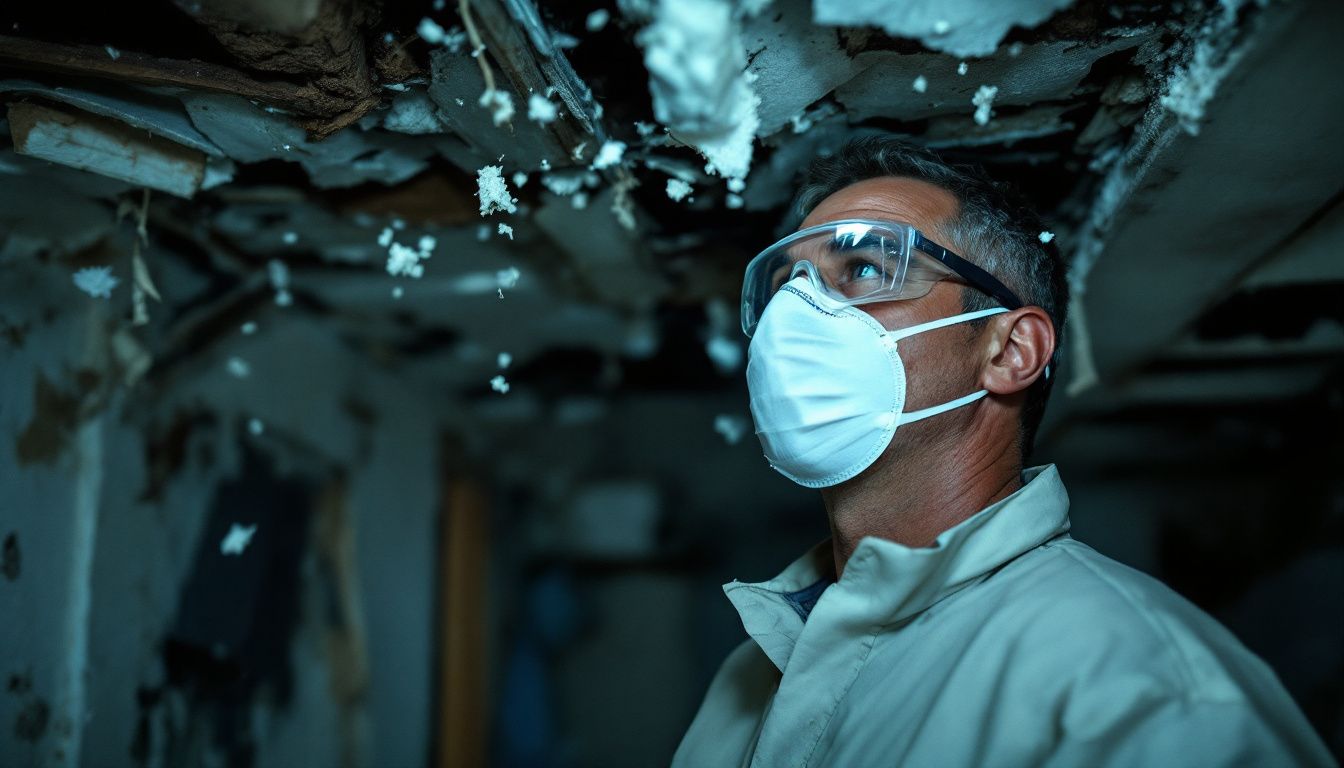
When Asbestos Is Disturbed in an Emergency, Every Minute Counts
A structural collapse, a burst pipe tearing through a ceiling, a fire ripping through an older building — any of these can release asbestos fibres into the air within seconds. Asbestos cleanup in an emergency is one of the most high-stakes situations a property manager or building owner will ever face, and getting it wrong puts lives at serious risk.
Asbestos-related disease remains the UK’s single largest cause of work-related deaths. The fibres are invisible to the naked eye, they have no smell, and they cause no immediate symptoms — which is exactly what makes a fast, structured response so critical.
This post walks you through the correct protocol, step by step, from the moment you suspect asbestos has been disturbed to the point where your building is safe to reoccupy.
Identifying Whether Asbestos Is Present
Before you can manage an asbestos emergency, you need to know what you’re dealing with. Any building constructed or refurbished before 2000 may contain asbestos-containing materials (ACMs). That covers the vast majority of the UK’s commercial and residential building stock.
Where Asbestos Hides in Buildings
ACMs can appear in dozens of locations, many of which are not immediately obvious. Common areas include:
- Ceiling tiles and textured coatings such as Artex
- Pipe lagging and thermal insulation around boilers
- Floor tiles and the adhesive beneath them
- Roof sheets and guttering on older industrial buildings
- Electrical panels and fire-resistant boards
- Spray coatings on structural steelwork
- Partition walls and ceiling void insulation
If your building has a valid management survey on file, that is your first point of reference. It will tell you exactly where ACMs are located, their condition, and their risk rating.
If you don’t have one, you are already operating without a critical piece of safety information — and that is a gap that needs addressing before the next emergency, not after it.
You Cannot Identify Asbestos Visually
This is one of the most dangerous misconceptions in building management. Asbestos cannot be confirmed by appearance alone. A material may look fibrous, dusty, or aged, but only laboratory analysis of a sample can confirm the presence of asbestos.
In an emergency, if there is any reasonable suspicion that a disturbed material contains asbestos, treat it as though it does until testing proves otherwise. This is not overcaution — it is the only defensible approach.
Immediate Actions: The First 30 Minutes
The first half hour after a suspected asbestos disturbance is the most critical window. Your decisions in this period will determine how far contamination spreads and how many people are exposed.
Step 1 — Stop All Work and Evacuate the Area
The moment asbestos disturbance is suspected, all work in the affected area must stop immediately. Everyone — workers, visitors, and occupants — must leave the zone without delay.
Do not attempt to clean up debris yourself. Do not allow anyone back in to retrieve belongings. The risk of secondary exposure from re-entering a contaminated space is significant.
Step 2 — Establish an Exclusion Zone
Cordon off the affected area using physical barriers, hazard tape, and clear warning signage. The exclusion zone should extend beyond the immediately visible damage, as airborne fibres can travel further than the visible disturbance.
Close all doors and windows to the affected space to prevent fibres migrating through airflow. If the building has a central HVAC or air handling system, shut it down for the affected zone immediately. Running ventilation after an asbestos disturbance can spread fibres throughout an entire building.
Step 3 — Notify the Responsible Person and Relevant Authorities
Under the Control of Asbestos Regulations, the duty holder or responsible person for the building must be informed immediately. In a commercial or public building, this is typically the building manager, facilities director, or equivalent.
Depending on the severity of the incident, the Health and Safety Executive (HSE) may need to be notified. Certain asbestos incidents — particularly those involving licensed asbestos removal work that goes wrong — carry mandatory reporting requirements. Your licensed contractor will advise on whether formal notification is required, but do not delay contacting a specialist while you work this out.
Asbestos Cleanup: Who Can Do It and How
This is where many property managers make a costly and dangerous mistake. Asbestos cleanup is not a job for a general cleaning team or maintenance staff. The type of contractor you need depends on the type of asbestos involved and the nature of the disturbance.
Licensed vs. Non-Licensed Removal
The Control of Asbestos Regulations divides asbestos work into three categories:
- Licensed work — required for the most hazardous ACMs, including sprayed coatings, lagging, and certain insulation boards. Only HSE-licensed contractors can carry out this work.
- Notifiable non-licensed work (NNLW) — lower-risk materials that still require notification to the HSE before work begins, along with medical surveillance and record-keeping.
- Non-licensed work — the lowest-risk category, such as minor work on asbestos cement products in good condition.
In an emergency scenario, where materials have been significantly disturbed or damaged, the work will almost always fall into the licensed category. Do not allow anyone without the appropriate HSE licence to carry out the cleanup.
Supernova’s asbestos removal service covers licensed and non-licensed work across the UK, with emergency response capability to get the right team to your site quickly.
The Cleanup Process Step by Step
A licensed asbestos cleanup will typically follow this sequence:
- Air monitoring — baseline air sampling is conducted before cleanup begins to establish contamination levels.
- Enclosure setup — the work area is sealed with polythene sheeting and negative pressure units (NPUs) to prevent fibres escaping during removal.
- Wet cleaning — surfaces are dampened to suppress fibre release. Dry sweeping or vacuuming with standard equipment is strictly prohibited, as it aerosolises fibres.
- HEPA vacuuming — specialist H-class vacuums collect fine dust and debris from all surfaces, working from top to bottom.
- Waste bagging — all contaminated material is double-bagged in clearly labelled, heavy-duty polythene bags and sealed securely.
- Decontamination — the enclosure and all equipment are decontaminated before removal. Workers pass through a decontamination unit before leaving the work area.
- Clearance air testing — an independent analyst carries out a thorough visual inspection and air testing. The area cannot be reoccupied until clearance is certified.
Worker Safety and Personal Protective Equipment
Anyone involved in asbestos cleanup must be properly equipped and trained. There are no exceptions, regardless of how minor the disturbance appears.
Required PPE for Asbestos Cleanup
Standard PPE for licensed asbestos work includes:
- Disposable coveralls (Type 5, Category 3 minimum)
- FFP3 disposable respirator or a half-face respirator with P3 filters — surgical masks and standard dust masks are completely inadequate
- Disposable gloves and overshoes
- Eye protection where there is risk of splash or debris
All PPE must be disposed of as asbestos waste after use. Workers must pass through a decontamination shower or wet-wipe decontamination procedure before removing their respirator.
Removing a respirator before decontamination is complete is one of the most common causes of secondary exposure — and one of the most preventable.
Training Requirements
The Control of Asbestos Regulations require that anyone liable to disturb asbestos during their work receives appropriate asbestos awareness training. For those carrying out licensed removal work, a significantly higher standard of training and certification is required.
This training must be refreshed regularly — it is not a one-time requirement. If your maintenance or facilities team has not received asbestos awareness training, that is a compliance gap that needs addressing now.
Handling and Disposing of Asbestos Waste
Asbestos waste is classified as hazardous waste under UK law. It cannot be placed in general skips, mixed with other construction waste, or taken to standard household waste sites. The consequences of improper disposal include significant fines and potential criminal prosecution.
Correct Asbestos Waste Procedure
- All ACMs and contaminated materials must be double-bagged in UN-approved, clearly labelled asbestos waste sacks
- Bags must be sealed immediately after filling and must not be overfilled
- Waste must be transported by a registered waste carrier with the correct consignment notes
- Disposal must be at a licensed facility authorised to accept hazardous asbestos waste
- Consignment notes must be retained for a minimum of three years
Your licensed contractor will handle this process as part of the removal work, but as the duty holder, you remain responsible for ensuring it is done correctly. Always request copies of the waste transfer documentation for your records.
Regulatory Compliance After an Asbestos Emergency
An asbestos emergency does not end when the cleanup team leaves. There are ongoing compliance obligations that the duty holder must fulfil.
Updating Your Asbestos Register
Your asbestos register and management plan must be updated to reflect the incident, the materials removed, and the current condition of any remaining ACMs. If the emergency resulted in significant structural changes to the building, a follow-up survey may be required to reassess what remains.
For non-domestic properties, maintaining an up-to-date asbestos register is a legal requirement under the Control of Asbestos Regulations. Failure to do so is a prosecutable offence.
Incident Records and Reporting
Keep a detailed written record of the incident. This documentation protects you legally and provides an essential audit trail if questions are raised later about worker or occupant exposure. Your record should include:
- The date, time, and nature of the disturbance
- Which materials were affected and their location
- Who was present in the area at the time
- What immediate actions were taken and by whom
- The contractor engaged, their licence number, and the scope of work carried out
- Air test results and clearance certification
Considering a Post-Emergency Survey
Depending on the scale of the emergency and the extent of structural damage, it is often prudent to commission a demolition survey of the affected areas before any reinstatement work begins. HSG264, the HSE’s guidance on asbestos surveys, sets out the standards for this type of survey and the circumstances in which it is required.
If significant structural work is planned as part of the reinstatement, this survey is not optional — it is a legal requirement to ensure workers carrying out that reinstatement are not exposed to ACMs that were not identified during the emergency response.
Asbestos Cleanup in Schools and Public Buildings
Schools, hospitals, and other public buildings face additional scrutiny when it comes to asbestos management. A large proportion of the UK’s school estate was built during the peak period of asbestos use, and many buildings contain significant quantities of ACMs.
In a school setting, an asbestos emergency requires immediate communication with the local authority or academy trust, notification to parents and staff where appropriate, and a clear reoccupation protocol based on independent air clearance testing.
Staff responsible for these buildings must have a current, accessible asbestos management plan and must know how to act on it. If you manage a school, hospital, or public building without a current asbestos management plan, addressing that gap is urgent. The legal and moral duty of care is significant.
Preparing Before an Emergency Happens
The best time to prepare for an asbestos emergency is before one occurs. If you do not yet have a current asbestos management survey in place, commissioning one is the single most effective step you can take to protect your building, your occupants, and yourself legally.
Knowing where your ACMs are, what condition they are in, and what action level they sit at means that when something goes wrong — and in older buildings, something eventually will — you are not starting from zero.
Property managers in major cities can access fast, accredited surveying from Supernova’s regional teams. Whether you need an asbestos survey London, an asbestos survey Manchester, or an asbestos survey Birmingham, our teams are available to survey your building and produce a fully compliant report that meets HSG264 standards.
Having that survey on file before an emergency means your exclusion zone is set correctly, your contractor knows exactly what they’re dealing with, and your duty of care is documented. It is not an administrative exercise — it is practical risk management.
Get Expert Help from Supernova Asbestos Surveys
Whether you are dealing with an asbestos emergency right now or want to ensure you are properly prepared before one happens, Supernova Asbestos Surveys can help. With over 50,000 surveys completed across the UK, our UKAS-accredited team provides fast, reliable asbestos surveying, air testing, and removal coordination.
Call us on 020 4586 0680 or visit asbestos-surveys.org.uk to speak with our team or book a survey. We provide emergency response as well as planned survey work — so whatever situation you are facing, you do not have to face it without expert support.
Frequently Asked Questions
What should I do first if I suspect asbestos has been disturbed?
Stop all work immediately and evacuate everyone from the affected area. Establish an exclusion zone using hazard tape and signage, shut down any HVAC systems serving the area, and contact a licensed asbestos contractor as quickly as possible. Do not attempt to clean up any debris yourself.
Can my regular cleaning or maintenance team carry out asbestos cleanup?
No. Asbestos cleanup must be carried out by appropriately trained and, in most emergency scenarios, HSE-licensed contractors. Using untrained staff to clean up asbestos is a criminal offence under the Control of Asbestos Regulations and puts those individuals at serious risk of exposure.
How do I know if my building contains asbestos?
If your building was constructed or refurbished before 2000, it may contain asbestos-containing materials. The only way to know for certain is to commission a professional asbestos management survey. You cannot identify asbestos by appearance alone — laboratory analysis is required to confirm its presence.
What happens to asbestos waste after a cleanup?
All asbestos waste is classified as hazardous waste under UK law. It must be double-bagged in UN-approved sacks, transported by a registered waste carrier with the correct consignment notes, and disposed of at a licensed facility. Your licensed contractor will manage this process, but as duty holder you should retain copies of all waste transfer documentation.
Do I need a new asbestos survey after an emergency?
In many cases, yes. If the emergency caused significant structural damage or if reinstatement work is planned, a refurbishment and demolition survey of the affected areas is required before that work begins. Your asbestos register must also be updated to reflect what was removed and the current condition of any remaining ACMs.