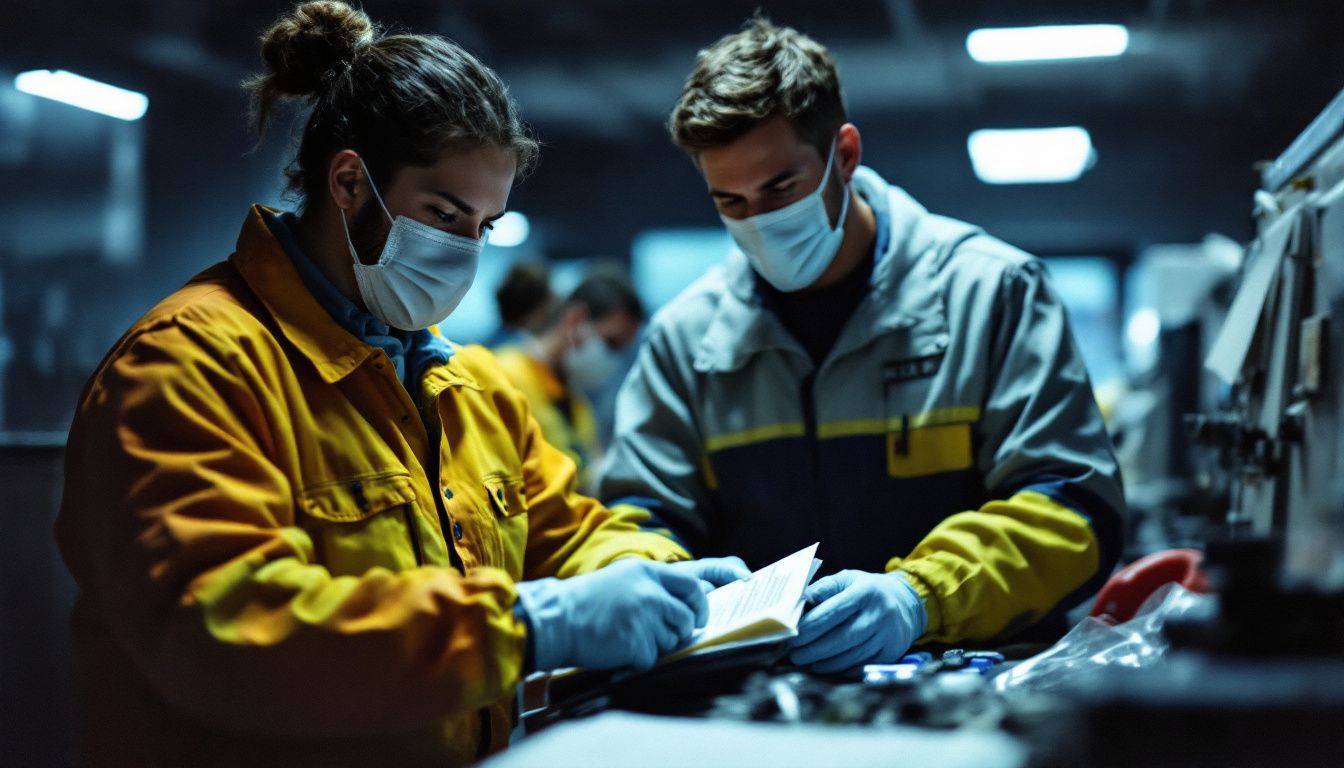
When Asbestos Is Disturbed at Work, Every Minute Counts
An asbestos emergency response situation can develop in seconds — a ceiling tile cracks, pipe lagging gets knocked, a wall gets cut into during a renovation. What happens in the next few minutes determines whether a minor incident stays contained or becomes a serious, long-term health risk for everyone in the building.
Asbestos remains the single largest cause of work-related deaths in the UK. The material was used extensively in construction until its full ban in 1999, meaning millions of buildings still contain it today. If your workplace was built or refurbished before 2000, there is a realistic chance asbestos-containing materials (ACMs) are present somewhere on the premises.
What follows is exactly what to do when something goes wrong — from the first moment of discovery through to decontamination, disposal, and getting back to normal operations safely.
Why Asbestos Emergencies Demand an Immediate Response
Asbestos fibres are microscopic. You cannot see them, smell them, or taste them. Once disturbed, they become airborne and can travel through ventilation systems, on clothing, and on the soles of shoes.
The damage they cause — mesothelioma, asbestos-related lung cancer, asbestosis — does not show up for decades, which is part of what makes them so dangerous. The World Health Organisation is clear: there is no safe level of asbestos exposure. That is not a precautionary exaggeration — it is the basis for the strict legal framework governing asbestos management in the UK under the Control of Asbestos Regulations and supporting HSE guidance including HSG264.
A proper asbestos emergency response is not about overreacting. It is about recognising that even a small release of fibres in an occupied workspace is a serious event requiring a structured, competent response.
Step One: Evacuate the Area Without Delay
The moment asbestos-containing material is suspected of being disturbed, the priority is getting people out. Do not wait for confirmation. Do not attempt to clean up. Move everyone away from the affected area immediately.
A designated safety officer or responsible person should guide the evacuation and confirm that all workers have left the zone. Everyone who was in the area at the time of the disturbance should be accounted for and their details recorded — including the time they left and how long they may have been exposed.
Key Evacuation Actions
- Stop all work in the affected area immediately
- Direct all personnel away from the zone using the nearest safe exit
- Do not allow anyone to re-enter for any reason
- Keep a written log of who was present and when they left
- Prevent others from entering by positioning staff at access points
- Ask those who were in the area not to brush down their clothing — this can release trapped fibres
Buildings constructed before 2000 are particularly likely to contain ACMs in locations that are not always obvious — above ceiling tiles, within partition walls, around pipework, or beneath floor coverings. If there is any doubt about what has been disturbed, treat it as a potential asbestos emergency until confirmed otherwise.
Step Two: Isolate and Seal the Contaminated Zone
Once people are clear, the next priority in any asbestos emergency response is preventing the spread of fibres to other parts of the building. This is not something that should be improvised — it requires a methodical approach.
Close all doors and windows in and around the affected area. Switch off any HVAC or ventilation systems that serve that zone, as air movement is one of the fastest ways fibres travel through a building. Where possible, seal gaps around doors and vents using heavy-duty polythene sheeting and duct tape.
Isolation Checklist
- Close and seal all doors leading to the contaminated area
- Turn off ventilation, air conditioning, and heating systems in the zone
- Seal air vents and gaps with polythene sheeting
- Erect physical barriers and post clear warning signage
- Restrict access to essential trained personnel only
- Maintain a log of everyone entering and exiting the zone
Only workers with appropriate personal protective equipment (PPE) and relevant training should enter the isolation zone. No exceptions.
Step Three: Notify the Right People Immediately
An asbestos emergency is not something to manage quietly or delay reporting. Your duty holder, health and safety manager, and any relevant site manager must be informed straight away. In many workplace scenarios, notification of the relevant enforcing authority — either the HSE or the local authority — may also be required.
Your workplace should have a pre-prepared emergency contact list that is accessible to all staff. It should include:
- The designated asbestos duty holder or responsible person
- Your health and safety officer
- A licensed asbestos removal contractor
- The HSE incident contact centre (for reportable incidents)
- Occupational health contacts for any potentially exposed workers
Only licensed contractors are legally permitted to work with most forms of asbestos under the Control of Asbestos Regulations. Do not attempt to clean up, bag, or remove any material yourself unless you hold the relevant licence and have the appropriate equipment. Attempting DIY remediation not only creates additional risk — it is a criminal offence.
Identifying Asbestos-Containing Materials in the Workplace
Effective asbestos emergency response starts long before an incident occurs. Knowing where ACMs are located in your building — and in what condition — is a legal requirement for duty holders under the Control of Asbestos Regulations.
If your building has an asbestos register, this should be the first document consulted when an incident occurs. It will tell you whether the material that has been disturbed is confirmed or presumed to contain asbestos, what type it is, and what condition it was in at the time of the last survey.
Where Asbestos Is Commonly Found
Asbestos was used in an enormous range of building products. In a pre-2000 commercial or industrial building, you might find it in:
- Ceiling tiles and textured coatings (including Artex-style finishes)
- Floor tiles and the adhesive used to fix them
- Pipe lagging and boiler insulation
- Roof sheets, guttering, and soffit boards
- Partition walls and wall panels
- Fire doors and fire-resistant panels
- Sprayed coatings on structural steelwork
- Cement products including soffits and rainwater goods
Asbestos cement products are among the most widely encountered in UK buildings and, while considered lower risk when intact, can release fibres rapidly when cut, drilled, or broken. Sprayed coatings and pipe lagging are considered higher risk because the fibres are more loosely bound and more easily released.
Visual Inspection — What to Look For
A visual check of potentially affected materials can help inform the response, but it cannot confirm the presence of asbestos. Only laboratory analysis of a sample can do that.
During a visual check:
- Look for crumbling, friable, or powdery surfaces on old insulation or ceiling materials
- Check for water damage, which can degrade ACMs and make them more likely to release fibres
- Note any areas where maintenance or construction work has recently been carried out
- Photograph anything suspicious before touching or disturbing it further
- Do not scrape, prod, or sample materials without proper training and PPE
If you do not have an up-to-date asbestos register for your building, or if works have been carried out that may have disturbed previously recorded ACMs, commissioning a fresh survey should be a priority. Our team carries out asbestos survey London work across the capital with rapid turnaround for urgent situations.
Personal Protective Equipment and Engineering Controls
If trained personnel must enter the contaminated zone — to assess the situation, establish containment, or begin remediation — they must be properly equipped. The right PPE is not optional; it is a legal requirement and a basic safeguard against a potentially fatal exposure.
Required PPE for Asbestos Work
- Respiratory protective equipment (RPE): A minimum of a half-face mask fitted with a P3 filter, or a full-face respirator for higher-risk work. Disposable FFP3 masks are not sufficient for significant asbestos work.
- Disposable coveralls: Type 5 disposable overalls that cover the entire body, including the head. These must be disposed of as asbestos waste after use.
- Gloves: Disposable nitrile or similar — not fabric gloves that can trap and carry fibres.
- Boot covers: To prevent fibres being tracked out of the contaminated zone on footwear.
Engineering Controls That Reduce Fibre Release
Beyond PPE, engineering controls form a critical layer of protection during any asbestos emergency response. These include:
- Negative pressure enclosures: Sealed enclosures maintained at negative air pressure relative to surrounding areas, preventing fibres from escaping
- Local exhaust ventilation (LEV): Systems that capture fibres at the point of disturbance
- Type H vacuum cleaners: Specifically designed for asbestos work — standard vacuum cleaners will spread fibres rather than contain them
- Wet methods: Dampening materials before disturbance significantly reduces the release of airborne fibres
Dry sweeping is never acceptable in a contaminated area. It disperses fibres into the air and makes a bad situation considerably worse.
Decontamination and Safe Disposal of Asbestos Waste
Once the immediate emergency is under control and licensed contractors are on site, the focus shifts to decontamination and safe disposal. This is not a process that can be rushed or cut short.
Cleaning the Affected Area
All surfaces within the contaminated zone must be cleaned using wet methods and Type H vacuum cleaners. Wet rags and damp cloths can be used to wipe down hard surfaces, but they must be treated as asbestos waste immediately after use.
No surface should be dry-dusted or swept. Air monitoring should be carried out during and after the clean-up process to confirm that fibre levels have returned to safe limits before the area is re-occupied. This monitoring must be carried out by a competent person using the appropriate equipment.
Disposing of Asbestos Waste Correctly
All asbestos waste — including contaminated materials, PPE, cleaning cloths, and polythene sheeting — must be double-bagged in heavy-duty polythene bags specifically designed for asbestos waste. Each bag must be clearly labelled with the appropriate hazard warning.
Asbestos waste is classified as hazardous waste under UK legislation. It must be transported by a licensed waste carrier and disposed of at a licensed facility. Fly-tipping asbestos waste is a serious criminal offence with significant penalties.
For full asbestos removal and disposal carried out by licensed professionals, Supernova Asbestos Surveys can manage the entire process from survey through to clearance certification.
Health Surveillance and Post-Incident Monitoring
After an asbestos emergency, the duty to protect workers does not end when the area is cleaned up. Anyone who may have been exposed — even briefly — should be referred to occupational health for assessment. This is both a legal obligation and a basic duty of care.
Exposure records must be maintained for a minimum period specified under the Control of Asbestos Regulations. These records form an important part of any future health surveillance and may be relevant to compensation claims that arise years or decades later.
Regular air monitoring in the weeks following an incident can provide reassurance that the remediation was effective and that no residual contamination remains. It also demonstrates due diligence on the part of the duty holder.
Reviewing and Updating Your Emergency Plan
Every asbestos emergency, however minor, should trigger a review of your existing asbestos management plan and emergency procedures. A near-miss or contained incident is valuable information — use it to identify gaps in your response protocols before a more serious event occurs.
Your review should consider:
- Whether the incident was foreseeable and whether your risk assessment reflected that risk
- Whether staff responded correctly and whether further training is required
- Whether your asbestos register accurately reflects the current condition of ACMs in the building
- Whether your emergency contact list is current and accessible to all relevant personnel
- Whether the physical controls in place — barriers, signage, PPE stocks — were adequate
If your asbestos management plan has not been reviewed recently, or if your building has undergone any works since the last survey, a fresh management survey should be commissioned. Our teams provide asbestos survey Manchester and asbestos survey Birmingham services for businesses across the UK that need a reliable, accredited partner for ongoing asbestos management.
Training: The Foundation of an Effective Asbestos Emergency Response
No emergency plan works if the people expected to follow it have never been trained. Under the Control of Asbestos Regulations, anyone who is liable to disturb asbestos in the course of their work must receive appropriate information, instruction, and training.
For most workplaces, this means ensuring that:
- Facilities managers and site supervisors understand what ACMs may be present and where
- Maintenance workers know how to identify suspect materials and what to do if they encounter them
- All staff know the basic emergency procedure — stop, leave, report
- A designated person is trained to lead the initial response and liaise with licensed contractors
Asbestos awareness training is widely available and relatively low cost. It is a basic investment that can prevent an incident from escalating into a major health and legal crisis. Refresher training should be provided regularly, and records of all training must be kept.
Legal Responsibilities of the Duty Holder
The duty to manage asbestos in non-domestic premises falls on the duty holder — typically the owner, employer, or person responsible for the maintenance and repair of the building. This duty is set out in the Control of Asbestos Regulations and is not transferable.
In the event of an asbestos emergency, the duty holder is responsible for ensuring that the correct response is carried out, that affected workers are protected, and that the incident is properly documented and reported where required. Failure to meet these obligations can result in prosecution, significant fines, and in serious cases, imprisonment.
The HSE takes asbestos management failures seriously. Enforcement action following an asbestos incident is not uncommon, particularly where it can be shown that the duty holder was aware of the presence of ACMs and failed to take adequate precautions.
Having a robust, tested asbestos emergency response procedure in place — and being able to demonstrate that it was followed — is the most effective protection against enforcement action and civil liability.
Frequently Asked Questions
What should I do first if I think asbestos has been disturbed at work?
Stop all work in the affected area immediately and evacuate everyone from the zone. Do not attempt to clean up or collect samples. Once the area is clear, seal it off as best you can — close doors, switch off ventilation — and contact a licensed asbestos contractor. Record the names of everyone who was present and how long they may have been in the area.
Can I clean up disturbed asbestos myself?
No. Under the Control of Asbestos Regulations, most asbestos removal and remediation work must be carried out by a licensed contractor. Attempting to clean up asbestos yourself without the appropriate licence, training, and equipment is a criminal offence and creates serious health risks. Contact a licensed contractor as soon as the area has been evacuated and isolated.
How do I know if a material contains asbestos?
You cannot tell by looking at it. Visual inspection can indicate that a material may be suspect — particularly if it is old, crumbling, or in a location where asbestos was commonly used — but only laboratory analysis of a sample can confirm the presence of asbestos. If you are unsure, treat the material as if it contains asbestos until testing proves otherwise.
Who do I need to notify after an asbestos incident at work?
At a minimum, you must notify your duty holder and health and safety manager immediately. Depending on the circumstances, you may also be required to notify the HSE or the relevant local authority. If any workers were potentially exposed, they must be referred to occupational health and their exposure must be recorded. A licensed asbestos contractor should be engaged to carry out remediation and provide clearance certification.
How long do I need to keep records of an asbestos exposure incident?
The Control of Asbestos Regulations specify minimum retention periods for exposure records. Given that asbestos-related diseases can take decades to manifest, these records may be critical in any future health surveillance or compensation proceedings. Your occupational health provider and health and safety adviser can confirm the specific requirements applicable to your situation.
Get Expert Support for Your Asbestos Emergency Response
Supernova Asbestos Surveys has completed over 50,000 surveys across the UK and provides rapid-response support for businesses dealing with asbestos incidents. Whether you need an urgent survey, licensed removal, or help reviewing your asbestos management plan, our accredited team is ready to help.
Call us on 020 4586 0680 or visit asbestos-surveys.org.uk to speak with a specialist. Do not wait for an incident to happen before putting the right procedures in place.