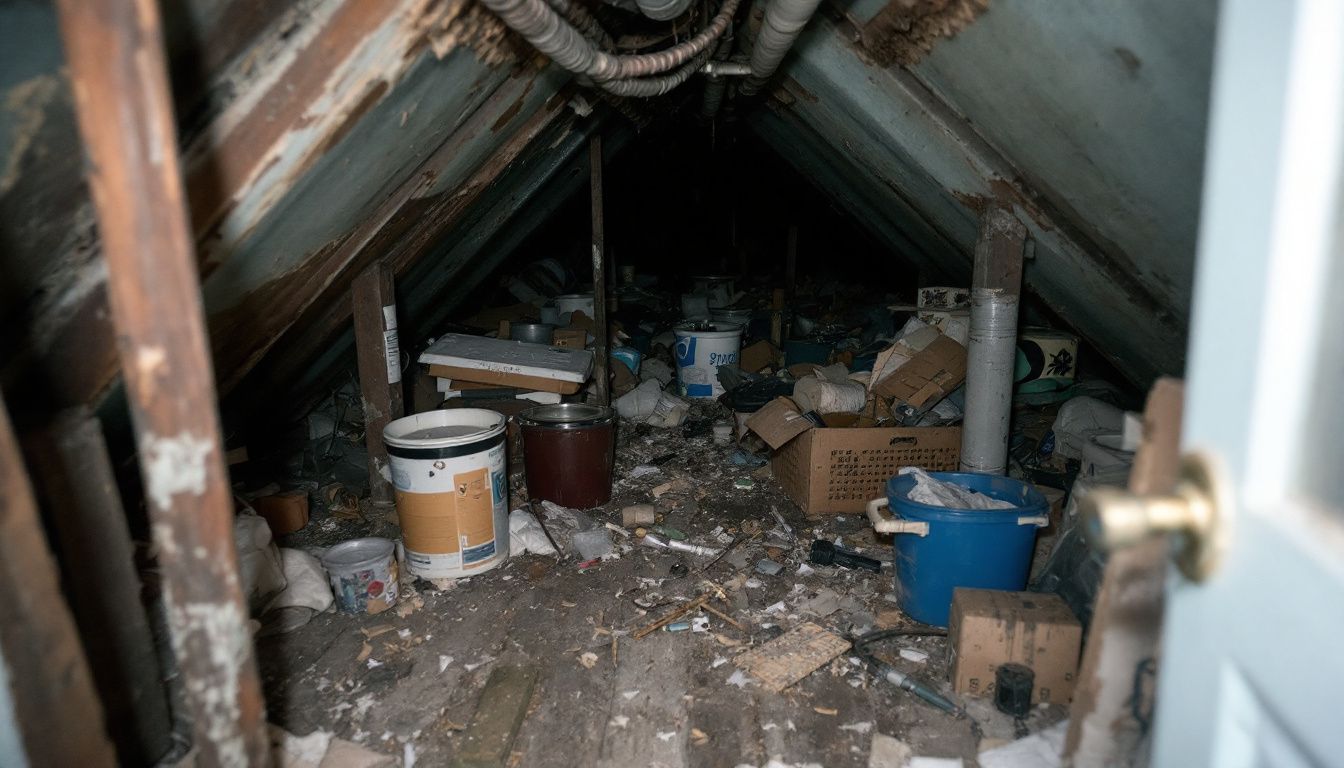
If You Come Across Suspected Asbestos, or If You Disturb Asbestos, What Is the First Thing You Must Do?
Stop. Put everything down, walk away, and do not go back in. If you come across suspected asbestos, or if you disturb asbestos, what is the first thing you must do — before anything else — is stop work immediately and evacuate. Not in a few minutes. Right now.
Asbestos fibres are invisible to the naked eye. Once airborne, you can inhale them without any awareness it is happening. The diseases they cause — mesothelioma, asbestosis, lung cancer — can take decades to develop, and that long latency period is precisely what makes asbestos so dangerous. There is no immediate alarm, no pain, no obvious sign that harm has been done.
Whether you are a homeowner mid-renovation, a landlord whose contractor has just cracked open a ceiling tile, or a tenant who has noticed something unusual during a repair, this post walks you through every step of the correct response — and explains why each one matters.
Why Stopping Work Immediately Is Non-Negotiable
Asbestos-containing materials that are intact and undisturbed pose a relatively low risk. The danger escalates sharply the moment those materials are cut, drilled, sanded, scraped, or broken. Any activity that releases fibres into the air creates an exposure risk — and the longer that activity continues, the greater the volume of fibres released.
Many homeowners make the mistake of pressing on to “just finish the job” after spotting something suspicious. Every additional minute of disturbance compounds the problem. The correct response is to down tools, leave the area, and seal it off before making any further plan.
This is not overcaution. It is the legally correct response under the Control of Asbestos Regulations, which place a duty on anyone managing or working in a building to manage asbestos risks appropriately. Continuing work after identifying a potential asbestos risk is not only dangerous — it may also expose you to legal liability.
Step-by-Step: What to Do When You Come Across Suspected Asbestos or Disturb It
Work through these steps in order. They apply whether you have stumbled upon a suspicious material during renovation work or have already disturbed something and are now concerned about the consequences.
1. Stop Work and Leave the Area
Put your tools down and walk away from the area calmly. Do not attempt to clean up any dust or debris — this will only release more fibres into the air and extend your exposure.
Do not use a vacuum cleaner. Standard domestic hoovers are not designed to capture asbestos fibres and will spread them further throughout the property. Instruct anyone else in the area to leave immediately, and keep children and pets well away from the space.
2. Seal Off the Affected Area
Once everyone is clear, seal the area as effectively as possible. Close all doors and windows to that room. If you have heavy-duty plastic sheeting and tape available, use them to cover doorways and any gaps where air might circulate.
Turn off any ventilation systems, fans, or air conditioning units that serve the affected area. These will circulate fibres throughout the building if left running, potentially contaminating rooms that were previously unaffected.
3. Do Not Re-Enter Without Proper Protection
If you must re-enter — for example, to retrieve something essential — you need appropriate personal protective equipment. At minimum, this means a properly fitted FFP3 respirator (not a basic dust mask), disposable coveralls, gloves, and eye protection.
In most cases, the safest decision is simply not to re-enter until a professional has assessed the situation. The contents of a room are not worth the health risk.
4. Remove and Bag Any Contaminated Clothing
If you were present when asbestos was disturbed, your clothing may have fibres on it. Remove outer clothing carefully — do not shake it — and seal it in a plastic bag immediately. Shower as soon as possible, washing your hair thoroughly.
Do not carry contaminated clothing through other rooms of the property. Fibres can transfer from fabric to furniture, carpets, and other surfaces, spreading contamination well beyond the original incident area.
5. Contact a Licensed Asbestos Professional
Once the area is sealed and you are safely away from the scene, contact a licensed asbestos surveying company. Do not attempt to identify, handle, or remove the material yourself.
Under the Control of Asbestos Regulations, certain types of asbestos work are legally restricted to licensed contractors, and even non-licensed work must follow strict safety protocols. A professional will carry out asbestos testing to confirm whether the material contains asbestos and, if so, what type and in what condition. This gives you an accurate picture of the risk and determines what remedial action is needed.
How to Recognise Suspected Asbestos-Containing Materials
You cannot identify asbestos by sight alone — laboratory analysis is the only reliable confirmation method. However, knowing where asbestos was commonly used in UK properties helps you recognise situations that warrant caution.
Asbestos was used extensively in UK construction until its full ban in 1999. Properties built or refurbished before that date may contain asbestos in a wide range of locations, including:
- Textured coatings on ceilings and walls (such as Artex)
- Insulating board used in partition walls, ceiling tiles, and fire doors
- Pipe lagging and boiler insulation
- Vinyl floor tiles and the adhesive beneath them
- Roof sheeting, soffit boards, and guttering — particularly in garages and outbuildings
- Sprayed coatings on structural steelwork
- Rope seals and gaskets in older heating systems
- Cement products including corrugated roofing sheets and rainwater pipes
If your property was built before 2000 and you are planning any intrusive work, arranging a management survey before a single drill bit touches the wall is the most reliable way to establish what is present and where. It removes the guesswork entirely.
The Importance of Professional Asbestos Testing
Guessing is not good enough when it comes to asbestos. The only way to confirm whether a material contains asbestos fibres is through laboratory analysis. A sample is taken by a trained professional, sent to an accredited laboratory, and examined using polarised light microscopy or scanning electron microscopy.
If you have found a material you are concerned about but have not disturbed it, and it appears to be in good condition, you may be able to use a testing kit to collect a small sample safely. This should only be done if the material is genuinely intact and you can take a sample without causing further disturbance.
If the material is already damaged or crumbling, call a professional rather than attempting to sample it yourself. For a thorough, accredited assessment, asbestos testing carried out by a qualified surveyor is the most reliable route. It removes any ambiguity and gives you a documented record of the findings that can inform future decisions about the property.
What Happens After Testing: Your Options
Once testing confirms the presence of asbestos, you have several options depending on the type of material, its condition, and what you intend to do with the property.
Leave It in Place and Manage It
If the asbestos-containing material is in good condition and is not going to be disturbed, it is often safest to leave it where it is. Asbestos that is intact and sealed poses a low risk. The material should be recorded in an asbestos register, monitored regularly, and flagged to any contractors who work in the property in future.
This approach is widely supported by HSE guidance, including HSG264, which makes clear that management — not always removal — is the appropriate response to asbestos in good condition.
Encapsulation
Some asbestos materials can be encapsulated — sealed with a specialist coating that binds the fibres and prevents them from becoming airborne. This is a less disruptive option than removal and can be appropriate for materials in reasonable condition.
Encapsulation does not eliminate the asbestos, so the material must still be recorded and monitored. Any future contractors working in the area must be made aware of its presence.
Removal
Where asbestos materials are damaged, deteriorating, or need to be disturbed for planned works, removal is the appropriate course of action. Licensed asbestos removal must be carried out by a contractor licensed by the HSE. They will set up controlled conditions, use appropriate PPE, and dispose of waste at a licensed facility.
Never attempt to remove asbestos yourself. Beyond the serious health risk, unlicensed removal of certain asbestos materials is a criminal offence under the Control of Asbestos Regulations.
Your Legal Duties as a Homeowner, Landlord, or Property Manager
The legal framework around asbestos in the UK is clear. The Control of Asbestos Regulations place a duty to manage asbestos on those responsible for non-domestic premises. For homeowners in purely residential properties, the regulations are less prescriptive — but HSE guidance provides a clear framework for safe practice that applies to everyone.
If you are a landlord, you have a legal obligation to ensure asbestos-containing materials in your properties are identified, assessed, and managed. Failure to do so can result in significant fines and, more importantly, serious harm to tenants and contractors.
If you commission work on a pre-2000 property without first establishing whether asbestos is present, you may be placing contractors at risk. Under the Construction (Design and Management) Regulations, principal designers and contractors have duties to consider asbestos risk as part of pre-construction planning.
The practical upshot is straightforward: if your property was built before 2000, get it surveyed before any intrusive work begins. Whether you need an asbestos survey London team, an asbestos survey Manchester specialist, or an asbestos survey Birmingham service, professional help is available nationwide.
The Long-Term Health Consequences of Asbestos Exposure
Understanding why the immediate response matters so much requires understanding what asbestos exposure actually does to the body. When asbestos fibres are inhaled, they lodge in the lung tissue. The body cannot break them down or expel them. Over time — often spanning decades — this causes scarring and inflammation that can develop into serious disease.
The conditions associated with asbestos exposure include:
- Mesothelioma — a cancer of the lining of the lungs or abdomen, almost exclusively caused by asbestos exposure and carrying a very poor prognosis
- Asbestosis — progressive scarring of lung tissue that causes breathlessness and significantly reduces quality of life
- Lung cancer — risk is substantially elevated by asbestos exposure, particularly in those who also smoke
- Pleural plaques and pleural thickening — changes to the lining of the lungs that can cause discomfort and breathing difficulties
There is no safe level of asbestos exposure. The latency period between exposure and diagnosis is what makes asbestos so insidious — by the time symptoms appear, the damage is long done. This is why stopping work immediately and seeking professional advice is not an overreaction. It is the only rational response.
Should You See a Doctor After Potential Asbestos Exposure?
If you believe you have been exposed to asbestos fibres — even briefly — it is worth speaking to your GP and informing them of what happened. There is no treatment that can reverse asbestos exposure, but having a record of the incident is important for your medical history.
Your GP may refer you for a chest X-ray or other investigations depending on the circumstances. Even if they do not, having the exposure documented means that any future respiratory symptoms can be assessed in the correct context.
Do not assume that because you feel fine, nothing has happened. The absence of immediate symptoms means nothing with asbestos-related disease. Document the incident, note the date, the location, and the nature of the work being carried out, and keep that record somewhere safe.
Common Mistakes People Make — and How to Avoid Them
Even well-intentioned people make costly errors when they encounter suspected asbestos. Being aware of these mistakes makes it far easier to avoid them under pressure.
Continuing Work to “See What It Is”
Cutting further into a suspicious material to get a better look at it is one of the most dangerous things you can do. If it is asbestos, you are releasing more fibres. If it is not, you have wasted time and caused unnecessary damage. Stop, seal, and test — in that order.
Using a Standard Vacuum Cleaner
This cannot be emphasised enough. A standard domestic hoover will not capture asbestos fibres — the particles are too small for ordinary filters. Using one will push fibres through the exhaust and spread them into the air. Only HEPA-filtered vacuums designed for asbestos use are appropriate, and these should only be operated by trained professionals.
Assuming Old Buildings Have Already Been Cleared
Many people assume that if a property has been renovated or refurbished in recent years, any asbestos will have been removed. This is not a safe assumption. Asbestos-containing materials are frequently missed during refurbishment, particularly in less accessible areas such as roof voids, service ducts, and beneath floor coverings. Always verify through a proper survey.
Attempting DIY Removal
The temptation to “just get rid of it” is understandable, but it is both dangerous and, in many cases, illegal. Removing certain asbestos materials without an HSE licence is a criminal offence. Even for materials that do not require a licence to remove, strict working procedures apply. The risks to your health and legal standing are simply not worth it.
Not Telling Future Contractors
If asbestos has been identified in your property — whether removed, encapsulated, or left in place and managed — any future contractor working in or near that area must be informed before they begin. Failing to do so puts them at risk and may expose you to liability if they are subsequently harmed.
Planning Work on a Pre-2000 Property? Do This First
The single most effective thing you can do to avoid an asbestos incident is to survey before you start. An asbestos management survey will identify the location, type, and condition of any asbestos-containing materials in the accessible areas of your property, giving you the information you need to plan work safely.
This is not just good practice — it is the approach recommended by the HSE and supported by HSG264 guidance. Surveyors are trained to look in the places that are most likely to contain asbestos and to assess the risk each material presents.
If you are planning more intrusive work — a full refurbishment, an extension, or demolition — a refurbishment and demolition survey is required. This involves a more invasive inspection to locate asbestos in areas that will be disturbed during the works.
Do not rely on previous surveys carried out years ago. Materials deteriorate, conditions change, and a survey that was accurate five years ago may not reflect the current state of the building. If in doubt, commission a fresh assessment.
Get Professional Help From Supernova Asbestos Surveys
Supernova Asbestos Surveys has completed over 50,000 surveys across the UK. Our team of qualified surveyors operates nationwide, providing management surveys, refurbishment and demolition surveys, asbestos testing, and full project support for remediation and removal.
If you have come across suspected asbestos, disturbed a material you are concerned about, or simply want to establish what is present in your property before work begins, we are here to help. We provide clear, accurate reports with practical recommendations — not jargon-heavy documents that leave you more confused than when you started.
Call us on 020 4586 0680 or visit asbestos-surveys.org.uk to book a survey or speak to a member of our team. The sooner you know what you are dealing with, the sooner you can make safe, informed decisions about your property.
Frequently Asked Questions
If you come across suspected asbestos, or if you disturb asbestos, what is the first thing you must do?
The very first thing you must do is stop work immediately and leave the area. Do not attempt to clean up, do not continue working, and do not re-enter without appropriate protective equipment. Seal the area by closing doors and windows, turn off any ventilation, and contact a licensed asbestos professional to assess the situation.
Can I take an asbestos sample myself?
If the material is intact, undamaged, and can be sampled without causing disturbance, a home testing kit may be suitable. However, if the material is damaged, crumbling, or has already been disturbed, you should not attempt to sample it yourself. Contact a licensed asbestos surveying company to carry out sampling safely and send it to an accredited laboratory for analysis.
Is asbestos in my home illegal?
No. The presence of asbestos in a property is not illegal. Asbestos was widely used in UK construction until 1999, and a great many properties still contain it. What matters is how it is managed. Asbestos-containing materials that are in good condition and are not being disturbed can be left in place provided they are recorded, monitored, and flagged to any future contractors. What is illegal is removing certain types of asbestos without an HSE licence.
How long does asbestos exposure take to cause illness?
Asbestos-related diseases typically have a very long latency period — often between 20 and 50 years between exposure and the development of symptoms. This is one of the reasons asbestos is so dangerous: there is no immediate indication that harm has occurred. If you believe you have been exposed, inform your GP and have the incident documented in your medical records, even if you feel well.
Do I need a survey before renovating a pre-2000 property?
Yes. HSE guidance strongly recommends that any property built before 2000 is surveyed for asbestos before intrusive work begins. For refurbishment or demolition work, a refurbishment and demolition survey is required to locate asbestos in areas that will be disturbed. A management survey is appropriate for ongoing management of a property where no major work is planned. Both types of survey should be carried out by a qualified, accredited surveyor.