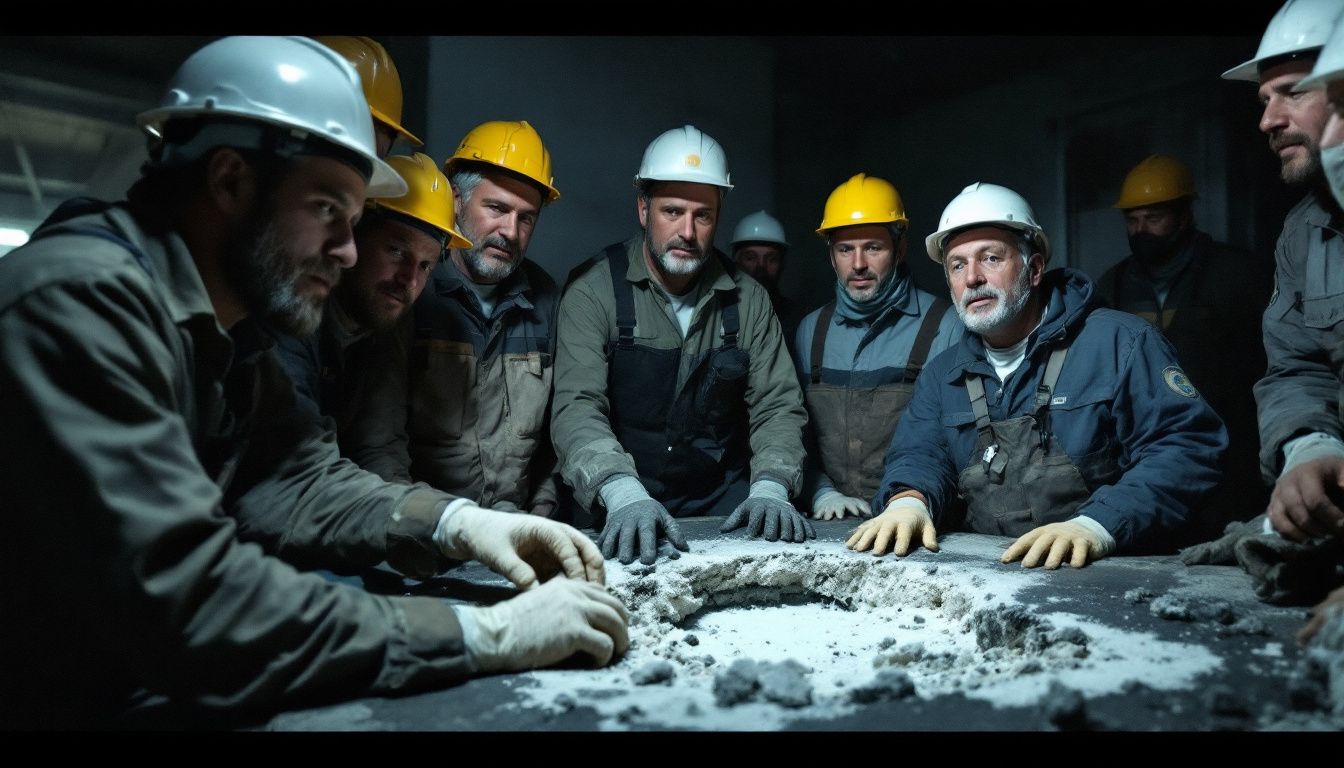
When Asbestos Is Disturbed at Work, Every Minute Counts
An asbestos emergency response is not something you can improvise on the spot. When asbestos-containing materials are unexpectedly disturbed — through accidental damage, unplanned maintenance work, or a structural incident — the decisions made in the first few minutes determine how far the risk spreads and who gets exposed.
Whether you manage a commercial property, oversee a construction site, or are responsible for a public building, the guidance below sets out exactly what to do, how to plan ahead, and what UK law expects of you.
Why Asbestos Emergencies Are Different From Other Workplace Incidents
Asbestos fibres are invisible to the naked eye. They have no smell. You cannot feel them in the air. That invisibility is precisely what makes an asbestos emergency so dangerous — exposure can happen before anyone realises there is a problem.
When asbestos-containing materials (ACMs) are disturbed, microscopic fibres become airborne. Inhaled fibres can lodge permanently in lung tissue, causing diseases including mesothelioma, asbestosis, and lung cancer — conditions that may not manifest for decades after exposure. This delayed effect leads many people to underestimate the urgency of responding correctly in the moment.
Under the Control of Asbestos Regulations, dutyholders have a legal obligation to manage asbestos in non-domestic premises and to respond appropriately when an incident occurs. Failure to act — or acting incorrectly — can result in prosecution, significant fines, and lasting harm to workers and building occupants.
Identifying Asbestos-Containing Materials Before an Emergency Happens
The best asbestos emergency response starts before any emergency occurs. Knowing where ACMs are located in your building is the foundation of any effective plan.
Buildings constructed before 2000 commonly contain asbestos in a wide range of materials, including:
- Ceiling tiles and suspended ceiling systems
- Pipe lagging and boiler insulation
- Textured coatings such as Artex on walls and ceilings
- Roof sheets, guttering, and soffits
- Floor tiles and adhesive backing
- Partition walls and fire doors
- Spray-applied fire protection coatings
- Loose-fill insulation in ceiling voids and lofts
- Window surrounds and external panels
The challenge is that ACMs often look identical to non-asbestos materials. Visual inspection alone is not enough. A management survey carried out by a qualified surveyor is the only reliable way to locate, assess, and record ACMs across your premises.
Without an up-to-date asbestos register, your emergency response will always be reactive — and potentially too slow.
Warning Signs That Asbestos May Have Been Disturbed
Even with a register in place, you need to recognise the physical indicators that ACMs may have been damaged. Look out for:
- Crumbling or flaking material on ceilings, walls, or around pipework
- Grey-white fibrous dust or debris near older building materials
- Damaged ceiling tiles, particularly after maintenance or water ingress
- Broken or cut pipe lagging
- Disturbed insulation in roof spaces or service voids
If any of these signs are present and the building pre-dates 2000, treat the area as potentially contaminated until confirmed otherwise by a professional.
Developing Your Asbestos Emergency Response Plan
Every non-domestic premises covered by the Control of Asbestos Regulations should have a written asbestos emergency response plan. This is not a document to file away — it is a practical tool that staff need to know and be able to act on.
Your plan should include:
- Clear trigger points — what constitutes an asbestos emergency on your site
- Named roles and responsibilities — who takes charge, who contacts the authorities, who manages communication with staff
- Immediate actions checklist — step-by-step instructions for the first responder on scene
- Contact details — licensed asbestos contractors, occupational health providers, the HSE, and your insurer
- Location of PPE and emergency equipment — clearly signposted and regularly checked
- Evacuation routes — routes that avoid the affected area
- Exposure record protocol — how to document who was present and for how long
The plan should be reviewed regularly and updated whenever there are changes to the building, its occupants, or the asbestos register. Staff should be trained on it — not just handed a copy.
Immediate Actions When Asbestos Is Disturbed
If asbestos is disturbed unexpectedly, the response in the first few minutes is critical. Follow this sequence without deviation.
Step 1 — Stop All Work Immediately
Any activity that may be contributing to the disturbance must cease at once. Tools down, machinery off. Continued work increases fibre release and widens the area of contamination.
Step 2 — Evacuate the Affected Area
Clear all personnel from the immediate area without delay. Do not allow anyone without appropriate PPE to re-enter. Instruct people to leave via the safest available route, avoiding passing through the contaminated zone where possible.
Step 3 — Isolate and Seal the Zone
Establish a physical barrier around the affected area. Use barrier tape, warning signs, and where possible, seal doors, windows, and ventilation openings with heavy-duty polythene sheeting and tape. Switch off any HVAC systems serving the area to prevent fibres circulating through the building’s air handling system.
The controlled zone should be clearly marked, and no one should enter without appropriate respiratory protection and PPE.
Step 4 — Notify the Responsible Person
Alert your site manager, facilities manager, or designated dutyholder immediately. They are responsible for initiating the formal response — contacting a licensed asbestos contractor, informing the HSE where required, and coordinating health monitoring for anyone potentially exposed.
Step 5 — Record Who Was Exposed
This is a legal requirement under the Control of Asbestos Regulations. You must record the names of all individuals who were present in the area at the time of the disturbance, the duration of potential exposure, and the nature of the work being carried out. These records must be retained for 40 years.
Prompt, accurate recording also supports any occupational health referrals and protects your organisation in the event of a future claim.
Step 6 — Contact a Licensed Asbestos Contractor
Do not attempt to clean up or contain disturbed asbestos without specialist involvement. Depending on the type and condition of the material, a licensed contractor under the Control of Asbestos Regulations may be legally required to carry out remediation.
Even where licensed work is not mandatory, professional involvement is strongly advisable. The contractor will carry out air monitoring, establish a formal enclosure if needed, and manage the safe removal and disposal of contaminated materials.
Protective Equipment: What Is Required and Why
PPE is the last line of defence — not the first. Containment and evacuation take priority. But for anyone who must enter a contaminated area as part of the asbestos emergency response, the correct equipment is non-negotiable.
Respiratory Protection
Standard dust masks are completely inadequate for asbestos work. Respiratory protective equipment (RPE) must be appropriate for the level of exposure. For most asbestos emergency situations, this means a half-face or full-face respirator with P3 filters, or a powered air-purifying respirator (PAPR) for higher-risk scenarios.
RPE must be face-fit tested for each individual wearer. An untested mask — even a high-specification one — may allow fibres to bypass the seal entirely. HSG264 sets out the standards for respiratory protection in asbestos-related work.
Protective Clothing
Anyone entering a contaminated zone must wear:
- Disposable Type 5 coveralls (Tyvek or equivalent)
- Disposable gloves — nitrile or rubber
- Disposable overshoes or dedicated footwear
- Hood to cover hair
All PPE must be disposed of as asbestos waste after use. It must never be taken home, shaken out, or reused. Decontamination procedures — including removing coveralls carefully, turning them inside out, and double-bagging — must be followed at the boundary of the controlled zone.
Containment and Preventing the Spread of Fibres
Once the area is isolated, the priority shifts to preventing fibres from migrating beyond the controlled zone. The following measures apply:
- Wet suppression — lightly dampen disturbed materials to reduce airborne fibre release. Never use high-pressure water, which can spread contamination further.
- HEPA-filtered vacuum equipment — standard vacuums must never be used on asbestos debris. Only industrial HEPA vacuums rated for asbestos use are appropriate.
- No dry sweeping — sweeping dry asbestos debris dramatically increases fibre release into the air.
- Double-bagging waste — all asbestos waste must be placed in heavy-duty, clearly labelled asbestos waste bags, double-bagged and sealed before removal.
- Negative pressure enclosures — for significant disturbances, a licensed contractor will typically establish a negative pressure enclosure to prevent fibres escaping during remediation.
Air monitoring should be carried out throughout the remediation process and after completion to confirm that fibre levels have returned to background levels before the area is reopened.
Legal Obligations and Reporting Requirements
UK law places specific duties on employers and dutyholders when an asbestos incident occurs. Understanding these obligations is essential — ignorance is not a defence.
Reporting to the HSE
Certain asbestos incidents must be reported to the Health and Safety Executive under RIDDOR (Reporting of Injuries, Diseases and Dangerous Occurrences Regulations). This includes situations where workers are exposed to asbestos in circumstances that were not adequately controlled. Your licensed contractor or health and safety adviser can confirm whether a specific incident triggers a RIDDOR report.
Notifiable Non-Licensed Work
Some categories of asbestos work — known as Notifiable Non-Licensed Work (NNLW) — must be notified to the relevant enforcing authority before work begins. This applies even where a licence is not required. Records of NNLW must be maintained and health surveillance provided to workers involved.
Employee Health Monitoring
Anyone potentially exposed during an asbestos incident should be referred to occupational health for assessment. For workers regularly involved in asbestos work, ongoing health surveillance is a legal requirement.
Even for a one-off exposure event, documenting the incident and arranging a health review demonstrates your duty of care and creates a clear record should any health concerns arise in the future.
Training Your Team Before an Emergency Occurs
An asbestos emergency response plan is only as effective as the people who have to implement it. Regular, documented training is both a legal requirement and a practical necessity.
Training should cover:
- How to recognise potentially asbestos-containing materials
- What to do — and what not to do — if disturbance is suspected
- How to raise the alarm and who to contact
- Correct use and disposal of PPE
- The location of the asbestos register and emergency response plan
Awareness training for all staff who work in or visit the building is distinct from the specialist training required for those carrying out asbestos work. Both have their place.
The HSE’s guidance is clear that workers should not be put at risk through lack of information. Annual refresher training keeps knowledge current and ensures that new staff are brought up to speed promptly. Records of all training must be maintained.
Asbestos Emergency Response Across the UK
Asbestos is a nationwide issue. Pre-2000 buildings exist in every city, town, and region — and the risk of an unplanned disturbance is just as real in a Victorian office block in one part of the country as it is in a 1970s school or a post-war commercial premises in another.
If your premises are in the capital, Supernova provides rapid asbestos survey London services, with experienced surveyors available across all London boroughs. For sites in the North West, our asbestos survey Manchester team covers the full Greater Manchester area and surrounding regions.
In the Midlands, our asbestos survey Birmingham service supports property managers, contractors, and public sector organisations across the city and beyond. Wherever your premises are located, having a local surveying partner who understands your building stock and can respond quickly is a significant advantage when an asbestos emergency occurs.
Supernova Asbestos Surveys operates nationally, with the capacity to mobilise quickly when an incident requires urgent assessment or investigation. Our surveyors are BOHS-qualified and work to the standards set out in HSG264 and the Control of Asbestos Regulations.
After the Emergency: Returning to Safe Use
Once remediation work is complete, the area cannot simply be reopened and returned to use. A structured clearance process must be followed.
This typically includes:
- Visual inspection — a thorough check by a competent person to confirm no visible debris or contamination remains
- Air testing — four-stage clearance testing carried out by an independent UKAS-accredited laboratory to confirm that airborne fibre concentrations are at or below background levels
- Clearance certificate — a formal written clearance certificate issued before the area is reopened
- Updated asbestos register — the register must be updated to reflect the incident, any materials removed, and the current condition of remaining ACMs
- Incident review — a debrief to identify what went wrong, what worked well, and what changes are needed to the emergency response plan
Skipping any of these steps — particularly the air testing — is not acceptable. It puts future occupants at risk and exposes the dutyholder to serious legal liability.
What Good Asbestos Emergency Preparedness Looks Like
The organisations that handle asbestos emergencies most effectively are not the ones that respond fastest in the moment — they are the ones that have done the groundwork beforehand. Good preparedness means:
- An accurate, up-to-date asbestos register based on a professional survey
- A written emergency response plan that is tested and understood by relevant staff
- Established relationships with a licensed asbestos contractor before an incident occurs
- Documented training records for all relevant personnel
- Clear communication protocols so that the right people are informed quickly
- Regular review of the plan — not just after an incident, but as part of routine building management
Asbestos management is not a one-time task. It is an ongoing responsibility that sits with the dutyholder for as long as ACMs remain in the building. Every survey, every training session, and every plan review reduces the risk that an unplanned disturbance becomes a serious incident.
Frequently Asked Questions
What should I do first if I suspect asbestos has been disturbed in my workplace?
Stop all work in the affected area immediately, evacuate all personnel, and seal off the zone as best you can without putting anyone at further risk. Switch off any ventilation systems serving the area, then contact your designated dutyholder and a licensed asbestos contractor. Do not attempt to clean up the debris yourself.
Do I need a licensed contractor for every asbestos emergency?
Not necessarily, but professional involvement is always advisable. Under the Control of Asbestos Regulations, licensed contractors are legally required for certain types of work — particularly involving friable or high-risk materials such as sprayed coatings, lagging, and insulating board. For other materials, the work may fall under Notifiable Non-Licensed Work (NNLW), which still requires notification to the enforcing authority and health surveillance for workers. A specialist can advise on the correct category for your specific situation.
How long must exposure records be kept after an asbestos incident?
Under the Control of Asbestos Regulations, records of asbestos exposure must be retained for 40 years. This includes the names of those present, the duration of exposure, and the nature of the work or incident. These records are essential for occupational health monitoring and for any future legal proceedings.
Can I reopen an area after asbestos has been cleaned up without formal air testing?
No. A formal four-stage clearance procedure must be completed before any area affected by an asbestos disturbance is returned to use. This includes a visual inspection and independent air testing by a UKAS-accredited laboratory. A written clearance certificate must be issued before the area is reoccupied. Reopening without this process is a serious breach of duty and puts occupants at risk.
What is the difference between an asbestos management survey and an emergency response?
A management survey is a planned, proactive inspection carried out to locate and assess ACMs in a building before any disturbance occurs. It forms the basis of your asbestos register and informs your emergency response plan. An asbestos emergency response is the reactive process triggered when ACMs are unexpectedly disturbed. The two are closely linked — without a current management survey and register, your emergency response will always be slower and less informed than it needs to be.
Get Expert Support From Supernova Asbestos Surveys
Supernova Asbestos Surveys has completed over 50,000 surveys across the UK. Our BOHS-qualified surveyors work to HSG264 standards and can support you with management surveys, asbestos registers, and emergency response planning — wherever your premises are located.
If you need to commission a survey, update an existing register, or discuss your emergency response arrangements, contact our team today. Call us on 020 4586 0680 or visit asbestos-surveys.org.uk to find out more.