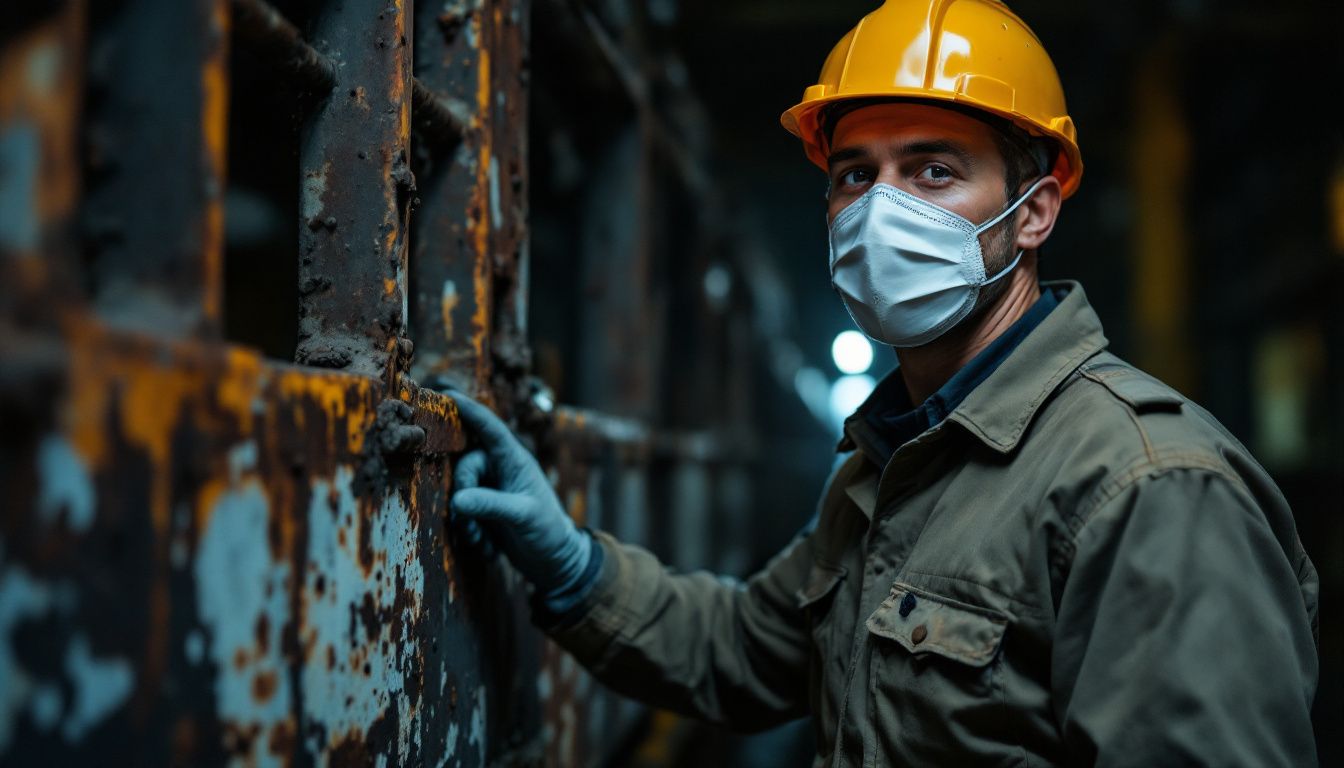
Why PPE for Railway Workers Is the First Line of Defence Against Asbestos
Railway maintenance yards are among the most asbestos-laden working environments in the UK. Decades of rolling stock built with asbestos-containing materials means that every time a worker drills, sands, or strips an old component, they risk releasing fibres capable of causing mesothelioma, asbestosis, and lung cancer.
PPE for railway workers is not optional — it is a legal requirement and, in many cases, the difference between a long career and a terminal diagnosis. The UK banned asbestos in 1999, but its legacy persists in brake pads, pipe insulation, fireproofing coatings, and gaskets across older trains, depots, and infrastructure.
Managing that legacy safely demands a structured approach — starting with understanding where asbestos hides, and ending with the right protective equipment worn correctly every single time.
Where Asbestos Hides in Railway Maintenance Yards
Before any PPE conversation makes sense, workers and managers need to know exactly what they are protecting against. Asbestos was used extensively across the rail industry because it handled heat, fire, and vibration exceptionally well — the same properties that made it useful also made it difficult to replace and difficult to remove safely.
Insulation on Pipes, Boilers, and Fireboxes
Steam-era locomotives relied heavily on asbestos insulation to retain heat and reduce fire risk. Blue asbestos (crocidolite) was widely used until the late 1960s, after which white asbestos (chrysotile) became the standard substitute. Both types can still be found wrapped around pipes, boilers, and heat-exposed surfaces in older rolling stock and depot infrastructure.
The insulation often appears as thick, layered padding between metal components. It becomes dangerous when it degrades or is disturbed during maintenance, releasing microscopic fibres that can remain airborne for hours.
Brake Pads and Gaskets
Brake components are one of the most common sources of asbestos exposure in railway yards. Worn brake pads and deteriorating gaskets shed fibres during normal use, and the act of removing or inspecting them dramatically increases that release.
Workers handling brake systems on older rolling stock must treat every component as potentially contaminated until confirmed otherwise. There are no exceptions to this rule.
Fireproofing Materials
Walls, ceilings, and areas around pipework in older train cars and depot buildings were frequently treated with asbestos-based fireproofing sprays and boards. These coatings can appear intact but become friable — meaning they crumble and release fibres — when cut, drilled, or scraped.
Fireproofing materials are particularly hazardous because they are often hidden behind other surfaces, meaning workers may not even realise they are disturbing them.
Floor Tiles, Cable Coatings, and Stored Components
Old floor tiles commonly used asbestos as a backing material. Cable sheathings in older train cars can also contain asbestos, and stored components that have sat in depots for years may have degraded to the point where simply moving them releases fibres.
Even cleaning a storage area with compressed air can distribute asbestos dust across an entire work zone — a risk that is easily overlooked and potentially catastrophic.
Identifying Asbestos-Containing Materials Before Work Begins
No amount of PPE eliminates the need for proper identification of asbestos-containing materials (ACMs) before maintenance work starts. The Control of Asbestos Regulations require duty holders to manage asbestos risk — which means knowing where it is, assessing its condition, and acting accordingly.
Visual Inspection
A visual inspection is the starting point, but it is never sufficient on its own. Trained workers should look for the following indicators:
- Components or materials manufactured before 1999, particularly pre-1980 items which carry the highest risk
- Fibrous, woolly, or fluffy textures on insulation or fireproofing surfaces
- Damaged, crumbling, or patched areas on walls, ceilings, and pipe lagging
- Absence of an asbestos-free label or certification on older parts
- Signs of previous repairs that may have disturbed underlying ACMs
Any suspected material should be tagged with a clear warning, photographed, and its location recorded on a site plan. Do not disturb it further until testing is complete.
Asbestos Surveys and Laboratory Testing
Where visual inspection raises concerns, a formal asbestos survey is required. Under HSE guidance (HSG264), management surveys are used for routine work in occupied premises, while demolition surveys are required before any intrusive maintenance or structural work begins.
Trained surveyors collect samples using methods that minimise fibre release, and those samples are analysed by an accredited laboratory. Survey reports must be kept on site, shared with anyone likely to disturb ACMs, and reviewed whenever the scope of work changes.
If your maintenance yard operates in or near the capital, a specialist asbestos survey London service can cover both depot buildings and rolling stock infrastructure. For sites in the North West, an asbestos survey Manchester team can be mobilised quickly to support planned maintenance shutdowns.
PPE for Railway Workers: What Is Required and Why
Once asbestos risk has been identified and assessed, personal protective equipment becomes a critical control measure. PPE for railway workers dealing with asbestos must be selected, maintained, and used in accordance with the Control of Asbestos Regulations and HSE guidance.
PPE is not a catch-all solution — it works alongside engineering controls and safe systems of work, not instead of them.
Respiratory Protective Equipment (RPE)
Respiratory protection is the single most important element of PPE for railway workers exposed to asbestos. The type of RPE required depends on the level of exposure risk:
- FFP3 disposable masks — suitable for low-level, short-duration tasks where fibre concentrations are expected to be minimal
- Half-face respirators with P3 filters — appropriate for moderate-risk tasks involving disturbance of non-friable ACMs
- Full-face respirators with P3 filters — required for higher-risk activities, including work in enclosed spaces or where friable materials are present
- Powered air-purifying respirators (PAPRs) — used in the highest-risk scenarios, providing a continuous flow of filtered air
All RPE must be face-fit tested before use. A mask that does not seal correctly offers negligible protection. Workers with facial hair, scars, or unusual facial geometry may need alternative RPE solutions — this must be assessed individually, not assumed.
Protective Clothing
Asbestos fibres cling to clothing and can be carried home, putting families at risk — a phenomenon known as secondary exposure. Disposable coveralls must be worn for any task involving potential asbestos disturbance.
Key requirements include:
- Disposable Type 5/6 coveralls covering the entire body, including the head
- Nitrile or heavy-duty rubber gloves worn inside coverall cuffs
- Boot covers or dedicated work boots that do not leave the controlled work area
- No personal clothing worn underneath that cannot be laundered at high temperature or disposed of safely
Used coveralls must be removed in a specific sequence to avoid self-contamination, double-bagged in labelled asbestos waste bags, and disposed of as hazardous waste. Workers must never shake out or brush down contaminated clothing under any circumstances.
Eye and Head Protection
Where full-face respirators are not in use, sealed protective goggles should be worn to prevent fibre contact with the eyes. Safety helmets with integrated face shields offer additional protection in overhead work situations.
Standard safety glasses are not adequate — they do not seal against the face and allow fibres to reach the eyes from the sides and above. This is a common and potentially serious oversight on site.
Additional PPE Considerations
Beyond the core items, a complete PPE regime for railway workers in asbestos-risk environments should include:
- Hearing protection compatible with the respirator being worn
- High-visibility elements where required for site safety
- Clearly marked clean and dirty zones for donning and doffing PPE
- A decontamination unit or area with wet wipes and waste bags at the work zone exit
Tasks That Carry the Highest Asbestos Exposure Risk
Understanding which activities are most likely to disturb asbestos helps supervisors prioritise controls and ensure PPE is in place before work starts — not after fibres are already airborne. The following tasks carry the greatest risk in railway maintenance environments:
- Brake system repairs — removing, grinding, or inspecting brake pads and drums on older rolling stock
- Drilling or cutting into walls, ceilings, or structural panels in pre-2000 depot buildings or train cars
- Pipe lagging removal — stripping insulation from hot water or steam pipes
- Scraping or sanding painted or coated surfaces on older vehicles
- Demolition or refurbishment of depot buildings, workshops, or signal boxes
- Disturbing stored components — moving old parts that have degraded in storage
- Ground works near old rail lines — excavation can uncover buried asbestos waste
For any of these tasks, a task-specific risk assessment must be completed before work begins, and PPE must be selected to match the assessed risk level. Generic assessments are not acceptable under current regulations.
Engineering Controls That Support PPE for Railway Workers
PPE for railway workers is most effective when it operates within a properly controlled work environment. Engineering controls reduce the concentration of airborne fibres before they reach a worker’s breathing zone — meaning PPE has less work to do and any failure is less catastrophic.
Enclosures and Negative Pressure Units
For higher-risk asbestos work, the work area must be enclosed and placed under negative pressure using a filtered extraction unit. This prevents fibres from escaping into adjacent areas. Only workers with appropriate PPE and training should enter the enclosure.
Wet Suppression
Dampening asbestos-containing materials with water or a specialist wetting agent before disturbance significantly reduces fibre release. This is a simple, low-cost control that should be standard practice wherever ACMs are being handled.
HEPA Vacuum Equipment
Standard vacuum cleaners will not capture asbestos fibres — they simply redistribute them. Only vacuums fitted with HEPA filters rated to H class should be used in asbestos work areas. Compressed air must never be used to clean surfaces where asbestos may be present.
Air Monitoring
Air monitoring before, during, and after asbestos work provides objective evidence that fibre concentrations remain within safe limits. Results must be documented and retained as part of the site’s asbestos management records. This is not optional for licensed work.
Training and Legal Responsibilities for Railway Employers
Providing PPE is only part of the employer’s duty. Under the Control of Asbestos Regulations, employers must ensure that anyone liable to disturb asbestos — or supervise those who do — receives adequate information, instruction, and training.
That training must cover:
- The health risks associated with asbestos exposure, including the diseases it causes and their latency periods
- The types of ACMs likely to be encountered in railway environments
- How to identify potential ACMs and what to do when they are found
- The correct selection, use, and disposal of PPE and RPE
- Emergency procedures in the event of accidental disturbance
- The legal framework governing asbestos work, including notification requirements for licensed work
Training must be refreshed regularly and records kept. Supervisors bear particular responsibility — if a worker is not wearing PPE correctly, the supervisor is accountable. Ignorance of the regulations is not a defence.
Employers also have a duty to maintain an asbestos register for any premises they control. That register must be accessible to anyone who may disturb ACMs, and it must be kept up to date as conditions change or work is carried out.
When PPE Is Not Enough: Licensed Asbestos Removal
There are situations where PPE and management controls are insufficient — where the only safe option is licensed removal. Under the Control of Asbestos Regulations, certain types of asbestos work can only be carried out by a licensed contractor.
This includes work with friable asbestos, sprayed coatings, lagging, and any work where significant disturbance is unavoidable. Attempting to remove these materials without the appropriate licence — regardless of how good your PPE is — is illegal and puts workers at serious risk.
Licensed contractors have the training, equipment, and legal authority to carry out this work safely, and they are subject to notification requirements with the HSE before work begins. If your site survey identifies materials requiring asbestos removal, the work must be planned carefully and handed to specialists.
For sites in the Midlands, our asbestos survey Birmingham team can assess depot buildings and rolling stock infrastructure ahead of any planned maintenance or refurbishment programme.
Building a Safe System of Work for Asbestos in Railway Yards
PPE for railway workers does not exist in isolation. It sits within a broader safe system of work that must be designed, documented, and enforced before any maintenance activity begins. The hierarchy of controls — eliminate, substitute, isolate, control, then PPE — applies just as firmly in a railway depot as it does anywhere else.
A robust safe system of work for asbestos in railway maintenance environments should include:
- An up-to-date asbestos register and management plan for all premises
- Pre-work surveys for any task that may disturb building fabric or rolling stock
- Task-specific risk assessments reviewed by a competent person
- Written method statements for all asbestos-related activities
- Defined roles and responsibilities for supervisors, workers, and the duty holder
- Clear emergency procedures in the event of accidental fibre release
- Regular review of the management plan, particularly after incidents or changes in work scope
No single element of this system is optional. Gaps in documentation, training, or PPE provision are not minor administrative failings — they are breaches of the Control of Asbestos Regulations with serious legal and health consequences.
Frequently Asked Questions
What type of PPE do railway workers need for asbestos exposure?
At minimum, railway workers disturbing asbestos-containing materials require a P3-rated respirator (face-fit tested), disposable Type 5/6 coveralls, nitrile gloves, and boot covers. The exact specification depends on the risk level assessed for each task — higher-risk activities such as lagging removal or work in enclosed spaces require full-face respirators or powered air-purifying respirators (PAPRs). All PPE must be selected, used, and disposed of in line with the Control of Asbestos Regulations and HSE guidance.
Do railway maintenance workers need asbestos awareness training?
Yes. Under the Control of Asbestos Regulations, any worker who may disturb asbestos — or who supervises those who do — must receive appropriate asbestos awareness training. This covers the health risks, how to identify potential ACMs, correct PPE use, and what to do if asbestos is found unexpectedly. Training must be refreshed regularly and records retained by the employer.
When is a licensed asbestos contractor required in a railway yard?
A licensed contractor is legally required for work involving friable asbestos, sprayed coatings, pipe lagging, and any activity where significant disturbance of high-risk ACMs is unavoidable. The Control of Asbestos Regulations set out the specific categories of licensable work. Carrying out this work without a licence is a criminal offence. If a survey identifies licensable materials, the work must be notified to the HSE and handed to a licensed removal contractor.
How do I find out if my railway depot contains asbestos?
The first step is commissioning a formal asbestos survey carried out by a qualified surveyor working to HSG264 standards. A management survey is appropriate for occupied premises where routine maintenance is planned. A demolition or refurbishment survey is required before any intrusive or structural work begins. Survey reports must be retained on site, included in the asbestos register, and shared with all workers who may disturb ACMs.
Can PPE alone protect railway workers from asbestos?
No. PPE is a critical last line of defence, but it must operate within a properly controlled work environment. Engineering controls — such as enclosures, wet suppression, HEPA vacuuming, and air monitoring — must be in place first. PPE supplements these controls; it does not replace them. A worker relying solely on PPE without supporting controls faces a significantly higher risk of exposure, particularly if the PPE fails or is not fitted correctly.
Protect Your Workforce — Speak to Supernova Asbestos Surveys
Supernova Asbestos Surveys has completed over 50,000 surveys across the UK, working with rail operators, depot managers, and maintenance contractors to identify asbestos risk before it becomes an emergency. Our accredited surveyors work to HSG264 standards and can mobilise quickly to support planned shutdowns, emergency inspections, or ongoing management programmes.
Whether you need a management survey for a working depot, a pre-demolition survey ahead of refurbishment, or specialist advice on PPE and safe systems of work, our team is ready to help. Call us on 020 4586 0680 or visit asbestos-surveys.org.uk to arrange a survey at your site.