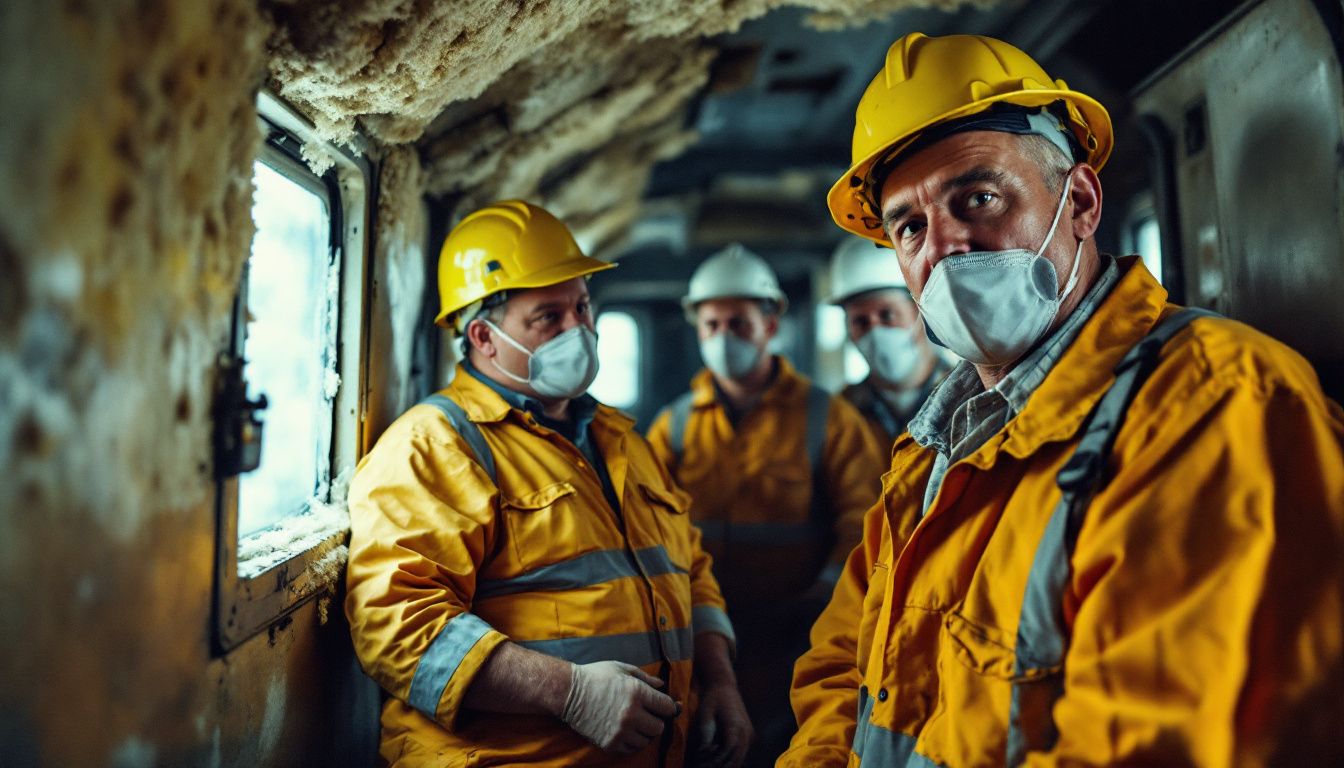
Asbestos in Railway Rolling Stock: What Depot Managers Must Know
Old trains are not just ageing infrastructure — they are potential asbestos hazards on wheels. Decades before the UK’s 1999 ban, rolling stock was routinely built with asbestos-containing materials (ACMs) woven into almost every structural and mechanical system. For railway operators, depot managers, and maintenance crews, understanding the risks and the correct abatement procedures is a legal obligation, not a choice.
If your depot or fleet includes vehicles built before 1999, everything below is directly relevant to how you manage your legal duties, protect your workforce, and keep operations running safely.
Where Asbestos Hides in Railway Rolling Stock
Asbestos was used extensively in rail vehicles because of its fire resistance, thermal insulation properties, and durability. The difficulty is that it was applied across an enormous range of components — not just in the obvious places most people think of.
Common Locations of ACMs in Rolling Stock
- Brake linings and pads — one of the highest-risk areas, as friction wear generates fine respirable dust
- Pipe and boiler lagging in engine rooms — asbestos wrapping was standard thermal insulation practice
- Floor tiles in passenger carriages — particularly vehicles built before 1980
- Wall and ceiling panels — fire-resistant boards positioned throughout passenger and crew areas
- Door seals and gaskets — asbestos was mixed into sealing compounds for thermal and acoustic performance
- Electrical insulation blankets — used around junction boxes and wiring runs
- Cable ducts — asbestos wrapping was applied to prevent fire spreading along wiring routes
- Window putty — trace asbestos fibres were incorporated into glazing compounds
- Roof panels — asbestos sheeting was used for weather resistance and fire protection
- Anti-corrosion paint coatings — some older paints applied to metal surfaces contained asbestos
- Storage compartment boards — fire resistance was the primary driver for their inclusion
The sheer range of locations means that any maintenance or refurbishment work on pre-1999 rolling stock carries potential exposure risk. Workers who disturb these materials without proper controls can inhale fibres without realising it — and the health consequences can take decades to emerge.
Conducting an Asbestos Survey on Rolling Stock
Before any maintenance, refurbishment, or decommissioning work begins on older rolling stock, a thorough asbestos survey is legally required. This is not a box-ticking exercise — it is the foundation of a safe working environment for everyone in your depot.
Types of Survey Required
For rolling stock that remains in service and is subject to routine maintenance, a management survey is typically the starting point. This identifies ACMs that could be disturbed during normal operations and assesses their current condition and risk level.
Where major refurbishment or decommissioning is planned, a demolition survey is required. This is a more intrusive process, designed to locate all ACMs before any structural work begins — including in areas that would not normally be accessed during routine maintenance.
What Surveyors Look For
Qualified surveyors check for the three main types of asbestos found in rolling stock: chrysotile (white asbestos), amosite (brown asbestos), and crocidolite (blue asbestos). All three present serious health risks, with crocidolite considered the most hazardous due to its fibre structure.
Surveyors take representative samples of suspect materials, which are then analysed under polarised light microscopy at a UKAS-accredited laboratory. Results confirm both the presence and type of asbestos, informing the risk assessment and management plan that follows.
Depot managers should maintain detailed records of all carriages and vehicles built before 1999, noting which components have been surveyed, what was found, and the current condition of any identified ACMs. These records are a regulatory requirement under the Control of Asbestos Regulations — not simply good housekeeping.
If your fleet operates from or is maintained in the capital, our asbestos survey London team can carry out compliant rolling stock assessments quickly and with minimal disruption to your operations.
Legal and Regulatory Requirements for Railway Operators
The railway sector is subject to overlapping regulatory frameworks when it comes to asbestos management. Getting this wrong carries serious legal and financial consequences — and ignorance of where ACMs are located is not a defence.
Control of Asbestos Regulations
The Control of Asbestos Regulations place a duty on employers and those in control of premises — including rolling stock — to manage asbestos risks. This means identifying ACMs, assessing their condition, and putting in place a written management plan that is kept current.
For rolling stock specifically, operators must ensure that anyone liable to disturb ACMs during maintenance is informed of their location and has received appropriate training. Unlicensed work on certain ACM types is prohibited — only licensed contractors can carry out notifiable non-licensed work or full licensed removal.
HSE and ORR Enforcement
The Health and Safety Executive (HSE) and the Office of Rail and Road (ORR) share enforcement responsibilities across the railway sector. Both bodies have the authority to inspect depots and rolling stock, review survey records, and take enforcement action where operators fall short of their duties.
The ORR focuses specifically on railway-related health and safety, while the HSE covers the broader asbestos regulatory framework under HSG264 guidance. In practice, railway operators are accountable to both — and penalties for non-compliance can include improvement notices, prohibition notices, and prosecution.
The R2 Database
The R2 database is used across the rail industry to track asbestos management activity on rolling stock. Operators are required to record survey findings, maintenance activities involving ACMs, and removal work within this system.
Keeping this database accurate and up to date is a regulatory expectation — not a suggestion that can be deferred. Gaps in the R2 record can be treated as evidence of inadequate asbestos management during an ORR or HSE inspection.
Methods of Asbestos Abatement in Rolling Stock
When ACMs need to be removed or managed in place, the method used depends on the material type, its condition, and the scope of planned work. There are two primary approaches: full removal and encapsulation.
Full Removal Techniques
Full asbestos removal from rolling stock is a controlled, methodical process. Licensed contractors follow a strict sequence to protect workers and prevent fibre release into the surrounding environment.
- The work area is sealed with heavy-duty polythene sheeting and negative pressure is maintained using air extraction units with HEPA filtration
- Workers don full personal protective equipment including disposable coveralls, gloves, boots, and appropriate respiratory protective equipment (RPE)
- Asbestos materials are wetted down before removal to suppress dust generation
- Removed ACMs are double-bagged immediately in clearly labelled, sealed waste sacks
- Air monitoring is carried out throughout the work to verify fibre levels remain within safe limits
- Workers decontaminate in designated clean-room facilities before leaving the work area
- Final air clearance testing is conducted by an independent analyst before the area is signed off for reuse
- Asbestos waste is transported by licensed carriers to an approved disposal facility
- All stages are documented with written records and photographic evidence
If you need specialist asbestos removal from rolling stock or associated depot infrastructure, Supernova works with licensed removal contractors and can coordinate the full process from initial survey through to final clearance certification.
Encapsulation and Containment
Where ACMs are in good condition and full removal is not immediately necessary, encapsulation is a legitimate management strategy. Specialist sealants are applied to asbestos surfaces, binding any loose fibres and creating a durable protective barrier. Containment using rigid barriers or enclosures can also be used to isolate ACMs from areas where workers are regularly present.
Both approaches require ongoing monitoring to ensure the integrity of the seal or enclosure is maintained over time. Encapsulation is not a permanent solution — it is a risk management measure. Operators must continue to monitor encapsulated materials and plan for eventual removal as part of their long-term asset management strategy. Leaving it indefinitely is not an option under the Control of Asbestos Regulations.
Best Practices for Asbestos Management in Railway Depots
Managing asbestos in a live operational depot is more complex than managing it in a static building. Rolling stock moves, maintenance schedules are tight, and multiple contractors may be working on the same vehicle at different times. Structure and clear communication are essential.
Staff Training and Awareness
Every member of staff who works on or around pre-1999 rolling stock needs asbestos awareness training. This is a legal requirement under the Control of Asbestos Regulations and covers how to recognise potential ACMs, what to do if materials are disturbed or damaged, and who to report concerns to.
Awareness training does not qualify workers to carry out asbestos work — it simply ensures they do not unknowingly create a risk. Separate, more detailed training is required for those who may carry out non-licensed work on ACMs as part of their role.
Clear Signage and Access Controls
Areas of rolling stock known to contain ACMs should be clearly labelled. Depot managers should establish access controls so that only trained and authorised personnel work on or near identified asbestos-containing materials.
If a worker discovers what they suspect is damaged or disturbed asbestos, the area should be vacated immediately and the incident reported to the depot’s asbestos manager. Work should not resume until the material has been assessed by a competent person.
Record Keeping and the Asbestos Register
Every depot should maintain an asbestos register for its rolling stock fleet. This document records the location, type, condition, and risk rating of all identified ACMs across the entire fleet. It should be reviewed and updated following any maintenance work, survey, or removal activity.
The register is a live document — not something that gets filed away after a survey and forgotten. It must be readily accessible to maintenance staff, contractors, and health and safety personnel at all times. Failing to maintain it accurately is a regulatory breach.
For depots in the North West, our asbestos survey Manchester team provides compliant rolling stock surveys and full asbestos register documentation as part of every assessment.
Contractor Management
Any contractor working on rolling stock that contains ACMs must be made aware of the asbestos register before work begins. Depot managers have a legal duty to share this information — failure to do so puts contractors at risk and exposes the operator to direct legal liability.
Contractors carrying out licensed asbestos work must hold a current HSE licence. Operators should verify this before any work commences and retain copies of the licence and method statements on file. This is a basic due diligence step that protects both the depot and the contractor.
Depots in the Midlands can access our asbestos survey Birmingham service for rapid, compliant assessments across rolling stock and associated depot buildings.
Health Risks and Why Abatement Cannot Be Deferred
Asbestos-related diseases — including mesothelioma, asbestosis, and lung cancer — have long latency periods. Workers exposed to asbestos fibres today may not develop symptoms for 20 to 40 years. By the time a diagnosis is made, the damage is irreversible.
This is precisely why the regulatory framework demands proactive management rather than a reactive response. Waiting until a worker reports symptoms, or until an inspection flags a problem, is far too late. The duty to manage asbestos exists to prevent harm before it occurs — and that duty falls squarely on depot managers and operators.
Mesothelioma, in particular, is almost exclusively caused by asbestos exposure. It is an aggressive cancer with a poor prognosis, and the railway sector has historically seen elevated rates of asbestos-related disease due to the widespread use of ACMs in rolling stock and depot infrastructure. The human cost of inadequate asbestos management is not abstract — it is measurable, and it is preventable.
Planning for Fleet Decommissioning and Refurbishment
As older rolling stock reaches the end of its operational life, the question of asbestos management becomes even more pressing. Decommissioning a pre-1999 vehicle without a thorough asbestos survey is not legally permissible — and attempting to carry out refurbishment work without first establishing what ACMs are present puts workers at serious risk.
The earlier asbestos surveys are commissioned in the planning cycle, the more time operators have to budget for removal work, arrange licensed contractors, and schedule activities around operational requirements. Leaving surveys until the last moment creates pressure to cut corners — and that is where regulatory breaches and worker harm become most likely.
A well-planned decommissioning programme treats asbestos management as a core project workstream, not an afterthought. Survey findings should feed directly into the project plan, with removal activities sequenced to allow safe access for refurbishment or disposal teams once clearance certificates are issued.
Frequently Asked Questions
Is asbestos still present in modern railway rolling stock?
Asbestos was banned from use in the UK in 1999. Any rolling stock manufactured or substantially refurbished after that date should not contain ACMs. However, vehicles built or last overhauled before 1999 may still contain asbestos in a wide range of components. Age alone is not a reliable guide — a thorough survey is the only way to confirm whether ACMs are present.
Who is responsible for managing asbestos in rolling stock?
Under the Control of Asbestos Regulations, the duty to manage asbestos falls on whoever has control of the rolling stock. In practice, this is typically the train operating company or rolling stock owner. Depot managers also carry responsibilities for the vehicles in their care, particularly regarding informing maintenance staff and contractors of known ACM locations.
What is the R2 database and why does it matter?
The R2 database is the rail industry’s system for recording asbestos management activity on rolling stock. Operators must log survey findings, maintenance work involving ACMs, and any removal activity. The ORR and HSE can request access to R2 records during inspections, and gaps or inaccuracies in the record can be treated as evidence of inadequate asbestos management.
Can maintenance staff carry out any asbestos work themselves?
Some lower-risk, non-licensed work may be carried out by trained staff under strict controls — but this has clear limits. Licensed asbestos removal must only be carried out by HSE-licensed contractors. Depot managers should never assume that because work appears minor it falls outside the licensing requirement. If in doubt, seek advice from a qualified asbestos consultant before any work begins.
How often should rolling stock asbestos surveys be updated?
There is no fixed statutory interval, but the asbestos register and associated management plan should be reviewed whenever the condition of known ACMs changes, following any maintenance or removal work, and at regular intervals as part of the operator’s overall asbestos management programme. HSG264 guidance recommends that the condition of ACMs is monitored regularly, with the frequency determined by the risk level assigned to each material.
Work With Supernova on Your Rolling Stock Asbestos Compliance
Supernova Asbestos Surveys has completed over 50,000 surveys across the UK, working with operators, depot managers, and property owners to deliver compliant, accurate asbestos assessments. Our surveyors understand the specific challenges of rolling stock environments — the access constraints, the operational pressures, and the regulatory requirements that apply to the rail sector.
Whether you need a management survey for vehicles in active service, a demolition survey ahead of decommissioning, or coordination of licensed removal work, we can support you at every stage. We operate nationwide, with dedicated teams covering London, Manchester, Birmingham, and all points in between.
Call us on 020 4586 0680 or visit asbestos-surveys.org.uk to discuss your rolling stock survey requirements with a member of our team.