
Finding damaged asbestos in a rented home can turn a routine tenancy problem into a serious health and legal issue very quickly. If you are asking can I sue my landlord for asbestos, the answer is sometimes yes, but only where the facts show your landlord failed to manage the risk properly and that failure caused you loss, disruption or injury.
Asbestos is still present in many older UK properties. Its presence alone does not automatically mean your landlord has broken the law, but damaged materials, unsafe repairs, poor communication and ignored complaints can all create legal exposure for landlords and managing agents.
If you suspect asbestos in your flat, house or room, focus on safety first. Do not drill, sand, scrape or remove anything yourself. Keep a written record, report the issue straight away and get specialist advice before anyone starts work.
Can I sue my landlord for asbestos if it is found in my home?
You may be able to bring a claim if your landlord owed you a duty, breached that duty and you suffered harm as a result. That harm could be physical injury, financial loss, damage to belongings, temporary rehousing costs or serious disruption to your use of the property.
What matters is not simply whether asbestos exists. The key question is whether the asbestos was managed properly.
A claim is more likely where:
- The landlord knew or should have known asbestos was present and risky
- Damaged asbestos-containing materials were left in place without action
- Repair or refurbishment works disturbed asbestos without suitable precautions
- You reported concerns and the landlord ignored or delayed their response
- You had to leave the property because the home became unsafe
- Your belongings were contaminated after unsafe work or poor containment
- You developed a medically recognised condition linked to exposure
A claim is less likely where:
- The asbestos-containing material was in good condition and properly managed
- The landlord acted promptly after being notified
- There is no evidence of exposure, loss or injury
- The material was damaged by unauthorised work carried out by someone else
So when people ask can I sue my landlord for asbestos, the practical answer is this: you may have a case where there has been negligence, disrepair, unsafe works or a failure to respond reasonably once the risk became known.
What the law says about asbestos in rented property
Several areas of UK law can apply when asbestos affects a tenant. The exact duty depends on where the asbestos is, what type of property is involved and whether the issue relates to repairs, maintenance or common parts.
The broad principle is straightforward. Landlords, freeholders, managing agents and contractors must not expose tenants, visitors or workers to avoidable asbestos risk.
Control of Asbestos Regulations
The Control of Asbestos Regulations set out the legal framework for identifying and managing asbestos risk. In non-domestic premises and in the common parts of domestic buildings, there is a duty to manage asbestos.
That matters in blocks of flats, HMOs and mixed-use buildings. Shared corridors, stairwells, risers, service ducts, plant rooms, lift shafts and basements may all fall within areas that require active asbestos management.
HSG264 and asbestos surveys
HSG264 is the HSE guidance used across the asbestos surveying industry. It explains how surveys should be planned, carried out and reported, and it distinguishes between survey types depending on what is happening at the property.
If a landlord arranges intrusive work without the right survey, that can become a major issue. Before disturbance of the building fabric, the correct survey should be in place so asbestos-containing materials are not accidentally broken, drilled or spread through the property.
Housing disrepair and safety duties
Landlords also have duties under housing and repairing law. If asbestos-containing materials become dangerous because of leaks, impact damage, crumbling finishes, broken boards or neglected maintenance, a landlord may face liability if they do not act within a reasonable time.
Local authorities can also step in where asbestos creates a housing hazard. Environmental health teams may inspect, require remedial action and take enforcement steps where necessary.
When asbestos becomes a legal problem for landlords
Asbestos is most dangerous when fibres are released and inhaled. Materials in good condition can often be managed in place, but damaged or disturbed materials are different.
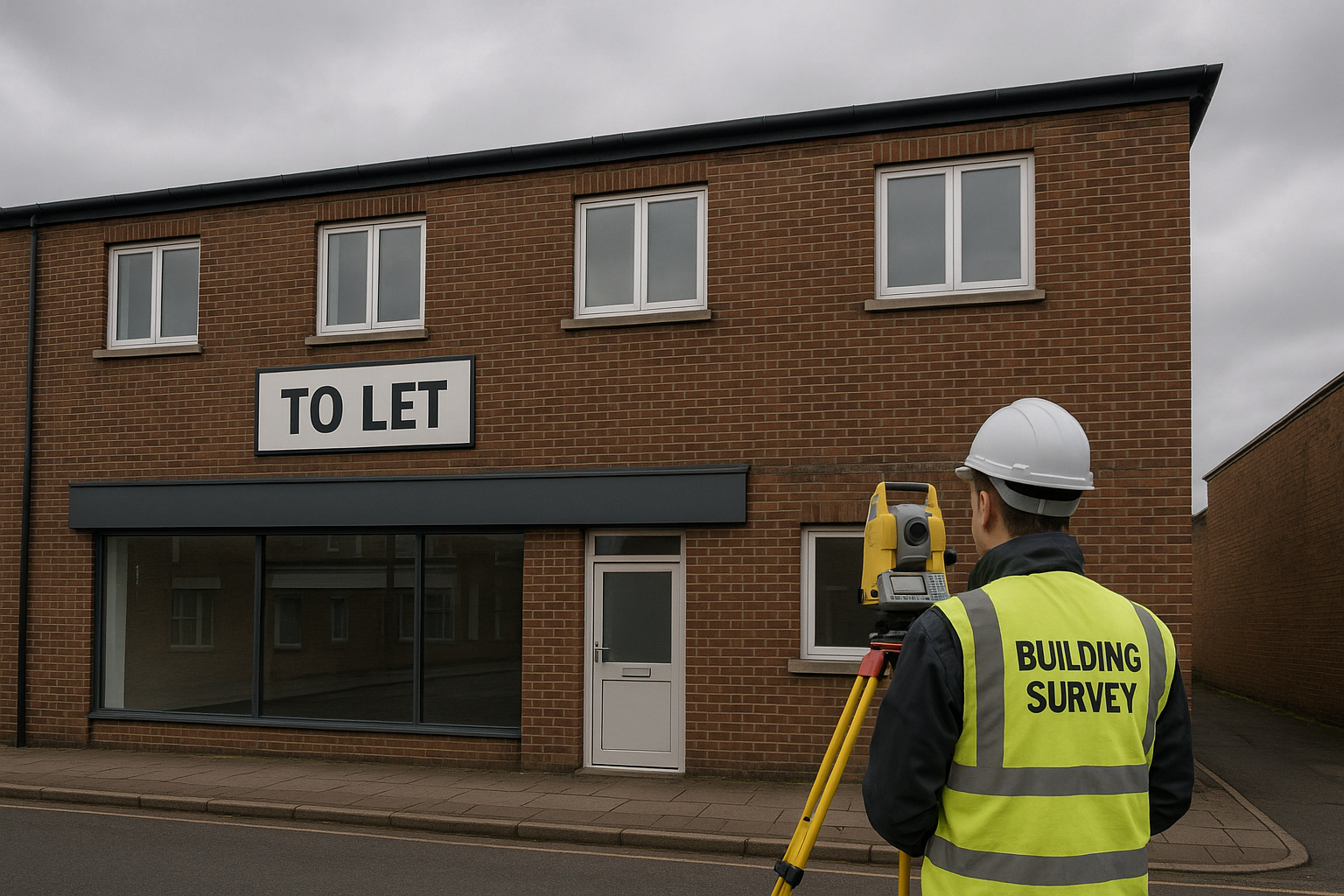
From a legal point of view, the problem usually starts when a landlord fails to assess, warn, contain, repair or remove the risk properly.
Common situations that lead to disputes
- A ceiling, insulation board or soffit starts breaking up
- Pipe lagging or old panels are damaged during repairs
- A contractor drills into asbestos-containing material during maintenance
- A tenant reports dust or debris and the complaint is dismissed
- Refurbishment starts without a suitable survey
- Shared parts of a building contain damaged asbestos and no management plan exists
- Tenants are left in occupation during unsafe works
These are the scenarios where people most often ask can I sue my landlord for asbestos. A strong paper trail can make all the difference, especially if it shows the landlord had notice and failed to act.
What you need to prove if you want to sue
Suspicion alone is rarely enough. If you want to know can I sue my landlord for asbestos and succeed, you will usually need evidence on five main points.
1. The asbestos risk existed
This is often proven by an asbestos survey, lab sampling, photographs, contractor notes, council correspondence or inspection records. If there is any doubt about what the material is, a professional survey is usually the starting point.
For example, if you need independent evidence in the capital, arranging an asbestos survey London service can help confirm whether suspect materials contain asbestos and whether urgent action is needed.
2. The landlord owed you a duty
In most tenancies this is not the hardest point to prove. The more detailed question is what that duty covered.
Was the asbestos inside your flat, in a shared area, or disturbed by contractors sent by the landlord? The location and circumstances affect how liability is assessed.
3. The landlord breached that duty
You may need to show the landlord failed to inspect, failed to warn, failed to arrange the right survey, failed to use competent contractors or failed to respond reasonably after being notified.
Examples of breach can include:
- Ignoring written complaints about damaged textured coatings, boards or lagging
- Sending tradespeople in without checking for asbestos first
- Starting refurbishments without a proper survey
- Leaving debris behind after work
- Failing to isolate or secure the area
4. You suffered loss, damage or injury
This could include a range of outcomes, not just long-term illness. Practical losses often matter just as much in housing cases.
- Temporary accommodation costs
- Damage to possessions
- Cleaning and decontamination costs
- Loss of use of rooms
- Distress and inconvenience in a housing claim
- Medical investigation and treatment
- Asbestos-related illness in serious cases
5. The breach caused the loss
This is known as causation. In illness claims, it can be the most difficult part because asbestos-related disease can take many years to develop and often requires detailed medical evidence and specialist legal advice.
If your question is can I sue my landlord for asbestos after a diagnosis, speak to a solicitor experienced in asbestos and housing claims as soon as possible. Do not rely on general assumptions about exposure.
What to do if you suspect asbestos in your rented home
The wrong reaction can make the situation worse. If you suspect a material contains asbestos, take careful, practical steps.
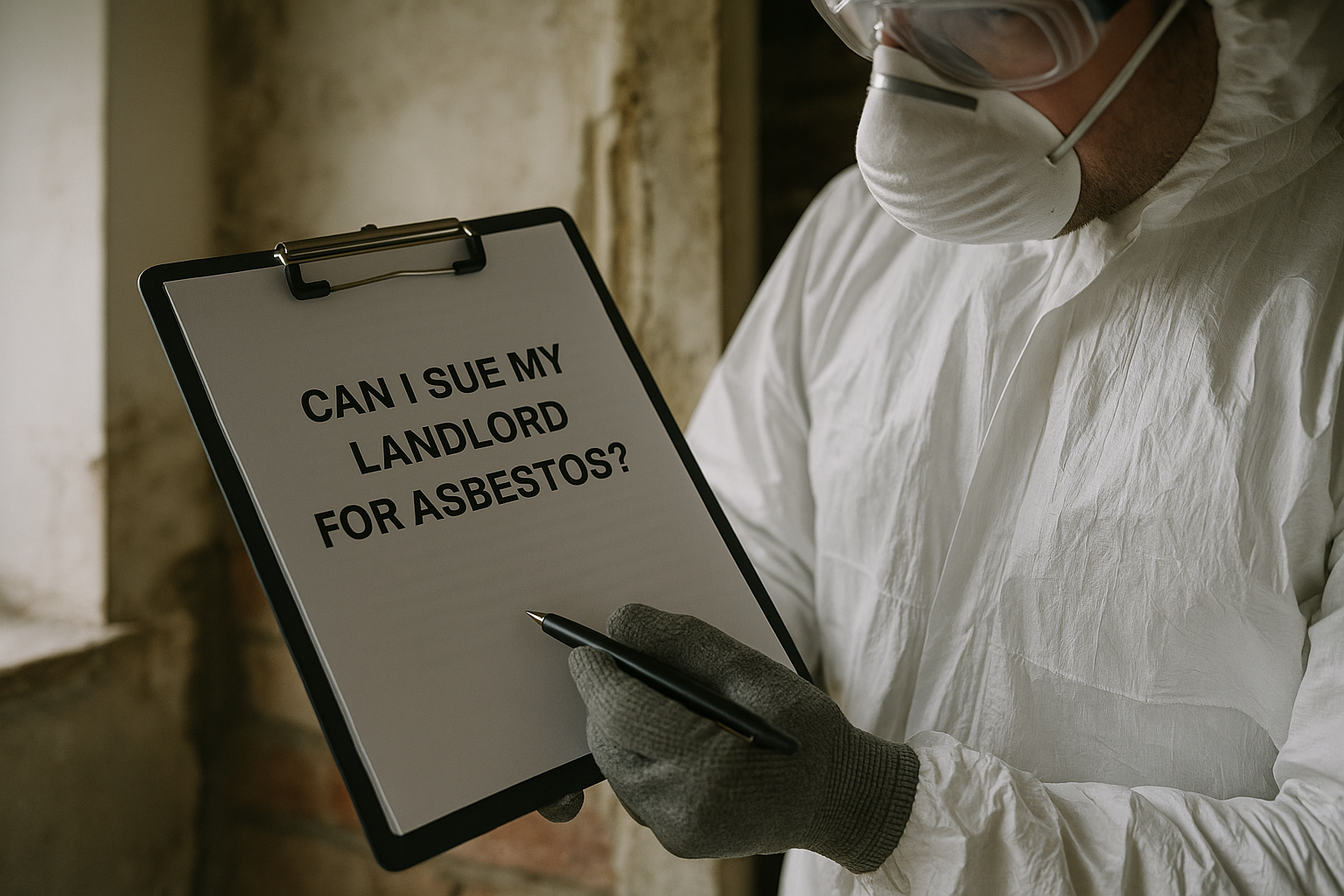
- Stop disturbing the material. Do not drill, cut, scrape, sand, vacuum or bag it yourself.
- Keep people away. Shut doors if possible and avoid spreading dust.
- Report it in writing. Email your landlord or managing agent so you have a dated record.
- Take photographs. Record the location, visible damage and any dust or debris.
- Ask what asbestos information exists. Request copies of any survey, register or contractor report.
- Ask about planned works. If builders are due to attend, ask whether a suitable survey has been carried out in line with HSG264.
- Contact the council if ignored. Environmental health may inspect where there is a serious hazard.
- Get independent professional advice. A qualified surveyor can identify the risk and recommend the next step.
If the material is confirmed as asbestos and is damaged or likely to be disturbed, the remedy may be encapsulation, repair, access control or removal depending on the product, condition and location.
Where removal is necessary, use professional asbestos removal support rather than allowing anyone to attempt a DIY fix.
How asbestos surveys can support your case
An asbestos survey often becomes the foundation of the dispute. Without one, everyone is arguing about assumptions. With one, you have evidence of what is present, where it is, what condition it is in and what action is recommended.
Management surveys
A management survey is used to locate, as far as reasonably practicable, the presence and condition of asbestos-containing materials that could be damaged or disturbed during normal occupation, including routine maintenance.
This type of survey is often relevant where a tenant has concerns about an occupied property, shared areas or ongoing maintenance arrangements.
Refurbishment and demolition surveys
Before intrusive work starts, a more invasive survey is usually required. If major strip-out or structural works are planned, a demolition survey may be needed to identify hidden asbestos before the building fabric is disturbed.
If a landlord sends builders in to replace kitchens, remove ceilings, alter pipework or open up walls without the right survey, that can be a serious failing.
For tenants in the North West, an asbestos survey Manchester appointment can provide independent evidence where maintenance, refurbishment or suspected damage is involved. In the Midlands, an asbestos survey Birmingham service can help establish the facts quickly if a dispute with a landlord is developing.
Can you claim compensation for asbestos exposure?
Potentially, yes. But there is a difference between a dangerous situation and a successful compensation claim. If you are asking can I sue my landlord for asbestos, compensation will depend on evidence of breach and evidence of loss.
Claims involving illness
If you have developed an asbestos-related condition and believe exposure in rented accommodation played a role, seek specialist legal advice immediately. These cases need careful handling and proper medical evidence.
Conditions linked to asbestos exposure can include:
- Mesothelioma
- Asbestosis
- Asbestos-related lung cancer
- Pleural thickening
Not every exposure leads to illness, and not every illness claim can be traced back to one tenancy. That is why evidence of exposure history, survey findings, witness accounts and medical records is so important.
Claims involving disruption and property loss
Even where no illness has developed, tenants may still have a valid claim linked to practical loss. This often applies where the property became unsafe or unusable because the asbestos risk was mishandled.
You may be able to claim for:
- Temporary rehousing costs
- Damage or contamination to belongings
- Loss of enjoyment of part of the property
- Delays caused by unsafe repair practices
- Out-of-pocket expenses linked to the incident
- Distress and inconvenience in the right type of housing claim
So if your concern is can I sue my landlord for asbestos even though you are not ill, the answer may still be yes if the landlord’s failures caused measurable loss or serious disruption.
Practical evidence to collect before speaking to a solicitor
A well-documented case is easier to assess and usually stronger. Start gathering evidence as soon as you suspect there is a problem.
- Your tenancy agreement
- Emails, letters and texts to and from the landlord or agent
- Photographs and videos of the suspected material
- Dates when you first noticed the issue
- Names of contractors who attended the property
- Any invoices, reports or notices left behind
- Medical records if you have symptoms or a diagnosis
- Receipts for hotel stays, cleaning or replacement items
- Council inspection notes or environmental health correspondence
- Statements from neighbours or other occupants who witnessed the issue
Keep everything in date order. If you later ask a solicitor can I sue my landlord for asbestos, a clear timeline helps them assess whether there was notice, delay, breach and resulting loss.
What landlords should have done
Many disputes could be avoided if landlords handled asbestos risks properly from the start. Good management is not complicated, but it does require the right steps at the right time.
Reasonable action often includes:
- Checking whether asbestos is likely in an older property
- Arranging the right survey before maintenance or intrusive work
- Keeping records of known asbestos-containing materials
- Using competent contractors
- Preventing tenants from being exposed during works
- Responding promptly to reports of damage or debris
- Following HSE guidance on containment, repair and removal
If these basics were ignored, your position becomes stronger when asking can I sue my landlord for asbestos.
When to speak to a solicitor and when to speak to a surveyor
You do not always need to start with a solicitor. If the immediate issue is identifying the material and making the property safe, a surveyor is often the best first call.
Speak to a surveyor when:
- You need to confirm whether a material contains asbestos
- You want an independent report on condition and risk
- Works are planned and you are worried the wrong survey has been used
- You need evidence before pressing the landlord for action
Speak to a solicitor when:
- You have suffered loss, injury or major disruption
- The landlord has ignored repeated complaints
- The council has been involved and the issue remains unresolved
- You believe unsafe works have caused contamination or exposure
- You need advice on compensation or formal legal action
Often, both professionals are needed. The survey establishes the facts. The solicitor uses those facts to advise on liability and compensation.
Frequently Asked Questions
Is it illegal for a landlord to rent out a property with asbestos?
No. Asbestos is not automatically unlawful simply because it is present in an older property. The legal issue is whether the asbestos is damaged, likely to be disturbed or poorly managed, and whether the landlord has taken reasonable steps to control the risk.
Can I sue my landlord for asbestos exposure without a diagnosis?
Possibly, but it depends on what loss you have suffered. You may still have a housing-related claim for disruption, temporary accommodation costs, contamination of belongings or distress and inconvenience, even if no asbestos-related illness has been diagnosed.
Should I move out if I suspect asbestos in my flat?
Not always. Some asbestos-containing materials can remain safely in place if they are in good condition and properly managed. If the material is damaged, debris is present or unsafe work is taking place, get professional advice urgently and ask the landlord what immediate safety measures are being taken.
What survey should a landlord arrange before building work?
That depends on the nature of the work. For normal occupation and routine maintenance, a management survey may be relevant. Before intrusive refurbishment or structural work, a more invasive survey is usually required in line with HSG264.
How long do I have to make a claim?
Time limits depend on the type of claim and the facts of the case. Personal injury claims, housing disrepair claims and contract-related claims can all work differently. If you think asbestos in your rented home has caused harm, get legal advice promptly rather than waiting.
If you need clear evidence before taking the next step, Supernova Asbestos Surveys can help with fast, professional asbestos inspections across the UK. We carry out surveys for rented homes, blocks, HMOs and properties undergoing repair or refurbishment. Call 020 4586 0680 or visit asbestos-surveys.org.uk to arrange expert support.