Where Asbestos Contamination Hides in UK Buildings — and What to Do About It
Asbestos contamination is one of the most serious hidden hazards in older UK buildings. If your property was constructed before 2000, there is a realistic chance that asbestos-containing materials (ACMs) are present somewhere — often in places you would never think to look. The fibres are invisible to the naked eye, and disturbing them without proper precautions can have life-altering consequences.
This is not a theoretical risk. Asbestos-related diseases including mesothelioma and asbestosis remain a significant cause of occupational death in the UK. Knowing where asbestos contamination is most likely to occur — and what to do when you suspect it — is the first step towards protecting yourself, your family, or your building’s occupants.
Why Asbestos Was Used So Widely in UK Buildings
Asbestos was considered a wonder material for much of the twentieth century. It is naturally fire-resistant, a superb insulator, and remarkably durable — qualities that made it attractive to builders and manufacturers across dozens of industries. More than 3,000 different construction products incorporated asbestos at some point.
From textured coatings on ceilings to lagging around boiler pipes, it was applied almost everywhere. Buildings constructed or refurbished between the 1930s and 1980s are at particularly high risk, though properties built right up to 1999 can still contain ACMs — a full ban on all asbestos types in Great Britain was not introduced until 1999.
Common Areas of Asbestos Contamination in Residential Properties
Visual inspection alone cannot confirm the presence of asbestos. However, knowing the most likely locations helps you prioritise where professional attention is needed most urgently.
Insulation in Lofts, Walls, and Around Pipes
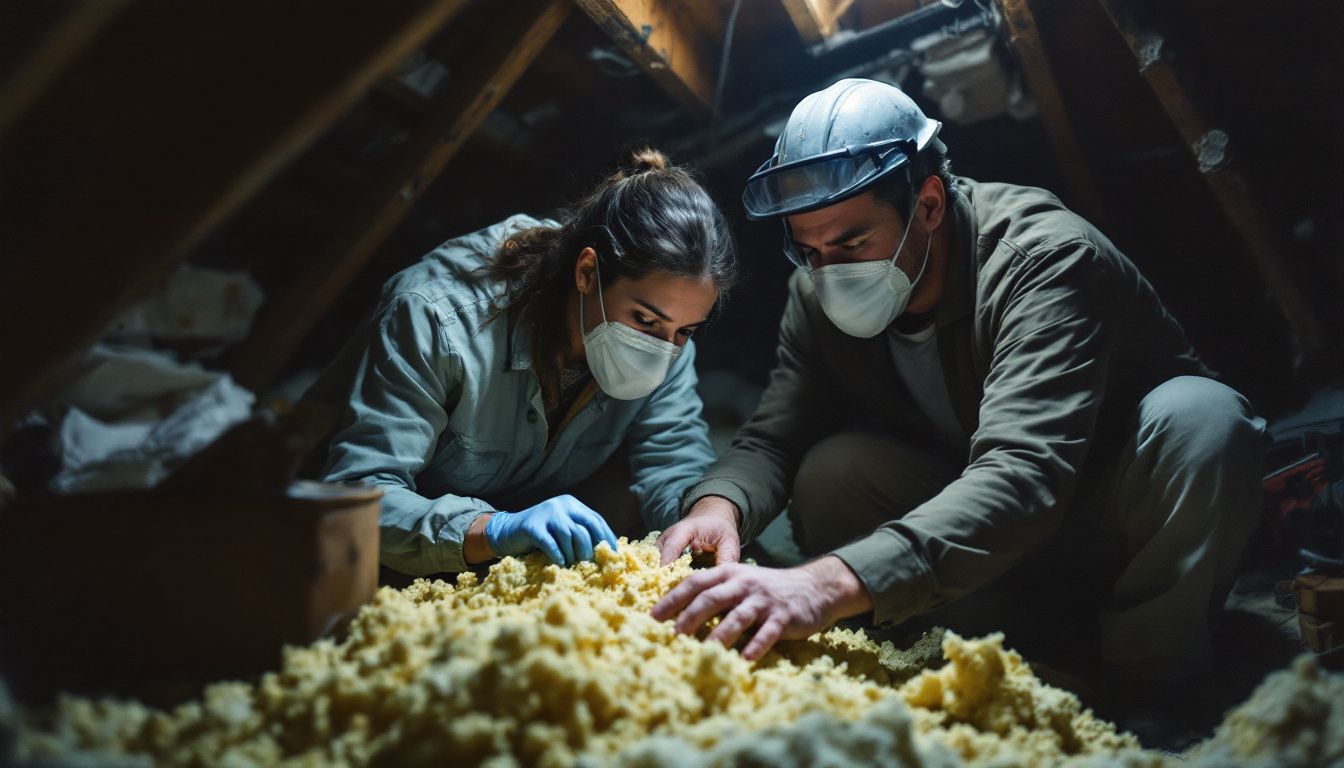
Loose-fill asbestos insulation was used in cavity walls and loft spaces, particularly in properties built during the 1960s and 1970s. This form of contamination is especially dangerous because the material is friable — it crumbles easily, releasing fibres into the air with minimal disturbance.
Pipe lagging and boiler insulation are equally concerning. Older heating systems frequently used asbestos-based materials to wrap pipes and tanks, and these can deteriorate significantly over time. If you notice crumbling or damaged insulation around any heating or plumbing components, do not touch it.
Floor Tiles and Vinyl Flooring
Vinyl floor tiles manufactured before the 1980s commonly contained chrysotile (white asbestos). The tiles themselves, when in good condition, pose a relatively low risk. The danger arises during removal or sanding, when fibres become airborne.
The adhesive used to lay these tiles — often called black mastic — can also contain asbestos. If you are planning any flooring work in an older property, have the materials tested before any work begins.
Textured Coatings — Including Artex and Similar Products
Textured decorative coatings applied to ceilings and walls were widely used in the UK from the 1960s through to the early 1990s. Many of these products contained chrysotile asbestos. Artex is the best-known brand, though numerous similar products were available.
Intact textured coatings in good condition are generally considered low risk. However, any drilling, scraping, or sanding — even as part of a minor redecoration — can release fibres. Always assume these coatings contain asbestos until proven otherwise.
Roofing Materials and Roof Panels
Corrugated asbestos cement sheeting was a staple of industrial and agricultural buildings, but it also appeared on domestic garages, outbuildings, and extensions. Asbestos cement is a bonded material, which means fibres are less likely to be released under normal conditions — but weathering, drilling, or cutting changes that picture entirely.
Roofing felt, guttering, and soffits from the same era can also harbour ACMs. If your property has any original outbuildings or flat-roofed extensions, these should be included in any asbestos assessment.
Electrical Panels, Fuse Boxes, and Wiring
Older electrical installations sometimes used asbestos as an insulating material within consumer units and fuse boxes. Asbestos paper and millboard were used as heat-resistant linings inside these units.
Any work on older electrical systems should be preceded by a check for ACMs in the surrounding area. An electrician working on a pre-1980s consumer unit without this information is taking an unnecessary risk.
Basements and Plant Rooms
Mechanical and plant rooms — boiler rooms, basement utility areas, and similar spaces — concentrate the risk considerably. Pipe lagging, boiler casing, and duct insulation all converge in these areas.
If your building has a basement or dedicated plant room, it warrants close attention during any survey. These spaces are often overlooked precisely because they are out of sight.
Asbestos Contamination in Commercial and Industrial Buildings
The risks in commercial premises are, if anything, more acute. Duty holders — owners and managers of non-domestic buildings — have a legal obligation under the Control of Asbestos Regulations to manage asbestos risk actively. This is known as the Duty to Manage, set out in Regulation 4.
Commercial buildings from the post-war period to the late 1990s may contain ACMs in:
- Sprayed coatings on structural steelwork and concrete
- Suspended ceiling tiles
- Partition walls and fire-break materials
- Floor coverings and adhesives
- Roof cladding and rainwater goods
- Insulation boards around heating systems
Sprayed asbestos applied directly to steel beams and concrete as a fire-protection measure is among the most hazardous forms of contamination due to its friable nature. If you manage a commercial property and do not have an up-to-date asbestos register, you are likely in breach of your legal duties.
A management survey is the starting point for establishing that register and demonstrating compliance. It covers all accessible areas of the building and produces a risk-rated report that forms the basis of your asbestos management plan.
How to Confirm Asbestos Contamination — The Right Way
You cannot identify asbestos by looking at it. The only way to confirm contamination is through laboratory analysis of a physical sample. There are two routes available to you.
Professional Asbestos Survey
A professional survey conducted by a BOHS P402-qualified surveyor is the most thorough and legally defensible approach. The surveyor will carry out a systematic inspection of the property, collect samples from suspect materials using correct containment procedures, and submit those samples to a UKAS-accredited laboratory for analysis under polarised light microscopy.
For properties that are occupied and in normal use, a management survey is the appropriate starting point. If you are planning renovation or structural works, a refurbishment survey is required — this is a more intrusive investigation that accesses areas likely to be disturbed during the works.
Where total demolition is planned, a demolition survey is required by law before any structural work begins. This is the most thorough survey type and must locate all ACMs throughout the entire structure, including those that would not normally be accessible.
Once ACMs have been identified and a management plan is in place, those materials need to be monitored over time. A re-inspection survey ensures that the condition of known ACMs is regularly assessed and that your register remains current.
DIY Testing Kits
For homeowners who suspect a specific material and want a quick answer, a testing kit allows you to collect a sample yourself and send it to an accredited laboratory for analysis. This is a cost-effective option for a single suspect material, though it does not replace a full survey.
It should only be used where sampling can be done safely without significantly disturbing the material. If there is any doubt, call a professional. Our asbestos testing service covers both professional sampling and laboratory analysis, giving you accurate, legally recognised results.
What Happens If Asbestos Contamination Is Found?
Finding asbestos in your property does not automatically mean it needs to be removed. In many cases, if the material is in good condition and is not likely to be disturbed, managing it in place is the safer and more practical option. This is why a risk assessment forms part of every professional survey report.
Where ACMs are damaged, deteriorating, or in locations where disturbance is unavoidable — such as during planned renovation works — asbestos removal becomes necessary. Licensed removal must be carried out by a contractor holding an HSE licence for notifiable work. Attempting to remove asbestos yourself is not only dangerous but potentially illegal depending on the type and quantity involved.
The three management options following a positive identification are:
- Manage in place — monitor the condition of the ACM regularly, restrict access if needed, and update your asbestos register accordingly.
- Encapsulate or seal — apply a specialist encapsulant to bind fibres and prevent release. Suitable for ACMs in reasonable condition that cannot easily be removed.
- Remove — the appropriate choice where materials are heavily damaged, where planned works would disturb them, or where ongoing management is impractical.
The Legal Framework Around Asbestos Contamination
UK asbestos law is clear and carries real consequences for non-compliance. The key legislation and guidance you need to understand are:
- Control of Asbestos Regulations — the primary legislation governing the management, handling, and removal of asbestos in Great Britain. It sets out licensing requirements, notification duties, and the obligation to protect workers and building occupants from exposure.
- Regulation 4 — Duty to Manage — applies to non-domestic premises. Requires duty holders to identify ACMs, assess their condition, prepare a written plan for managing the risk, and implement and monitor that plan.
- HSG264 — Asbestos: The Survey Guide — the HSE’s definitive guidance on how asbestos surveys should be conducted. Any survey you commission should comply with HSG264 standards.
Failure to comply with these obligations can result in substantial fines and, in serious cases, criminal prosecution. More importantly, non-compliance puts lives at risk. If you are a duty holder without an asbestos register in place, addressing this should be your immediate priority.
Asbestos Contamination and Fire Risk
Asbestos management does not exist in isolation. Many older buildings that contain ACMs also have outdated fire protection systems, and the two risks can interact — for example, if fire-stopping materials containing asbestos are disturbed during emergency works or routine maintenance.
A fire risk assessment should be carried out alongside your asbestos management programme, particularly in commercial and multi-occupancy residential premises. Understanding both risk profiles gives you a complete picture of your building’s safety status and helps you meet your broader duties as a responsible duty holder.
Practical Steps to Take Right Now
If you own or manage a property built before 2000 and have not yet established whether asbestos contamination is present, here is a straightforward action plan:
- Do not disturb suspect materials. If you see damaged insulation, textured coatings, or old floor tiles, leave them alone until they have been assessed.
- Identify the appropriate survey type. Occupied building in routine use? Book a management survey. Planning renovation or demolition? You need a refurbishment or demolition survey respectively.
- Commission a BOHS-qualified surveyor. Only use surveyors with recognised qualifications and laboratories with UKAS accreditation. The results need to be legally defensible.
- Establish an asbestos register. Once surveyed, record the location, type, condition, and risk rating of all identified ACMs. This document forms the foundation of your management plan.
- Review and re-inspect regularly. ACMs in good condition today may deteriorate over time. Schedule periodic re-inspections to keep your register accurate and your management plan current.
- Inform anyone working on the building. Contractors, maintenance staff, and tradespeople must be made aware of any known or suspected ACMs before they begin work. This is a legal requirement under the Control of Asbestos Regulations.
If you only suspect one specific material and want a fast, affordable answer before committing to a full survey, our asbestos testing service provides laboratory-confirmed results from a single sample.
What to Expect From a Supernova Asbestos Survey
When you book a survey with Supernova Asbestos Surveys, a BOHS P402-qualified surveyor will contact you to arrange a convenient appointment — often available within the same week. On the day, the surveyor carries out a thorough visual inspection and collects samples from any materials suspected to contain asbestos.
Samples go to our UKAS-accredited laboratory for analysis, and you receive a written report — including an asbestos register, risk assessment, and management plan — within three to five working days. The report is fully compliant with HSG264 and satisfies all requirements under the Control of Asbestos Regulations.
Here is how the process works:
- Booking — contact us by phone on 020 4586 0680 or online at asbestos-surveys.org.uk. We confirm availability and survey type with you.
- Survey day — your qualified surveyor attends, inspects all relevant areas, and takes samples using safe containment procedures.
- Laboratory analysis — samples are submitted to our UKAS-accredited laboratory for polarised light microscopy analysis.
- Report delivery — you receive a full written report within three to five working days, complete with your asbestos register and management recommendations.
- Ongoing support — if ACMs are identified, we can advise on next steps including encapsulation, removal, or ongoing re-inspection scheduling.
Supernova Asbestos Surveys has completed over 50,000 surveys nationwide. Our surveyors work across residential, commercial, and industrial properties, and we cover the full range of survey types required under HSG264 and the Control of Asbestos Regulations.
Do not wait until works are already under way to find out whether asbestos contamination is present. The time to act is before any disturbance occurs — not after.
Frequently Asked Questions
How do I know if my property has asbestos contamination?
You cannot tell by looking. Asbestos fibres are invisible to the naked eye, and many ACMs look identical to non-asbestos alternatives. The only reliable way to confirm or rule out asbestos contamination is through laboratory analysis of a physical sample taken by a qualified surveyor or using a tested sampling method. If your property was built or refurbished before 2000, treat suspect materials as potentially containing asbestos until proven otherwise.
Is asbestos contamination always dangerous?
Not immediately. ACMs in good condition that are not being disturbed pose a low risk because fibres are not being released into the air. The danger arises when materials are damaged, deteriorating, or disturbed through drilling, cutting, or demolition. This is why condition assessment is central to every professional asbestos survey — risk is determined by both the type of material and its current state.
What is the difference between a management survey and a refurbishment survey?
A management survey is designed for occupied buildings in normal use. It covers all accessible areas and identifies ACMs that could be disturbed during routine maintenance or occupancy. A refurbishment survey is required before any renovation or structural work and involves a more intrusive inspection of areas that will be affected by the works. Both must comply with HSG264 guidance.
Do homeowners have a legal duty to manage asbestos?
The formal Duty to Manage under Regulation 4 of the Control of Asbestos Regulations applies to non-domestic premises. However, homeowners still have responsibilities — particularly if they employ contractors to carry out work. Anyone who disturbs ACMs without proper precautions can face prosecution, and contractors must be informed of any known or suspected asbestos before starting work. If you are selling a property, known asbestos contamination may also need to be disclosed.
Can I remove asbestos myself?
In very limited circumstances, minor amounts of certain non-licensable ACMs can be removed by a competent person following strict HSE guidance. However, most asbestos removal — particularly anything involving friable or high-risk materials — must be carried out by an HSE-licensed contractor. Attempting to remove asbestos without the correct training, equipment, and legal authority is dangerous and potentially a criminal offence. Always seek professional advice before attempting any removal work.