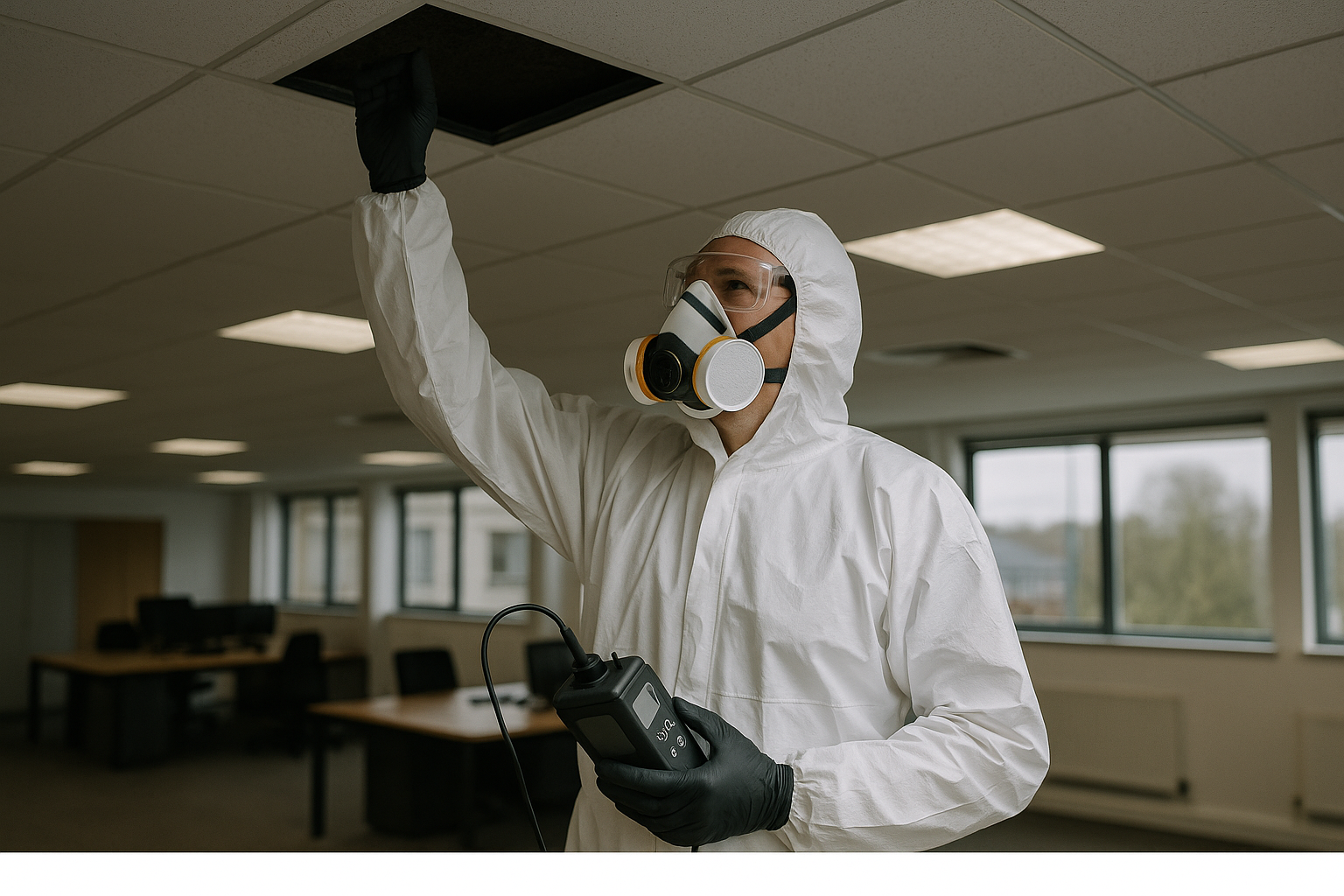
Asbestos management becomes urgent the moment you take responsibility for an older building. If the property was built before the UK ban on asbestos use, you cannot rely on guesswork, an old survey file, or a contractor saying a material “looks fine”. You need accurate information, a clear plan, and records that would stand up to scrutiny if the HSE asked to see them.
For property managers, landlords, facilities teams, schools, housing providers, and commercial owners, asbestos management is not about creating paperwork for its own sake. It is about preventing fibre release, protecting occupants and contractors, and meeting your duties under the Control of Asbestos Regulations. Done properly, it keeps routine maintenance moving and helps you avoid expensive delays when work starts.
What asbestos management actually means
Asbestos management is the process of identifying asbestos-containing materials, assessing their condition, recording the risk, and making sure nobody disturbs them without proper controls. In many buildings, the safest option is not immediate removal. It is controlled management supported by good survey information, an asbestos register, and a live management plan.
This approach aligns with the duty to manage in non-domestic premises and with HSE guidance, including HSG264 for asbestos surveys. The aim is straightforward: know where asbestos is, understand its condition, and make sure anyone who could disturb it has the right information before work begins.
Effective asbestos management usually includes:
- Identifying suspect materials through the correct survey type
- Sampling and analysis by a competent provider
- Creating or updating an asbestos register
- Assessing material risk and priority risk
- Labelling or otherwise communicating locations where appropriate
- Putting a written management plan in place
- Reviewing ACMs regularly through inspection and re-inspection
- Sharing asbestos information with staff, trades, and contractors before work starts
If any of those steps are missing, asbestos management quickly turns into paperwork rather than control.
Who is responsible for asbestos management?
If you control maintenance or repair in a non-domestic property, you are likely to have duties under the Control of Asbestos Regulations. That can include freeholders, managing agents, employers, facilities managers, tenants with repairing obligations, and those responsible for common parts in residential blocks.
The duty is not limited to offices or factories. It can apply to shops, schools, surgeries, warehouses, churches, industrial units, and communal areas of flats. The practical question is always the same: who has control over the building and the work carried out within it?
Your day-to-day asbestos management responsibilities usually include:
- Finding out whether asbestos is present, and where
- Presuming materials contain asbestos if there is no strong evidence to the contrary
- Keeping an up-to-date record of known or presumed ACMs
- Assessing the risk of exposure
- Preparing and implementing a management plan
- Reviewing the plan and the condition of ACMs regularly
- Providing information to anyone liable to disturb the material
A common mistake is assuming an old survey covers everything forever. It does not. Buildings change, occupancy changes, maintenance activity changes, and materials deteriorate. Asbestos management has to be active, not filed away and forgotten.
Start asbestos management with the right survey
One of the biggest causes of poor asbestos management is using the wrong survey for the job. A survey must match the purpose of the building activity. If it does not, the information may be incomplete, and that creates real risk for tradespeople and occupants.
Management survey
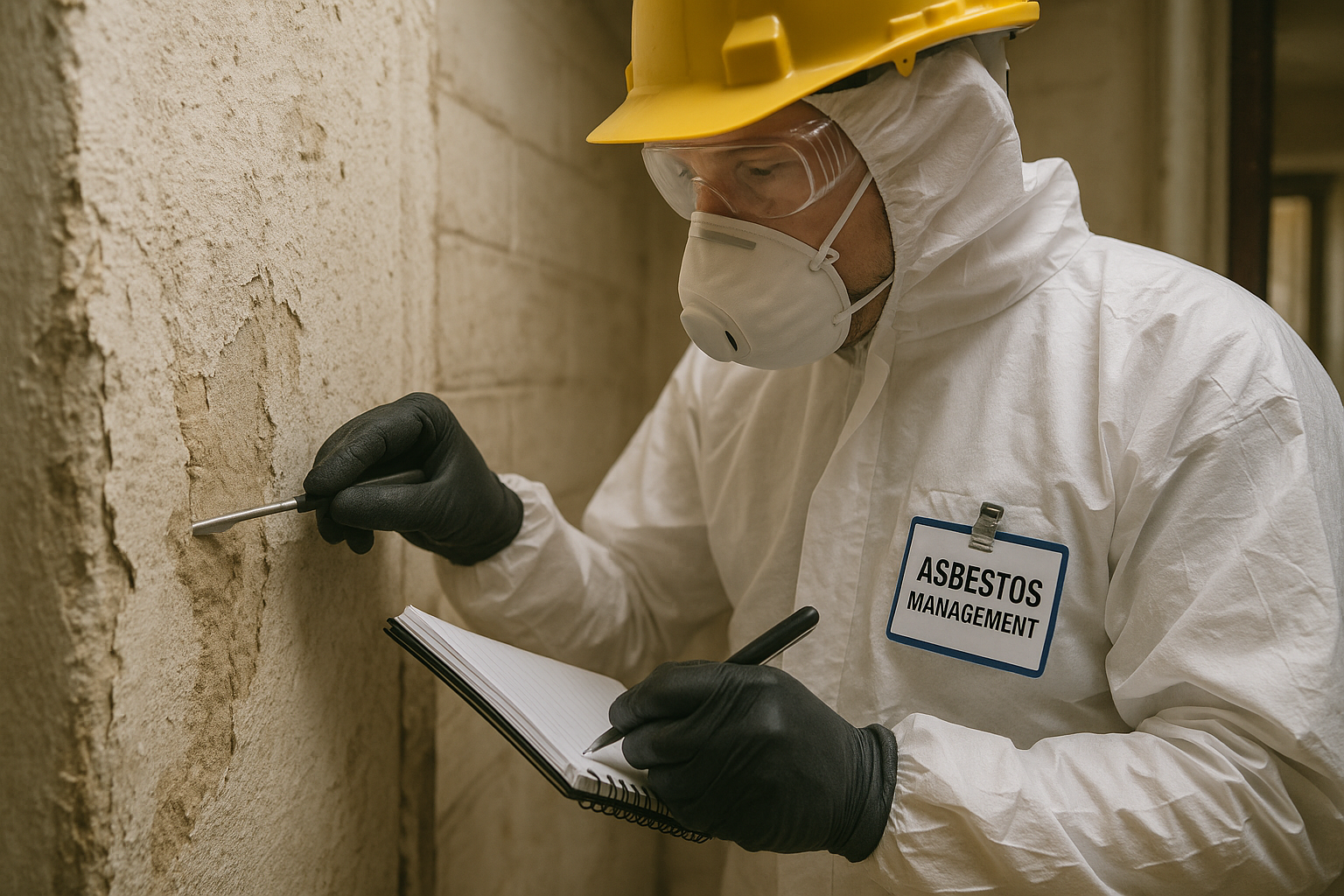
A management survey is designed for normal occupation, routine maintenance, and day-to-day asbestos management. It helps locate, as far as reasonably practicable, the presence and extent of ACMs that could be disturbed during ordinary use or foreseeable maintenance.
This is the starting point for many occupied buildings. It supports the asbestos register and gives dutyholders the information needed to manage asbestos safely in place.
Refurbishment survey
If you are planning intrusive works, a management survey is not enough. Before upgrades, strip-out, rewiring, new kitchens, HVAC works, or structural alterations, you need a refurbishment survey.
This survey is fully intrusive in the areas affected by the planned works. It is intended to find hidden ACMs within the fabric of the building so contractors are not exposed once work starts.
Demolition survey
Where a structure, or part of it, is due to be demolished, a demolition survey is required. This is also intrusive and aims to identify all ACMs so they can be dealt with before demolition proceeds.
Skipping this stage is a fast way to create delays, enforcement issues, and contamination risks on site.
Re-inspection survey
Asbestos management does not end once ACMs are identified. Their condition must be reviewed at suitable intervals. A re-inspection survey checks previously identified asbestos-containing materials and records whether their condition has changed.
If damage, deterioration, water ingress, or repeated disturbance is found, your management plan needs updating straight away.
Building an asbestos register and management plan
A survey report is useful, but it is not the same as a working asbestos management system. The real value comes from turning survey findings into a register your team can use and a management plan people actually follow.
What your asbestos register should contain
Your asbestos register should be clear, current, and easy to access. At a minimum, it should record:
- The location of each known or presumed ACM
- The product type and asbestos type where identified
- The extent or quantity
- The material condition
- The risk assessment or priority rating
- Any action taken, such as encapsulation, labelling, or restricted access
- The date of inspection and next review date
If contractors cannot understand the register quickly, it is not doing its job. “AIB panel above suspended ceiling in boiler room” is far more useful than a vague note saying “possible asbestos in plant area”.
What your management plan should cover
Your plan should explain how asbestos management works in practice on your site. That usually includes:
- Who is responsible for managing asbestos information
- How the register is stored and updated
- How staff and contractors are informed before work starts
- Permit-to-work or authorisation procedures
- Inspection and re-inspection arrangements
- Emergency arrangements if suspect asbestos is damaged
- Decision-making on repair, encapsulation, monitoring, or removal
Keep the plan site-specific. A generic template downloaded years ago will not help if a contractor drills into asbestos insulating board because nobody checked the ceiling void against the register.
Practical asbestos management on occupied sites
The best asbestos management plans are simple enough to use every day. Occupied buildings need controls that fit around real maintenance activity, tenant turnover, reactive repairs, and contractor access.
Before any work starts
Always check the asbestos register before maintenance, installation, IT cabling, fire alarm upgrades, decorative works, or access to service risers. Even low-level tasks can disturb ACMs if they involve drilling, sanding, lifting ceiling tiles, or opening boxed-in services.
Make this a fixed step in your job approval process. Do not leave it to memory or assumption.
- Check whether the work area is covered by a suitable survey.
- Review the asbestos register for the exact location.
- Confirm whether the planned task is intrusive.
- Stop and arrange the correct survey if information is missing.
- Brief contractors and record that the information was issued.
When asbestos can stay in place
Not every ACM needs removal. If the material is in good condition, unlikely to be disturbed, and properly recorded, leaving it in place may be the safest option. That is a normal part of sensible asbestos management.
Typical examples include sealed asbestos cement sheets in low-risk areas or textured coatings that are in sound condition and not affected by planned works.
When action is needed
You should review remedial action if an ACM is damaged, accessible in a vulnerable location, affected by leaks, repeatedly disturbed, or due to be impacted by upcoming work. Depending on the situation, the right action could be repair, encapsulation, enclosure, restricted access, or licensed removal.
Where removal is the right option, use a specialist provider for asbestos removal and make sure the scope matches the survey findings and the condition on site.
Training, communication, and contractor control
Even a well-prepared register will fail if the wrong people never see it. Most asbestos incidents happen during routine work by people who were unaware of the risk, misunderstood the survey, or assumed someone else had checked.
Strong asbestos management depends on communication.
Who needs asbestos information?
- In-house maintenance teams
- Electricians, plumbers, decorators, and general builders
- IT and telecoms installers
- Fire and security engineers
- Cleaning and caretaking staff where relevant
- Project managers and principal contractors
- Anyone approving works on site
Information should be given before work begins, not after a contractor has already opened up the area. Build asbestos checks into inductions, work orders, permits, and contractor sign-in procedures.
Training matters
People who may come across asbestos during their work need suitable asbestos awareness training. Those carrying out survey, sampling, analytical, or removal work need the relevant competence for those tasks.
For dutyholders and property managers, the practical point is simple: do not ask untrained staff to identify or disturb suspect materials. If there is uncertainty, stop work and get competent advice.
Sampling, testing, and what to do if you find a suspect material
Sometimes asbestos management starts with a material nobody expected to find. A riser panel, boxing, floor tile adhesive, textured coating, cement flue, or old insulation board may only come to light during maintenance or a void inspection.
If you come across a suspect material:
- Stop work immediately
- Keep people out of the area if there is any sign of damage or dust
- Do not sweep, vacuum, drill, or break the material
- Arrange sampling by a competent professional
- Use an appropriate testing kit only where suitable and without disturbing the material unsafely
- Update the register and management plan once results are confirmed
DIY assumptions cause problems. A material that looks harmless may contain asbestos, while another that looks suspicious may not. Proper sampling and analysis remove the guesswork.
How asbestos management links to wider compliance
Buildings are rarely managed in silos. Asbestos management should sit alongside your wider health and safety and property compliance arrangements, not outside them. Planned maintenance, contractor control, water safety, and fire precautions often overlap in the same plant rooms, risers, ceiling voids, and service cupboards.
If one compliance process ignores another, people get mixed messages. That is why many dutyholders review asbestos information alongside a fire risk assessment, especially in complex commercial or multi-occupied premises.
Access routes, compartmentation works, emergency lighting upgrades, and fire stopping projects can all involve intrusive activity. If asbestos information is not checked first, one safety project can create another safety problem.
Common asbestos management mistakes to avoid
Most failures are not caused by complicated legal points. They come from everyday shortcuts.
- Relying on an old survey without checking whether it is still relevant
- Using a management survey for refurbishment or demolition work
- Keeping an asbestos register that contractors cannot easily access
- Failing to review ACM condition after leaks, damage, or tenant alterations
- Assuming domestic common parts are exempt from asbestos management duties
- Letting small reactive jobs proceed without checking asbestos information
- Not recording who was given asbestos information before work started
- Asking untrained staff to sample or remove suspect materials
If any of these sound familiar, tighten the process now. Small gaps in asbestos management tend to show up at the worst possible moment, usually when contractors are already on site and the programme is under pressure.
How often should asbestos management be reviewed?
Asbestos management is not a one-off exercise. The condition of ACMs should be monitored at suitable intervals, and the management plan should be reviewed whenever there is a relevant change.
You should review your asbestos management arrangements when:
- A re-inspection is due
- Materials have been damaged or disturbed
- There has been water ingress, impact damage, or deterioration
- The building use changes
- New tenants or contractors start using the site
- Refurbishment or demolition works are planned
- Additional sampling or removal has been carried out
As a practical rule, if the building has changed, your asbestos management records may need to change as well.
Asbestos management for different property types
The core principles stay the same, but the practical controls will vary depending on the building.
Offices and commercial premises
Routine churn is common in offices. Fit-outs, cabling, partition changes, and M&E upgrades can all disturb hidden ACMs. Good asbestos management means checking survey coverage before every intrusive task, even when the work looks minor.
Schools and healthcare settings
These sites need tight contractor control because occupancy can be sensitive and disruption has wider consequences. Clear communication, restricted access, and careful scheduling are essential.
Industrial units and warehouses
Asbestos cement roofs, wall sheets, service ducts, and plant areas are often part of the risk picture. Damage from impact, leaks, or maintenance access should trigger review.
Residential blocks
The duty to manage can apply to common parts such as corridors, risers, meter cupboards, plant rooms, and roof spaces. Asbestos management often fails here when landlords focus only on individual flats and ignore communal areas.
Getting local survey support when you need it
Speed matters when a contractor is waiting, a tenant fit-out is due to start, or a suspect material has been found during maintenance. Working with a surveyor who understands local property stock and can respond quickly makes asbestos management far easier to control.
If your property is in the capital, arranging an asbestos survey London service can help you move from uncertainty to a workable plan quickly. For sites in the North West, an asbestos survey Manchester can support both routine compliance and project planning. If you are managing premises in the Midlands, an asbestos survey Birmingham can provide the survey information needed to keep works safe and compliant.
Frequently Asked Questions
What is the purpose of asbestos management?
The purpose of asbestos management is to prevent exposure to asbestos fibres by identifying ACMs, assessing their condition, recording the risk, and making sure nobody disturbs them without suitable controls. In many cases, safe management in place is the correct option.
Do all older buildings need an asbestos survey?
If a building was constructed before the UK ban on asbestos use, asbestos should be considered unless there is strong evidence to show it is absent. Whether you need a management, refurbishment, or demolition survey depends on how the building is occupied and what work is planned.
How often should asbestos be re-inspected?
There is no single interval that suits every property. Re-inspection should be carried out at suitable intervals based on the material, its condition, location, and likelihood of disturbance. Higher-risk or vulnerable materials may need more frequent review.
Can asbestos be left in place?
Yes. If an asbestos-containing material is in good condition, unlikely to be disturbed, and properly managed, leaving it in place can be the safest option. The key is that asbestos management must remain active, documented, and regularly reviewed.
What should I do if a contractor damages a suspect material?
Stop work immediately, keep people away from the area, and do not attempt to clean up dust or debris without proper controls. Seek competent advice, arrange assessment or sampling, and update your asbestos management records before work resumes.
Need expert help with asbestos management?
If you need a survey, re-inspection, sampling, or support building a practical asbestos management system, Supernova Asbestos Surveys can help. We carry out surveys nationwide for commercial, residential, education, and public sector properties.
Call 020 4586 0680 or visit asbestos-surveys.org.uk to book the right service and get clear, compliant advice from an experienced team.