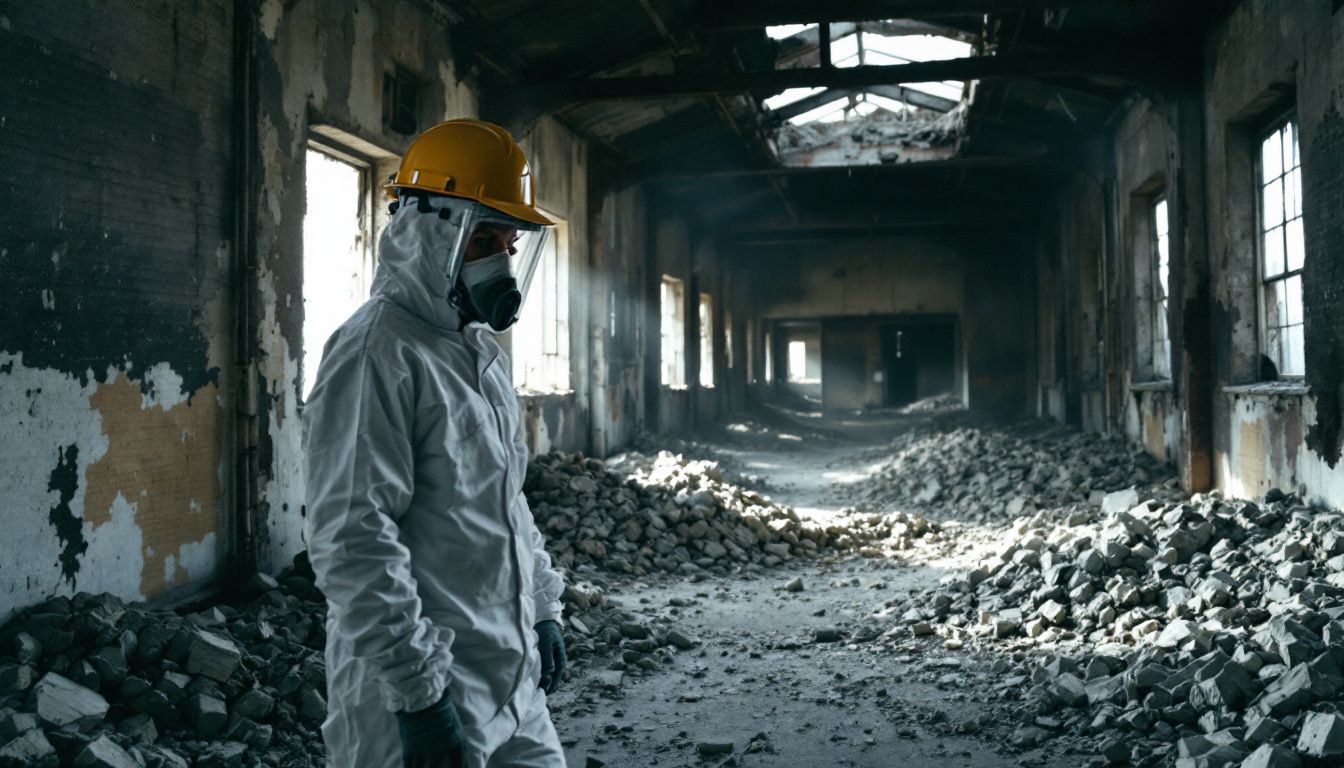
Choosing the Right Asbestos Respirator: What Every Worker and Property Owner Needs to Know
Asbestos fibres are invisible to the naked eye, odourless, and utterly silent in the damage they cause. An asbestos respirator is not just a piece of kit — it is the single most critical barrier between a worker’s lungs and a disease that can take decades to surface and has no cure. Getting it wrong is not an option.
Asbestos-related diseases, including mesothelioma, asbestosis, and lung cancer, remain a leading cause of occupational death in the United Kingdom. The fibres responsible are microscopic — a standard dust mask offers no meaningful protection whatsoever. Understanding which respirator to use, how to fit it correctly, and when to replace it is essential knowledge for anyone working in or around asbestos-containing materials (ACMs).
Why Respiratory Protection Must Be the Priority in Asbestos Work
When asbestos-containing materials are disturbed — drilled, cut, sanded, or demolished — fibres become airborne. They are then inhaled and lodge permanently in lung tissue. Unlike many workplace hazards, no safe level of asbestos exposure has been definitively established, and the consequences may not become apparent for 20 to 40 years.
This latency period is what makes asbestos so insidious. Workers exposed decades ago are only now being diagnosed with terminal conditions. That is why respiratory protection during any work involving ACMs must be treated as non-negotiable — not as a precaution to consider only if the job seems dusty.
The Control of Asbestos Regulations set out clear legal duties for employers and contractors working with asbestos. These regulations require that adequate respiratory protective equipment (RPE) is provided, maintained, and correctly used. HSE guidance document HSG264 provides further technical detail on survey and assessment procedures, while HSE guidance on RPE specifies the protection factors required for different types of asbestos work.
Types of Asbestos Respirator: Which One Is Right for the Job?
Not all respirators are equal. The type of asbestos work being carried out determines which respirator is appropriate. Using an under-specified respirator is as dangerous as wearing no protection at all — it creates false confidence while fibres continue to enter the airways.
Disposable FFP3 Respirators
FFP3 disposable masks are the minimum standard for low-risk, short-duration asbestos work. They carry an assigned protection factor (APF) of 20, meaning they reduce the wearer’s exposure to one-twentieth of the ambient concentration. They are single-use and must be discarded after each task — never stored for reuse.
These are appropriate for work with lower-risk asbestos materials, such as non-licensed notifiable work. They are not suitable for licensed asbestos removal, where higher protection factors are required.
Half-Face Respirators with P3 Filters
A reusable half-face respirator fitted with P3 particulate filters offers an APF of 20 — the same as an FFP3 disposable — but with the advantage of a more robust seal and replaceable filter cartridges. The filters must be changed regularly in accordance with manufacturer guidance and must never be cleaned or reused once saturated.
These are suited to non-licensed asbestos work and some lower-risk notifiable non-licensed work (NNLW). Fit testing is mandatory before use, not optional.
Full-Face Respirators with P3 Filters
A full-face respirator with P3 filters provides an APF of 40 — double that of a half-face unit. The full-face design also protects the eyes and mucous membranes, which is particularly important when fibre concentrations are higher or when work involves significant disturbance of ACMs.
These are appropriate for licensed asbestos removal work and situations where the risk assessment indicates elevated exposure levels. Fit testing is a legal requirement, not a recommendation.
Powered Air-Purifying Respirators (PAPRs)
Powered air-purifying respirators use a battery-powered blower to force air through a HEPA filter before delivering it to the wearer. A full-face or hood-type PAPR can achieve an APF ranging from 20 to over 2,000, depending on the design and configuration.
They are particularly useful where workers have facial hair that prevents a tight seal on a conventional respirator, or where prolonged work makes wearing a tight-fitting mask uncomfortable. PAPRs are widely used in licensed asbestos removal operations, particularly for high-risk work involving sprayed coatings, lagging, or large-scale demolition projects where fibre levels may be significantly elevated.
Airline Respirators
Airline respirators supply clean, breathable air from a remote source via a hose. They can achieve very high APFs and are used in the most hazardous asbestos environments — typically enclosed spaces or situations where fibre concentrations are expected to be extremely high.
They require careful management of the airline and a reliable clean air supply, making them more complex to deploy than filter-based options. Proper training and supervision are essential when airline systems are in use.
Fit Testing: The Step That Cannot Be Skipped
Selecting the correct respirator type is only half the battle. A respirator that does not fit correctly offers dramatically reduced protection — sometimes little more than an unfiltered mask. The HSE is explicit: all tight-fitting respirators must be fit tested before use, and fit testing must be repeated if the wearer’s face shape changes significantly, for example due to weight loss or dental work.
There are two types of fit test:
- Qualitative fit testing — uses the wearer’s sense of taste or smell to detect leakage. Suitable for disposable and half-face respirators.
- Quantitative fit testing — uses instrumentation to measure actual leakage. Required for full-face respirators and recommended for higher-risk work.
Fit testing must be carried out by a competent person and the results recorded. Workers should also perform a pre-use face seal check — a simple positive or negative pressure check — every single time they put on a tight-fitting respirator.
Facial hair is a significant compliance issue. Even a day’s stubble can compromise the seal on a tight-fitting respirator. Workers required to wear tight-fitting RPE must be clean-shaven at the point where the mask contacts the face. This is not a matter of personal preference — it is a legal compliance issue under the Control of Asbestos Regulations.
Maintaining and Caring for Your Asbestos Respirator
Reusable respirators must be maintained properly to remain effective. A poorly maintained respirator may look functional but offer significantly reduced protection in practice.
Inspection Before Each Use
Before putting on a reusable respirator, inspect the facepiece for cracks, tears, or distortion. Check that valve seats are clean and undamaged, and inspect the head harness for elasticity and general condition. If any component is compromised, replace it before commencing work — never continue with damaged equipment.
Cleaning After Use
Reusable facepieces must be cleaned after each use. Use only cleaning products approved by the respirator manufacturer — some chemicals can degrade the rubber or silicone facepiece material. Remove filters before cleaning and store them separately in a sealed bag.
Never clean a respirator in a way that could spread asbestos contamination. Cleaning should take place within the decontamination unit on site, following the established decontamination procedure.
Filter Replacement
P3 filters used in asbestos work do not have a fixed service life based on time alone. They should be replaced when breathing resistance increases noticeably, when the filter becomes physically damaged, or following any work where high fibre concentrations were encountered. Filters must also be replaced if the respirator has been stored incorrectly or if there is any doubt about their integrity.
Storage
Store reusable respirators in a clean, sealed container away from dust, chemicals, and direct sunlight. Do not leave them lying on surfaces in the work area where they can become contaminated. Designate a clean storage area within the decontamination unit or welfare facility.
The Asbestos Respirator as Part of a Complete PPE System
An asbestos respirator works as part of a broader personal protective equipment system. Respiratory protection alone is insufficient — fibres can settle on skin, clothing, and hair, and be transferred to clean areas or inadvertently ingested. Every element of the PPE ensemble matters.
A complete PPE system for asbestos work typically includes:
- Disposable coveralls — Type 5 category minimum, with elasticated hood, wrists, and ankles to prevent fibre contamination of clothing and skin.
- Disposable gloves — Nitrile or neoprene, worn over the coverall cuffs and taped in place to eliminate gaps.
- Safety footwear — Steel-toecapped boots with non-slip soles. Disposable boot covers are worn over these and removed during decontamination.
- Eye protection — Goggles or a full-face respirator where there is a risk of fibre contact with the eyes.
Coverall cuffs, leg openings, and the junction between gloves and sleeves should all be taped to eliminate gaps. This is particularly important during active removal work where fibre concentrations are at their highest.
Decontamination: Removing PPE Without Spreading Contamination
Putting PPE on correctly is important. Removing it safely is equally critical — and arguably where more mistakes occur. Contaminated PPE that is removed carelessly can release fibres into the environment, contaminate the worker’s hair and clothing, and spread asbestos well beyond the work area.
The correct sequence for removing PPE in an asbestos decontamination unit is:
- Vacuum the outer surface of the coverall using an H-class vacuum before leaving the work area.
- Remove boot covers and dispose of them in a sealed asbestos waste bag.
- Remove the coverall by rolling it inward, keeping the contaminated surface inside. Dispose of it in a sealed asbestos waste bag.
- Remove gloves and dispose of them in the asbestos waste bag.
- Move to the clean area and remove the respirator. If reusable, clean and store it correctly. If disposable, place it in the waste bag.
- Shower thoroughly before leaving the site.
All disposable PPE must be treated as asbestos-contaminated waste. It must be double-bagged in clearly labelled asbestos waste bags and disposed of in accordance with the relevant waste regulations.
Legal Duties: Who Is Responsible?
Under the Control of Asbestos Regulations, employers have a duty to provide suitable RPE and PPE to workers who may be exposed to asbestos fibres. This includes ensuring equipment is appropriate for the level of risk, properly maintained, and that workers are trained in its correct use.
Workers also carry legal responsibilities — they must use the PPE provided, report defects, and follow the procedures established by their employer. Ignoring PPE requirements is not just a disciplinary matter; it is a breach of health and safety law.
Licensed asbestos removal contractors must hold a licence from the HSE and are subject to additional notification and supervision requirements. If you are commissioning asbestos work, always verify that the contractor holds the appropriate licence for the type of work being carried out. You can find out more about what responsible asbestos removal involves before appointing any contractor.
Before any removal work begins, a thorough asbestos survey should be completed to identify and characterise all ACMs on site. Whether you need an asbestos survey in London, an asbestos survey in Manchester, or an asbestos survey in Birmingham, Supernova has experienced surveyors ready to assist.
Training: Knowledge Is as Important as Equipment
The best asbestos respirator in the world offers limited protection if the person wearing it has not been trained to use it correctly. Under the Control of Asbestos Regulations, workers who are liable to be exposed to asbestos must receive adequate information, instruction, and training before they begin work.
Training must cover the health risks associated with asbestos exposure, the types of work that could result in exposure, the correct use and maintenance of RPE and PPE, and the decontamination procedures to follow. It must be relevant to the specific type of work being carried out and refreshed at regular intervals.
For licensed work, additional training requirements apply. Supervisors and workers on licensed sites must hold recognised asbestos training qualifications, and records of training must be maintained. Competency is not assumed — it must be demonstrated and documented.
Employers should never allow workers to begin asbestos-related tasks on the basis of informal instruction alone. Proper accredited training protects both the worker and the organisation from legal liability.
Common Mistakes That Undermine Respirator Effectiveness
Even when the correct asbestos respirator has been selected, fit tested, and issued, protection can still be compromised by avoidable errors. Awareness of these common mistakes is the first step to eliminating them.
- Wearing the respirator around the neck between tasks — This contaminates the interior of the facepiece with fibres from the work environment.
- Reusing disposable FFP3 masks — A single-use mask used more than once may have a compromised seal and degraded filter performance.
- Failing to check the seal before entering the work area — A pre-use seal check takes seconds and could prevent significant exposure.
- Using expired or damaged filters — Filters that have been stored incorrectly or physically damaged must be replaced before use, without exception.
- Removing the respirator inside the enclosure — The respirator must remain in place until the worker has left the contaminated area and completed the appropriate decontamination steps.
- Assuming a tight fit without testing — Face shapes vary significantly. A respirator that fits one worker well may leak significantly on another.
Each of these errors represents a real and preventable exposure risk. Supervisors should conduct regular checks to ensure that RPE is being worn correctly throughout the working day, not just at the start of a shift.
When an Asbestos Survey Comes First
Selecting and wearing the correct asbestos respirator is vital — but it is only relevant once you know asbestos is present. Many property owners and managers commission refurbishment or maintenance work without first establishing whether ACMs exist in the building. This is both legally non-compliant and genuinely dangerous.
Under the Control of Asbestos Regulations, a refurbishment and demolition survey must be carried out before any work that could disturb the fabric of a building built before the year 2000. A management survey is required for occupied premises to identify and manage ACMs in situ.
Without a survey, contractors and workers cannot know what they are dealing with, what RPE is required, or whether the work even needs to be licensed. A survey is not a bureaucratic formality — it is the foundation on which all safe asbestos management decisions are built.
Supernova Asbestos Surveys provides both management and refurbishment surveys across the UK, carried out by qualified and experienced surveyors. Getting the survey right before work begins is how you ensure that the right asbestos respirator — and all other protective measures — are in place from the outset.
Frequently Asked Questions
What is the minimum standard asbestos respirator for asbestos work?
The minimum standard for low-risk, short-duration asbestos work is an FFP3 disposable respirator with an assigned protection factor (APF) of 20. For licensed asbestos removal, a full-face respirator with P3 filters (APF of 40) or higher-rated equipment such as a powered air-purifying respirator is required. The appropriate type depends on the nature of the work and the findings of the risk assessment.
Can I use a standard dust mask instead of a proper asbestos respirator?
No. Standard dust masks — including basic surgical-type face coverings — offer no meaningful protection against asbestos fibres. Only respirators that meet the FFP3 standard or above, fitted correctly and fit tested where required, provide adequate protection. Using an inadequate mask creates a false sense of security and leaves the wearer exposed to potentially lethal fibres.
Is fit testing a legal requirement for asbestos respirators?
Yes. Under HSE guidance and the Control of Asbestos Regulations, all tight-fitting respirators must be fit tested before use. This applies to disposable FFP3 masks, half-face respirators, and full-face respirators. Fit testing must be carried out by a competent person, results must be recorded, and testing must be repeated if the wearer’s facial structure changes significantly.
How often should P3 filters be replaced on a reusable asbestos respirator?
P3 filters do not have a fixed time-based replacement schedule. They should be replaced when breathing resistance increases noticeably, when they are physically damaged, after work involving high fibre concentrations, or whenever there is any doubt about their condition or integrity. Always follow the manufacturer’s guidance and err on the side of caution — filters are inexpensive compared to the health consequences of inadequate protection.
Do I need an asbestos survey before deciding which respirator workers should use?
Yes. A survey identifies the type, condition, and location of asbestos-containing materials, which directly informs the risk assessment. The risk assessment determines the level of exposure workers are likely to face, which in turn determines the correct asbestos respirator and broader PPE requirements. Without a survey, it is impossible to make an informed and legally compliant decision about respiratory protection.
Get Expert Help Today
If you need professional advice on asbestos in your property, our team of qualified surveyors is ready to help. With over 50,000 surveys completed across the UK, Supernova Asbestos Surveys delivers clear, actionable reports you can rely on.
Call us on 020 4586 0680 or visit asbestos-surveys.org.uk for a free, no-obligation quote.