School Asbestos Clearance: What Every Dutyholder Needs to Know
Asbestos is present in the majority of UK school buildings constructed before 2000 — and that means millions of pupils and staff potentially sharing their daily environment with hazardous materials. School asbestos clearance is not just a procedural box to tick; it is a legal obligation with serious consequences when ignored. Whether you manage a primary school, secondary academy, or further education college, understanding what the law demands could protect lives.
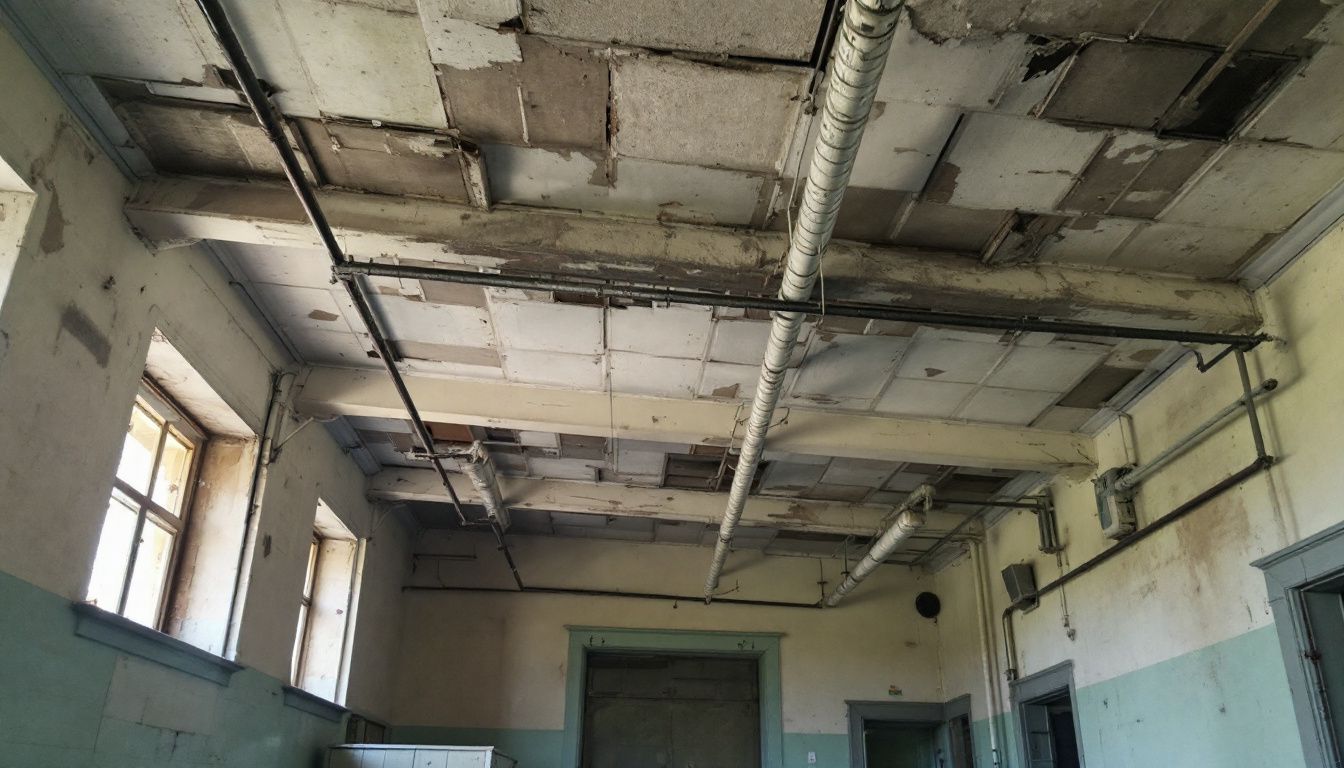
The challenge is that asbestos in schools rarely looks dangerous. It sits quietly inside ceiling tiles, floor coverings, pipe lagging, and wall panels — undisturbed and largely invisible. The moment it is disturbed, however, the risk changes entirely.
Why Asbestos Remains a Serious Issue in UK Schools
Asbestos was widely used in UK construction from the 1950s through to the late 1990s. Blue and brown asbestos were banned in 1984, and white asbestos followed in 1999. That still leaves decades’ worth of asbestos-containing materials (ACMs) embedded in thousands of school buildings across England, Scotland, and Wales.
The Health and Safety Executive has consistently highlighted schools as a priority sector for asbestos management. Staff who carry out routine maintenance — drilling walls, cutting ceiling tiles, adjusting pipe runs — face repeated low-level exposure if ACMs are not properly identified and managed. Repeated exposure, even at low levels, carries genuine long-term health risk.
There are three main types of asbestos found in school buildings:
- Chrysotile (white asbestos) — found in ceiling tiles, floor tiles, and roofing materials
- Amosite (brown asbestos) — common in thermal insulation, ceiling tiles, and asbestos insulation board (AIB)
- Crocidolite (blue asbestos) — found in pipe lagging and spray coatings; considered the most hazardous
All three types are dangerous when fibres become airborne. None should be treated casually.
The Legal Framework Governing School Asbestos Clearance
The primary legislation governing asbestos management in UK schools is the Control of Asbestos Regulations, supported by the Health and Safety at Work etc. Act. Together, these place a clear duty on those responsible for non-domestic premises — including schools — to identify, assess, and manage any asbestos present.
Regulation 4 of the Control of Asbestos Regulations, often called the Duty to Manage, is the cornerstone of school compliance. It requires dutyholders to:
- Identify whether ACMs are present in the building
- Assess the condition and risk of those materials
- Produce and maintain a written asbestos management plan
- Keep an up-to-date asbestos register
- Ensure anyone who may disturb ACMs is informed of their location
- Review and monitor the plan at regular intervals
The HSE’s guidance document HSG264 sets out the technical standards for conducting asbestos surveys. Every survey carried out in a school should comply with HSG264 to be considered legally defensible.
Department for Education guidance also provides schools with specific advice on managing asbestos in educational settings, covering everything from contractor management to staff training obligations.
Who Is Responsible? Understanding Dutyholder Obligations
In a school, the dutyholder is typically the person or organisation with the greatest degree of control over the premises. That could be a local authority, an academy trust, a board of governors, or a school’s facilities manager — and in many cases, responsibility is shared across more than one party.
Whoever holds that responsibility must ensure the following are in place:
- An accurate, current asbestos register covering all known and suspected ACMs
- A written asbestos management plan that is actively followed, not just filed away
- Periodic re-inspection survey visits to monitor the condition of known ACMs
- Asbestos awareness training for all staff who may encounter ACMs during their work
- Clear procedures for contractors working on site
Governors and trustees carry oversight responsibility. They should be asking their facilities teams to evidence compliance — not assuming it is handled. Ignorance of the regulations is not a legal defence.
Academy Trusts and Multi-Academy Trusts
For academy trusts, the responsibility sits firmly with the trust itself rather than a local authority. Multi-academy trusts managing multiple sites need consistent asbestos management procedures across every building in their portfolio. A single non-compliant site creates liability for the whole organisation.
Local Authority Maintained Schools
In maintained schools, the local authority typically retains responsibility for the building fabric, while the school’s governing body is responsible for the day-to-day management of the site. Both parties need clarity on where their respective duties begin and end.
Types of Asbestos Survey Required in Schools
Not every survey is the same, and using the wrong type for your circumstances can leave you legally exposed. Schools typically require two distinct types of survey at different stages of their management cycle, with a third required once ACMs have been identified and need ongoing monitoring.
Management Survey
A management survey is the standard survey required to locate and assess ACMs in a building that is in normal occupation. It is non-intrusive and designed to identify all reasonably accessible ACMs, forming the foundation of your school’s asbestos register and management plan.
Every school without a current, valid asbestos survey should arrange a management survey immediately. Operating without one is a breach of the Duty to Manage.
Refurbishment Survey
Before any building work, renovation, or refurbishment takes place — even relatively minor works such as fitting new cabling or replacing flooring — a refurbishment survey is legally required. This is an intrusive survey that examines areas likely to be disturbed during the planned works.
Skipping a refurbishment survey before works begin is one of the most common compliance failures in schools. It puts contractors, staff, and pupils at direct risk.
Re-inspection Survey
Once ACMs are identified, their condition must be monitored over time. A periodic re-inspection checks whether known ACMs have deteriorated, been damaged, or need to be escalated for management action. Most schools should carry out re-inspections at least annually, though the frequency should reflect the risk assessment for each individual material.
School Asbestos Clearance: When Removal Is Required
Not all asbestos needs to be removed. In many cases, ACMs that are in good condition and unlikely to be disturbed are best managed in place. However, there are circumstances where asbestos removal becomes necessary:
- When ACMs are in poor condition and cannot be safely managed in situ
- Prior to demolition or major refurbishment works
- When materials have been damaged and fibres may have been released
- When the ongoing management burden outweighs the cost of removal
Any removal work involving licensed asbestos — such as asbestos insulation board, pipe lagging, or spray coatings — must be carried out by a licensed asbestos removal contractor. This is a legal requirement under the Control of Asbestos Regulations, not optional guidance.
Following removal, the area must be cleared by an independent analyst before it can be reoccupied. School asbestos clearance is the final confirmation that a space is genuinely safe before pupils and staff return — and it must follow a defined, sequenced process.
The Four-Stage Clearance Process Explained
The four-stage clearance procedure is the accepted industry standard for confirming that an area is safe following licensed asbestos removal work. Each stage must be completed in sequence — there are no shortcuts.
- Stage 1 — Visual inspection by the removal contractor: The removal contractor carries out an initial visual check to confirm the work area is clean and all visible debris has been removed.
- Stage 2 — Independent visual inspection: An independent analyst — not connected to the removal contractor — carries out their own thorough visual inspection of the enclosure.
- Stage 3 — Air testing: Background and clearance air samples are taken by the independent analyst. Results are compared against the clearance criterion set out in HSG248.
- Stage 4 — Certificate of reoccupation: If the air test results are satisfactory, the analyst issues a certificate of reoccupation. Only at this point can the area be returned to normal use.
No school should allow an area to be reoccupied on the basis of a verbal assurance alone. The certificate of reoccupation is the only legally acceptable confirmation that school asbestos clearance has been properly completed.
Emergency Response to Accidental Disturbance
If ACMs are accidentally disturbed during school operations — a ceiling tile broken during a PE lesson, a wall drilled by a contractor who was not properly briefed — the response must be immediate. The area should be vacated and secured, the incident reported, and a specialist engaged to assess whether airborne fibre release has occurred.
Do not attempt to clean up disturbed asbestos with a standard vacuum cleaner or dustpan. This will spread fibres further. Only specialist equipment and trained operatives should be used.
Air testing following a suspected disturbance event requires sample analysis by a UKAS-accredited laboratory to confirm whether fibre levels are within safe limits. This is not a step that can be skipped or estimated.
If you are unsure whether a material in your school might contain asbestos and no existing survey data covers that area, a testing kit can be used to collect a sample for laboratory analysis before any further disturbance occurs.
Practical Safety Measures Every School Should Have in Place
Beyond the legal minimum, there are practical steps that significantly reduce the risk of accidental asbestos exposure in schools:
- Display asbestos register information in areas accessible to site managers and contractors
- Brief all contractors before they begin any work on site — provide them with the asbestos register and require them to sign to confirm they have read it
- Never use drawing pins, staples, or screws in asbestos insulation board panels
- Label known ACMs clearly so they are not inadvertently disturbed
- Ensure your asbestos management plan is reviewed after any incident, building work, or significant change to the building’s use
- Keep training records for all staff who have completed asbestos awareness training
- Arrange a re-inspection if the building has been subject to storm damage, flooding, or any event that could have disturbed ACMs
A school with robust asbestos management procedures is not just legally compliant — it is actively protecting the long-term health of everyone who uses the building.
Fire Risk and Asbestos: An Overlooked Connection
Schools managing asbestos should also be aware that fire risk assessments and asbestos management are closely linked. Certain fire-stopping materials and fire-resistant boards used in older school buildings contain asbestos. Any work arising from a fire risk assessment — such as upgrading fire doors or improving compartmentation — must be preceded by a refurbishment survey to check for ACMs in the affected areas.
Integrating asbestos awareness into fire safety planning avoids the scenario where remedial fire safety works inadvertently create an asbestos exposure incident. The two disciplines should never be managed in isolation.
Schools that commission a fire risk assessment alongside their asbestos management review are far better positioned to identify overlapping risks before work begins.
Asbestos Surveys Across the UK: Local Coverage for Schools
Schools across the country need access to qualified, responsive asbestos surveyors. Whether you require an asbestos survey London for an inner-city academy or an asbestos survey Manchester for a multi-site trust, the standard of work — and the legal obligations — remain exactly the same.
Location should never be a barrier to compliance. Qualified surveyors operating under UKAS accreditation and following HSG264 should be your baseline expectation, regardless of where your school is based.
When selecting a surveying firm, look for evidence of relevant accreditation, experience in educational settings, and the ability to provide the full range of services — from initial management survey through to clearance certification. A firm that can only offer part of the process will require you to manage multiple contractors and increases the risk of gaps in your compliance record.
Building Your School’s Asbestos Management Plan
An asbestos management plan is not a document you produce once and file away. It is a living record that must be updated whenever circumstances change — after a survey, following an incident, before any planned works, and at regular review intervals.
A well-structured plan should include:
- A complete asbestos register with location, type, condition, and risk rating for each ACM
- Clear procedures for how ACMs will be managed, monitored, and reviewed
- Named individuals responsible for each element of the plan
- Records of all surveys, re-inspections, and any remedial works carried out
- Contractor briefing procedures and sign-off records
- Staff training records and refresher schedules
- Emergency procedures for accidental disturbance
Governors and senior leadership should be sighted on the plan annually. It should not live solely in a site manager’s filing cabinet — it is a governance document as much as an operational one.
If your current plan is out of date, incomplete, or has never been formally reviewed, the time to address that is before an incident occurs — not after.
Frequently Asked Questions
What is school asbestos clearance and when is it needed?
School asbestos clearance is the formal process of confirming that an area is safe for reoccupation following licensed asbestos removal work. It involves a four-stage procedure — including independent visual inspection and air testing by a UKAS-accredited analyst — culminating in the issue of a certificate of reoccupation. It is required after any licensed removal work before pupils or staff can return to the affected area.
Does every school need an asbestos survey?
Any school building constructed before 2000 must have a current asbestos management survey in place unless there is documentary evidence confirming the building contains no ACMs. Operating without a valid survey is a breach of the Duty to Manage under the Control of Asbestos Regulations. Schools that have not surveyed their premises — or whose surveys are significantly out of date — should arrange a new management survey as a priority.
Who is responsible for asbestos management in an academy school?
In an academy, responsibility for asbestos management sits with the academy trust rather than the local authority. The trust is the dutyholder and must ensure that a valid asbestos register, management plan, and re-inspection programme are in place for every school in its portfolio. Governors and trustees carry oversight responsibility and should be asking for evidence of compliance.
Can asbestos be left in place in a school building?
Yes — provided it is in good condition, unlikely to be disturbed, and is being properly monitored. The Control of Asbestos Regulations do not require removal in all cases. However, ACMs must be recorded in the asbestos register, their condition assessed, and they must be subject to periodic re-inspection. Any deterioration in condition must trigger a review of whether management in place remains appropriate.
What should a school do if asbestos is accidentally disturbed?
The affected area should be vacated and secured immediately. Do not attempt to clean up the debris with standard cleaning equipment. Contact a specialist to assess the situation and arrange air testing through a UKAS-accredited laboratory. The incident should be recorded, and the asbestos management plan reviewed in light of what occurred. If a licensed contractor is required for remediation, the four-stage clearance process must be followed before the area is reoccupied.
Get Expert Support for Your School’s Asbestos Compliance
Supernova Asbestos Surveys has completed over 50,000 surveys nationwide, working with schools, academy trusts, and local authorities across the UK. Our fully accredited team provides the complete range of services — from initial management surveys and refurbishment surveys through to re-inspections, removal oversight, and school asbestos clearance certification.
If your school needs a survey, a re-inspection, or advice on what your current compliance position means in practice, speak to our team today.
Call us on 020 4586 0680 or visit asbestos-surveys.org.uk to arrange your survey or request a quote.