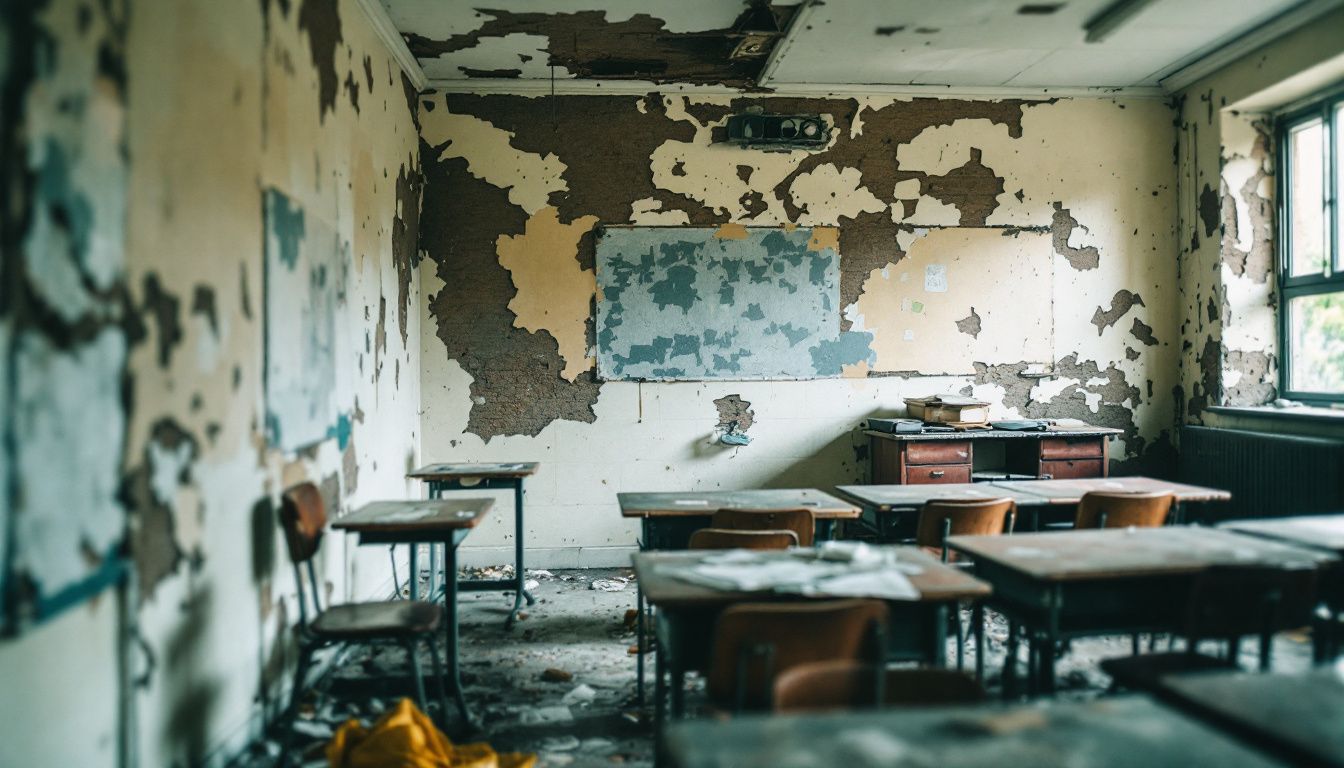
Asbestos in Schools: The Hidden Danger Putting Children and Staff at Risk
Walk into almost any state school built before 2000 and there is a strong chance asbestos is present somewhere in the building. Asbestos in schools remains one of the most serious and underappreciated public health challenges facing UK education today. The material was widely used in construction throughout the second half of the twentieth century, and the ban on its use did not arrive until 1999 — meaning the vast majority of older school buildings still contain it.
This is not a historical footnote. It is an ongoing risk that affects pupils, teachers, caretakers, and contractors every single day.
How Widespread Is Asbestos in Schools?
Around 80% of state schools in England are estimated to contain asbestos-containing materials (ACMs). That figure reflects just how heavily the construction industry relied on asbestos during the post-war building boom, when prefabricated and system-built schools went up rapidly across the country.
Asbestos was favoured because it was cheap, durable, fire-resistant, and easy to work with. It was used in a wide range of building materials, many of which are still in place today. Common ACMs found in school buildings include:
- Asbestos insulating board (AIB) used in ceiling tiles, partition walls, and door panels
- Sprayed asbestos coatings on structural steelwork and ceilings
- Asbestos lagging around pipes and boilers
- Textured coatings such as Artex on ceilings and walls
- Asbestos cement in roofing sheets, guttering, and rainwater pipes
- Vinyl floor tiles containing chrysotile asbestos
- Soffit boards and fascia panels
Many of these materials are not immediately visible. They are tucked behind wall linings, above suspended ceilings, or beneath floor coverings — which is precisely what makes them so difficult to manage without professional assessment.
Why Children Face a Heightened Risk
Asbestos fibres cause harm when they are disturbed and become airborne. Once inhaled, the microscopic fibres lodge in lung tissue and cannot be expelled by the body. Over time, this can lead to devastating and often fatal diseases.
The diseases associated with asbestos exposure include:
- Mesothelioma — an aggressive cancer of the lining of the lungs or abdomen, almost exclusively caused by asbestos exposure
- Lung cancer — with risk significantly elevated by asbestos exposure, particularly in smokers
- Asbestosis — a chronic scarring of the lung tissue that causes progressive breathlessness
- Pleural thickening — a diffuse thickening of the lung lining that restricts breathing
What makes children particularly vulnerable is the length of time between exposure and disease onset. Asbestos-related diseases typically take 20 to 50 years to develop after initial exposure. A child exposed at school in their early years carries that risk into adulthood, often with no awareness of what they were exposed to or when.
There is also evidence that children’s developing bodies may be more susceptible to the carcinogenic effects of asbestos fibres than adults. The Department for Education acknowledged over a decade ago that children may develop mesothelioma more readily than adults following exposure.
Current estimates suggest that between 200 and 300 adults who attended school during the 1960s and 1970s die each year from asbestos-related diseases linked to their time in education. One widely reported case is that of Dianne Willmore, who developed mesothelioma following her time as a pupil at Bowring Comprehensive School in the 1970s. Her case brought significant public attention to the issue of asbestos in schools and the long tail of harm it causes.
The Additional Risk Posed by RAAC
In recent years, reinforced autoclaved aerated concrete (RAAC) has emerged as a separate structural concern in school buildings. RAAC was used extensively in flat roofs, floors, and walls in schools built between the 1950s and 1990s, and it is now known to be prone to sudden structural failure as it degrades.
The intersection of RAAC and asbestos creates a compounded risk. Buildings containing RAAC are often the same buildings that contain ACMs. Structural movement or deterioration of RAAC panels can disturb nearby asbestos materials, releasing fibres into the air. Any remediation or demolition work involving RAAC in these buildings must be preceded by a thorough asbestos survey to ensure worker and occupant safety.
Legal Duties for Schools Under the Control of Asbestos Regulations
Schools are non-domestic premises, which means they fall squarely within the scope of the Control of Asbestos Regulations. The duty to manage asbestos under Regulation 4 places clear legal obligations on whoever is responsible for maintaining the building — this is typically the local authority for maintained schools, or the academy trust or governing body for academies and independent schools.
The dutyholder’s obligations include:
- Taking reasonable steps to identify the location and condition of any ACMs in the building
- Assessing the risk that those materials pose to anyone who works in or uses the building
- Preparing and maintaining a written asbestos management plan
- Ensuring that anyone who may disturb ACMs during their work is informed of the location and condition of those materials
- Monitoring the condition of ACMs regularly and updating the management plan accordingly
Failure to comply with these duties is a criminal offence. More importantly, failure to comply puts children and staff at genuine risk of life-altering illness.
The HSE’s guidance document HSG264 sets out the standards for asbestos surveying and is the benchmark against which all professional surveys should be conducted. Any survey carried out in a school should comply fully with HSG264.
The Knowledge Gap Among School Staff
One of the most pressing concerns around asbestos management in schools is the lack of awareness among those who work in them. Research has indicated that a significant proportion of educational staff have limited knowledge of asbestos — where it might be found, what it looks like, or what they should do if they suspect they have disturbed it.
This matters enormously in practice. School caretakers and site managers carry out maintenance tasks on a daily basis — drilling into walls, cutting through ceiling tiles, disturbing pipework. Without proper awareness of where ACMs are located, these routine tasks can inadvertently release asbestos fibres into occupied spaces.
Contractors brought in to carry out refurbishment or repair work face similar risks. Under the Control of Asbestos Regulations, dutyholders are required to share asbestos information with contractors before any work begins. But this only works if the asbestos information is accurate, up to date, and actually communicated.
Training and awareness for school staff is not optional — it is a legal requirement and a practical necessity.
What Type of Asbestos Survey Does a School Need?
The type of survey required depends on what the school intends to do with the building. There are three main types of survey relevant to schools:
Management Survey
A management survey is the standard survey for buildings in normal occupation. It identifies the location, extent, and condition of ACMs that could be disturbed during everyday use and maintenance. For most schools, this is the starting point — it provides the information needed to create or update an asbestos register and management plan.
Refurbishment Survey
Before any building work, renovation, or significant maintenance is carried out, a refurbishment survey is required. This is a more intrusive survey that examines areas that will be disturbed during the works. It must be completed before contractors begin work, without exception.
Re-inspection Survey
Once ACMs have been identified and a management plan is in place, the condition of those materials must be monitored over time. A re-inspection survey assesses whether the condition of known ACMs has changed since the last inspection and updates the risk ratings accordingly. For schools, annual re-inspections are generally recommended as best practice.
Practical Steps Schools Should Take Now
If you are responsible for managing a school building, the following actions should be on your immediate agenda:
- Check whether a current asbestos register exists — if the building was constructed before 2000 and no survey has been carried out, this is an urgent priority
- Commission a management survey if one has not been completed, or if the existing survey is out of date
- Ensure the asbestos register is accessible to all relevant staff and contractors
- Schedule annual re-inspections to monitor the condition of identified ACMs
- Provide asbestos awareness training to caretakers, site managers, and any staff who carry out maintenance activities
- Brief contractors on the asbestos register before any work begins — this is a legal requirement
- Commission a refurbishment survey before any building works, no matter how minor they appear
If you are unsure whether a material in your building contains asbestos, do not disturb it. A professional surveyor can take a sample for laboratory analysis. You can also order a testing kit for suspected materials in appropriate circumstances, though professional sampling is always recommended for occupied premises such as schools.
The Role of a Fire Risk Assessment
Asbestos management does not exist in isolation. Schools also have legal obligations around fire safety, and the two areas of compliance often intersect. A fire risk assessment is a legal requirement for all non-domestic premises and should be reviewed regularly alongside the asbestos management plan. In the event of a fire, damaged ACMs can release fibres — making it essential that fire safety and asbestos management plans are considered together.
Why Acting Now Protects Future Generations
The latency period for asbestos-related disease means that the harm being done today may not become apparent for decades. Children sitting in classrooms with deteriorating ACMs overhead, or in corridors where maintenance work has disturbed asbestos-containing materials, are accumulating a risk that will follow them throughout their lives.
The legal framework exists. The guidance is clear. The surveys are affordable and straightforward to arrange. What is needed is action — from local authorities, academy trusts, governing bodies, and school leaders — to ensure that every school building is properly assessed, every risk is documented, and every person who works in or attends those buildings is protected.
Asbestos in schools is not an insurmountable problem. It is a manageable one — but only if it is taken seriously and addressed systematically.
Supernova Asbestos Surveys: Helping Schools Stay Safe and Compliant
Supernova Asbestos Surveys has completed over 50,000 surveys across the UK, including schools, colleges, and other educational premises. Our BOHS P402-qualified surveyors work to HSG264 standards on every survey, and all samples are analysed at our UKAS-accredited laboratory.
We offer fast turnaround — often with same-week availability — and deliver clear, actionable reports that give dutyholders exactly what they need to meet their legal obligations and protect the people in their care.
Whether your school is in London, Manchester, Birmingham, or anywhere else in the UK, we can help. We provide an asbestos survey London service, an asbestos survey Manchester service, and an asbestos survey Birmingham service, as well as nationwide coverage across England, Scotland, and Wales.
To discuss your school’s requirements or to arrange a survey, call us on 020 4586 0680 or visit asbestos-surveys.org.uk to request a free quote. Do not leave asbestos management to chance — the stakes are too high.
Frequently Asked Questions
Is asbestos still present in UK schools?
Yes. Around 80% of state schools in England are estimated to contain asbestos-containing materials. The UK did not ban asbestos until 1999, so any school building constructed before that date may contain ACMs. The presence of asbestos is not automatically dangerous — undisturbed materials in good condition pose a low risk — but they must be identified, assessed, and managed by a dutyholder.
What health risks does asbestos pose to children?
Children who inhale asbestos fibres face the risk of developing mesothelioma, lung cancer, asbestosis, and pleural thickening in later life. Because these diseases have a latency period of 20 to 50 years, the harm caused by childhood exposure may not become apparent until adulthood. There is evidence that children’s developing bodies may be more susceptible to asbestos-related harm than adults.
Who is legally responsible for managing asbestos in a school?
The dutyholder under the Control of Asbestos Regulations is whoever is responsible for maintaining the building. For maintained schools, this is typically the local authority. For academies and independent schools, it is usually the academy trust or governing body. The dutyholder must identify ACMs, assess the risk, maintain a written management plan, and ensure that anyone who may disturb the materials is informed.
What should a school do if asbestos is suspected in the building?
Do not disturb the material. Commission a management survey from a qualified asbestos surveyor to identify and assess any ACMs in the building. If building or maintenance work is planned, a refurbishment survey must be completed before work begins. Ensure the asbestos register is kept up to date and that all relevant staff and contractors have access to it.
How often should asbestos in a school be re-inspected?
Annual re-inspections are generally considered best practice for schools. A re-inspection survey assesses whether the condition of known ACMs has changed since the last inspection and updates risk ratings accordingly. The frequency may need to increase if the building is undergoing significant use changes, maintenance activities, or if any ACMs are in a deteriorating condition.