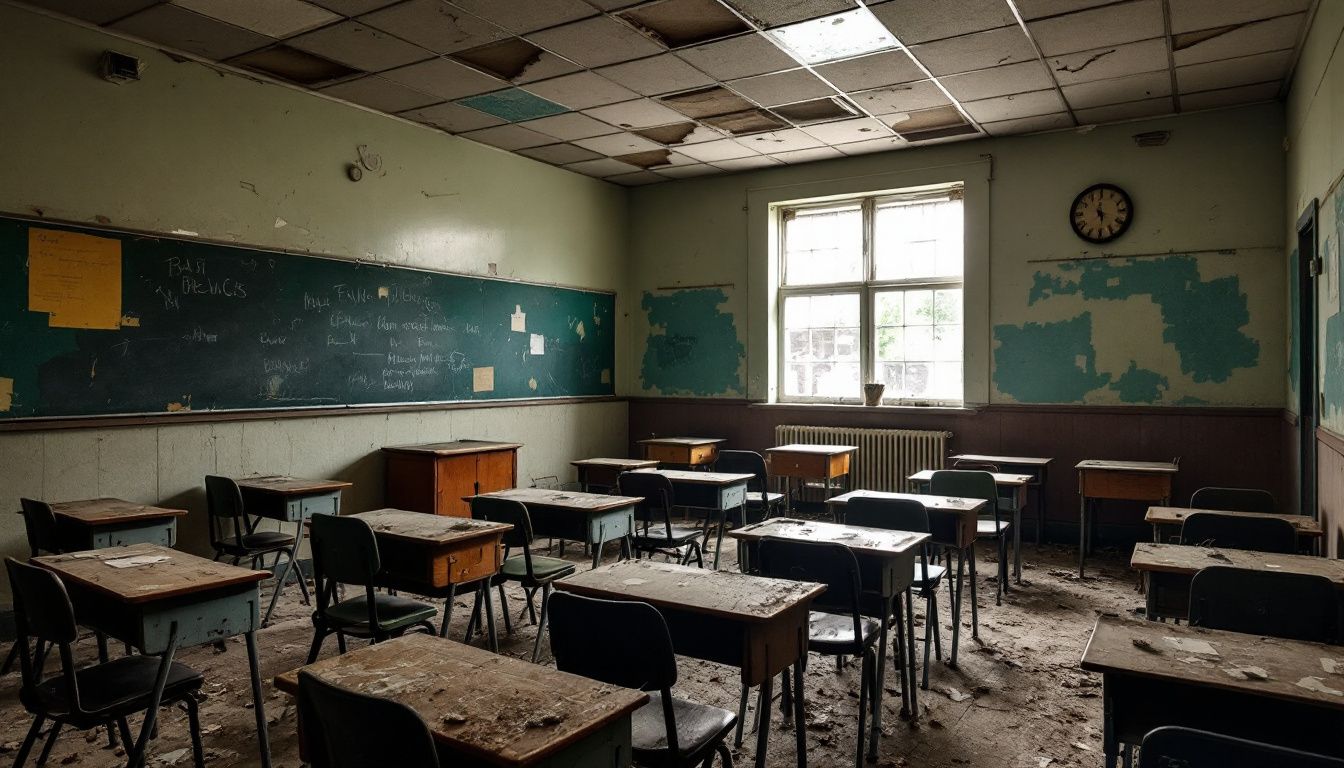
Why Asbestos Surveys for Education Settings Are a Legal and Moral Obligation
Walk into almost any UK school built before 2000 and you are almost certainly walking into a building that contains asbestos. It was used extensively throughout the 1950s, 1960s, 1970s and into the 1990s — in ceiling tiles, pipe lagging, floor tiles, roof panels and partition boards.
For school business managers, head teachers and local authority estates teams, that reality carries a serious legal duty. Asbestos surveys for education settings are not optional. They are the foundation of every legally compliant asbestos management plan, and getting them right protects pupils, teachers, support staff and contractors from one of the most dangerous occupational health hazards in the built environment.
The Scale of the Problem in UK Schools
The UK has one of the highest rates of asbestos-related disease in the world — a direct legacy of decades of heavy industrial and commercial use. Schools are not immune. The Health and Safety Executive has long recognised that educational buildings represent a significant proportion of non-domestic premises where asbestos-containing materials (ACMs) are present.
Asbestos fibres are invisible to the naked eye. When materials containing asbestos are disturbed — during maintenance work, a refurbishment project, or even by a pupil accidentally damaging a ceiling tile — those fibres become airborne. Prolonged or repeated inhalation can cause mesothelioma, asbestosis and lung cancer, diseases that typically take decades to develop after exposure.
For school staff who work in the same building year after year, the cumulative risk is real. That is why asbestos surveys for education premises must be thorough, accurate and regularly reviewed.
Your Legal Duties Under the Control of Asbestos Regulations
The Control of Asbestos Regulations place a duty to manage asbestos on those who own, occupy or are responsible for non-domestic premises. Schools — whether state-funded, independent, academies or further education colleges — fall squarely within this legal framework.
Regulation 4 is the cornerstone. It requires duty holders to:
- Take reasonable steps to determine the location and condition of any ACMs in the premises
- Presume materials contain asbestos unless there is strong evidence to the contrary
- Assess the risk from identified ACMs
- Prepare and implement a written asbestos management plan
- Review and monitor that plan regularly
- Provide information about the location and condition of ACMs to anyone who may disturb them
Failure to comply is not just a regulatory matter — it can result in enforcement action, prosecution and significant fines. More importantly, it puts lives at risk.
HSG264, the HSE’s definitive survey guide, sets out precisely how asbestos surveys should be planned and conducted. Every survey Supernova carries out is fully aligned with HSG264 standards.
Types of Asbestos Survey Used in Schools
Not every survey is the same. The type of survey you need depends on what you intend to do with the building. Choosing the wrong type is a common and costly mistake.
Management Survey
A management survey is the standard survey required for any occupied building. Its purpose is to locate ACMs that could be disturbed during normal occupation and routine maintenance. It is non-intrusive — the surveyor will inspect accessible areas, take samples from suspect materials, and produce a risk-rated register.
For most schools, this is the starting point. If you do not already have an up-to-date management survey, commissioning one should be your immediate priority.
Refurbishment Survey
Before any refurbishment or maintenance work that will disturb the building fabric, you need a refurbishment survey. This is more intrusive than a management survey — it involves accessing areas behind walls, above ceilings and within floor voids that a management survey would not reach.
If your school is planning a classroom refit, a boiler room upgrade or even replacing windows, a refurbishment survey must be completed before work begins. Sending contractors in without one is a legal breach and a serious health risk.
Demolition Survey
If a school building or part of it is scheduled for demolition, a demolition survey is required. This is the most thorough and destructive type of survey, designed to locate every ACM in the structure before demolition work commences. It must be completed in full — no exceptions.
Re-inspection Survey
Once ACMs are identified and a management plan is in place, the condition of those materials must be monitored over time. A re-inspection survey assesses whether known ACMs have deteriorated, been damaged or had their risk profile changed. Schools should carry these out at least annually as part of their ongoing duty to manage.
What Happens During an Asbestos Survey in a School
Understanding the process helps you prepare the building, communicate with staff and ensure the survey captures everything it needs to.
Step 1 — Scoping and Booking
Before the surveyor arrives, the scope of the survey is agreed. For a school, this typically covers all occupied areas, plant rooms, roof spaces, corridors, sports halls, kitchens and outbuildings. The larger and more complex the site, the more detailed the scoping conversation needs to be.
Step 2 — Site Visit and Visual Inspection
A BOHS P402-qualified surveyor attends at the agreed time and carries out a systematic visual inspection of the building, looking for materials that may contain asbestos. Common locations in schools include:
- Ceiling tiles and suspended ceiling systems
- Floor tiles and adhesive compounds
- Pipe and boiler lagging in plant rooms and service ducts
- Textured decorative coatings on walls and ceilings
- Roof panels and soffits on older buildings
- Partition boards and fire doors
- Window surrounds and external panels on prefabricated buildings
Step 3 — Sampling
Representative samples are collected from suspect materials using correct containment procedures to prevent fibre release. Samples are labelled, logged and sealed for transport to the laboratory.
If you prefer to carry out preliminary asbestos testing on a specific material before booking a full survey, our bulk sample service provides a straightforward option. For smaller-scale initial checks, a testing kit can be posted directly to you, allowing you to collect and submit samples with clear instructions.
Step 4 — Laboratory Analysis
All samples are analysed at our UKAS-accredited laboratory using polarised light microscopy (PLM) in accordance with ISO/IEC 17025 standards. This is the recognised method for identifying asbestos fibre types and provides legally defensible results. You will typically receive results within 3–5 working days of the site visit.
Step 5 — Report Delivery
The final report includes a full asbestos register detailing the location, quantity, condition and risk rating of every ACM identified. It is produced in digital format, fully compliant with HSG264, and provides everything you need to demonstrate legal compliance and build your management plan.
Reading Your Asbestos Survey Report
A good asbestos survey report is a working document, not something to file away and forget. Understanding what it tells you is essential for managing risk effectively.
The risk rating assigned to each ACM is based on its condition, accessibility and the likelihood of disturbance. Materials in good condition in inaccessible locations may carry a low priority rating — meaning they can be managed in place with regular monitoring. Damaged or deteriorating materials in high-traffic areas will carry a higher priority rating and may require remediation or removal.
The register should clearly state:
- The exact location of each ACM (room, floor, building zone)
- The type of asbestos identified
- The quantity and surface area
- The current condition and risk score
- The recommended action — manage in place, repair, encapsulate or remove
Where asbestos removal is recommended, this must be carried out by a licensed contractor before any works that would disturb the material take place.
Building and Implementing Your Asbestos Management Plan
The survey report is the input. The management plan is what you do with it. Every school with identified ACMs is legally required to have a written management plan that is actively implemented and regularly reviewed.
A robust plan for a school should include:
- The asbestos register — kept up to date and accessible to all relevant staff and contractors
- Risk control actions — clear steps for each ACM, with timescales and responsibility assigned
- Communication procedures — a system for informing staff, contractors and visitors about the location of ACMs before they carry out any work
- Staff training — ensuring all relevant personnel understand asbestos awareness, what to do if they suspect damage, and how to follow the permit-to-work system
- Emergency procedures — a clear protocol for responding to accidental disturbance, including who to contact and how to secure the affected area
- Re-inspection schedule — annual monitoring of known ACMs to check for deterioration
- Plan review cycle — the plan itself should be reviewed every 6 to 12 months, or sooner if circumstances change
The management plan must be available to anyone who needs it — including contractors working on site. Providing this information is not just good practice; it is a legal requirement under the Control of Asbestos Regulations.
Communicating Asbestos Risk to School Staff and Contractors
One of the most common failures in school asbestos management is poor communication. A thorough survey and a detailed management plan are rendered ineffective if the people most likely to disturb ACMs — maintenance staff, contractors, cleaning teams — are not aware of where those materials are.
Every school should have a clear permit-to-work system. Before any maintenance or building work begins, the person responsible must check the asbestos register, confirm whether ACMs are present in the work area, and ensure appropriate precautions are in place.
Asbestos awareness training is a legal requirement for anyone whose work could disturb asbestos. This includes caretakers, maintenance staff and any contractor working on the building fabric. Training records should be maintained and refreshed regularly.
If your school also requires a fire risk assessment, this can often be coordinated alongside your asbestos management activities to reduce disruption and ensure a joined-up approach to building safety compliance.
How Often Should Schools Commission Asbestos Surveys?
There is no single fixed interval for every type of survey, but the following guidance applies to most educational settings:
- Management survey — required if none exists, or if the existing survey is significantly out of date or does not cover all areas of the building
- Re-inspection — at least annually for all known ACMs; more frequently if materials are in poor condition or in areas of high activity
- Refurbishment survey — required before any works that will disturb the building fabric, regardless of how recent the management survey is
- Demolition survey — required in full before any demolition work begins
If your school has undergone significant changes — new extensions, changes of use, storm damage or fire — the existing survey and management plan should be reviewed immediately. The same applies if your school is in London or another major urban area where older building stock is prevalent; our asbestos survey London service covers educational premises across the capital.
What Asbestos Surveys for Education Settings Cost
Transparent pricing matters when budgeting for compliance. At Supernova, we provide fixed-price quotes with no hidden fees. Costs vary depending on the size of the site, the number of buildings and the type of survey required.
A management survey for a single primary school will cost significantly less than a full refurbishment survey across a large secondary campus. The most accurate way to get a figure is to call us or submit a brief description of your site online — we will provide a written quote, usually within 24 hours.
What you should not do is delay commissioning a survey because of uncertainty about cost. The financial and legal consequences of non-compliance — enforcement notices, prosecution, civil claims — far outweigh the cost of the survey itself.
Choosing a Qualified Asbestos Surveying Company for Your School
Not all surveying companies are equal. When selecting a provider for asbestos surveys for education premises, look for the following:
- UKAS accreditation — the surveying company should hold UKAS accreditation for asbestos surveying and sampling
- BOHS P402-qualified surveyors — individual surveyors should hold the relevant professional qualification
- HSG264 compliance — reports must be produced in accordance with HSE guidance
- Experience in educational settings — schools present unique challenges around access, timetabling and safeguarding that require sector-specific experience
- UKAS-accredited laboratory — sample analysis should be carried out by an accredited laboratory, not outsourced to an unknown third party
- Clear, usable reports — the report should be a practical working document, not a dense technical file that requires a specialist to interpret
Supernova has completed over 50,000 surveys nationwide, including a significant number for schools, colleges and local authority estates teams. Our surveyors understand the operational constraints of educational buildings and work around your timetable to minimise disruption.
For schools that require ongoing support — whether that is annual re-inspections, pre-works refurbishment surveys or advice on managing a complex asbestos register — we offer a straightforward service model with a dedicated point of contact.
If you want to understand more about the testing process before committing to a full survey, our asbestos testing service page covers the options in detail, including bulk sampling and laboratory turnaround times.
Frequently Asked Questions
Are all UK schools required to have an asbestos survey?
Any school built before 2000 has a legal duty under the Control of Asbestos Regulations to determine whether asbestos-containing materials are present. In practice, this means commissioning a management survey if one does not already exist or if the existing survey is out of date. Schools built after 2000 are unlikely to contain asbestos, but the duty to presume still applies unless there is documented evidence to the contrary.
What type of asbestos survey does a school need?
Most schools need a management survey as the baseline — this covers all accessible areas during normal occupation. Before any refurbishment or maintenance work that disturbs the building fabric, a refurbishment survey is also required. If any part of the building is being demolished, a demolition survey must be completed first. Annual re-inspection surveys are required once ACMs have been identified and logged.
Who is responsible for asbestos management in a school?
The duty holder under the Control of Asbestos Regulations is typically the employer — which in a maintained school is usually the local authority, the governing body or the academy trust, depending on the school’s status. In practice, responsibility is often delegated to the school business manager or premises manager, but the legal duty sits with the organisation that controls the premises.
How long does an asbestos survey take in a school?
This depends on the size and complexity of the site. A single-storey primary school can typically be surveyed in half a day. A large secondary school with multiple buildings, plant rooms and sports facilities may require a full day or more. Supernova will confirm the expected duration when providing your quote, so you can plan access and staff communication accordingly.
What happens if asbestos is found in a school?
Finding asbestos does not automatically mean the building is unsafe or needs to be closed. The survey report will assign a risk rating to each material. Low-risk ACMs in good condition can be managed in place with regular monitoring. Higher-risk or damaged materials may require encapsulation or removal by a licensed contractor. The key is to have a clear management plan in place and to ensure all relevant staff and contractors are informed.
Get Your School’s Asbestos Survey Booked Today
Supernova Asbestos Surveys has completed over 50,000 surveys across the UK, working with schools, colleges, local authorities and academy trusts to meet their legal obligations and protect the people in their buildings.
Whether you need a first-time management survey, a pre-works refurbishment survey or annual re-inspection support, we provide fixed-price quotes, rapid turnaround and HSG264-compliant reports you can act on immediately.
Call us on 020 4586 0680 or visit asbestos-surveys.org.uk to request a quote or speak to a member of our team.