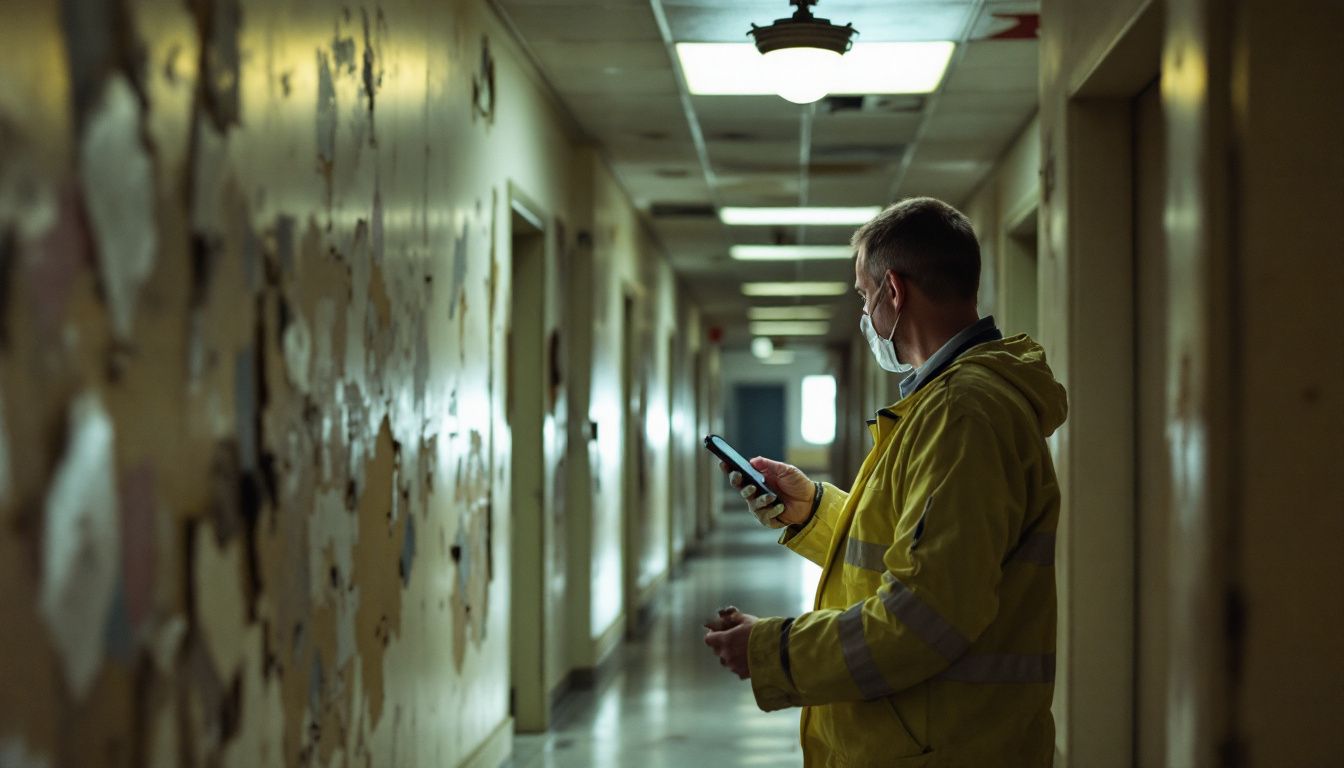
Why Education Asbestos Surveys Are a Legal and Moral Necessity
Every school day, hundreds of thousands of children and teachers walk into buildings that may contain one of the most dangerous substances ever used in construction. Asbestos doesn’t announce itself — it hides inside ceiling tiles, pipe lagging, floor tiles, and wall panels, often in the very rooms where children spend their formative years.
Education asbestos surveys exist precisely to find it, assess it, and ensure it is properly managed before anyone is harmed. For duty holders — headteachers, governors, academy trust directors, and local authorities — understanding the surveying process isn’t optional. It is a legal requirement.
The Scale of Asbestos Risk in UK Schools
The UK has one of the highest rates of asbestos-related disease in the world, a direct legacy of the material’s widespread use in post-war construction. Schools built before 2000 are particularly likely to contain asbestos-containing materials (ACMs), given that white asbestos (chrysotile) was not banned until 1999.
Blue asbestos (crocidolite) and brown asbestos (amosite) were banned earlier in 1985, but materials containing them may still be present in older school buildings. The problem isn’t confined to a handful of ageing structures — it affects a significant proportion of the UK’s educational estate.
Common locations for ACMs in educational buildings include:
- Insulation boards used in ceiling and wall panels
- Pipe lagging around heating systems
- Roof tiles and asbestos cement products
- Spray coatings applied to structural steelwork
- Floor tiles and the adhesive beneath them
- Textured coatings such as Artex on ceilings
- Boiler rooms and service ducts
When ACMs are in good condition and left undisturbed, they may pose a low immediate risk. The danger escalates when materials are damaged, deteriorating, or disturbed during maintenance work — activities that happen routinely in busy school environments.
What Education Asbestos Surveys Actually Involve
An education asbestos survey is a structured inspection of a school building carried out by a qualified surveyor, aimed at identifying, locating, and assessing any materials that contain or are suspected to contain asbestos. The survey must be conducted in line with HSG264, the HSE’s definitive guidance on asbestos surveying, and carried out by a surveyor holding a BOHS P402 qualification or equivalent.
There are several survey types, each suited to different circumstances. Choosing the right one matters — the wrong survey type won’t satisfy your legal obligations.
Management Survey
A management survey is the standard survey required for all non-domestic premises, including schools, to locate ACMs that could be disturbed during normal occupation and routine maintenance. It is non-intrusive, meaning the surveyor inspects accessible areas without causing major disruption to the school day.
The result is an asbestos register and risk assessment that forms the backbone of a school’s asbestos management plan. Every school should have one — and if yours doesn’t, that needs to be addressed immediately.
Refurbishment Survey
Before any building work, renovation, or upgrade takes place in a school, a refurbishment survey is legally required. This is a more intrusive inspection designed to locate all ACMs in the areas to be disturbed.
Contractors cannot safely begin work until this survey has been completed and reviewed. Skipping this step isn’t just a legal risk — it can expose contractors and building occupants to potentially lethal fibre release.
Demolition Survey
If a school building or part of it is being demolished, a demolition survey must be completed beforehand. This is the most thorough type of survey, requiring full access to all areas including those that are normally inaccessible.
Every ACM must be identified and removed prior to demolition work commencing. There are no shortcuts here — this is both a legal requirement and a fundamental safety obligation.
Re-Inspection Survey
Once ACMs have been identified and a management plan is in place, those materials must be monitored regularly. A re-inspection survey assesses whether the condition of known ACMs has changed, whether the risk rating needs updating, and whether any new materials have come to light.
Schools are typically advised to arrange re-inspections annually, or at least every three years depending on the risk profile of the site. Leaving known ACMs unmonitored is not a compliant approach.
The Legal Framework for Education Asbestos Surveys
The duty to manage asbestos in non-domestic premises is set out under Regulation 4 of the Control of Asbestos Regulations. Schools fall squarely within this legal framework, with no exemptions.
The duty holder — which may be the governing body, academy trust, local authority, or another responsible person depending on the school’s structure — must:
- Take reasonable steps to find out whether ACMs are present
- Assess the condition and risk of any ACMs found
- Maintain an up-to-date asbestos register
- Produce and implement an asbestos management plan
- Provide information about ACM locations to anyone who may disturb them
- Review and update the management plan regularly
Failure to comply is not just an administrative oversight — it is a criminal offence. Penalties can include significant fines and, in cases of serious harm, prosecution. The HSE actively inspects schools to check compliance, and any school without a current asbestos register and management plan is operating outside the law.
Who Is Responsible for Asbestos in Schools?
The question of who holds the duty is sometimes confused in schools, particularly where buildings are managed by multiple parties. Here is a clear breakdown:
- Local authority-maintained schools: Responsibility typically sits with the local authority, though day-to-day management may be delegated to the headteacher or site manager.
- Academy trusts: The trust itself is the duty holder and is responsible for all premises it manages.
- Governing bodies: In some settings, governors hold responsibility for ensuring compliance with asbestos management obligations.
- Independent schools: The proprietor or board of trustees holds the duty.
Regardless of the structure, the duty holder must ensure that qualified surveyors conduct inspections, that registers are maintained, and that all staff and contractors who may work near ACMs are informed of their location and condition.
Health Risks That Make Education Asbestos Surveys Non-Negotiable
Asbestos fibres, when inhaled, can cause a range of serious and often fatal diseases. These include mesothelioma — a cancer of the lining of the lungs caused exclusively by asbestos exposure — asbestosis, a chronic scarring of the lung tissue, and asbestos-related lung cancer.
These diseases have long latency periods. Symptoms may not appear for 20 to 40 years after exposure, which means people harmed today won’t know it for decades. Teachers and school staff who work in buildings with deteriorating ACMs face a genuine occupational health risk.
Children, whose lungs are still developing, may be even more vulnerable to the effects of fibre inhalation. The moral case for rigorous education asbestos surveys is as compelling as the legal one — no duty holder should wait for a regulatory inspection to prompt action.
What Happens After an Asbestos Survey?
Receiving a survey report is the beginning of a management process, not the end of one. The report will detail every suspected or confirmed ACM, its location, its condition, and a risk rating. From this, the duty holder must take clear, documented action.
Practical steps following a survey include:
- Keeping the asbestos register up to date and accessible to relevant staff
- Briefing site managers, cleaners, and maintenance staff on ACM locations
- Providing information to contractors before any work begins
- Arranging for damaged or high-risk materials to be remediated or removed
- Scheduling re-inspections at appropriate intervals
Where materials need to be removed, only licensed contractors working under the Control of Asbestos Regulations may carry out the work. Supernova’s asbestos removal service uses licensed operatives and includes air monitoring to confirm fibre levels remain safe throughout the process.
Schools should also consider whether a fire risk assessment is due at the same time. Combining both inspections can be a practical and cost-effective approach to building safety compliance.
DIY Sampling — When Is It Appropriate?
In some limited circumstances, a responsible person may wish to collect a sample from a suspected material for laboratory analysis before commissioning a full survey. Supernova’s testing kit allows bulk samples to be collected and sent to a UKAS-accredited laboratory for analysis.
However, this should never replace a full professional survey in a school setting. It may be used to gather preliminary information, but a qualified surveyor must carry out any formal inspection required under the duty to manage.
In an environment with children present, cutting corners on asbestos identification is never appropriate.
What to Expect From a Supernova Education Asbestos Survey
When you book an education asbestos survey with Supernova, the process is designed to be straightforward and to minimise disruption to the school day. Here’s how it works:
- Booking: Contact us by phone or online. We confirm availability quickly — often within the same week — and send a booking confirmation with everything you need.
- Site Visit: A BOHS P402-qualified surveyor attends at the agreed time and carries out a thorough visual inspection of the premises, working around school schedules where possible.
- Sampling: Representative samples are collected from suspect materials using correct containment procedures to prevent fibre release during the process.
- Lab Analysis: Samples are analysed under polarised light microscopy (PLM) at our UKAS-accredited laboratory, ensuring accurate and legally defensible results.
- Report Delivery: You receive a detailed asbestos register and risk-rated management plan in digital format within 3–5 working days.
The report is fully compliant with HSG264 and satisfies legal requirements under the Control of Asbestos Regulations. Results are presented clearly, with risk ratings that make it straightforward for duty holders to prioritise action — no jargon-heavy reports that leave you uncertain about next steps.
Survey Costs and Pricing
Supernova offers transparent, fixed-price asbestos surveys across the UK. For educational premises, pricing reflects the size and complexity of the site. As a guide:
- Management Survey: From £195 for smaller premises; school sites are priced based on floor area and number of buildings.
- Refurbishment and Demolition Survey: From £295, covering all areas to be disturbed prior to works.
- Re-Inspection Survey: From £150, plus £20 per ACM re-inspected.
- Bulk Sample Testing Kit: From £30 per sample.
- Fire Risk Assessment: From £195 for standard commercial premises.
All prices are subject to property size and location. Request a free quote for your school or educational site and we will provide a fixed price with no hidden fees.
Asbestos Surveys Across the UK
Supernova operates nationwide, with surveyors available across England, Scotland, and Wales. Whether your school is in the capital or further afield, we can help.
If you need an asbestos survey in London or an asbestos survey in Manchester, our teams are on hand with same-week availability in most areas.
Why Schools Choose Supernova
With over 50,000 surveys completed and more than 900 five-star reviews, Supernova is one of the UK’s most trusted asbestos consultancies. Educational institutions choose us for good reason:
- BOHS P402/P403/P404 Qualified Surveyors: All surveyors hold British Occupational Hygiene Society qualifications — the gold standard in asbestos surveying.
- UKAS-Accredited Laboratory: All samples are analysed in our accredited laboratory, giving legally defensible results.
- Minimal Disruption: We schedule visits around school timetables and work efficiently to avoid interrupting lessons or activities.
- Clear, Actionable Reports: Reports are written in plain language so duty holders can act quickly and confidently.
- Nationwide Coverage: From urban academies to rural primary schools, we cover the full length and breadth of the UK.
- Fixed Pricing: No surprise invoices — you know the cost before we arrive.
To book an education asbestos survey or discuss your school’s requirements, call us on 020 4586 0680 or visit asbestos-surveys.org.uk. Our team is available to answer questions and arrange a survey at a time that suits your school.
Frequently Asked Questions
Are schools legally required to have an asbestos survey?
Yes. Under Regulation 4 of the Control of Asbestos Regulations, all non-domestic premises — including schools — must have an asbestos management survey if they were built before 2000. The duty holder must identify ACMs, assess their condition, and maintain an up-to-date asbestos register and management plan. Operating without one is a criminal offence.
How often should a school’s asbestos be re-inspected?
HSE guidance recommends that known ACMs are re-inspected at least annually in most school settings, though the frequency may vary depending on the condition and risk rating of the materials. Higher-risk materials in areas of heavy use should be monitored more frequently. A qualified surveyor can advise on the appropriate re-inspection schedule for your site.
Who is the duty holder for asbestos in a school?
This depends on the school’s structure. For local authority-maintained schools, responsibility typically sits with the local authority. For academy trusts, the trust is the duty holder. For independent schools, the proprietor or board of trustees holds the duty. In all cases, the duty holder must ensure that surveys are carried out, registers are maintained, and relevant staff and contractors are informed.
Can school staff carry out their own asbestos sampling?
In limited circumstances, a responsible person may use a bulk sampling kit to collect a sample for laboratory analysis. However, this is not a substitute for a professional survey. In a school environment where children are present, all formal asbestos inspections must be carried out by a BOHS-qualified surveyor in line with HSG264. DIY sampling should only ever be used as a preliminary step, never as a replacement for a compliant survey.
What happens if asbestos is found in a school?
Finding asbestos doesn’t automatically mean the school must close or that materials need to be removed immediately. If ACMs are in good condition and are unlikely to be disturbed, they can often be safely managed in place under a documented management plan. Where materials are damaged, deteriorating, or in areas where disturbance is likely, remediation or licensed removal will be required. A qualified surveyor will advise on the appropriate course of action based on the risk rating of each material identified.