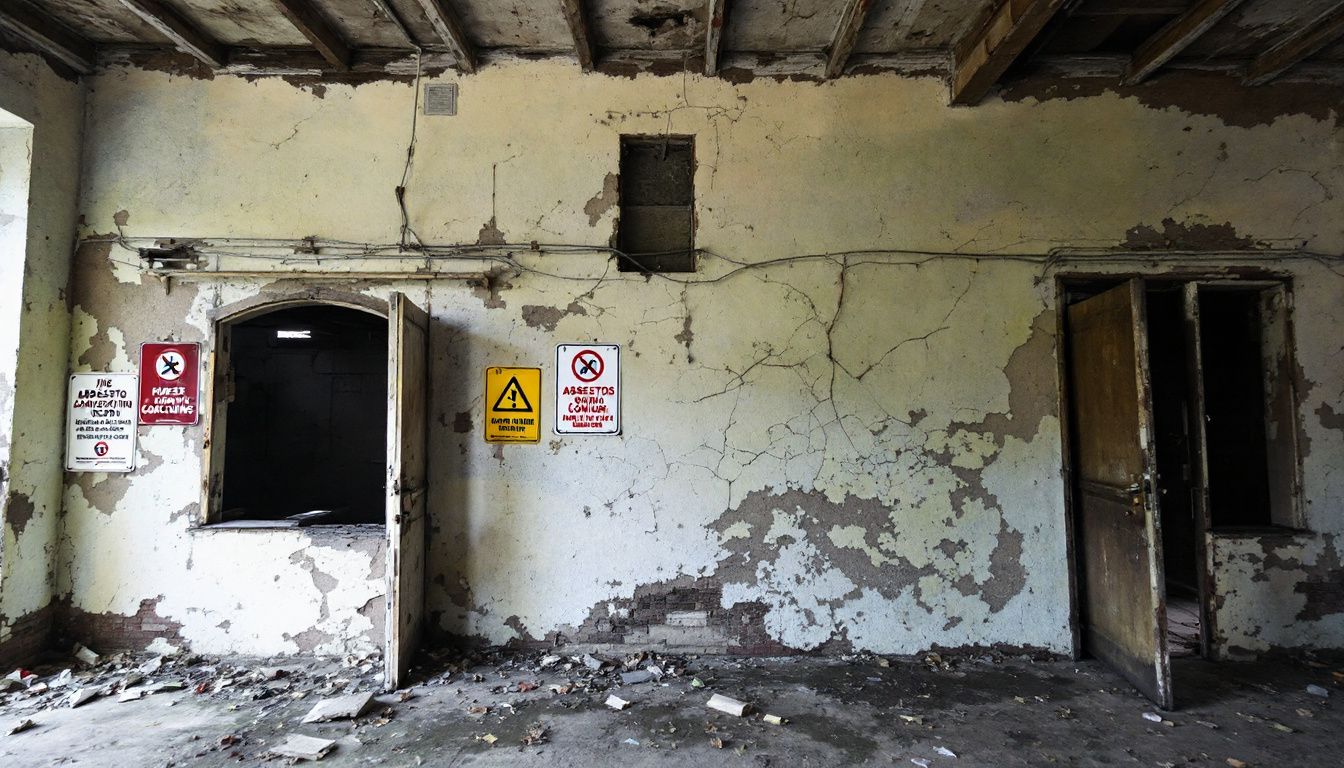
What Is ACM Asbestos — and Why Does It Still Matter?
If you own, manage, or work in a building constructed before 2000, there is a realistic chance it contains ACM asbestos — asbestos-containing materials woven into the very fabric of the structure. These materials were used throughout the twentieth century because asbestos was cheap, durable, and highly effective as an insulator and fire retardant.
The problem is that when ACMs are disturbed, damaged, or begin to deteriorate, they release microscopic fibres that cause serious, often fatal, disease. Asbestos-related conditions continue to claim thousands of lives in the UK every year — the majority of those cases trace back to buildings where ACMs were never properly identified or managed.
Understanding what ACM asbestos is, where it hides, and what your legal obligations are is the first step to protecting yourself, your workers, and everyone who occupies your property.
What Does ACM Stand For?
ACM stands for asbestos-containing material. The term refers to any product or substance in which asbestos has been deliberately incorporated during manufacture — and it covers an enormous range of building materials, from the obvious to the deeply hidden.
There are six types of asbestos mineral, but three were used most commonly in UK construction:
- Chrysotile (white asbestos) — the most widely used, found in cement sheets, roofing, floor tiles, and textured coatings
- Amosite (brown asbestos) — commonly used in thermal insulation boards and ceiling tiles
- Crocidolite (blue asbestos) — considered the most hazardous; used in spray insulation and pipe lagging
All three are dangerous. All three are banned in the UK. And all three may still be present in buildings that have never been surveyed or remediated.
Where Is ACM Asbestos Found in Buildings?
One of the most challenging aspects of managing ACM asbestos is that it is often completely invisible. It does not announce itself. It can be lurking beneath floor coverings, above suspended ceilings, inside wall cavities, or wrapped around pipework hidden behind plasterwork.
Common locations where ACMs are discovered include:
- Sprayed coatings on structural steelwork, beams, and columns
- Asbestos insulating board (AIB) used in ceiling tiles, partition walls, and fire doors
- Pipe and boiler lagging
- Textured decorative coatings such as Artex on ceilings and walls
- Vinyl floor tiles and the adhesive beneath them
- Roofing sheets and rainwater goods made from asbestos cement
- Electrical switchgear and consumer units
- Gaskets and rope seals in heating systems
- Toilet cisterns and window panels in older prefabricated buildings
A single commercial building from the 1960s or 1970s might contain a dozen different ACMs across multiple locations — some in good condition, others already deteriorating. The variety is significant, and it is why a thorough professional survey is the only reliable way to understand what you are dealing with.
Friable vs Non-Friable ACMs
Not all ACM asbestos poses the same level of immediate risk. A useful distinction is between friable and non-friable materials.
Friable ACMs — such as sprayed coatings and loose insulation — crumble easily and release fibres readily. Non-friable ACMs, such as asbestos cement, are more tightly bound and less likely to release fibres unless cut, drilled, or broken.
However, condition matters enormously. A non-friable ACM that has been damaged, is water-affected, or is deteriorating can become just as hazardous as a friable material. Visual inspection alone is never sufficient — professional assessment is essential.
The Health Risks of ACM Asbestos Exposure
Asbestos fibres are too small to see with the naked eye. When inhaled, they lodge permanently in the lung tissue and pleural lining, causing progressive scarring and, in many cases, cancer. The diseases caused by asbestos exposure have long latency periods — symptoms may not appear until 20 to 40 years after initial exposure.
The principal diseases associated with ACM asbestos exposure include:
- Mesothelioma — a rare and aggressive cancer of the lining of the lungs or abdomen, almost exclusively caused by asbestos exposure
- Asbestosis — chronic scarring of the lung tissue that causes progressive breathlessness
- Asbestos-related lung cancer — with risk significantly increased by smoking
- Pleural thickening and pleural plaques — scarring of the lung lining that can cause breathlessness and chest pain
There is no safe level of asbestos exposure. The UK’s occupational exposure control limit is 0.1 fibres per cubic centimetre of air, but this is a regulatory ceiling — not a threshold below which exposure is considered harmless.
Your Legal Duties Around ACM Asbestos
UK law places clear obligations on those who own or manage non-domestic premises. The Control of Asbestos Regulations establish a duty to manage asbestos — commonly referred to as Regulation 4 — which requires dutyholders to:
- Take reasonable steps to find and assess ACMs
- Maintain an up-to-date asbestos register
- Produce a written management plan
- Ensure that plan is implemented and reviewed regularly
The HSE’s guidance document HSG264 sets out the technical standards for asbestos surveys and underpins the work that qualified surveyors carry out. Compliance with HSG264 is not optional — it is the benchmark against which survey quality is measured.
Failure to comply with the duty to manage can result in enforcement action, substantial fines, and — most critically — serious harm to building occupants and workers. Ignorance is not a defence. If your building has never been surveyed, you are already at risk of non-compliance.
Who Has the Duty to Manage?
The duty to manage applies to anyone who has responsibility for the maintenance and repair of non-domestic premises. This includes building owners, facilities managers, landlords of commercial property, and managing agents. In some circumstances, the duty can be shared between multiple parties — but it cannot be ignored or delegated away entirely.
For domestic properties, the formal duty to manage does not apply in the same way, but homeowners and landlords still have obligations — particularly when undertaking renovation or refurbishment work. Disturbing ACMs without proper precautions is an offence regardless of property type.
Types of Asbestos Survey for ACM Identification
The appropriate type of survey depends on what you intend to do with the building. There are three main survey types recognised under HSG264, each serving a distinct purpose.
Management Survey
A management survey is the standard survey required for the ongoing management of a building in normal use. It is designed to locate, as far as is reasonably practicable, all ACMs in accessible areas. Samples are taken from suspect materials and analysed in a UKAS-accredited laboratory, with the result being an asbestos register and risk-rated management plan.
Refurbishment Survey
Before any renovation, refurbishment, or intrusive maintenance work, a refurbishment survey is required. This is more intrusive than a management survey — it involves accessing hidden voids, lifting floor coverings, and opening up areas that would be disturbed during the planned works. It must be completed before work begins, without exception.
Demolition Survey
A demolition survey is required before any part of a building is demolished. It is the most intrusive survey type and must locate all ACMs in the entire structure, including those only accessible during demolition. This survey must be completed before demolition contractors begin work.
Re-inspection Survey
Once ACMs have been identified and a management plan is in place, regular monitoring is required. A re-inspection survey checks the condition of known ACMs, updates their risk rating, and ensures the management plan remains current. Annual re-inspections are recommended as a minimum for most premises.
What Happens During an Asbestos Survey?
A professional asbestos survey follows a structured, transparent process. Here is what you can expect when you book with Supernova Asbestos Surveys:
- Booking — Contact us by phone or online. We confirm availability and send a booking confirmation, often with same-week availability.
- Site visit — A BOHS P402-qualified surveyor attends at the agreed time and carries out a thorough visual inspection of the property.
- Sampling — Representative samples are collected from suspect materials using correct containment procedures to prevent fibre release.
- Laboratory analysis — Samples are analysed under polarised light microscopy (PLM) at a UKAS-accredited laboratory.
- Report delivery — You receive a detailed asbestos register and risk-rated management plan in digital format, typically within 3–5 working days.
The report is fully compliant with HSG264 guidance and satisfies all legal requirements under the Control of Asbestos Regulations. It gives you everything you need to demonstrate duty of care and manage your ACMs safely going forward.
Managing ACM Asbestos in Place
Not all ACM asbestos needs to be removed. In many cases, if materials are in good condition and are unlikely to be disturbed, the safest course of action is to manage them in place. This means monitoring their condition, restricting access where necessary, and ensuring anyone who might work near them is informed of their presence.
Effective management of ACMs in place requires:
- A current, accurate asbestos register accessible to relevant personnel
- A written management plan that is reviewed and updated regularly
- Regular re-inspections to monitor condition changes
- Clear labelling of ACMs where practicable
- Contractor briefings before any work is carried out near known ACMs
Managing ACMs in place is not a permanent solution in every case. If materials are deteriorating, if the building is being refurbished, or if the risk assessment indicates that removal is the safer long-term option, removal must be considered seriously.
When Does ACM Asbestos Need to Be Removed?
Removal is not always the right answer — but in certain circumstances, it is the only appropriate course of action. ACM asbestos should be removed when:
- It is in poor condition and cannot be effectively repaired or encapsulated
- The building is being refurbished or demolished
- The material is in a high-traffic area where disturbance is unavoidable
- The risk assessment concludes that the ongoing risk of managing in place outweighs the risk of removal
Asbestos removal must be carried out by a licensed contractor for the most hazardous materials, including sprayed coatings, AIB, and pipe lagging. Our asbestos removal service is carried out by fully licensed operatives working within sealed, negative-pressure enclosures, with full decontamination procedures and compliant waste disposal.
Asbestos Testing: What If You Are Not Sure?
If you have identified a suspect material in your property but are not certain whether it contains asbestos, sampling and analysis is the only way to know for certain. Visual identification is not reliable — many materials that look like they contain asbestos do not, and vice versa.
Our professional asbestos testing service provides UKAS-accredited laboratory analysis of samples collected by our qualified surveyors, giving you a legally defensible result you can act on with confidence.
For situations where you need to test a specific material without commissioning a full survey, our testing kit allows you to collect a sample yourself and send it to our UKAS-accredited laboratory for analysis. This is a cost-effective option for homeowners or those dealing with a single suspect material.
However, for any commercial property or where multiple suspect materials are present, a full professional survey is the appropriate route. Bulk sampling without a full survey does not satisfy the duty to manage.
ACM Asbestos and Fire Risk
There is an important intersection between asbestos management and fire safety that is frequently overlooked. Many ACMs — particularly asbestos insulating board — were used specifically because of their fire-resistant properties. This means they are often found in fire doors, fire barriers, and other fire-stopping elements of a building.
If these materials are removed or damaged without proper planning, the fire compartmentation of the building can be compromised. Any asbestos management plan must therefore be developed in conjunction with a broader understanding of the building’s fire safety strategy. Removing an ACM fire door, for example, requires a suitable replacement that meets current fire safety standards.
This is one reason why asbestos surveys and fire risk assessments should never be treated as entirely separate exercises — they inform each other, and the people responsible for each need to be communicating.
ACM Asbestos in Domestic Properties
While the duty to manage sits firmly in the non-domestic sector, homeowners are not exempt from the risks of ACM asbestos. Properties built or refurbished before 2000 may contain a wide range of ACMs, and the most common trigger for exposure in domestic settings is DIY work — drilling, cutting, or sanding materials that turn out to contain asbestos.
If you are planning any renovation work on an older home, having suspect materials tested before you start is straightforward and relatively inexpensive. Our asbestos testing options are available to both domestic and commercial clients, and our team can advise on the most appropriate approach for your situation.
For larger domestic projects — extensions, loft conversions, full refurbishments — a professional survey before work begins is strongly advisable, both for your own protection and to satisfy any contractual requirements your builder or insurer may have.
Finding ACM Asbestos Surveys Near You
Supernova Asbestos Surveys operates nationwide, with surveyors available across England, Scotland, and Wales. Whether you need a survey in the capital or further afield, we can typically offer fast turnaround with minimal disruption to your operations.
If you are based in the capital and need an asbestos survey London clients can rely on, our London team has extensive experience across commercial, residential, and public sector properties throughout the city and surrounding areas.
For clients in the north-west, our asbestos survey Manchester service covers the Greater Manchester area and surrounding regions, with the same standard of BOHS-qualified surveying and UKAS-accredited laboratory analysis.
Wherever your property is located, the process is the same: qualified surveyors, accredited analysis, and a report that meets every requirement under HSG264 and the Control of Asbestos Regulations.
Frequently Asked Questions
What is the difference between ACM asbestos and asbestos itself?
Asbestos refers to the naturally occurring mineral fibres — chrysotile, amosite, crocidolite, and three others. ACM asbestos, or asbestos-containing material, refers to any manufactured product or building material in which those fibres have been incorporated. In practice, when people talk about managing ACMs, they mean managing the physical materials in a building that contain asbestos — not the raw mineral itself.
Is ACM asbestos dangerous if it is in good condition?
ACMs in good condition and unlikely to be disturbed are generally considered lower risk. The fibres only become a hazard when they are released into the air — which happens when materials are damaged, deteriorating, or disturbed during maintenance or refurbishment work. However, condition can change over time, which is why regular re-inspection is a legal and practical requirement, not an optional extra.
Do I need a survey if my building was built after 2000?
Buildings constructed entirely after November 1999 are unlikely to contain ACMs, as the final ban on asbestos use in the UK came into force at that point. However, if a building was refurbished using older materials, or if there is any uncertainty about the construction date or materials used, a survey remains the only way to be certain. When in doubt, survey.
Can I remove ACM asbestos myself?
For the most hazardous materials — including sprayed coatings, asbestos insulating board, and pipe lagging — removal must be carried out by a licensed contractor under the Control of Asbestos Regulations. Some lower-risk materials, such as asbestos cement in small quantities, may be removed by a non-licensed operative following specific legal requirements, but this still requires proper training, equipment, and notification procedures. Unlicensed removal of licensable materials is a criminal offence.
How often should ACMs be re-inspected?
HSE guidance recommends that known ACMs are re-inspected at least annually, though higher-risk materials or those in areas of heavy use may warrant more frequent checks. The re-inspection updates the condition rating of each ACM and ensures the management plan reflects the current state of the building. If the condition of any material has changed significantly, the risk assessment and management actions must be updated accordingly.
Speak to Supernova Asbestos Surveys Today
With over 50,000 surveys completed nationwide, Supernova Asbestos Surveys is the UK’s leading asbestos surveying company. Whether you need a management survey, a refurbishment survey ahead of planned works, or straightforward advice on your obligations around ACM asbestos, our qualified team is ready to help.
Call us on 020 4586 0680 or visit asbestos-surveys.org.uk to get a quote or book your survey. We offer fast turnaround, UKAS-accredited analysis, and reports that satisfy every requirement under the Control of Asbestos Regulations — giving you the certainty and compliance you need.