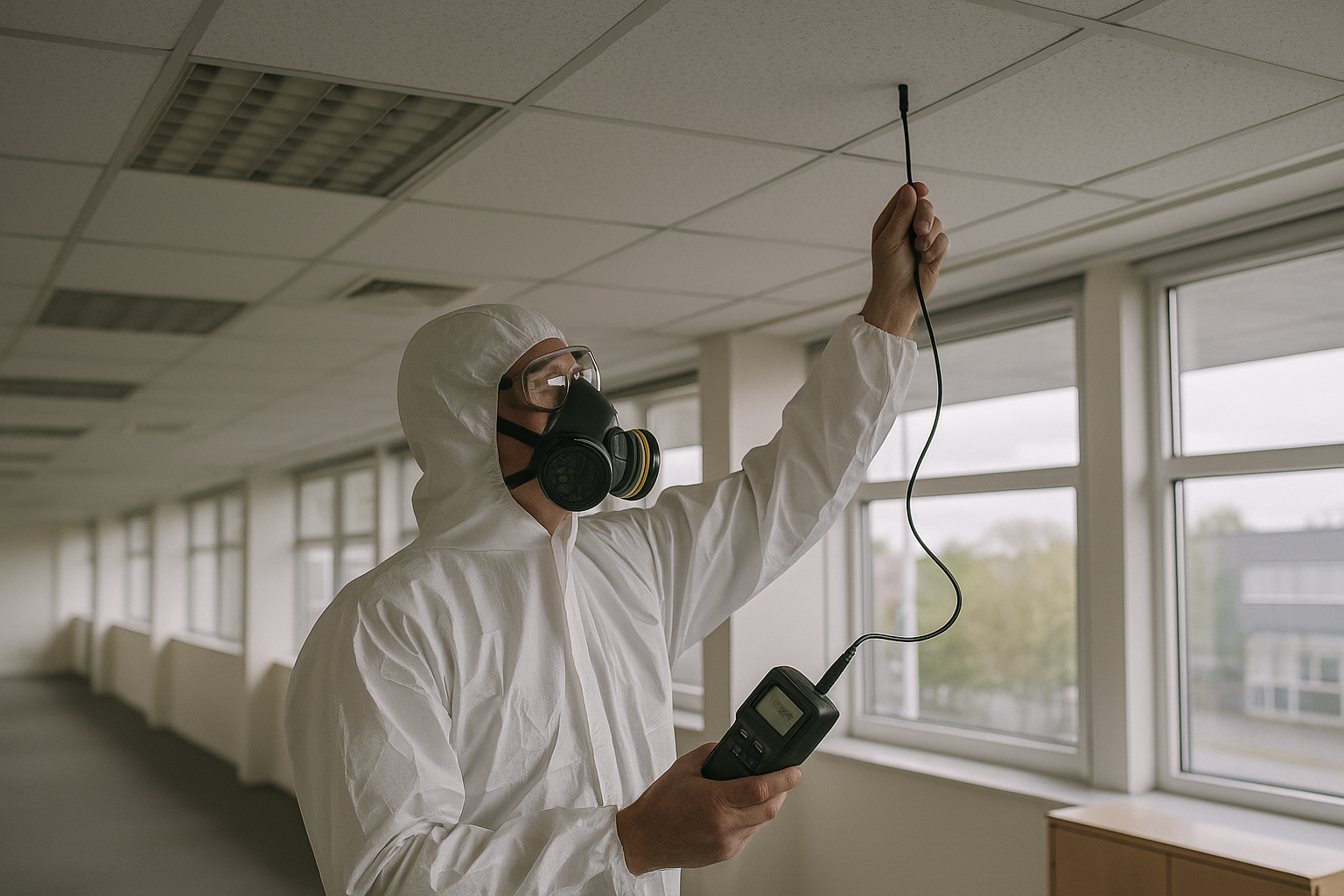
Asbestos in Construction: What Property Managers, Landlords and Facilities Teams Need to Know
Asbestos in construction is still turning up in offices, schools, warehouses, shops and rented properties across the UK — often in places nobody expected. The real danger is not simply that it exists. It is that routine maintenance, a minor fit-out or gradual deterioration can disturb it without anyone realising, turning a manageable material into a serious health risk, a compliance failure and a costly disruption.
A ceiling tile gets shifted. An old riser is opened. Floor finishes are lifted. A contractor drills into a wall panel. Any of these everyday tasks can release fibres from a material that has sat undisturbed for decades. That is exactly how property managers, landlords and facilities teams get caught out.
Asbestos was used widely because it worked. It resisted heat, improved insulation, added strength and helped manufacturers produce durable building products at low cost. Those same qualities explain why it still matters today — many of those materials remain in place, often unnoticed, in buildings that are still occupied and still being maintained.
The practical question is straightforward: if asbestos-containing materials are in your building, do you know where they are, what condition they are in, and whether any planned work could disturb them? If the answer is no, you need proper asbestos information before anyone starts work.
Why Asbestos in Construction Was Used So Widely
For decades, asbestos was treated as a useful building material rather than a dangerous one. It was mixed into thousands of products because it offered fire resistance, thermal performance, durability and flexibility in manufacturing — all at relatively low cost.
That is why asbestos in construction can still be found across domestic, commercial, industrial and public sector buildings. It was not limited to one trade or one type of product. It appeared in structural protection, insulation, finishes, service installations and external building elements.
Common reasons it was used included:
- Fire resistance around structural elements and compartment lines
- Thermal insulation to pipes, boilers, plant and ductwork
- Strengthening of cement sheets, panels and moulded products
- Acoustic and lining performance in boards and ceiling systems
- Use in coatings, sealants, adhesives, gaskets and floor products
Any building constructed or refurbished before the ban should be treated as potentially containing asbestos until a competent survey and, where required, laboratory analysis prove otherwise. Guesswork is not a management strategy.
The Six Types of Asbestos Found in Construction Materials
There are six recognised asbestos minerals. In UK buildings, three are encountered far more often than the others — but all six are hazardous and all must be taken seriously if identified. These six types sit within two mineral groups: serpentine and amphibole. Chrysotile is the serpentine form. The other five are amphiboles.
1. Chrysotile (White Asbestos)
Chrysotile is the type most commonly associated with asbestos in construction. Its fibres are curly rather than needle-like, but it is still a known carcinogen and must never be treated as low concern simply because it was widely used.
You may find chrysotile in:
- Asbestos cement sheets and roof panels
- Vinyl floor tiles and bitumen adhesives
- Textured coatings
- Gaskets and seals
- Ceiling tiles
- Wall linings and some insulation products
2. Amosite (Brown Asbestos)
Amosite was widely used in insulation products and is commonly associated with asbestos insulating board (AIB). It is generally considered higher risk than asbestos cement because fibres can be released more easily if the material is damaged.
It is often found in:
- Asbestos insulating board
- Ceiling tiles
- Fire protection around structural steel
- Partition walls, soffits and service ducts
- Thermal insulation products
3. Crocidolite (Blue Asbestos)
Crocidolite is widely regarded as one of the most hazardous asbestos types because of its very fine fibres. It was used in specialist and high-temperature applications and can be found in sprayed coatings, pipe lagging, some cement products, insulation materials and older gaskets and seals.
If crocidolite is suspected, stop work immediately. Isolate the area if necessary and arrange professional assessment before anyone proceeds.
4. Tremolite
Tremolite was less commonly used as a main ingredient in building products. It is more often encountered as contamination within other minerals and materials, including some insulation products, contaminated talc-based products, certain sealants and coatings, and vermiculite-related materials.
5. Anthophyllite
Anthophyllite was used less frequently in construction but can still be identified in older materials or as contamination. It has been linked to some insulation products, cement-based materials, rubber compounds and contaminated mineral products.
6. Actinolite
Actinolite is another less common asbestos type that may appear in building products or as contamination within other materials. It cannot be identified reliably by eye and has been associated with cement products, plaster and wall materials, roofing products, textured finishes and contaminated insulation.
The practical point is consistent across all six types: all asbestos is hazardous. The right management response depends on the material, its condition, how easily fibres could be released and whether planned work could disturb it.
Serpentine vs Amphibole: What the Difference Means in Practice
The two asbestos groups are not just a geological detail. They help explain why different asbestos-containing materials behave differently when damaged.
Serpentine asbestos — represented by chrysotile — has curly fibres. Amphibole asbestos, which includes amosite and crocidolite, has straighter, needle-like fibres that are highly durable in lung tissue and more likely to cause serious harm once inhaled.
For property management, the practical takeaways are:
- All asbestos types are hazardous — there is no safe type
- Some materials release fibres more readily than others
- Friability and condition are often as important as fibre type
- Management decisions must be based on survey findings and risk of disturbance, not visual assumptions
A material that looks solid may still contain asbestos. A material that seems undisturbed may become a problem the moment maintenance work starts. Visual judgement is not a substitute for professional assessment.
Where Asbestos in Construction Is Commonly Found
One of the biggest challenges with asbestos in construction is the sheer range of products that contained it. In older premises, asbestos can be present in obvious locations and in hidden voids that only become accessible during works.
Common locations include:
- Roofing and cladding such as corrugated cement sheets, roof panels and wall panels
- Pipe lagging, boiler insulation and duct insulation
- Asbestos insulating board in partitions, ceiling voids, risers, soffits and fire door linings
- Vinyl floor tiles and the adhesive beneath them
- Textured coatings on walls and ceilings
- Plant rooms with older services and insulation systems
- Electrical backing boards and components within older installations
- External rainwater goods such as gutters, downpipes and hoppers
- Cement flues, tanks, panels and garage roofs
Two rules help avoid expensive mistakes. First, age alone does not confirm asbestos is present. Second, appearance alone does not rule it out. If there is any doubt, arrange professional sampling rather than relying on site judgement.
Higher-Risk and Lower-Risk Asbestos Materials
Not every asbestos-containing material presents the same level of immediate risk. The key issue is how firmly the fibres are bound into the product and how likely the material is to be disturbed during normal occupation or planned works.
Higher-Risk Materials
These materials are generally more friable and more likely to release fibres if damaged:
- Pipe lagging
- Sprayed coatings
- Loose fill insulation
- Asbestos insulating board
- Damaged thermal insulation products
These often require tighter controls and may require licensed removal, depending on the planned work and the specific material involved.
Lower-Risk Materials
These are usually more tightly bound, though they can still become dangerous if cut, drilled, sanded, broken or badly weathered:
- Asbestos cement sheets
- Roof panels
- Gutters and downpipes
- Vinyl floor tiles
- Some textured coatings in good condition
Lower risk does not mean no risk. It means the management approach may differ if the material is in good condition and unlikely to be disturbed during normal occupation. The moment any work could affect these materials, the risk profile changes.
Health Risks Linked to Asbestos Exposure
The danger from asbestos in construction comes from inhaling airborne fibres. You cannot see those fibres with the naked eye, and exposure can happen without any immediate warning signs or symptoms.
Diseases linked to asbestos exposure include:
- Mesothelioma — a cancer of the lining of the lungs, abdomen or heart
- Lung cancer
- Asbestosis — scarring of the lung tissue
- Pleural thickening and pleural plaques
One of the hardest aspects of asbestos-related disease is the latency period. Symptoms may not appear for many years after exposure, which is exactly why preventing disturbance now is so important.
If a material may contain asbestos, the safest response is to stop work and get it assessed professionally. Do not break a sample off yourself. Do not sweep debris. Do not ask a general contractor to simply be careful around it.
Your Legal Duties Under UK Asbestos Regulations
If you are responsible for non-domestic premises, the duty to manage asbestos is likely to apply to you. That can include landlords, employers, facilities managers, managing agents and anyone with maintenance or repair responsibilities for a building.
Under the Control of Asbestos Regulations, dutyholders must take reasonable steps to determine whether asbestos is present, assess the risk and manage that risk properly. Survey work should follow HSG264, and HSE guidance makes clear that asbestos information must be available before maintenance, refurbishment or demolition begins.
In practice, that usually means:
- Identifying suspected asbestos-containing materials
- Assessing their condition and the likelihood of disturbance
- Keeping an asbestos register where required
- Preparing and maintaining an asbestos management plan
- Sharing relevant information with anyone liable to disturb the material
- Reviewing records regularly and updating them when changes occur
If contractors are due on site, they need the right asbestos information before they start. That applies whether the job is a minor service installation or a full strip-out.
Choosing the Right Survey for Your Building
Choosing the right asbestos service matters. The wrong type of survey can leave hidden materials unidentified and expose contractors to unnecessary risk.
Management Survey
For occupied premises in normal use, a management survey is usually the starting point. Its purpose is to locate, as far as reasonably practicable, asbestos-containing materials that could be damaged or disturbed during normal occupation, maintenance or installation work.
Refurbishment Survey
If you are planning intrusive works, you will usually need a refurbishment survey. This is more intrusive and is designed to identify asbestos within the specific areas affected by planned works, including hidden materials behind finishes and within voids.
Demolition Survey
Where a structure is due to come down, a demolition survey is required to locate asbestos-containing materials so they can be managed before demolition proceeds. This is fully intrusive because the building is not expected to remain in normal occupation.
Sampling and Laboratory Analysis
If a suspect material needs confirmation, professional sampling followed by UKAS-accredited laboratory analysis is the only reliable way to identify whether asbestos is present and which type. Visual identification alone is never sufficient — many asbestos-containing materials look identical to non-asbestos alternatives.
Asbestos Surveys Across the UK
Supernova Asbestos Surveys operates nationwide. Whether you need an asbestos survey in London, an asbestos survey in Manchester or an asbestos survey in Birmingham, our surveyors are experienced across all property types and sectors.
With over 50,000 surveys completed, we work with property managers, landlords, local authorities, housing associations, commercial occupiers and contractors who need reliable, accredited asbestos information they can act on.
What to Do If You Suspect Asbestos Is Present
If you suspect asbestos is present in your building, the steps are straightforward:
- Stop any work that could disturb the suspected material
- Do not attempt to sample it yourself — disturbing asbestos without proper controls is dangerous and potentially unlawful
- Keep people away from the area until it has been assessed
- Contact a competent, accredited surveyor to inspect and, where necessary, sample the material
- Act on the findings — whether that means managing in place, monitoring condition or arranging removal
If contractors are already on site and have potentially disturbed asbestos-containing material, the area should be vacated immediately and professional advice sought before re-entry.
The cost of getting asbestos information upfront is a fraction of the cost of dealing with a disturbance incident, a regulatory investigation or a contractor claim after the fact.
Frequently Asked Questions
What types of asbestos are most commonly found in UK construction?
Chrysotile (white asbestos), amosite (brown asbestos) and crocidolite (blue asbestos) are the three types most frequently encountered in UK buildings. Chrysotile is the most common overall and was used in a wide range of products from cement sheets to floor tiles. Amosite is frequently found in asbestos insulating board and ceiling tiles. Crocidolite, while less widespread, is considered among the most hazardous due to its very fine fibres.
How do I know if my building contains asbestos?
You cannot tell by looking. Many asbestos-containing materials are visually indistinguishable from non-asbestos alternatives. The only reliable way to determine whether asbestos is present is through a professional survey carried out by a competent surveyor, followed by UKAS-accredited laboratory analysis of any suspect samples. If your building was constructed or refurbished before the UK ban, it should be treated as potentially containing asbestos until proven otherwise.
Is asbestos in construction still a legal concern today?
Yes. The Control of Asbestos Regulations place a legal duty on those responsible for non-domestic premises to manage asbestos risk. This duty applies to landlords, employers, facilities managers and managing agents. Failure to comply can result in enforcement action, prosecution and significant financial penalties. The duty does not disappear simply because a building is old or because no one has complained about asbestos before.
What is the difference between a management survey and a refurbishment survey?
A management survey is designed for buildings in normal occupation. It locates asbestos-containing materials that could be disturbed during routine maintenance and use. A refurbishment survey is required before any intrusive or renovation works begin. It is more destructive in nature and is focused on identifying asbestos within the specific areas where work is planned, including materials hidden behind finishes or within voids. Using the wrong survey type can leave hazardous materials undetected.
Can I remove asbestos myself?
In most cases, no. Licensed removal is required for higher-risk materials such as asbestos insulating board, pipe lagging and sprayed coatings. Even for materials that do not require a licensed contractor, the work must be carried out safely, with proper controls, by someone who is competent to do so. Attempting DIY removal of asbestos-containing materials is dangerous and likely to breach the Control of Asbestos Regulations. Always seek professional advice before any removal work begins.
Get Professional Asbestos Support From Supernova
Supernova Asbestos Surveys has completed over 50,000 surveys across the UK. Our UKAS-accredited surveyors work with property managers, landlords, facilities teams and contractors to provide clear, reliable asbestos information that meets regulatory requirements and protects everyone on site.
Whether you need a management survey for an occupied building, a refurbishment survey ahead of planned works or a demolition survey before a site comes down, we can help. We cover the whole of the UK, with dedicated teams across London, Manchester, Birmingham and beyond.
Call us on 020 4586 0680 or visit asbestos-surveys.org.uk to discuss your requirements or book a survey.