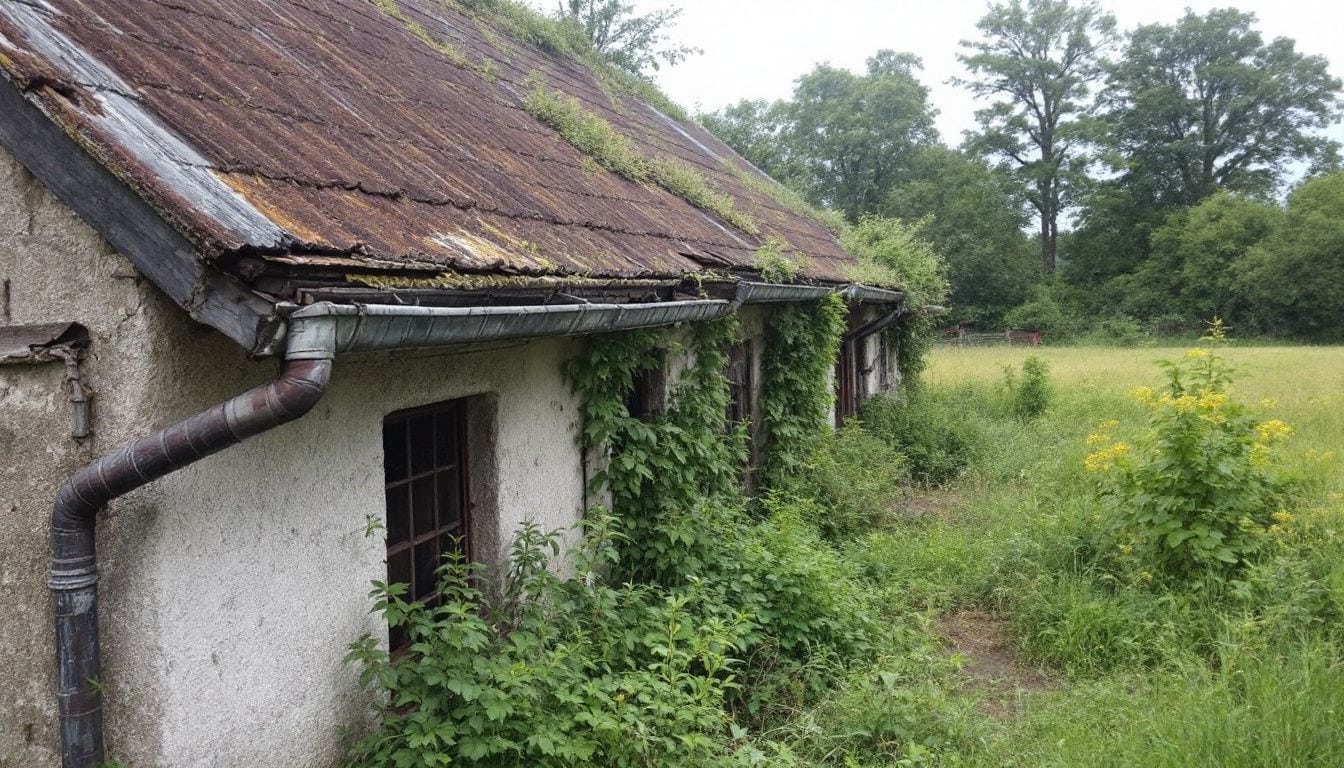
Why Farm Buildings Are One of the Biggest Asbestos Risks in the UK
If you own or manage a farm, an asbestos survey for farms should be near the top of your property management list — particularly if any of your buildings date from before 2000. Agricultural land is home to some of the most asbestos-heavy structures in the country, and unlike commercial offices or schools, farm buildings often go uninspected for decades.
Asbestos was used extensively in agricultural construction right up until its ban in late 1999. Corrugated roofing, wall cladding, guttering, pipe lagging — all of it was routinely installed across barns, storage sheds, workshops, and outbuildings. Much of it is still there today, quietly deteriorating.
The legal obligations are clear, and the health risks are serious. Read on to find out where asbestos hides on farms, what the law requires of you, and how to get it properly managed.
Where Asbestos Hides on Agricultural Land
Asbestos-containing materials (ACMs) turn up in a surprisingly wide range of locations on farms. The sheer variety of structures on a typical agricultural holding — from Victorian-era stone barns to 1970s prefabricated sheds — means the risk profile can vary enormously from one property to the next.
Common locations where ACMs are found on farms include:
- Corrugated asbestos-cement roof sheets — by far the most common find on agricultural buildings
- Wall cladding and building partitions — often used in livestock housing, dairy units, and storage buildings
- Rainwater gutters and downpipes — asbestos-cement was widely used for external drainage
- Pipe lagging and flue insulation — particularly in older boiler rooms, grain driers, and heating systems
- Water tanks and toilet cisterns — common in farm offices, staff facilities, and older outbuildings
- Sprayed coatings and textured finishes — found on structural steelwork and ceilings in some older buildings
- Vinyl floor tiles and linoleum — older farm offices and domestic annexes may contain these
- Asbestos textiles and composites — used in fire blankets, rope seals, and gaskets in older machinery rooms
There is also the issue of buried asbestos. Fields and yards on older agricultural estates sometimes contain asbestos waste that has been buried over the years — whether from demolition projects, fly-tipping, or historical land management practices. This is a specific contamination risk that requires soil sampling and specialist assessment.
The Health Risks: Why Undisturbed Doesn’t Mean Safe Forever
ACMs that are in good condition and left completely undisturbed pose a relatively low immediate risk. The danger arises when materials are damaged, weathered, or disturbed — and on working farms, disturbance is almost inevitable.
Corrugated asbestos-cement roofing, for example, becomes increasingly fragile as it ages. Frost damage, UV degradation, and physical impact from falling debris or farm machinery can all cause fibres to be released. Workers carrying out repairs, pressure washing roofs, or simply moving around inside deteriorating buildings may be exposed without realising it.
Inhaling asbestos fibres causes serious and irreversible diseases, including:
- Mesothelioma — an aggressive cancer of the lung lining with no cure
- Asbestosis — scarring of the lung tissue that progressively reduces breathing capacity
- Asbestos-related lung cancer
- Pleural thickening — a condition that restricts lung expansion and causes breathlessness
These diseases typically take 20 to 40 years to develop after exposure, which means farm workers exposed today may not show symptoms until much later. The lag between exposure and diagnosis is one of the reasons asbestos continues to cause thousands of deaths per year in the UK.
What the Law Requires: Your Legal Duties as a Farm Owner or Manager
Asbestos management in the UK is governed by the Control of Asbestos Regulations, supported by the HSE guidance document HSG264 — Asbestos: The Survey Guide. These regulations apply to non-domestic premises, which includes all farm buildings, outbuildings, and commercial agricultural structures.
Under the duty to manage (Regulation 4), anyone who owns or has responsibility for non-domestic premises must:
- Take reasonable steps to identify whether ACMs are present
- Assess the condition and risk of any ACMs found
- Produce and maintain an asbestos register
- Create a written management plan and act upon it
- Provide information about ACMs to anyone who may disturb them
- Arrange periodic re-inspection of known ACMs
The duty applies to farm owners, tenant farmers with responsibility for buildings, and any managing agent acting on behalf of a landowner. Ignorance of the regulations is not a defence, and failure to comply can result in significant fines and enforcement action from the HSE.
Domestic farmhouses are not covered by the duty to manage in the same way — but any outbuildings, barns, or commercial structures on the same holding are.
What Type of Asbestos Survey Does a Farm Need?
Not all asbestos surveys are the same, and choosing the right type for your situation is essential. For agricultural properties, the survey you need depends on what you plan to do with the building.
Management Survey
A management survey is the standard survey for buildings that are in use and not undergoing any major works. It identifies ACMs that could be disturbed during normal occupation and routine maintenance, and produces an asbestos register and risk assessment.
This is the survey that satisfies the duty to manage under the Control of Asbestos Regulations. For most farm buildings in everyday use, it is the natural starting point — giving you a clear picture of what is present, where it is, and what condition it is in.
Refurbishment Survey
If you are planning renovation work — converting a barn, extending a building, replacing a roof, or carrying out any intrusive maintenance — you will need a refurbishment survey before work begins. This survey is more intrusive than a management survey and is designed to locate all ACMs in the areas where work will take place, including those hidden within the fabric of the building.
No contractor should begin refurbishment work on a pre-2000 agricultural building without this survey being completed first. It is a legal requirement, and any contractor who proceeds without one is exposing themselves — and you — to serious liability.
Demolition Survey
If a building is coming down entirely, a demolition survey is required. This is the most thorough type of survey, covering the entire structure including areas that would normally be inaccessible. All ACMs must be identified and removed by a licensed contractor before demolition can proceed.
On farms, demolition surveys are commonly required when old asbestos-cement roofed sheds are being cleared to make way for modern agricultural buildings or development projects.
Re-Inspection Survey
Once ACMs have been identified and a management plan is in place, those materials need to be checked regularly. A re-inspection survey assesses whether the condition of known ACMs has changed since the last inspection, and updates the risk ratings accordingly.
The HSE recommends re-inspection at least annually, though more frequent checks may be needed for materials in poor condition or high-traffic areas.
Asbestos Survey for Farms: What the Process Looks Like
If you have never had an asbestos survey carried out on your agricultural buildings before, here is what to expect when you book with Supernova Asbestos Surveys.
- Booking: Contact us by phone or through our website. We will confirm availability — often within the same week — and send a booking confirmation with all the details you need.
- Site Visit: A BOHS P402-qualified surveyor attends at the agreed time. On a farm, this typically involves a walk-through of all buildings and structures, identifying suspect materials visually and assessing their condition.
- Sampling: Representative samples are taken from suspect materials using correct containment procedures to prevent fibre release. On agricultural properties, this often includes roofing sheets, cladding panels, and pipe insulation.
- Laboratory Analysis: Samples are sent to our UKAS-accredited laboratory for analysis under polarised light microscopy (PLM). This confirms whether asbestos is present and identifies the fibre type.
- Report Delivery: Within 3–5 working days, you receive a detailed written report including an asbestos register, condition ratings, risk assessment, and management plan. The report is fully compliant with HSG264 and satisfies the requirements of the Control of Asbestos Regulations.
If you are unsure whether a specific material contains asbestos, our testing kit allows you to collect a sample yourself and send it for laboratory analysis — a cost-effective option for single suspect materials where a full survey is not yet required.
Asbestos Removal on Farms: Licensed vs Non-Licensed Work
Not all asbestos removal requires a licensed contractor, but the higher-risk materials do. Understanding the distinction is important for farm owners planning any building work.
Licensed work is required for materials that are friable (easily crumbled), heavily damaged, or that release fibres readily when disturbed. This includes sprayed asbestos coatings, pipe lagging, and insulating board. Licensed contractors must be approved by the HSE, and the work must be notified to the HSE in advance.
Non-licensed work covers lower-risk materials such as asbestos-cement products — the corrugated roofing sheets and cladding panels that are so common on farms. While a licence is not required, a risk assessment must still be carried out before any handling, and appropriate controls must be in place. Workers must be trained, and employers must keep records of the work carried out.
When you are ready to proceed, our asbestos removal service can advise on the right approach for your specific materials and arrange compliant removal by qualified contractors. Always confirm with your surveyor which category applies to the materials on your property before planning any removal work.
Soil Contamination: A Specific Risk on Agricultural Land
Beyond the buildings themselves, agricultural land can also be affected by asbestos contamination in the soil. This is a risk that is easy to overlook but can have serious consequences for farm workers and the land itself.
Soil contamination can arise from:
- Historical burial of demolition waste containing ACMs
- Weathering and fragmentation of deteriorating asbestos-cement structures
- Fly-tipping of asbestos waste on rural land
- Run-off from damaged roofing materials
Farm workers who cultivate, dig, or disturb contaminated ground may be exposed to fibres. If you suspect buried asbestos on your land — particularly if you are planning ground works or a change of land use — specialist soil sampling and environmental assessment should be carried out before any disturbance takes place.
Fire Risk Assessments for Farm Buildings
Asbestos is not the only legal compliance matter farm owners need to address. Non-domestic premises — including agricultural buildings — are also subject to fire safety legislation. A fire risk assessment is a separate legal requirement that must be carried out and regularly reviewed.
Farm buildings present specific fire risks: large open structures, stored combustibles such as hay and straw, fuel storage, and machinery. Combining your asbestos survey with fire risk assessments in a single site visit is an efficient way to address both obligations at once. Supernova can arrange both services together for agricultural clients.
Asbestos Surveys Across the UK: We Cover Agricultural Properties Nationwide
Supernova Asbestos Surveys operates across the whole of the UK, covering rural and agricultural properties wherever they are located. Whether you need an asbestos survey in London for a city-fringe agricultural holding or an asbestos survey in Manchester for a periurban farm site, our qualified surveyors can attend promptly and deliver a fully compliant report.
We understand that farms operate on their own schedules. We work flexibly around your operations to minimise disruption, and our surveyors are experienced in navigating the full range of agricultural building types — from ancient stone barns to modern steel-framed structures.
Survey Costs and What to Expect
Supernova Asbestos Surveys offers transparent, fixed-price surveys across the UK. Pricing for agricultural properties varies depending on the number of buildings, their size, and the type of survey required.
- Management Survey: From £195 for a standard small commercial or agricultural building
- Refurbishment & Demolition Survey: From £295, covering intrusive inspection of the areas to be worked on
- Re-Inspection Survey: Priced based on the number of known ACMs and buildings to be revisited
For larger agricultural holdings with multiple buildings, we provide bespoke quotations. Contact us directly and we will put together a tailored package that covers all structures on your site in a single, cost-effective visit.
All surveys are carried out by BOHS P402-qualified surveyors, and all laboratory analysis is conducted by a UKAS-accredited facility. Every report meets the requirements of HSG264 and the Control of Asbestos Regulations.
Practical Steps for Farm Owners Right Now
You do not need to wait for a problem to arise before acting. Here are the immediate steps any farm owner or manager should take:
- Identify your pre-2000 buildings. Any structure built or refurbished before the end of 1999 is a potential source of ACMs and should be treated as such until proven otherwise.
- Do not disturb suspect materials. If you can see deteriorating corrugated roofing, crumbling insulation, or damaged cladding, do not attempt to repair or remove it without a survey first.
- Book a management survey. This is the starting point for legal compliance and will give you a clear picture of what you are dealing with across all your buildings.
- Brief your workers. Anyone who works in or around your buildings — including contractors — must be made aware of the location and condition of any known ACMs.
- Keep your asbestos register up to date. Once you have had a survey, the register must be maintained and re-inspections carried out at regular intervals.
- Plan ahead for any building work. If renovation or demolition is on the horizon, commission the appropriate survey well in advance so that work is not delayed.
Frequently Asked Questions
Do I need an asbestos survey for every building on my farm?
You need a survey for every non-domestic building that was constructed or refurbished before 2000. This includes barns, sheds, workshops, storage buildings, and any other agricultural structures. The domestic farmhouse itself falls under different rules, but any outbuildings or annexes used for work purposes are covered by the duty to manage under the Control of Asbestos Regulations.
What happens if I find asbestos on my farm?
Finding asbestos does not automatically mean it needs to be removed. If the material is in good condition and is not likely to be disturbed, it can often be managed in place with regular monitoring. Your surveyor will provide a condition rating and risk assessment for each ACM found, along with a recommended management approach. Removal is only required when materials are in poor condition, are being disturbed by planned works, or pose an unacceptable risk to occupants.
Can I remove asbestos roofing sheets myself?
Asbestos-cement roofing sheets are classified as a non-licensed material, which means a licensed contractor is not legally required for their removal. However, you must still carry out a risk assessment before handling them, ensure workers are trained, use appropriate personal protective equipment, and comply with waste disposal regulations. In practice, most farm owners choose to use a specialist contractor to ensure full compliance and avoid personal liability. Our asbestos removal service can arrange this for you.
How often do I need to re-inspect asbestos on my farm?
The HSE recommends that known ACMs are re-inspected at least once a year. However, if materials are in poor condition, located in high-traffic areas, or are subject to regular disturbance, more frequent inspections may be appropriate. A re-inspection survey carried out by a qualified surveyor will update the condition ratings in your asbestos register and flag any materials that have deteriorated since the previous inspection.
Is asbestos in soil on my farmland a legal concern?
Yes. If you are aware of, or suspect, asbestos contamination in your soil — particularly if you are planning ground works, construction, or a change of land use — you have a duty to assess and manage that risk. Disturbing contaminated ground without prior assessment could expose workers to asbestos fibres and result in enforcement action. Specialist soil sampling and environmental assessment should be carried out before any ground disturbance takes place.
Book Your Asbestos Survey for Farms Today
Supernova Asbestos Surveys has completed over 50,000 surveys across the UK, including a wide range of agricultural and rural properties. Our BOHS-qualified surveyors understand the specific challenges of farm buildings — the variety of structures, the remote locations, and the need to work around active operations.
We offer fast turnaround, transparent pricing, and fully compliant reports that satisfy the requirements of the Control of Asbestos Regulations and HSG264. Whether you need a management survey for a working farm, a refurbishment survey ahead of a barn conversion, or a demolition survey for a site clearance, we can help.
Call us on 020 4586 0680 or visit asbestos-surveys.org.uk to get a quote or book a survey. We cover agricultural properties across the whole of the UK and can often attend within days of your enquiry.