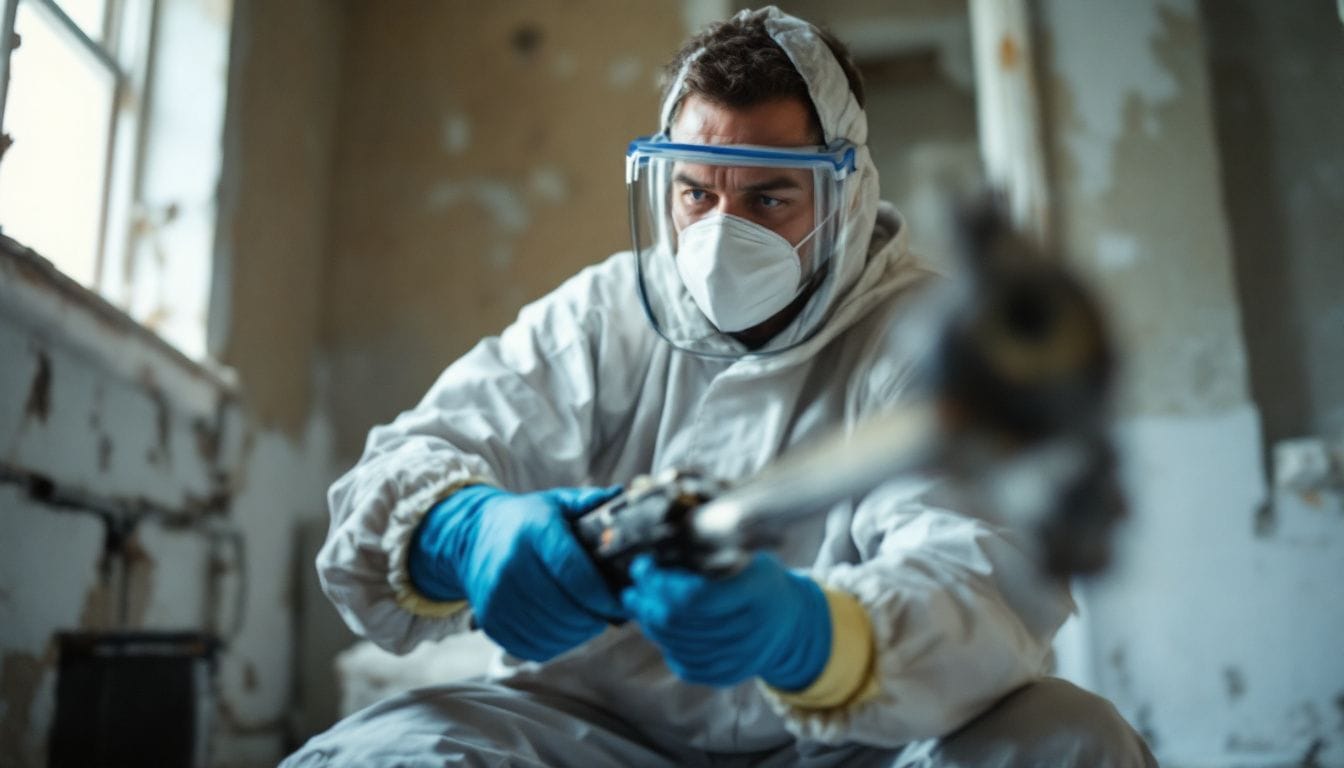
Asbestos Removal and Abatement: What Every UK Property Owner Needs to Know
Millions of buildings across the UK still contain asbestos. Whether you own a Victorian terrace, manage a 1970s office block, or are overseeing a school refurbishment, asbestos removal and abatement is a subject you cannot afford to get wrong. The consequences of poor handling — for health, for compliance, and for liability — are severe.
This post gives you a clear, practical picture of how asbestos is safely removed and managed, what emerging methods are being developed, and what your legal obligations are as a duty holder in the UK.
Why Asbestos Removal and Abatement Still Matters
The UK banned the import, supply, and use of all asbestos in 1999. But banning it did not make it disappear. Asbestos-containing materials (ACMs) remain present in hundreds of thousands of buildings constructed before the ban — and many of those buildings are still in daily use.
Asbestos is only dangerous when its fibres become airborne. Undisturbed and in good condition, it can often be managed in place. But the moment a building is refurbished, renovated, or demolished without proper assessment, the risk becomes very real.
Mesothelioma, asbestosis, and asbestos-related lung cancer continue to claim lives in the UK every year. The Health and Safety Executive (HSE) consistently cites asbestos as the single greatest cause of work-related deaths in Great Britain. That is why the framework around asbestos removal and abatement is so rigorous — and why cutting corners is never an option.
Removal vs Abatement: Understanding the Difference
These two terms are often used interchangeably, but they are not quite the same thing.
Asbestos removal refers specifically to the physical extraction of ACMs from a building or structure. This might involve removing asbestos insulation board, ceiling tiles, pipe lagging, or floor tiles.
Asbestos abatement is the broader term. It encompasses all strategies used to reduce or eliminate the risk posed by asbestos, including:
- Removal — physically taking the material out of the building
- Encapsulation — sealing the material with a specialist coating to prevent fibre release
- Enclosure — constructing a physical barrier around the ACM
- Management in place — monitoring and maintaining undisturbed ACMs under a formal asbestos management plan
The right approach depends on the type of asbestos, its condition, its location, and whether the building is being refurbished or simply maintained. A qualified surveyor will assess all of these factors before recommending a course of action.
The Survey Always Comes First
You cannot safely plan asbestos removal and abatement without knowing exactly what you are dealing with. That means commissioning the correct type of asbestos survey before any work begins.
Management Survey
A management survey is the standard survey for buildings in normal occupation. It identifies the location, type, and condition of any ACMs that could be disturbed during routine maintenance or that pose a risk to occupants. This survey forms the basis of your asbestos register and management plan.
Refurbishment Survey
Before any refurbishment or demolition work, a refurbishment survey is legally required. This is a far more intrusive inspection — surveyors access all areas that will be disturbed, including voids, ceiling spaces, and structural elements. It is designed to locate every ACM that workers might encounter during the project.
Re-inspection Survey
If you already have an asbestos register in place, a re-inspection survey keeps it current. ACMs can deteriorate over time, and the Control of Asbestos Regulations requires duty holders to review their management plans regularly. Annual re-inspections are standard practice for most commercial premises.
How Asbestos Removal Works in Practice
Licensed asbestos removal is a tightly controlled process. The HSE requires that certain types of asbestos work — particularly involving high-risk materials such as sprayed coatings, insulation, and asbestos insulating board — are carried out only by contractors holding an HSE licence.
Here is how a typical licensed asbestos removal project unfolds:
- Notification — The licensed contractor must notify the relevant enforcing authority at least 14 days before work begins, with some exceptions for emergency work.
- Controlled area setup — The work area is sealed off using polythene sheeting. Negative pressure units (NPUs) are installed to ensure air flows into the enclosure rather than out, preventing fibre escape.
- Wet removal methods — Water or a wetting agent is applied to suppress dust and reduce airborne fibre release during removal.
- Protective equipment — Workers wear full-face respirators and disposable coveralls rated to the appropriate standard for the material being removed.
- Air monitoring — Continuous or periodic air sampling takes place throughout the work to ensure fibre levels remain within safe limits.
- Waste disposal — All asbestos waste is double-bagged in clearly labelled UN-approved sacks and disposed of at a licensed waste facility. Asbestos waste cannot go to a standard skip or general landfill.
- Clearance inspection — Once removal is complete, an independent analyst carries out a four-stage clearance procedure, including a thorough visual inspection and air testing, before the area is handed back for use.
This level of rigour is not bureaucracy for its own sake. It is what keeps workers, occupants, and the wider environment safe.
Emerging Methods in Asbestos Abatement
The established methods of encapsulation, enclosure, and wet removal remain the industry standard — and for good reason. They are proven, reliable, and well-understood. But research into new abatement approaches continues to advance.
Robotic and Automated Removal Systems
AI-guided robotic systems are being developed to carry out removal tasks in environments too hazardous or confined for human workers. These systems reduce direct worker exposure and can operate continuously without the fatigue or human error that increases risk during long removal projects. While still emerging, this technology represents a significant shift in how high-risk abatement may be conducted in the future.
Advanced Filtration Technology
HEPA filtration is already the standard for asbestos work — capable of capturing the vast majority of airborne particles including asbestos fibres. Developments in filtration technology continue to improve the efficiency and reliability of negative pressure units and air scrubbers used during removal projects.
Dry Ice and Sponge Blasting
Alternative abrasive blasting techniques, including dry ice blasting and sponge blasting, are being explored as lower-dust alternatives to traditional methods for certain surface decontamination tasks. These approaches aim to reduce secondary contamination and simplify clean-up procedures.
Bioremediation Research
At the more experimental end of the spectrum, scientists are investigating whether certain microorganisms can break down asbestos fibres into non-toxic substances. Bioremediation remains a research-stage concept rather than a deployable technique, but it points to a future where asbestos abatement may one day involve biological rather than purely mechanical processes.
Microencapsulation
Microencapsulation involves encasing asbestos fibres in specialist polymers to render them inert and prevent release. This approach is being refined as an alternative to full removal in situations where disturbance risk is low but the material is in a deteriorating condition.
None of these emerging methods replace the need for a properly conducted survey and a licensed contractor. They are developments that may expand the toolkit available to abatement professionals — not shortcuts around established safety requirements.
IoT and Real-Time Air Quality Monitoring
One area where technology is already making a practical difference is environmental monitoring. IoT-enabled sensors can now provide continuous, real-time air quality data during removal projects, flagging fibre concentrations before they reach dangerous levels and allowing supervisors to respond immediately.
This kind of live data feed improves both safety outcomes and documentation — giving contractors, clients, and regulators a verifiable record of conditions throughout the project. It also supports a shift towards data-driven compliance, where decisions are backed by measurable evidence rather than periodic manual sampling alone.
The Legal Framework You Need to Understand
Asbestos management in the UK is governed by a clear and enforceable legal framework. Ignorance of these rules is not a defence — and the penalties for non-compliance can be severe.
Control of Asbestos Regulations
The Control of Asbestos Regulations set out the requirements for managing and working with asbestos in Great Britain. Key obligations include the duty to manage asbestos in non-domestic premises, licensing requirements for higher-risk work, notification duties, and the requirement to protect workers and others from exposure.
HSG264 — Asbestos: The Survey Guide
HSG264 is the HSE’s definitive guidance on how asbestos surveys should be planned and conducted. Any reputable surveyor will follow HSG264 standards as a matter of course. If your survey report does not reference this guidance, that is a red flag worth investigating.
The Duty to Manage
Regulation 4 of the Control of Asbestos Regulations places a legal duty on owners and managers of non-domestic premises to manage asbestos. This means identifying ACMs, assessing their condition and risk, and maintaining an up-to-date asbestos register and management plan.
Failing to meet this duty can result in prosecution, significant fines, and — more importantly — serious harm to the people who use your building.
When to Use an Asbestos Testing Kit
For residential property owners who suspect a material may contain asbestos but do not yet need a full survey, an asbestos testing kit can be a practical first step. Supernova’s postal testing kits allow you to collect a sample yourself — where this is safe and legally permissible — and have it analysed at a UKAS-accredited laboratory.
This is not a substitute for professional asbestos testing in commercial or public buildings, where the duty to manage applies. But for a homeowner wanting to know whether that artex ceiling or floor tile contains asbestos before booking a contractor, it is a cost-effective and sensible starting point.
Coordinating Asbestos Management with Fire Risk Assessments
Asbestos is not the only hazard that building owners and managers need to address. A fire risk assessment is a legal requirement for most non-domestic premises and should be carried out alongside — not instead of — your asbestos management obligations.
In older buildings where asbestos is a known or likely presence, fire risk assessments and asbestos surveys often need to be coordinated carefully. Certain fire protection materials installed in older buildings may themselves contain asbestos, and any fire-related damage or remediation work could disturb ACMs.
Managing both risks together, rather than in isolation, is the smarter and safer approach. Many duty holders find it efficient to instruct the same provider for both, ensuring nothing falls through the gaps between disciplines.
Choosing the Right Contractor for Asbestos Removal and Abatement
Not all asbestos work requires a licensed contractor, but the highest-risk tasks do. When selecting a contractor for asbestos removal and abatement work, check the following:
- Do they hold a current HSE asbestos licence for licensable work?
- Are their surveyors qualified to P402 or equivalent standard?
- Do they carry out independent four-stage clearance, or do they self-certify?
- Is their analytical laboratory UKAS-accredited?
- Do their survey reports reference HSG264?
- Can they provide references and evidence of completed projects?
A reputable contractor will be transparent about all of the above. If they are not, that tells you something important.
It is also worth noting that not all asbestos work falls into the licensed category. Notifiable non-licensed work (NNLW) and non-licensed work each carry their own requirements under the Control of Asbestos Regulations. A qualified surveyor can advise which category applies to your specific situation before any work begins.
What Happens After Asbestos Removal and Abatement?
Once removal or abatement work is complete, your obligations as a duty holder do not simply end. You will need to update your asbestos register to reflect what has been removed or treated. If ACMs remain in the building — managed in place rather than removed — your management plan must continue to be reviewed and updated at regular intervals.
The four-stage clearance certificate issued by the independent analyst at the end of a licensed removal project is an important document. Keep it alongside your asbestos register and make it available to contractors, insurers, or regulators if requested.
If your building undergoes further changes — extensions, refurbishments, or changes of use — you will need to revisit your asbestos position each time. The survey and management cycle is ongoing, not a one-off exercise.
Frequently Asked Questions
What is the difference between asbestos removal and asbestos abatement?
Asbestos removal refers specifically to the physical extraction of asbestos-containing materials from a building. Asbestos abatement is a broader term covering all strategies used to reduce or eliminate the risk posed by asbestos, including removal, encapsulation, enclosure, and management in place. The appropriate approach depends on the material type, its condition, and the planned use of the building.
Do I legally need a licensed contractor for asbestos removal?
Not all asbestos work requires a licensed contractor, but the highest-risk tasks do. Work involving sprayed coatings, asbestos insulating board, and pipe lagging must be carried out by an HSE-licensed contractor. Lower-risk materials may fall into the notifiable non-licensed or non-licensed categories, each with their own requirements under the Control of Asbestos Regulations. A qualified surveyor can advise which category applies to your situation.
How do I know if my building contains asbestos?
The only reliable way to confirm whether a material contains asbestos is through sampling and laboratory analysis. For commercial and public buildings, this should be carried out as part of a formal asbestos survey conducted by a qualified surveyor following HSG264 guidance. For residential properties, an asbestos testing kit can be a practical first step, allowing you to submit a sample to a UKAS-accredited laboratory for analysis.
How often does an asbestos management plan need to be reviewed?
The Control of Asbestos Regulations requires duty holders to review their asbestos management plans regularly. For most commercial premises, annual re-inspections are standard practice. The plan should also be reviewed whenever there is a change in the condition of ACMs, a change in the use of the building, or before any refurbishment or maintenance work that could disturb asbestos-containing materials.
Can asbestos be left in place rather than removed?
Yes — in many cases, asbestos that is in good condition and unlikely to be disturbed can be safely managed in place under a formal asbestos management plan. Removal is not always the safest or most appropriate option, as the act of removal itself carries risk if not properly controlled. A qualified surveyor will assess the condition and location of ACMs and recommend the most appropriate abatement strategy for your specific building and circumstances.
Get Expert Help with Asbestos Removal and Abatement
Supernova Asbestos Surveys has completed over 50,000 surveys across the UK. Our qualified surveyors follow HSG264 guidance and work with UKAS-accredited laboratories as standard. Whether you need a management survey, a refurbishment survey ahead of a building project, or professional guidance on asbestos removal and abatement, we are here to help.
Call us on 020 4586 0680 or visit asbestos-surveys.org.uk to find out more about our full range of services — including asbestos removal, fire risk assessments, and asbestos testing.