How Is Asbestos Extracted? From Ancient Hand-Digging to Industrial-Scale Mining
Asbestos did not end up in UK buildings by accident. Understanding how asbestos is extracted — from the earliest manual digging of fibrous rock to the mechanised open-cast mines of the industrial era — explains why this mineral became embedded in so many construction products, and why its legacy still affects hundreds of thousands of buildings across the UK today.
If you manage commercial premises, work with older buildings, or are planning renovation work, this history is directly relevant to the risks you may be managing right now.
The Ancient Origins: How Asbestos Was First Extracted
Archaeological evidence suggests humans were working with asbestos-containing minerals long before recorded history. Early peoples recognised that certain fibrous rocks resisted heat and flame — a remarkable property in a world where fire was both essential and unpredictable.
Some of the earliest documented uses include:
- Lamp and candle wicks made from asbestos fibres, dating back approximately 6,000 years
- Egyptian burial cloths woven with asbestos fibres to help preserve remains
- Finnish clay pots reinforced with asbestos to improve fire resistance, dating back roughly 4,500 years
- Funerary practices recorded by the historian Herodotus, in which asbestos shrouds were used during cremation ceremonies
The word asbestos derives from the Greek asbestos, meaning indestructible, and the Latin amiantus, meaning unsoiled or pure. These names reflect the almost mythical status the mineral held in ancient cultures.
Extraction at this stage was entirely manual. Workers located surface outcroppings of fibrous rock, broke them apart with stone and metal tools, and separated the fibrous material by hand. There was no understanding of the health hazards — only an appreciation of extraordinary properties.
Medieval and Early Modern Asbestos Production
Through the medieval period, knowledge of asbestos and how it was extracted spread across Europe and Asia. Its fire-resistant qualities made it prized among rulers, explorers, and military commanders.
King Charlemagne reportedly used an asbestos tablecloth, throwing it into flames to impress guests and confound those who thought he was cleaning it. Knights during the First Crusade used asbestos bags to carry burning pitch and tar, exploiting the material’s heat resistance in warfare.
In the late 13th century, Marco Polo visited a mine in China and documented asbestos extraction firsthand, noting that local workers wore non-flammable clothing woven from the fibres. His account helped dispel the popular myth that asbestos came from the fur of a fire-resistant animal.
By the early 18th century, asbestos was attracting the attention of rulers with industrial ambitions. Peter the Great oversaw the extraction of chrysotile asbestos in Russia, recognising its potential for large-scale use. Benjamin Franklin carried a fireproof asbestos purse to England — a curiosity that demonstrated the material’s properties to a wider European audience.
Production during this era remained artisanal. Chrysotile from Cyprus and tremolite from Italy were the primary sources. Workers extracted material from shallow surface deposits, dried and separated the fibres by hand, then wove or pressed them into cloths, ropes, and other products. The scale was small, but the techniques laid the groundwork for what followed.
How Is Asbestos Extracted at Industrial Scale? The 19th Century Changes Everything
The 19th century transformed asbestos from a curiosity into a global commodity. As industrialisation accelerated demand for fire-resistant and insulating materials, asbestos extraction shifted from hand-digging to mechanised mining on an enormous scale.
The Opening of Commercial Mines
The modern asbestos industry effectively began when chrysotile asbestos was discovered in Thetford Township, Quebec, Canada in the 1870s. This deposit was vast, and the first commercial chrysotile mine opened there, triggering a wave of industrial investment that would define global asbestos production for the next century.
Around the same period, crocidolite — blue asbestos, one of the most dangerous varieties — was identified in the Free State region of South Africa. By the 1880s, Australia had begun mining asbestos in New South Wales, and major asbestos industries were established in Scotland, Germany, and England.
Early manufacturers began producing asbestos fireproof roofing materials, setting a template for the sector that followed. Within decades, asbestos had moved from a scientific curiosity to a cornerstone of industrial construction.
Open-Cast and Underground Mining Methods
Commercial asbestos extraction relied on two primary methods, depending on the depth and nature of the deposit.
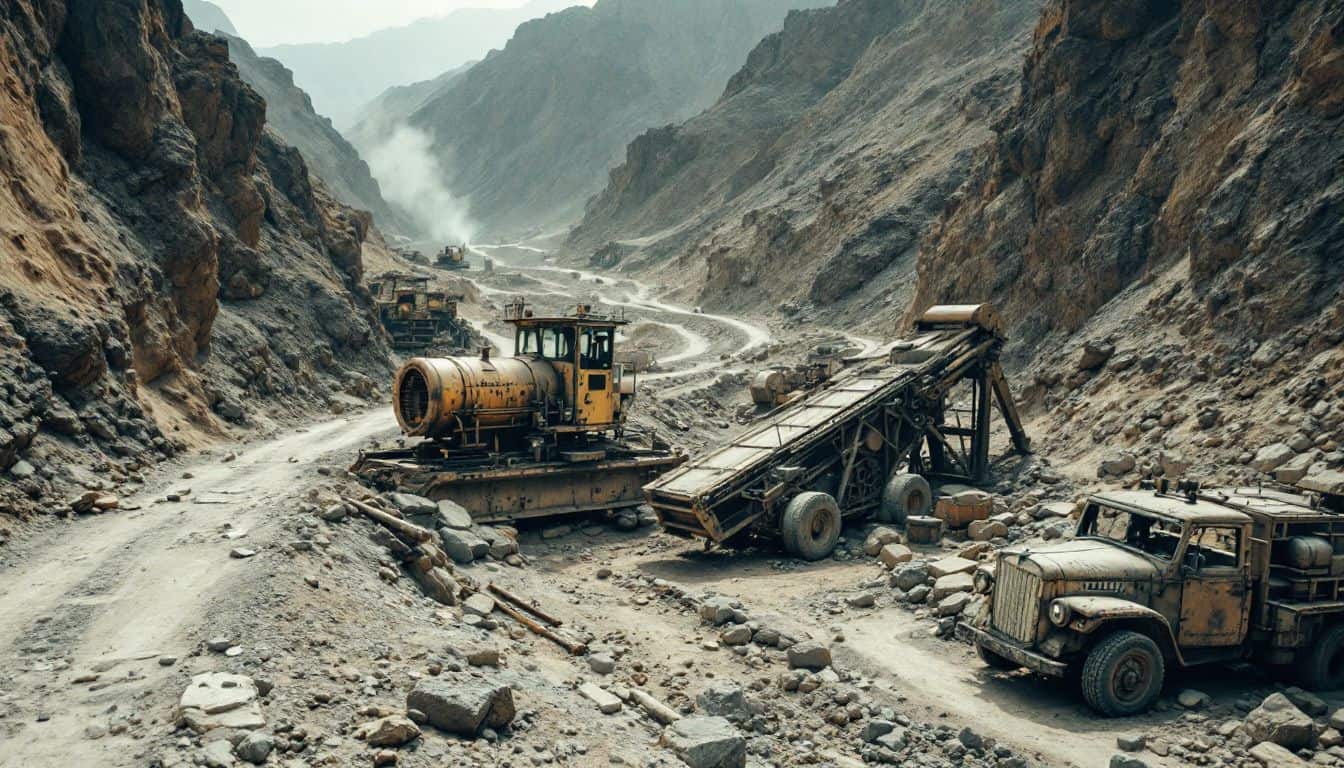
Open-cast (surface) mining was used where asbestos-bearing rock lay close to the surface. Large areas of land were stripped away using explosives and heavy machinery. Rock was blasted, loaded onto wagons, and transported to processing facilities. The Quebec chrysotile mines used this method extensively.
Underground mining was required for deeper deposits. Shafts and tunnels were driven into the rock, and workers drilled, blasted, and manually extracted ore in confined spaces with minimal ventilation. This method was common in South African crocidolite and amosite mines.
In both cases, the extraction process generated enormous quantities of airborne asbestos dust. Workers had no respiratory protection, no awareness of the fibres they were inhaling, and no regulatory framework to protect them. The health consequences would not be fully understood for decades.
Processing and Separating Asbestos Fibres
Once ore was extracted, it went through a series of processing stages to separate usable asbestos fibres from the surrounding rock:
- Crushing: Raw ore was fed through mechanical crushers to break the rock into smaller pieces
- Drying: Material was dried to reduce moisture, making fibre separation easier
- Fiberising: Dried ore was passed through fiberising machines that loosened and separated asbestos fibres from the host rock
- Screening and grading: Fibres were sorted by length and quality using vibrating screens and air classifiers
- Bagging and shipping: Graded fibres were compressed into bags and shipped to manufacturers worldwide
Each stage of this process released significant quantities of respirable fibres into the air. Processing facilities were among the most hazardous workplaces of the industrial era — though this was not formally acknowledged at the time.
The Six Types of Asbestos That Were Commercially Extracted
By the early 1900s, global asbestos production had reached significant scale, and the mineral was being incorporated into hundreds of different products — from roofing sheets and pipe insulation to brake linings and textiles.
Six main types of asbestos were commercially extracted:
- Chrysotile (white asbestos): The most widely used, accounting for the vast majority of global production. Mined primarily in Canada, Russia, and Zimbabwe.
- Crocidolite (blue asbestos): Considered the most dangerous variety. Mined in South Africa and Australia.
- Amosite (brown asbestos): Widely used in building insulation boards. Mined almost exclusively in South Africa.
- Anthophyllite: Mined in Finland, used in limited industrial applications.
- Tremolite: Found as a contaminant in other minerals, including talc and vermiculite.
- Actinolite: Rarely used commercially but found as a contaminant in other materials.
All six types are now classified as carcinogens. The Control of Asbestos Regulations prohibit the importation, supply, and use of all forms of asbestos in Great Britain.
The Human Cost of Early Asbestos Extraction
The health consequences of early asbestos mining and processing were catastrophic. Workers in mines and processing plants were exposed to extremely high concentrations of airborne fibres throughout their working lives, with no protective equipment and no awareness of the risks.
Early medical observations noted unusual lung conditions among asbestos workers from the late 19th century onwards. The disease now known as asbestosis — scarring of the lung tissue caused by inhaled fibres — was formally recognised and named in the 1930s.
Mesothelioma, a rare and aggressive cancer of the lining of the lungs and abdomen directly linked to asbestos exposure, was not fully understood until decades later. The tragedy is that warning signs existed early — factory inspectors in the UK noted the dusty conditions in asbestos textile mills in the early 1900s — yet commercial interests and a lack of regulatory will meant that widespread protective measures were not introduced for many years.
Workers paid the price with their lives. This history directly shapes why asbestos regulation in the UK is now so stringent. The Control of Asbestos Regulations and HSE guidance under HSG264 exist precisely because the consequences of inadequate management are severe and irreversible.
Why This History Matters for UK Property Owners and Managers Today
The scale of industrial asbestos production during the 19th and 20th centuries means that asbestos-containing materials are present in a significant proportion of UK buildings constructed before 2000. Understanding how asbestos is extracted and processed explains why it ended up in so many different products — and why it can be found in locations that might surprise you.
Asbestos was incorporated into:
- Ceiling tiles, floor tiles, and textured coatings such as Artex
- Pipe lagging and boiler insulation
- Roofing sheets, guttering, and soffit boards
- Insulation boards used in partition walls and fire doors
- Rope seals, gaskets, and electrical components
If your building was constructed or refurbished before 2000, there is a realistic possibility that asbestos-containing materials are present. The only way to know for certain is to commission a professional survey from a qualified surveyor.
The Surveys You Need to Manage Asbestos Safely
Management Surveys for Ongoing Duty of Care
For most non-domestic premises, a management survey is the starting point. This type of survey identifies the location, condition, and extent of any asbestos-containing materials in the accessible areas of a building, allowing you to create an asbestos register and management plan that satisfies your legal duty under the Control of Asbestos Regulations.
A management survey is not a one-off exercise. Conditions change, materials deteriorate, and buildings are modified. Regular professional assessment keeps your records accurate and your duty of care intact.
Refurbishment Surveys Before Any Building Work
If you are planning renovation, extension, or demolition work, you are legally required to commission a refurbishment survey before work begins. This is a more intrusive survey that covers all areas that will be disturbed, ensuring that contractors are not unknowingly cutting into asbestos-containing materials.
Skipping this step is not just a legal risk — it is a serious health risk for your contractors and anyone in the vicinity of the work.
Re-Inspection Surveys to Keep Records Current
Once you have an asbestos register in place, it needs to be kept up to date. A re-inspection survey assesses whether the condition of known asbestos-containing materials has changed, ensuring your management plan remains accurate and your duty of care is maintained over time.
Fire Risk Assessments and Asbestos
Asbestos management and fire safety are closely linked in older buildings. A fire risk assessment should be carried out alongside your asbestos survey to ensure a complete picture of the risks within your premises.
Damaged asbestos-containing materials can release fibres during a fire, creating a secondary hazard that needs to be factored into your emergency planning. Treating these two areas of compliance as separate exercises can leave dangerous gaps in your risk management.
Home Testing Kits for Residential Properties
If you are a homeowner concerned about a specific material, a professional-grade testing kit allows you to take a sample and have it analysed by an accredited laboratory. This is a practical first step before commissioning a full survey, particularly if you have identified a suspect material during DIY work or a property inspection.
Always follow safe sampling guidance when using a testing kit. If you are uncertain, stop and contact a professional surveyor before disturbing any material.
Asbestos Surveys Across the UK
Supernova Asbestos Surveys operates nationwide, with specialist teams covering every region of the country. Whether you need an asbestos survey in London, an asbestos survey in Manchester, or an asbestos survey in Birmingham, our surveyors are UKAS-accredited and experienced across all property types — from Victorian commercial premises to post-war industrial sites.
With over 50,000 surveys completed, we understand the full range of asbestos-containing materials found in UK buildings, and we know how to find them.
Frequently Asked Questions
How is asbestos extracted from the ground?
Asbestos is extracted using either open-cast (surface) mining or underground mining, depending on how deep the deposit lies. In open-cast mining, explosives and heavy machinery are used to strip away surface rock and expose asbestos-bearing ore. In underground mining, shafts and tunnels are driven into the rock, and workers drill and blast to reach the ore. Once extracted, the raw ore goes through a series of processing stages — crushing, drying, fiberising, and grading — to separate usable asbestos fibres from the surrounding rock.
What types of asbestos were commercially mined?
Six types of asbestos were commercially extracted: chrysotile (white), crocidolite (blue), amosite (brown), anthophyllite, tremolite, and actinolite. Chrysotile was by far the most widely used, accounting for the majority of global production. Crocidolite and amosite are considered particularly hazardous. All six types are now banned in Great Britain under the Control of Asbestos Regulations.
Is asbestos still being mined anywhere in the world?
Yes. Despite being banned in the UK and many other countries, asbestos is still mined and used in parts of the world, including Russia, Kazakhstan, and Brazil. The UK prohibits the importation, supply, and use of all forms of asbestos, so any asbestos found in UK buildings today is a legacy of historical production and use.
Why is asbestos found in so many UK buildings?
The industrial-scale extraction and processing of asbestos during the 19th and 20th centuries made it an extremely cheap and widely available material. Its fire-resistant, insulating, and strengthening properties meant it was incorporated into hundreds of construction products. Any UK building constructed or significantly refurbished before 2000 may contain asbestos-containing materials.
What should I do if I suspect asbestos in my building?
Do not disturb the material. Commission a professional asbestos survey from a UKAS-accredited surveyor. For occupied non-domestic premises, a management survey is the appropriate starting point. If you are planning building work, a refurbishment survey is legally required before work begins. Contact Supernova Asbestos Surveys on 020 4586 0680 or visit asbestos-surveys.org.uk to arrange a survey.
Speak to Supernova Asbestos Surveys
Understanding how asbestos is extracted and why it ended up in UK buildings is only the first step. Knowing what is in your building — and managing it correctly — is your legal and moral responsibility as a dutyholder.
Supernova Asbestos Surveys has completed over 50,000 surveys across the UK. Our UKAS-accredited surveyors provide management surveys, refurbishment surveys, re-inspection surveys, and fire risk assessments for commercial, industrial, and residential properties of all types.
Call us on 020 4586 0680 or visit asbestos-surveys.org.uk to book your survey or request a quote. Do not leave asbestos management to chance — the history of this mineral makes clear exactly what is at stake.