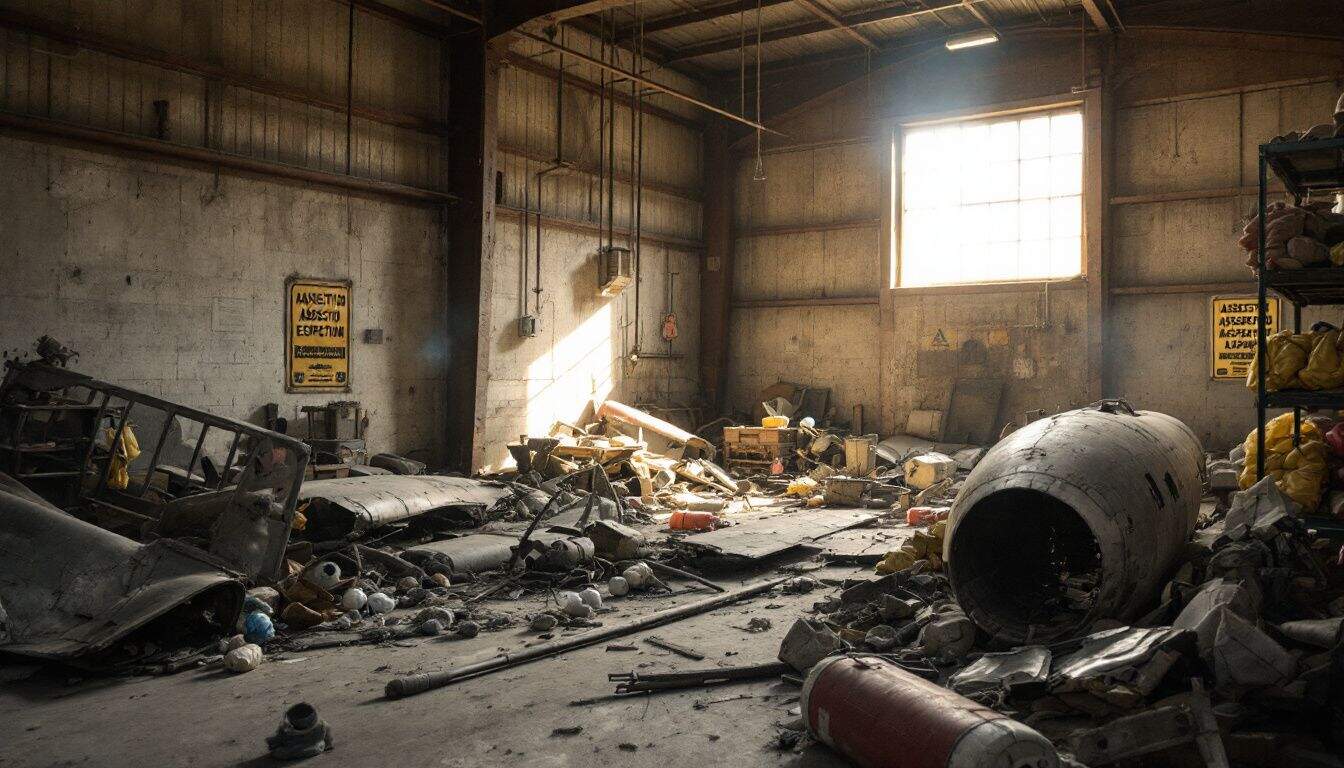
Asbestos in Aerospace: How the Industry Educates and Protects Its Workers
Asbestos was once considered an engineering marvel — heat-resistant, durable, and cheap to source. For decades, it was built into aircraft brake systems, gaskets, insulation panels, and engine components. Today, the question of how does the aerospace industry educate and inform their workers about the dangers of asbestos exposure sits at the heart of occupational health compliance across the sector.
This is not a problem that resolved itself when asbestos was banned in the UK. Older aircraft remain in service. Maintenance hangars built before 2000 may still contain asbestos-containing materials (ACMs). Every time a technician works on a legacy component without proper awareness, the risk is live and immediate.
Why Asbestos Remains a Genuine Threat in Aerospace
Asbestos was used extensively in aviation throughout the 20th century. It appeared in brake linings, fireproof insulation, cockpit panels, and hydraulic systems. Some older brake assemblies contained asbestos in significant concentrations, meaning routine maintenance work could disturb substantial quantities of fibres.
When asbestos fibres become airborne and are inhaled, they lodge permanently in lung tissue. Over time, this can lead to mesothelioma, asbestosis, and asbestos-related lung cancer. These diseases typically have a latency period of 20 to 40 years, which means workers exposed decades ago are still being diagnosed today.
The continued operation of older aircraft and the renovation of legacy facilities means that exposure risk has not disappeared. It has simply shifted from original installation to ongoing maintenance and repair. That reality makes worker education not just a legal obligation but a genuine matter of life and death.
How Does the Aerospace Industry Educate and Inform Their Workers About the Dangers of Asbestos Exposure?
The answer involves a layered approach: legally required training, practical workshops, accessible educational materials, digital learning, and ongoing employer-led communication. No single element is sufficient on its own — effective asbestos education requires all of these working together.
Each layer serves a different purpose. Mandatory training establishes the legal baseline. Workshops build practical competence. Written resources provide ongoing reference. Digital tools extend reach. Regular communication keeps awareness alive between formal training events.
Mandatory Asbestos Safety Training Programmes
Under the Control of Asbestos Regulations, employers are legally required to ensure that anyone liable to disturb asbestos during their work receives appropriate training before they do so. In the aerospace context, this applies to maintenance engineers, ground crew working in older hangars, and contractors carrying out refurbishment or repair work on legacy aircraft.
Training must be role-specific. A worker who might inadvertently encounter ACMs during routine maintenance needs asbestos awareness training. A worker who carries out non-licensed asbestos work — such as short-duration disturbance of lower-risk materials — requires a more detailed programme covering risk assessment, control measures, and the correct use of personal protective equipment (PPE).
Licensed asbestos work, such as the removal of high-risk materials, must only be carried out by licensed contractors. Employers in the aerospace sector typically deliver training through a mix of in-person instruction and online modules, ensuring that both permanent staff and contract workers are covered before they enter a risk area.
Workshops and Seminars on Asbestos Awareness
Beyond the baseline legal requirement, many aerospace employers invest in structured workshops and seminars that go deeper into practical hazard recognition. These sessions are typically led by occupational health and safety specialists who can draw on real-world examples from aviation maintenance environments.
Effective workshops cover:
- How to identify materials likely to contain asbestos in an aircraft or hangar setting
- The difference between bonded and friable ACMs, and why friable materials carry a higher risk
- Correct procedures for reporting suspected ACMs without disturbing them
- How to read and act on an asbestos register or management plan
- Practical demonstrations of PPE selection, fitting, and disposal
- What to do if an unexpected find occurs during maintenance work
Visual aids, case studies, and interactive exercises make these sessions far more effective than a slide deck alone. Workers who can practise a procedure in a controlled environment are significantly more likely to apply it correctly under real conditions.
Distribution of Educational Materials and Resources
Training sessions are reinforced by the distribution of clear, accessible reference materials. These include printed safety guides, task-specific asbestos essentials sheets, and quick-reference cards that workers can keep in their toolboxes or at their workstations.
Regulatory bodies including the Health and Safety Executive (HSE) publish detailed guidance — most notably HSG264, which covers asbestos surveying — alongside sector-specific advice that employers can adapt for their workforce. The key is accessibility: a safety guide that lives in a filing cabinet helps no one.
Effective employers ensure that materials are displayed in workshops, included in induction packs, and available digitally through internal systems so that workers can refer to them at any point during their working day.
Online Training Modules and Informational Videos
Digital learning has become an important part of the aerospace industry’s approach to asbestos education. Online training modules allow workers to complete required learning at a time and pace that fits their shift patterns — particularly useful for maintenance crews working non-standard hours.
Informational videos are particularly effective for demonstrating physical tasks: how to don and doff a respirator correctly, how to set up a controlled work area, and how to bag and label asbestos waste for disposal. Watching a procedure performed correctly — and seeing the consequences of doing it wrong — creates a stronger impression than written instructions alone.
These digital resources should be regularly updated to reflect changes in regulation and best practice, ensuring that workers always have access to current guidance rather than outdated materials.
Employer Responsibilities Under UK Law
The Control of Asbestos Regulations place clear duties on employers. Understanding these responsibilities is essential for any aerospace organisation managing asbestos risk — and ignorance of the law is not a defence if a worker is harmed.
Implementing a Clear Asbestos Management Plan
Any non-domestic premises — including aircraft hangars, maintenance facilities, and engineering workshops — must have an asbestos management plan if ACMs are present or suspected. This plan must identify the location and condition of all known or presumed ACMs, assess the risk they pose, and set out how they will be managed, monitored, or removed.
For aerospace employers, this means commissioning a professional survey of any facility built before 2000. An management survey provides the foundation on which a compliant management plan is built. Workers and contractors must then be informed of the plan’s contents — they need to know where ACMs are located so they can avoid disturbing them inadvertently.
If your organisation operates in the capital, a qualified asbestos survey London service can assess your premises and produce a fully compliant report. Specialist support is also available through our asbestos survey Manchester and asbestos survey Birmingham teams for facilities across the North West and Midlands.
Providing Personal Protective Equipment
Where workers may be exposed to asbestos fibres, employers must supply appropriate PPE at no cost to the worker. In an aerospace maintenance context, this typically includes:
- Disposable coveralls (Type 5 minimum) — these must not be reused or taken home for washing
- Respiratory protective equipment (RPE) appropriate to the level of exposure — typically a half-mask with P3 filter or a powered air-purifying respirator for higher-risk tasks
- Disposable gloves and overshoes where contamination risk is present
Workers must be trained in how to use this equipment correctly. Incorrectly fitted RPE provides little or no protection. Employers should carry out face-fit testing for any tight-fitting respirator and maintain records of this testing.
Regular Communication on Asbestos Safety Protocols
Training delivered once at induction is not sufficient. Asbestos safety must be a recurring topic in toolbox talks, team briefings, and safety meetings. This keeps awareness high, allows employers to communicate any changes to procedures or legislation, and gives workers the opportunity to raise concerns or report near-misses.
Regular communication also reinforces the message that reporting a potential asbestos find is the right thing to do — not an inconvenience or a cause for concern. A workplace culture where workers feel confident to stop work and flag a suspected ACM is one where serious exposures are prevented before they happen.
Health Monitoring and Medical Support
Education and PPE reduce the risk of exposure, but they do not eliminate it entirely. For workers in roles where asbestos exposure is reasonably foreseeable, health surveillance is a legal requirement under the Control of Asbestos Regulations.
What Health Surveillance Involves
Health surveillance for asbestos-exposed workers typically involves:
- An initial medical examination before the worker begins asbestos-related work
- Periodic reviews — usually every two to three years — carried out by an employment medical adviser or appointed doctor
- A lung function assessment to establish a baseline and monitor for any deterioration over time
- Chest X-rays in some higher-risk cases, though this is not routine for all workers
The purpose of health surveillance is early detection. Asbestos-related diseases are most treatable when identified at the earliest possible stage. Workers should be encouraged to report any respiratory symptoms — persistent cough, breathlessness, or chest pain — to their occupational health provider without delay, regardless of when their next scheduled review is due.
Supporting Workers with Asbestos-Related Conditions
If a worker is diagnosed with an asbestos-related disease, employers have both legal and moral obligations. These include notifying the relevant authorities, supporting the worker through any compensation or industrial injury benefit process, and reviewing workplace controls to prevent further cases.
Workers diagnosed with conditions such as mesothelioma may be eligible for compensation through civil claims or through government schemes. Employers should ensure that affected workers are signposted to appropriate legal and welfare support, rather than leaving them to navigate these processes alone.
The Role of Licensed Contractors in Asbestos Removal
When asbestos must be removed — whether from an aircraft component, a hangar structure, or a maintenance facility — the work must be carried out correctly and legally. Under the Control of Asbestos Regulations, the removal of most high-risk asbestos materials requires a licensed contractor.
Using an unlicensed contractor to carry out licensed work is a criminal offence. Licensed asbestos removal contractors are trained, equipped, and legally authorised to work with the most hazardous materials. They operate under strict controls, including notification to the HSE before work begins, use of enclosed work areas, air monitoring during removal, and proper disposal of waste at licensed sites.
For aerospace employers, this means that any planned maintenance or refurbishment work involving suspected ACMs must be preceded by a professional survey and, where removal is required, by engagement with a licensed contractor. Cutting corners here does not save money — it creates liability, endangers workers, and risks prosecution.
Building a Culture of Asbestos Awareness in Aerospace
Compliance with the letter of the law is the floor, not the ceiling. The aerospace employers who protect their workers most effectively are those who treat asbestos awareness as a genuine cultural priority rather than a box-ticking exercise.
That means senior leaders visibly championing safety, line managers reinforcing training messages in day-to-day conversations, and workers at every level feeling empowered to raise concerns without fear of consequences. It also means keeping records: documenting training completion, PPE provision, health surveillance, and any suspected ACM finds creates an audit trail that demonstrates compliance and supports continuous improvement.
New starters should receive asbestos awareness information as part of their induction — before they set foot in a workshop or hangar. Contractors and agency workers must receive equivalent training to permanent staff; the duty of care does not diminish because a worker is not on the payroll directly.
Periodic refresher training is also essential. Regulations and best practice evolve, and workers who completed training several years ago may be operating on outdated knowledge. A structured annual or biennial refresher programme keeps the entire workforce current.
Practical Steps for Aerospace Employers Right Now
If you manage an aerospace facility and are reviewing your asbestos education programme, the following steps provide a clear starting point:
- Audit your current training records. Identify who has received training, when, and at what level. Flag any gaps, particularly for contract workers and recent starters.
- Review your asbestos register. If your facility was built before 2000 and you do not have an up-to-date asbestos register, commission a management survey immediately.
- Check your PPE provision. Ensure that appropriate PPE is available, that face-fit testing records are current, and that workers know how to use their equipment correctly.
- Schedule a toolbox talk. Reinforce asbestos awareness with your maintenance teams — cover the location of ACMs in your facility, the correct reporting procedure, and what to do if an unexpected find occurs.
- Confirm your contractor arrangements. Any contractor working in areas where ACMs may be present must be briefed before work begins. Any removal work must be carried out by a licensed contractor.
- Review health surveillance arrangements. Confirm that workers in at-risk roles are enrolled in a health surveillance programme and that records are being maintained correctly.
None of these steps are complex or prohibitively expensive. All of them could prevent a worker from developing a fatal disease.
Frequently Asked Questions
Is asbestos still found in aircraft used today?
Yes. While asbestos is no longer used in the manufacture of new aircraft, older aircraft that remain in service may still contain ACMs in brake linings, insulation, gaskets, and other components. Maintenance engineers working on legacy aircraft should always check the aircraft’s maintenance documentation and any relevant asbestos register before beginning work.
What type of asbestos training is legally required for aerospace maintenance workers?
Under the Control of Asbestos Regulations, any worker liable to disturb asbestos must receive appropriate training before doing so. For most maintenance workers, this means asbestos awareness training at a minimum. Workers carrying out non-licensed asbestos work require more detailed training covering risk assessment, control measures, and PPE. Licensed asbestos work must only be carried out by licensed contractors.
Who is responsible for ensuring aerospace workers are trained on asbestos risks?
The employer holds primary responsibility under the Control of Asbestos Regulations. This duty extends to ensuring that contractors and agency workers receive equivalent training to permanent staff. Ignorance of the regulations is not a defence — if a worker is harmed due to inadequate training, the employer faces potential criminal prosecution and civil liability.
How often should asbestos awareness training be refreshed?
There is no fixed statutory interval for refresher training, but HSE guidance makes clear that training must remain current and relevant. Most occupational health practitioners recommend refresher training every one to two years, or whenever there is a significant change in the worker’s role, the workplace, or the applicable regulations. Annual toolbox talks on asbestos safety are considered good practice in high-risk industries including aerospace.
What should an aerospace worker do if they suspect they have disturbed asbestos?
Stop work immediately. Leave the area without disturbing the material further and prevent others from entering. Report the suspected find to your supervisor or safety officer straight away. Do not attempt to clean up or bag any material yourself unless you are trained and equipped to do so. The area should be assessed by a competent person before work resumes, and an air test may be required to confirm that fibre levels are safe.
Supernova Asbestos Surveys provides professional asbestos management surveys, refurbishment and demolition surveys, and licensed removal support for aerospace facilities, maintenance hangars, and engineering workshops across the UK. With over 50,000 surveys completed nationwide, our UKAS-accredited team delivers fully compliant reports that give employers the information they need to protect their workers and meet their legal obligations.
Call us on 020 4586 0680 or visit asbestos-surveys.org.uk to arrange a survey or discuss your asbestos management requirements.