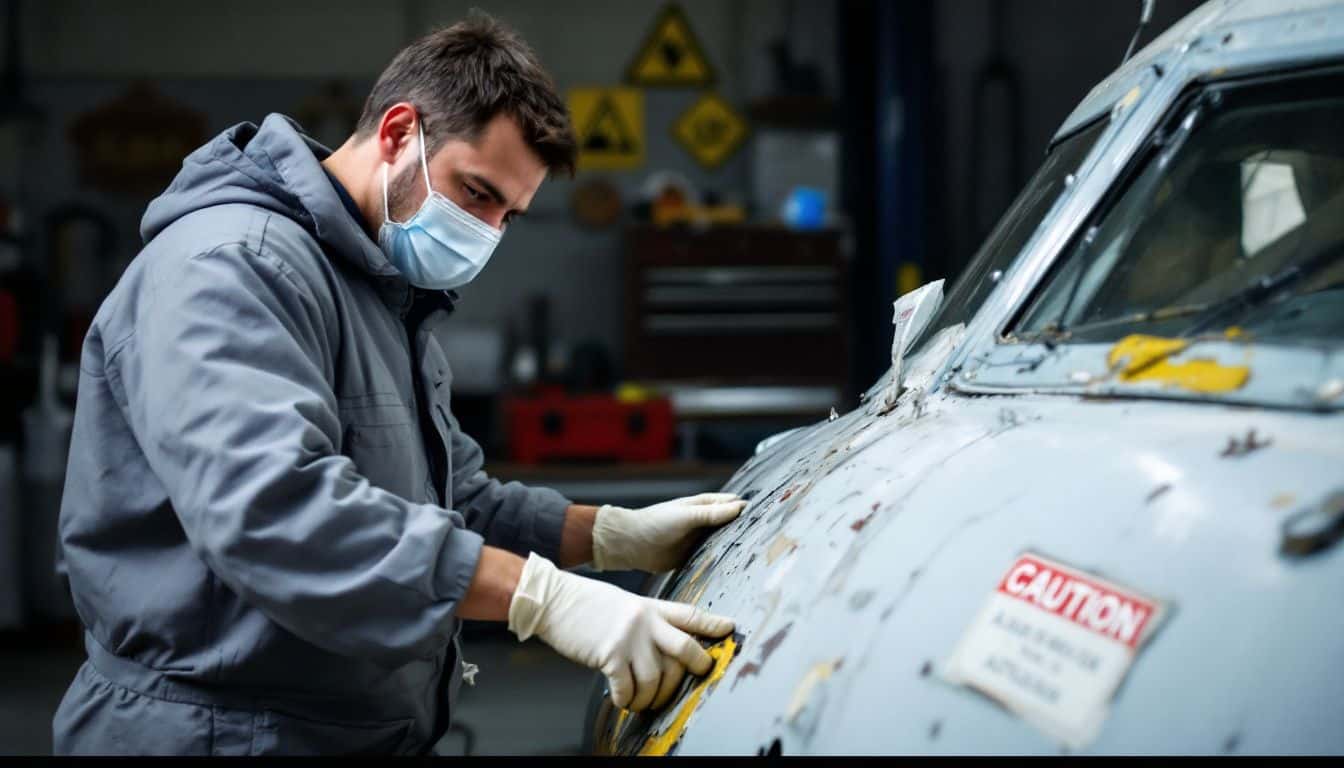
Asbestos and Aircraft Mechanics: What the Aerospace Industry Needs to Know
If you work on older aircraft, asbestos is not a historical footnote — it is a live occupational hazard. Asbestos aircraft mechanics face risks that many in the broader construction and maintenance industries simply do not encounter, because aviation asbestos is often hidden deep within components that require hands-on handling. Understanding where it sits, how to identify it, and what the law requires is not optional. It is essential.
Why Asbestos Was Used So Widely in Aviation
Throughout the mid-20th century, asbestos was considered an engineering asset. It was heat-resistant, durable, lightweight relative to alternatives, and cheap to source. For an industry built around extreme temperatures, high friction, and electrical systems, those properties were almost irresistible.
Military aircraft in particular made extensive use of asbestos. Brake systems, engine heat shields, fireproof blankets, gaskets, valves, electrical insulation, and even protective gloves worn by ground crew could all contain asbestos-based materials. Aircraft such as the C-130 Hercules, SR-71 Blackbird, F-4 Phantom II, P-38 Lightning, B-52 Superfortress, and UH-1 Huey are among those known to have incorporated asbestos in various components.
Asbestos use in military aviation peaked during and after the Second World War. By the 1980s, the industry had largely moved away from it, but legacy aircraft built before that transition remain in service, in storage, or in maintenance facilities across the UK and internationally. That is where the risk to asbestos aircraft mechanics persists today.
Where Asbestos Hides in Aircraft Components
One of the challenges for asbestos aircraft mechanics is that asbestos-containing materials (ACMs) in aviation are rarely obvious. They do not always look different from non-asbestos components, and they are frequently located in areas that require close physical contact during routine maintenance.
Brake Systems
Brake assemblies in older aircraft are among the highest-risk components. Asbestos content in some brake systems has been recorded at between 16% and 23% by composition. When brakes are inspected, replaced, or overhauled, the friction involved in their operation means fibres may already be present as fine dust before any tools are applied.
Engine and Thermal Components
Engine heat shields, exhaust gaskets, and thermal insulation wraps were commonly manufactured using asbestos. Any work that involves removing engine cowlings, accessing exhaust systems, or replacing gaskets on older aircraft should be treated as potentially involving ACMs until confirmed otherwise.
Electrical Insulation
Asbestos was used extensively in electrical wiring insulation and panel backing materials. Avionics work on legacy aircraft can disturb these materials, particularly in older airframes where wiring has not been replaced or upgraded.
Fabrics, Gloves, and Repair Equipment
Ground crew and maintenance personnel historically used asbestos-containing gloves and fire-resistant fabrics. Some older repair kits and patching compounds also contained asbestos. These items may still be present in maintenance facilities, storage areas, or on aircraft that have not been fully refurbished.
The Health Risks Facing Asbestos Aircraft Mechanics
The diseases caused by asbestos exposure are serious, irreversible, and often fatal. Mesothelioma, lung cancer, asbestosis, and pleural thickening are all associated with inhaling asbestos fibres. What makes this particularly dangerous in the aviation context is the latency period involved — mesothelioma can take anywhere from 20 to 60 years to develop after initial exposure. A mechanic who worked on aircraft in the 1970s or 1980s may only now be experiencing symptoms.
Veterans and former military personnel represent a significant proportion of those diagnosed with asbestos-related diseases, precisely because of the heavy use of asbestos in military aviation and shipbuilding during the post-war decades. Current mechanics working on legacy aircraft face the same fundamental risk if ACMs are not properly identified and controlled.
Fibres released during maintenance work are invisible to the naked eye. They can remain airborne for extended periods and settle on clothing, tools, and surfaces — creating secondary exposure risks for colleagues and even family members if contaminated workwear is taken home.
UK Regulations Governing Asbestos in the Aerospace Industry
The UK has some of the most stringent asbestos regulations in the world. For asbestos aircraft mechanics and the organisations that employ them, compliance with these regulations is a legal obligation, not a matter of best practice.
The Control of Asbestos Regulations
The Control of Asbestos Regulations apply to non-domestic premises and place clear duties on those who manage or work with buildings and structures containing asbestos. While aircraft are not buildings, the principles of the regulations — identification, risk assessment, management, and controlled removal — are directly applicable to aviation maintenance environments and are referenced by the Health and Safety Executive (HSE) in guidance for the sector.
Dutyholders are required to assess whether ACMs are present, determine their condition, and either manage them safely in place or arrange for their removal by a licensed contractor. Failing to meet these duties can result in prosecution, improvement notices, and prohibition orders.
HSE Guidance and HSG264
HSG264 is the HSE’s principal guidance document on asbestos surveys. Although written primarily for buildings, the survey methodology it outlines — management surveys, refurbishment surveys, and demolition surveys — provides a useful framework for aviation maintenance facilities and for assessing aircraft undergoing significant overhaul or decommissioning.
Any organisation responsible for maintaining older aircraft in the UK should have a documented asbestos management plan in place. This should identify all known or suspected ACMs, record their condition, and set out the actions required to control exposure.
Licensed Removal Requirements
Not all asbestos work requires a licensed contractor, but higher-risk materials — including most friable asbestos and any work likely to generate significant fibre release — must be carried out by contractors holding a licence issued by the HSE. For aviation maintenance facilities, this means that decisions about whether work is notifiable or licensable must be made carefully, and when in doubt, a licensed contractor should always be engaged.
Identifying Asbestos in Aircraft: Surveys and Testing
Before any maintenance, refurbishment, or decommissioning work begins on an older aircraft, a thorough asbestos survey should be conducted. This is not simply good practice — it is the foundation of any safe working approach.
A competent surveyor will inspect all accessible areas of the aircraft, take samples of suspected ACMs, and arrange for those samples to be analysed in an accredited laboratory. Asbestos testing at this stage provides definitive confirmation of whether materials contain asbestos and, if so, what type — chrysotile, amosite, crocidolite, or another variety — each carrying different risk profiles.
Survey findings should be recorded in a written report that identifies the location, condition, and extent of any ACMs found. This document then informs the risk assessment and management plan that must be in place before work proceeds.
For aircraft undergoing full decommissioning or structural dismantling, a more intrusive refurbishment and demolition survey is required. This involves accessing areas that would not normally be disturbed during routine maintenance, including sealed cavities, behind panels, and within structural elements. The asbestos testing process at this stage is more extensive and should be planned well in advance of any physical work beginning.
Best Practices for Asbestos Aircraft Mechanics During Maintenance Work
Even where ACMs have been identified and are being managed in place, asbestos aircraft mechanics need to follow strict protocols to minimise exposure during day-to-day maintenance activities.
Risk Assessment Before Every Task
Before starting any task on an older aircraft, mechanics should review the aircraft’s asbestos register or management plan. If no such document exists, that is itself a significant red flag that must be addressed before work begins. Every task that could disturb a known or suspected ACM requires a written risk assessment.
Personal Protective Equipment
Where there is any risk of asbestos fibre release, appropriate PPE is non-negotiable. This includes:
- Disposable coveralls (Type 5 minimum) that are removed and bagged on site
- Respiratory protective equipment (RPE) — typically a half-mask with a P3 filter or a powered air-purifying respirator (PAPR) for higher-risk tasks
- Nitrile or disposable gloves
- Overshoes or dedicated footwear that does not leave the work area
PPE must be correctly fitted and maintained. A mask that does not seal properly provides little meaningful protection. Face-fit testing for RPE is a requirement, not an option.
Containment and Air Monitoring
For higher-risk tasks, the work area should be enclosed and negative pressure maintained to prevent fibres from spreading. Air monitoring during and after the work provides an objective measure of whether fibre release has been controlled. This data should be recorded as part of the job documentation.
Decontamination Procedures
Mechanics must decontaminate before leaving the work area. This means removing and bagging coveralls inside out, cleaning RPE, and washing hands and face thoroughly. Contaminated materials — including used PPE — must be disposed of as asbestos waste in accordance with the relevant waste regulations.
Safe Removal of Asbestos from Older Aircraft
Where ACMs are in poor condition, are at risk of disturbance, or are being removed as part of a refurbishment or decommissioning project, safe removal by a licensed contractor is required. Asbestos removal from aircraft components follows the same fundamental principles as removal from buildings, but with additional complexity due to the confined spaces, structural intricacy, and specialist knowledge required.
Licensed contractors will establish a controlled work area, use appropriate containment, carry out the removal in accordance with a written plan of work, and dispose of all ACMs as hazardous waste. Waste must be double-bagged, clearly labelled, and transported to a licensed disposal facility. The entire process must be documented.
Following removal, a four-stage clearance procedure is typically carried out — visual inspection, background air monitoring, aggressive air sampling, and final air monitoring — before the area is declared safe for unrestricted access.
Challenges Specific to Aviation Asbestos Work
Asbestos aircraft mechanics and the contractors who support them face a number of challenges that are not present in standard building work.
Limited access: Aircraft components are often tightly packed and difficult to reach without partial disassembly. This increases the risk of inadvertently disturbing ACMs during the process of gaining access to the target component.
Incomplete records: Older military aircraft in particular may have incomplete or unavailable maintenance histories, meaning the full extent of ACMs present is unknown. This makes thorough surveying before any work begins even more critical.
Specialist knowledge required: Not every asbestos surveyor or removal contractor will have experience with aviation environments. It is important to engage professionals who understand both asbestos regulations and the specific challenges of working on aircraft.
International aircraft: Aircraft operating in the UK may have been manufactured and maintained under different regulatory regimes. The Federal Aviation Administration (FAA) in the United States has its own guidance on asbestos in aviation, and mechanics working on US-origin aircraft should be aware that the original design and maintenance records may reference different standards.
Supernova’s Nationwide Survey and Testing Services
Whether you are managing a maintenance facility in London, Manchester, or Birmingham, Supernova Asbestos Surveys has the expertise to support your asbestos management obligations. We have completed over 50,000 surveys across the UK and work with clients in a wide range of sectors, including those with complex or specialist environments.
If you are based in or around the capital, our asbestos survey London service provides fast, thorough assessments by fully qualified surveyors. In the North West, our asbestos survey Manchester team covers the full range of survey types including management, refurbishment, and demolition surveys. For clients in the Midlands, our asbestos survey Birmingham service is available to organisations of all sizes.
Frequently Asked Questions
Do the Control of Asbestos Regulations apply to aircraft?
The Control of Asbestos Regulations primarily apply to non-domestic premises. However, the HSE’s guidance makes clear that employers have a duty under the Health and Safety at Work Act to protect workers from asbestos exposure regardless of the environment. Aviation maintenance facilities are covered by the regulations, and the principles of identification, risk assessment, and controlled removal apply directly to work on aircraft containing ACMs.
Which aircraft components are most likely to contain asbestos?
In older aircraft, the highest-risk components include brake systems, engine heat shields, exhaust gaskets, electrical insulation, fireproof blankets, and thermal wrapping materials. Ground support equipment and older repair materials may also contain asbestos. Any aircraft built before the 1980s should be treated as potentially containing ACMs until a survey confirms otherwise.
Can asbestos aircraft mechanics carry out removal work themselves?
This depends on the type of asbestos and the nature of the work. Some lower-risk, non-licensable tasks can be carried out by trained and competent workers following a written risk assessment. However, work with higher-risk materials — including most friable asbestos — must be carried out by an HSE-licensed contractor. When in doubt, always consult a licensed professional before proceeding.
How is asbestos confirmed in an aircraft component?
Asbestos cannot be identified visually with certainty. A sample of the suspected material must be taken by a competent person and analysed in an accredited laboratory using polarised light microscopy or electron microscopy. This is the only reliable method for confirming whether a material contains asbestos and what type is present.
What should I do if I discover suspected asbestos during aircraft maintenance?
Stop work immediately and do not disturb the material further. Secure the area to prevent others from accessing it. Report the discovery to your supervisor and the person responsible for asbestos management in your facility. Arrange for a competent surveyor to inspect and sample the material before any further work takes place. Do not attempt to remove or clean up the material yourself.
Get Expert Asbestos Support from Supernova
If you are responsible for maintaining older aircraft or managing a facility where legacy aviation equipment is serviced, Supernova Asbestos Surveys can help you meet your legal obligations and protect your workforce. From initial surveys and laboratory testing through to licensed removal support and management planning, our team is ready to assist.
Call us on 020 4586 0680 or visit asbestos-surveys.org.uk to find out more or to book a survey.