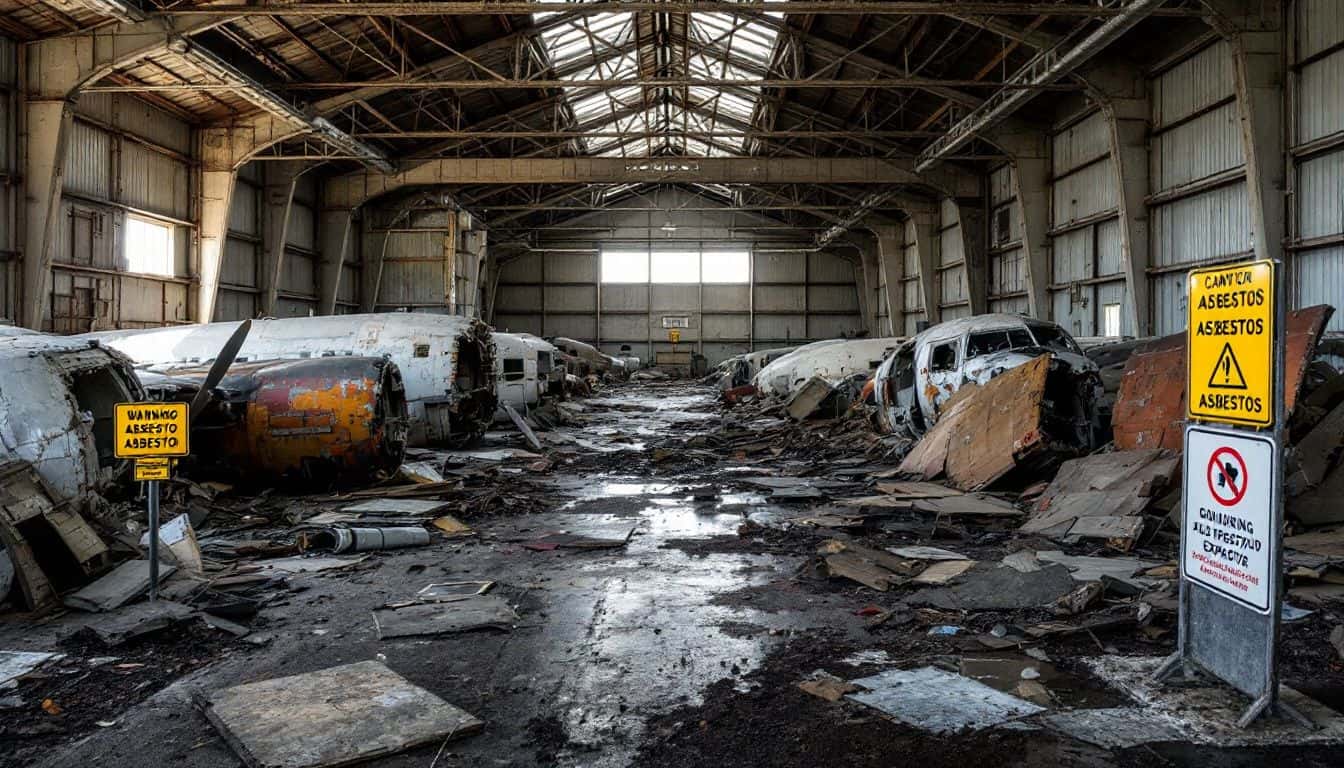
Aerospace Demolition and Asbestos: What the Industry Cannot Afford to Get Wrong
Aerospace demolition sits at the extreme end of industrial hazard. Aircraft and aviation facilities built before the 1980s contain asbestos-containing materials throughout their structures — from brake linings and insulation blankets to gaskets, adhesives, and soundproofing panels. When those materials are disturbed during demolition or renovation, the consequences for workers can be devastating and permanent.
This is not a theoretical risk. The aerospace industry has a well-documented history of asbestos use, and the latency period for asbestos-related diseases means workers exposed decades ago are still receiving diagnoses today. Managing that risk properly — from initial survey through to safe removal — is a legal and moral obligation, not an administrative formality.
Why Asbestos Was So Widely Used in Aerospace
Asbestos was genuinely useful in aerospace applications. Its resistance to extreme heat, its durability under friction, and its insulating properties made it an attractive material for engineers designing aircraft and aviation facilities throughout the mid-twentieth century.
Brake linings in many older aircraft contained significant concentrations of asbestos — enough to create a real inhalation risk during any maintenance, repair, or demolition work involving those components. Engineers at the time had little reason to seek alternatives. Asbestos worked, it was cheap, and the health consequences were not yet fully understood or acknowledged by industry or government.
Common Asbestos-Containing Materials in Aircraft and Aviation Facilities
Understanding where asbestos was used is the first step in managing it safely. In aerospace settings, the range of affected materials is broader than most people expect:
- Brake linings and pads — among the highest asbestos concentrations found in any aircraft component
- Thermal insulation blankets — used extensively throughout fuselages and engine compartments
- Gaskets and seals — present in engines, hydraulic systems, and fuel systems
- Adhesives and bonding agents — chrysotile asbestos was commonly used in aviation-grade adhesives
- Soundproofing materials — cabin linings and bulkhead panels frequently contained asbestos
- Protective clothing and fire blankets — serpentine asbestos was woven into heat-resistant garments
- Electrical insulation — wiring and panel insulation in older aircraft often contained asbestos
Aviation hangars, maintenance facilities, and ground infrastructure built during the same era present identical risks. Asbestos was used in roofing, floor tiles, pipe lagging, and wall panels across thousands of UK aerospace sites.
Any building constructed or substantially refurbished before 2000 should be treated as potentially containing asbestos until a survey confirms otherwise. That is not overcaution — it is the correct legal position under the Control of Asbestos Regulations.
Health Risks Associated with Aerospace Demolition and Asbestos Exposure
There is no safe level of asbestos exposure. When asbestos fibres are released into the air during aerospace demolition or renovation work, they can be inhaled and become permanently lodged in lung tissue. The diseases that follow are serious, progressive, and in most cases fatal.
Mesothelioma and Lung Cancer
Mesothelioma is the disease most closely associated with asbestos exposure. It is an aggressive cancer affecting the lining of the lungs, abdomen, or heart, and it carries a poor prognosis. Lung cancer risk is also significantly elevated in those with occupational asbestos exposure, particularly when combined with smoking.
Both conditions have a latency period of 20 to 50 years. Workers exposed during aerospace demolition projects in the 1970s and 1980s may only now be receiving diagnoses — a sobering reminder that the consequences of poor asbestos management are not always immediate.
Other Asbestos-Related Conditions
Beyond mesothelioma and lung cancer, asbestos exposure causes a range of serious respiratory conditions:
- Asbestosis — scarring of the lung tissue caused by prolonged fibre inhalation
- Pleural plaques — calcified areas on the pleural lining, indicating past exposure
- Pleural thickening — diffuse scarring that can restrict breathing capacity
- Chronic obstructive pulmonary disease (COPD) — often exacerbated by asbestos exposure in occupational settings
None of these conditions are curable. Early identification of asbestos risks — before any demolition or renovation work begins — is the only effective way to prevent them.
Who Is Most at Risk During Aerospace Demolition Projects
Asbestos risk in aerospace settings is not limited to the person holding the drill. Exposure can affect anyone in the vicinity of disturbed materials, and certain roles carry particularly elevated risk.
Aircraft Mechanics and Maintenance Engineers
Mechanics working on older aircraft are regularly in close contact with asbestos-containing components. Brake maintenance, engine overhauls, and insulation replacement all carry exposure risk if the materials involved have not been properly assessed beforehand.
Engineers involved in structural modifications or decommissioning of older aircraft face similar hazards. Without a thorough asbestos survey prior to any work, these professionals are effectively operating blind.
Demolition and Renovation Workers
Workers tasked with dismantling hangars, maintenance facilities, or decommissioned aircraft are at the sharp end of asbestos risk. Demolition work disturbs materials that may have been stable for decades, releasing fibres into the air in quantities that can be extremely dangerous.
Industrial hygienists, safety inspectors, and emergency response teams working alongside demolition crews also face secondary exposure risks if controls are not properly implemented from the outset.
Secondary Exposure Risks
Family members of aerospace workers have historically been affected by secondary asbestos exposure — fibres brought home on work clothing and contaminating domestic environments. This is why decontamination procedures at the end of each working shift are not bureaucratic box-ticking but a genuine health safeguard that protects people far beyond the worksite boundary.
Identifying Asbestos Before Aerospace Demolition Begins
The single most important step in any aerospace demolition or renovation project is identifying asbestos-containing materials before work starts. The Control of Asbestos Regulations places a legal duty on those responsible for non-domestic premises to manage asbestos risk, and this duty explicitly extends to pre-demolition surveys.
HSG264, the HSE’s guidance on asbestos surveys, sets out two main survey types relevant to aerospace demolition projects.
Management Surveys
A management survey is appropriate for ongoing maintenance and routine operations at live aerospace facilities. It identifies asbestos-containing materials that could be disturbed during normal day-to-day activity, and it underpins an asbestos register and management plan.
For any operational aerospace site, a current and accurate management survey is a baseline legal requirement. Without one, duty holders are exposed to significant regulatory and legal risk.
Refurbishment and Demolition Surveys
Before any aerospace demolition or major refurbishment work, a demolition survey is mandatory. This is a more intrusive inspection — surveyors access all areas that will be affected by the work, including above ceiling voids, within wall cavities, and beneath floor coverings.
The survey must be completed before work starts, not during it. Proceeding with demolition without this survey is a criminal offence under the Control of Asbestos Regulations, and it is an offence that the HSE takes seriously.
Warning Signs That Should Trigger an Immediate Survey
- Cracked, flaking, or damaged insulation on pipes or ductwork
- Loose or deteriorating ceiling tiles and panels
- Discoloured or powdery surfaces on older structural elements
- Buildings or aircraft constructed or substantially refurbished before 2000
- Unknown material composition in any structural or mechanical component
If you are unsure whether a material contains asbestos, treat it as though it does until asbestos testing confirms otherwise. That is not overcaution — it is the legally correct approach under the Control of Asbestos Regulations.
Asbestos Removal in Aerospace Demolition Projects
Once asbestos has been identified and assessed, there are two possible courses of action: management in place, where the material is in good condition and will not be disturbed, or removal. In aerospace demolition, removal is almost always the required approach.
Best Practice for Asbestos Identification on Site
Before any physical work begins, a licensed asbestos surveyor should conduct a thorough inspection of the site. Bulk samples are taken from suspect materials and sent for laboratory analysis. Air monitoring may also be carried out to establish baseline fibre levels before demolition commences.
All findings must be documented in a formal asbestos register, which must be made available to all contractors working on the site. This is a legal requirement under the Control of Asbestos Regulations — not a recommendation.
Steps for Professional Asbestos Removal in Aerospace Settings
- Establish a controlled exclusion zone — prevent unauthorised access to the work area
- Seal the area — use heavy-duty plastic sheeting and negative air pressure units to contain fibres
- Wet the materials — applying water or a wetting agent before removal suppresses fibre release
- Remove carefully — avoid breaking or cutting materials where possible; remove in the largest sections practicable
- Double-bag all waste — use labelled, sealed bags within leak-tight containers for disposal
- Decontaminate workers — full decontamination units must be used before leaving the exclusion zone
- Conduct clearance air testing — a four-stage clearance process must be completed before the area is handed back
Only licensed contractors can carry out notifiable asbestos removal work in the UK. This includes the removal of most sprayed coatings, lagging, and asbestos insulating board — all materials commonly found in aerospace facilities. Using an unlicensed contractor for this work is not just bad practice; it is a criminal offence.
UK Regulations Governing Asbestos in Aerospace Demolition
The UK regulatory framework for asbestos is robust and well-established. Aerospace demolition projects must comply with several overlapping pieces of legislation and guidance, and ignorance of the rules is not a defence.
Control of Asbestos Regulations
This is the primary legislation governing asbestos in the UK workplace. It sets out the duty to manage asbestos in non-domestic premises, the requirements for surveys and risk assessments, the training obligations for workers who may encounter asbestos, and the licensing requirements for removal contractors.
Breaches of the Control of Asbestos Regulations can result in significant fines and, in serious cases, criminal prosecution. Enforcement action by the HSE against companies that fail to comply is not uncommon, and the aerospace sector is not exempt from scrutiny.
HSG264 — Asbestos: The Survey Guide
HSG264 provides detailed practical guidance on how asbestos surveys should be planned and conducted. It defines the different survey types, sets out the competency requirements for surveyors, and explains how survey findings should be recorded and communicated.
Any surveyor working on an aerospace demolition project should be working to the standards set out in HSG264. If they are not, the survey results may be legally inadequate — which could expose the duty holder to significant liability.
Personal Protective Equipment Requirements
Workers involved in asbestos removal must be provided with appropriate PPE as a minimum requirement:
- FFP3-rated respiratory protective equipment (RPE) or powered air-purifying respirators
- Disposable Type 5 coveralls
- Nitrile gloves
- Safety goggles or full-face respiratory protection
PPE is the last line of defence, not the first. Engineering controls, enclosure, and wet suppression methods should always be implemented before relying on PPE alone. Providing PPE without implementing those upstream controls is a regulatory failure, not a risk management solution.
Asbestos Air Monitoring and Clearance Testing
Air monitoring is a critical component of safe aerospace demolition. It should be carried out at three stages: before work begins to establish a baseline, during removal operations to verify that controls are working, and after removal as part of the four-stage clearance procedure.
The four-stage clearance process — visual inspection, background air testing, clearance air sampling by an independent analyst, and final visual inspection — must be completed by a body independent of the removal contractor. This independence is not optional; it is a requirement under HSE guidance and is essential to the integrity of the process.
Where asbestos testing results indicate fibre levels above the clearance indicator, the area cannot be handed back for use. The removal contractor must re-clean and re-test until clearance is achieved.
Choosing the Right Asbestos Surveying Partner for Aerospace Demolition
Not all asbestos surveyors have the experience or technical capability to work in aerospace environments. The complexity of aircraft structures, the variety of asbestos-containing materials involved, and the regulatory demands of aerospace demolition projects require a surveying partner with demonstrable sector experience.
When selecting a surveyor, look for the following:
- UKAS-accredited laboratory for bulk sample analysis
- Surveyors holding P402 qualifications or equivalent recognised competency
- Demonstrable experience in industrial and aviation environments
- Clear documentation processes and a robust asbestos register format
- The ability to provide independent air monitoring and clearance testing
Supernova Asbestos Surveys operates nationwide and has completed surveys across a wide range of complex industrial sites. Whether your project is based in London, Manchester, Birmingham, or anywhere else in the UK, our surveyors bring the technical knowledge and regulatory understanding that aerospace demolition demands.
We cover projects across the country, including asbestos survey London projects, asbestos survey Manchester projects, and asbestos survey Birmingham projects, with the same rigorous standards applied at every location.
Frequently Asked Questions
Is a demolition survey legally required before aerospace demolition work begins?
Yes. Under the Control of Asbestos Regulations, a refurbishment and demolition survey must be completed before any demolition or major refurbishment work starts on a non-domestic premises. This applies to aerospace hangars, maintenance facilities, and any other aviation infrastructure. Proceeding without this survey is a criminal offence.
Can asbestos be found in aircraft built after 1980?
The risk is significantly lower in aircraft built after 1980, but it cannot be entirely discounted. Some asbestos-containing materials remained in use into the 1990s in certain applications. Any aircraft or facility constructed or substantially refurbished before 2000 should be surveyed before demolition or renovation work begins.
Who is legally responsible for managing asbestos during aerospace demolition?
The duty holder — typically the owner or operator of the premises — carries the primary legal responsibility under the Control of Asbestos Regulations. Principal contractors on demolition projects also carry significant responsibilities under CDM regulations. Both parties must ensure that asbestos surveys are completed, findings are communicated to all contractors, and removal is carried out by licensed operatives where required.
What happens if asbestos is discovered unexpectedly during demolition?
Work must stop immediately in the affected area. The site should be secured, access restricted, and a licensed asbestos surveyor called to assess the material. Under no circumstances should work continue until the material has been tested, assessed, and either safely removed or confirmed not to contain asbestos. Continuing work in the presence of suspected asbestos is a serious regulatory breach.
How long does an asbestos survey take for an aerospace facility?
The duration depends on the size and complexity of the facility. A large hangar or multi-building aviation site may require several days of survey work. A demolition survey is more intrusive than a management survey and will typically take longer, as surveyors must access all areas that will be affected by the planned work. Supernova Asbestos Surveys will provide a clear timeframe and scope of work before any survey begins.
Speak to Supernova Asbestos Surveys
Supernova Asbestos Surveys has completed over 50,000 surveys across the UK, working with clients in some of the most demanding industrial environments in the country. Our team understands the specific challenges of aerospace demolition and can provide the surveys, testing, and documentation your project requires.
Do not start any aerospace demolition or renovation project without the right asbestos intelligence in place. Call us on 020 4586 0680 or visit asbestos-surveys.org.uk to discuss your requirements with our team.