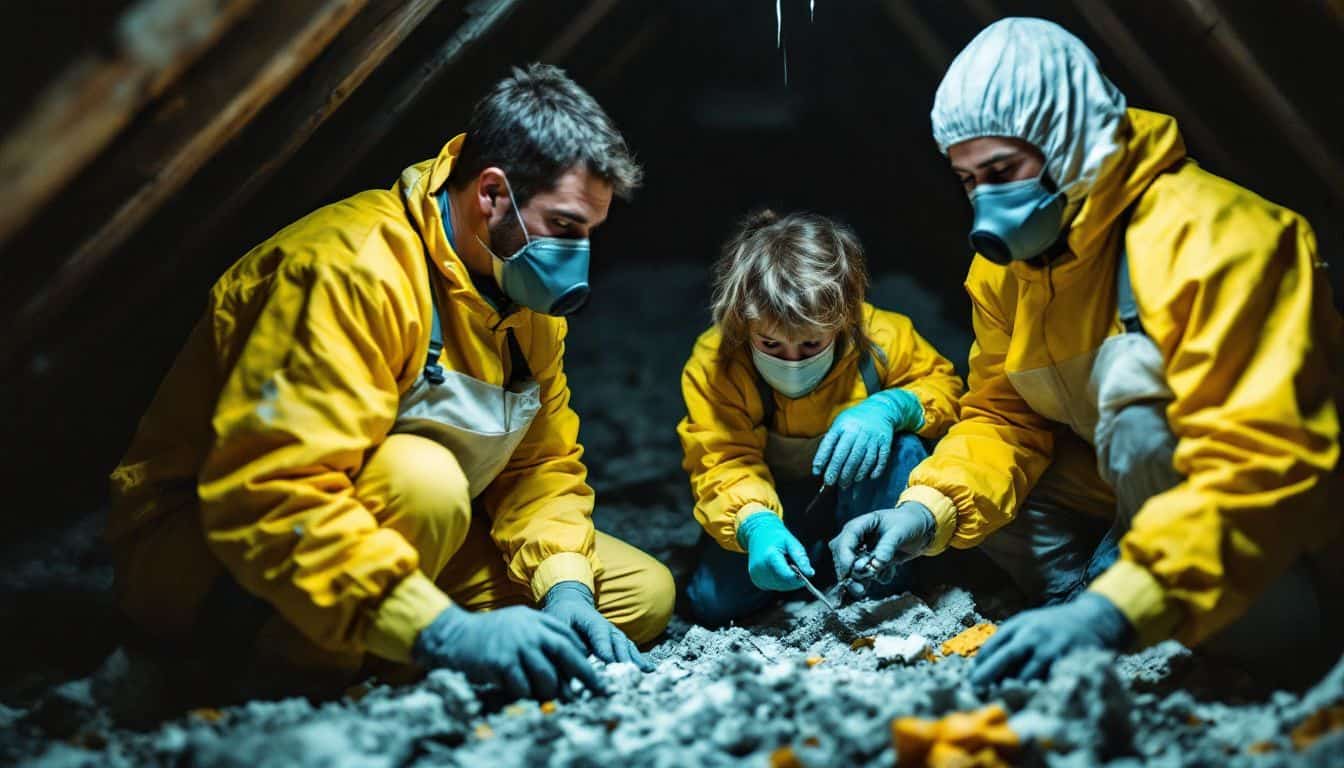
Keeping Your Family Safe During Asbestos Removal
Discovering asbestos in your home is unsettling. The thought of having it removed can feel even more so — but the alternative, leaving damaged or deteriorating material in place, carries its own serious risks.
Safe asbestos removal is not something you can improvise or hand to the cheapest contractor you can find online. Get it wrong, and the removal process itself can release far more fibres into the air than leaving the material undisturbed. Get it right, and your family is protected throughout — from the initial survey to the moment you walk back through the door with a clearance certificate in hand.
How to Identify Asbestos in Your Property
Before any removal work begins, you need to know exactly what you are dealing with. Asbestos cannot be identified by sight alone — it requires laboratory analysis of a physical sample taken by a trained professional. Do not attempt to take samples yourself.
Professional Asbestos Surveys
A professional asbestos survey is the essential first step. A qualified surveyor will inspect your property, take samples of suspected materials, and send them for laboratory analysis. This gives you a clear picture of where asbestos is present, what type it is, and what condition it is in.
If you are not planning any building work and simply want to understand what is in your property, a management survey will identify any asbestos-containing materials and assess their current risk level. If you are planning renovation or demolition, you will need a refurbishment survey before work starts — this is a more intrusive inspection specifically designed to locate asbestos in areas that will be disturbed.
Where Asbestos Is Commonly Found
In properties built or significantly renovated before 2000, asbestos-containing materials (ACMs) can appear in a surprising number of places. Common locations include:
- Ceiling tiles and textured coatings such as Artex
- Floor tiles and the adhesive beneath them
- Pipe lagging and boiler insulation
- Roof sheets, soffits, and guttering
- Partition walls and ceiling panels
- Insulation boards around fireplaces and heating systems
If your home was built before the late 1990s, treat any suspicious material with caution. Do not drill, sand, or disturb it until it has been professionally assessed.
UK Legal Requirements for Safe Asbestos Removal
In the UK, asbestos removal is governed by the Control of Asbestos Regulations, which set out strict legal duties for anyone managing or removing asbestos-containing materials. These regulations apply to both commercial and domestic properties.
The Health and Safety Executive (HSE) publishes detailed guidance — including HSG264 — to help surveyors, contractors, and duty holders comply with the law. Following this guidance is not optional; it is the baseline standard for any legitimate removal work.
Licensed vs. Non-Licensed Removal
Not all asbestos removal requires a licensed contractor, but the most hazardous types do. Work involving asbestos insulation, asbestos insulating board (AIB), and sprayed coatings must only be carried out by a contractor holding a licence issued by the HSE.
Lower-risk materials — such as asbestos cement — may be removed under a notification-only arrangement, but this still requires proper controls and trained operatives. When in doubt, always use a licensed contractor. The risk of getting it wrong is simply too high.
Notification Requirements
Licensed removal contractors must notify the relevant enforcing authority at least 14 days before starting work. This gives regulators visibility of where high-risk removal is taking place and ensures accountability.
Your contractor should handle this notification as a matter of course. If they do not mention it when you discuss the job, ask directly — it is a legal requirement, not an optional extra.
Planning for Safe Asbestos Removal
Good planning is what separates a safe removal job from a dangerous one. Before any work begins, a thorough risk assessment must be completed and a written method statement produced. These are not paperwork formalities — they are the documents that define exactly how the work will be carried out safely.
What a Risk Assessment Should Cover
A risk assessment for asbestos removal identifies the hazards present, evaluates the likelihood and severity of exposure, and sets out the controls that will be put in place. For domestic removal work, this should address:
- Material condition: Friable or damaged asbestos releases more fibres than material in good condition.
- Location: Confined spaces and restricted access areas increase risk.
- Scope of work: How much material needs to be removed and how workers will access it safely.
- Occupant safety: Whether family members — particularly children or anyone with a respiratory condition — need to be relocated during the work.
The risk assessment should be documented and shared with everyone involved, including you as the homeowner. Ask to see it before work starts.
Choosing a Qualified Contractor
Selecting the right contractor is one of the most important decisions you will make. Look for the following before agreeing to anything:
- An HSE licence for licensable removal work — check the HSE’s public register online
- Membership of a recognised trade body such as ARCA (Asbestos Removal Contractors Association)
- Clear method statements and risk assessments provided before work starts
- Transparent pricing with no pressure tactics
- Willingness to answer your questions in plain English
Supernova’s asbestos removal service is carried out by fully licensed and experienced professionals who follow every step of the HSE’s guidance. We do not cut corners — your family’s safety depends on it.
Safety Measures During the Removal Process
Safe asbestos removal depends on a combination of physical controls, personal protective equipment, and continuous monitoring. Each element plays a critical role, and none of them can be skipped.
Sealing Off the Work Area
Before removal begins, the work area must be fully isolated from the rest of the property. This typically involves:
- Sealing doorways, vents, and gaps with polythene sheeting and duct tape
- Disabling the heating, ventilation, and air conditioning system to prevent fibres circulating through the building
- Setting up a negative pressure enclosure (NPE) for high-risk work, which ensures air flows into the work area rather than out of it
- Establishing a decontamination unit (DCU) at the entrance so workers can remove PPE safely before leaving the controlled area
Your family should not be in the property during licensed removal work. Make arrangements to stay elsewhere until clearance has been formally confirmed.
Personal Protective Equipment
Every worker involved in asbestos removal must wear appropriate PPE throughout the job. This includes:
- A respirator with a suitable filter rating — minimum FFP3, or a full-face respirator for higher-risk work
- Disposable coveralls (Type 5 minimum)
- Gloves and boot covers
- Eye protection where there is a risk of splashing or airborne debris
PPE is the last line of defence, not the first. Proper enclosures and controls must always be in place before PPE is relied upon.
Air Quality Monitoring
During removal, air quality must be continuously monitored to ensure fibre levels remain within safe limits. This is typically done using phase contrast microscopy (PCM) or, for more detailed analysis, transmission electron microscopy (TEM).
Monitoring equipment is placed at the boundary of the work area and in the clean zone. If fibre levels exceed safe thresholds at any point, work must stop immediately — this is non-negotiable. Any contractor who dismisses air monitoring as unnecessary should be avoided without hesitation.
Decontamination and Clearance After Removal
The physical removal of asbestos-containing material is only part of the process. Thorough decontamination and a formal clearance inspection are what make it genuinely safe for your family to return.
Decontaminating the Work Area
Once all asbestos-containing material has been removed, the work area must be thoroughly cleaned before the enclosure is taken down. This involves:
- Wiping all surfaces with damp cloths to trap and remove settled fibres
- Vacuuming all surfaces with a HEPA-filtered vacuum — standard domestic vacuums must never be used, as they will redistribute fibres into the air
- Removing all polythene sheeting carefully, folding it inward so any fibres on the surface are contained
- Conducting a second visual inspection to confirm no material has been missed
The Clearance Inspection
A clearance inspection must be carried out by an independent analyst — not the same company that carried out the removal. This independence is critical to ensuring the result is objective and trustworthy.
The analyst will conduct a thorough visual inspection of the area and then take air samples for laboratory analysis. The results must fall below the clearance indicator level set by the HSE before the area can be signed off as safe for reoccupation.
Only once you have a written clearance certificate in hand should your family return to the property. Do not accept verbal reassurances — insist on documentation every time.
Disposal of Asbestos Waste
Asbestos waste is classified as hazardous waste under UK law and must be disposed of in strict accordance with that classification. This is not an area where shortcuts are acceptable — improper disposal is both illegal and dangerous.
Packaging and Transportation
All asbestos waste must be double-bagged in heavy-duty polythene bags, clearly labelled with the appropriate hazardous waste warning, and sealed securely before leaving the site. Larger items such as roof sheets should be wrapped in polythene sheeting and taped.
Waste must be transported in a sealed vehicle to an authorised hazardous waste disposal site. Your contractor must hold a waste carrier licence and provide you with a waste transfer note. Keep this document — you may need it to demonstrate legal compliance if you sell the property or if future work is carried out in the same area.
Documentation and Legal Compliance
Every stage of the removal process should generate paperwork, and you should keep copies of all of it. This includes:
- The asbestos survey report
- The contractor’s method statement and risk assessment
- Air monitoring results taken during and after removal
- The clearance certificate issued by the independent analyst
- Waste transfer notes for all asbestos waste removed from the property
This documentation is not just good practice — it may be legally required if you sell the property or if any future building work disturbs areas near where asbestos was previously found.
Post-Removal Safety and Ongoing Management
Once removal is complete and clearance has been granted, there are a few final steps to take to ensure your home remains safe going forward. If not all asbestos-containing materials were removed — which is sometimes the right decision when materials are in good condition and low risk — you will need a formal asbestos management plan.
This sets out how the remaining materials will be monitored and managed over time, and who is responsible for doing so. Schedule periodic reinspections to check the condition of any remaining ACMs. If their condition deteriorates, reassess whether removal is now the appropriate course of action.
Make sure anyone carrying out future maintenance or renovation work in your home is made aware of any remaining asbestos. This is both a legal obligation and a basic duty of care to the people working in your property.
Safe Asbestos Removal Across the UK
Supernova Asbestos Surveys provides professional asbestos surveys and removal services across the country. Whether you need an asbestos survey in London, an asbestos survey in Manchester, or an asbestos survey in Birmingham, our experienced team is ready to help.
With over 50,000 surveys completed nationwide, we have the expertise and the track record to handle every stage of the process — from initial survey through to removal, clearance, and ongoing management. Every job is carried out to the highest standards, with your family’s safety at the centre of everything we do.
Call us today on 020 4586 0680 or visit asbestos-surveys.org.uk to book a survey or speak to one of our specialists about safe asbestos removal at your property.
Frequently Asked Questions
Do I need to leave my home during asbestos removal?
Yes — for any licensed asbestos removal work, you and your family should not be in the property while the work is taking place. Licensed removal involves high-risk materials that require a sealed, controlled environment. You should only return once an independent clearance inspection has been completed and a written clearance certificate has been issued.
How do I know if a contractor is qualified to carry out asbestos removal?
Check the HSE’s public register of licensed asbestos removal contractors before appointing anyone. For licensable work — which includes removal of asbestos insulation, asbestos insulating board, and sprayed coatings — only HSE-licensed contractors are legally permitted to carry out the work. You can also look for membership of ARCA (Asbestos Removal Contractors Association) as an additional indicator of professionalism.
What is a clearance certificate and why does it matter?
A clearance certificate is a written document issued by an independent analyst confirming that the work area has been inspected and air-tested following asbestos removal, and that fibre levels fall below the HSE’s clearance indicator. It is your formal confirmation that the area is safe for reoccupation. Never return to a property after asbestos removal without one — verbal assurances are not sufficient.
Can I remove asbestos myself to save money?
For most types of asbestos-containing material, DIY removal is either illegal or carries serious risks that make it inadvisable. Licensable materials — including asbestos insulation and insulating board — must by law be removed by an HSE-licensed contractor. Even for lower-risk materials, improper removal can release fibres that cause long-term health damage. The cost of professional removal is far lower than the cost of getting it wrong.
What happens to asbestos waste after it is removed from my property?
Asbestos waste is classified as hazardous waste under UK law. It must be double-bagged, labelled, and transported by a licensed waste carrier to an authorised hazardous waste disposal site. Your contractor must provide you with a waste transfer note as proof of legal disposal. Keep this document — it may be required if you sell the property or if future work is carried out nearby.