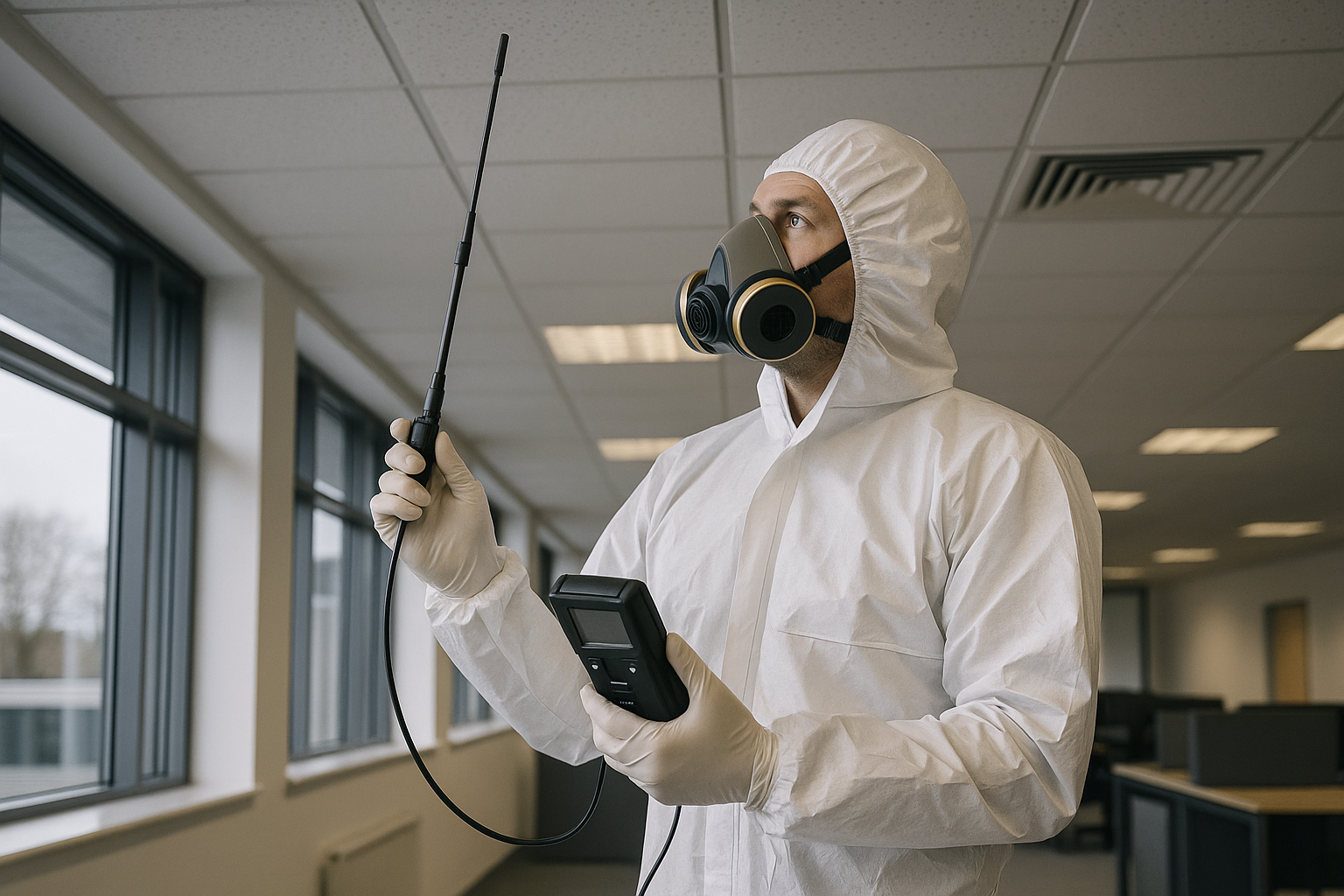
When Asbestos Is Disturbed, the Clock Starts Immediately
A broken ceiling tile, a drilled riser panel, flood-damaged boxing, or debris left after a contractor opens up a wall — any of these can turn a routine day into a serious asbestos incident. The best time to avoid an emergency involving asbestos is when it actually occurs, because the first few minutes determine whether you contain the problem quickly or allow fibres, disruption, and liability to spread across the site.
For property managers, landlords, employers, and facilities teams, asbestos emergencies rarely begin with drama. More often, they start with ordinary maintenance in an older building, a gap in the asbestos information, and one wrong decision after a suspect material has been disturbed.
If your premises were built before 2000, asbestos may still be present unless there is clear evidence showing otherwise. That does not mean every damaged panel is an immediate crisis, but it does mean you need a practical response plan, accurate survey information, and competent support when something unexpected happens.
Why the Best Time to Avoid an Emergency Involving Asbestos Is When It Actually Occurs
The phrase sounds counterintuitive, but the point is straightforward. Once a suspected asbestos-containing material has been cut, broken, drilled, or disturbed, you cannot undo that disturbance. What you can do is stop the situation getting worse.
That means acting immediately — not waiting for someone senior to arrive while workers continue moving through the area, and not attempting to tidy up dust with the wrong equipment. Delay is where manageable incidents become expensive ones.
People walk contamination into other rooms, debris gets handled unnecessarily, ventilation spreads fibres further, and the site loses control of what happened and who may have been exposed. The response window is immediate. Stop work, isolate the area, check the available asbestos information, and bring in competent asbestos professionals without delay.
When an Emergency Asbestos Survey May Be Needed
Not every asbestos issue calls for urgent attendance, but some incidents do require a fast survey response, sampling, or inspection to establish what has been disturbed and what should happen next.
Common triggers for an emergency survey include:
- Suspected asbestos uncovered during maintenance, refurbishment, or repair work
- Known asbestos-containing materials damaged by impact or poor workmanship
- Fire, flood, collapse, or water ingress affecting older building fabric
- Dust or debris created from an unidentified material in a pre-2000 property
- Work taking place in an area not clearly covered by the asbestos register
- Conflicting or outdated survey information
- Contractors opening hidden voids, ducts, risers, or service enclosures without adequate asbestos information
An emergency response is about control first and certainty second. You do not need to know exactly what the material is before stopping work. You do need to prevent further disturbance while competent advice is obtained.
What Counts as an Asbestos Emergency?
Not every asbestos-related issue requires emergency action. A sealed asbestos cement sheet in fair condition is normally managed in place. A damaged insulation board panel in a busy circulation area is a very different matter.
An asbestos emergency usually involves one or more of the following:
- Damage to a material that may release fibres
- Unexpected discovery during intrusive work
- Visible dust or debris from a suspect material
- Loss of control over an area containing known asbestos
- A realistic possibility that people have already been exposed
Typical Emergency Scenarios on Site
Certain patterns come up repeatedly across commercial, industrial, public sector, and residential premises. Recognising them helps you respond faster and more effectively.
- Refurbishment work uncovers hidden asbestos in ceiling voids, risers, partition walls, service ducts, floor layers, or fire protection materials
- Accidental impact from a trolley, forklift, ladder, or vehicle breaks boards, casings, or soffits
- Flood damage weakens asbestos-containing materials and leaves debris after drying or access works
- Fire damage cracks, exposes, or destabilises materials that were previously in acceptable condition
- Unauthorised contractor work involves drilling, sanding, cutting, or removal before the asbestos register is checked
In each of these situations, the best time to avoid an emergency involving asbestos is when it actually occurs. Immediate containment is what prevents a local problem from becoming a building-wide one.
Who Is Responsible When Asbestos Is Disturbed?
Asbestos incidents often become worse because people are unclear about who should make decisions. Under the Control of Asbestos Regulations, responsibilities differ depending on your role, but they all connect to one aim: preventing exposure.
Employers
Employers must protect employees and anyone else who may be affected by their work. Where asbestos exposure is possible, employers need suitable arrangements for information, instruction, training, and safe systems of work.
In practical terms, that means workers should have access to relevant asbestos information before they start. If the information is missing, unclear, or does not cover the exact work area, the job should not continue on assumptions.
Employers should also have a clear emergency procedure that covers:
- Who can stop the work
- How the area is isolated
- Who is notified internally
- When a surveyor or licensed contractor is called
- How the incident is recorded
- How potentially exposed workers are identified and managed
Employees and Contractors
Employees and contractors must follow the information and training they have been given. If they suspect asbestos has been disturbed, they should stop work immediately and report it. They should not:
- Take their own sample without proper competence and authorisation
- Sweep up debris
- Use a standard vacuum cleaner
- Bag materials casually
- Keep working to finish the task
The correct response is straightforward: stop work, keep others away, report it to the responsible person, and wait for competent instruction.
Duty Holders and Responsible Persons
In non-domestic premises, the duty to manage asbestos rests with the duty holder. That may be the owner, landlord, managing agent, employer, or another party responsible for maintenance and repair.
The duty holder should know whether asbestos is present or likely to be present, where it is, what condition it is in, how that information is communicated to anyone who could disturb it, and what the emergency response looks like if accidental disturbance happens. If any of those points are weak, the risk of an incident rises sharply.
How to Identify Suspect Asbestos Materials Safely
You cannot reliably identify asbestos by sight alone. Some materials look typical, but many asbestos-containing products are visually similar to non-asbestos alternatives. That is why visual guesswork is never enough.
If a material is suspect, treat it cautiously until it has been properly assessed and, where needed, sampled and analysed in line with HSE guidance.
Common Materials That May Contain Asbestos
In older buildings, asbestos may be found in:
- Asbestos insulation board in partitions, risers, soffits, ducts, and fire protection
- Pipe lagging and thermal insulation
- Sprayed coatings on steelwork and concrete
- Textured coatings on ceilings and walls
- Vinyl floor tiles and some adhesives
- Ceiling tiles and panels
- Asbestos cement roof sheets, wall cladding, gutters, downpipes, and flues
- Bath panels, heater back panels, and service boxing
- Plant insulation, rope seals, and gaskets
Warning Signs That Should Stop the Job
Work should pause immediately if:
- The material is in an older part of the building and not clearly covered by current survey information
- The product resembles a known asbestos application
- The material is damaged, dusty, crumbly, or broken
- The task involves opening hidden voids or boxed-in services
- The asbestos register does not clearly identify the exact work area
If certainty is needed, sampling and analysis should be carried out by competent professionals, with laboratory testing following the proper route. Site teams should not improvise.
Survey Information Is What Prevents Most Emergencies
Good asbestos management starts long before anything goes wrong. Accurate survey information is often the difference between a controlled project and an emergency call-out.
For normal occupation and routine maintenance, an management survey helps identify, as far as reasonably practicable, the presence and condition of asbestos-containing materials that could be disturbed during everyday use of the building. It gives you the baseline information your team needs to make safe decisions before any work starts.
Where intrusive work is planned, a more targeted approach is needed. Before major strip-out or structural works, a demolition survey is used to locate asbestos in the areas affected by the planned works so it can be dealt with before the project proceeds.
Surveying should follow the principles set out in HSG264. That means the scope must match the planned activity, the survey must be suitable for the premises, and the findings must be communicated clearly to the people who need them.
If you manage multiple sites, keep the asbestos register live. Review it before works start, update it after changes, and make sure contractors can access the right information without delay.
Location matters too, especially when work is moving quickly. Whether you need an asbestos survey London service for a city office, an asbestos survey Manchester visit for industrial premises, or an asbestos survey Birmingham appointment for a mixed-use property, the principle is the same: current asbestos information prevents emergency decisions being made in the dark.
Immediate Actions When Suspected Asbestos Has Been Disturbed
Simple actions taken quickly are more effective than complicated actions taken too late. The best time to avoid an emergency involving asbestos is when it actually occurs, and your first response should be calm, consistent, and practical.
Emergency Response Checklist
- Stop work immediately. No further cutting, drilling, lifting, breaking, or clearing.
- Keep people out. Prevent access to the area and nearby routes where contamination may spread.
- Do not disturb the material further. No sweeping, wiping, vacuuming, or bagging with ordinary equipment.
- Reduce movement. Avoid unnecessary foot traffic and anything that could spread debris.
- Inform the responsible person. This may be the site manager, duty holder, facilities manager, employer, or health and safety lead.
- Check the asbestos register and survey records. Confirm whether the material is already known and what the records say about its condition.
- Arrange competent asbestos support. That may mean a surveyor, analyst, or licensed contractor depending on the circumstances.
- Record what happened. Note the location, time, activity, people involved, and what was observed.
What Not to Do
These mistakes are common and costly:
- Letting the job continue while someone checks later
- Trying to clean up quickly to avoid disruption
- Using a domestic or standard site vacuum on debris
- Breaking off a piece to see what it looks like
- Moving debris to a bin without controls
- Giving casual reassurance before the facts are known
If there is visible dust or debris, treat the area with extra caution. The priority is containment, not speed.
Health Risks and the Reality of Asbestos Exposure
The health risk from asbestos comes from inhaling airborne fibres. Those fibres are not visible to the naked eye, which is one reason incidents are sometimes underestimated when there is no obvious dust cloud.
Diseases associated with asbestos exposure include:
- Mesothelioma
- Asbestos-related lung cancer
- Asbestosis
- Diffuse pleural thickening
The likelihood of fibre release depends heavily on the type and condition of the material. Friable products such as lagging, sprayed coatings, and asbestos insulation board can present a higher risk when disturbed than lower-risk materials such as asbestos cement in good condition. However, no asbestos-containing material should be treated casually once it has been damaged.
If there is a realistic possibility that workers or others have been exposed, this must be taken seriously. Potentially exposed individuals should be identified, the incident should be documented, and appropriate occupational health advice should be sought. Do not minimise the incident to avoid inconvenience.
Building an Asbestos Emergency Plan Before You Need One
The single most effective thing you can do is prepare before an incident occurs. That means having documented procedures, trained staff, accurate survey records, and access to competent asbestos professionals — all in place before anything goes wrong.
An effective asbestos emergency plan should cover:
- The location and accessibility of the asbestos register and survey reports
- Named individuals responsible for making decisions during an incident
- Clear stop-work authority given to all site workers, not just managers
- Contact details for a competent asbestos surveyor or contractor available at short notice
- An incident recording procedure that captures the facts without delay
- A process for identifying and managing potentially exposed individuals
- A review process so that lessons from near-misses and incidents improve future practice
Reviewing and testing this plan regularly — not just filing it — is what makes it effective. Run it past your contractors. Make sure your maintenance team knows what to do. Confirm that the asbestos register is accessible and up to date before any works begin.
The best time to avoid an emergency involving asbestos is when it actually occurs, but the preparation that makes a good response possible happens well in advance. Organisations that manage asbestos well are not lucky — they are prepared.
How Supernova Asbestos Surveys Can Help
Supernova Asbestos Surveys provides professional asbestos surveying services across the UK, with over 50,000 surveys completed for commercial, industrial, public sector, and residential clients. Whether you need a management survey to underpin your asbestos management plan, a demolition or refurbishment survey before major works, or urgent support following an unexpected discovery, our experienced surveyors are available to help.
We work to the standards set out in HSG264 and the Control of Asbestos Regulations, and we provide clear, accurate reports that give you the information you need to make safe decisions — fast.
To speak with a member of our team, call us on 020 4586 0680 or visit asbestos-surveys.org.uk to find out more about our services and book a survey.
Frequently Asked Questions
What should I do immediately if I think asbestos has been disturbed on site?
Stop all work in the affected area immediately. Prevent anyone else from entering, and do not attempt to clean up dust or debris using standard equipment. Inform the responsible person for the site, check the asbestos register if one is available, and contact a competent asbestos surveyor or contractor for guidance. Record the details of what happened, including who was present and what activity was taking place.
Does an emergency asbestos survey always need to be carried out after an incident?
Not always, but in many cases it is the right step. If the material involved is not clearly identified in your existing survey records, or if there is uncertainty about whether asbestos-containing materials have been disturbed, a surveyor should attend to assess the situation, take samples where appropriate, and advise on what action is needed. Acting on guesswork after an incident is not an acceptable approach.
Who is legally responsible if asbestos is accidentally disturbed during maintenance work?
Under the Control of Asbestos Regulations, responsibility depends on the circumstances. Employers have a duty to protect workers and others from exposure. Duty holders in non-domestic premises have a duty to manage asbestos and ensure that anyone who could disturb it has access to relevant information. Contractors also carry responsibilities for how they carry out work. In practice, an incident often involves shared responsibility, which is why clear procedures, accurate records, and proper communication before work starts are so important.
Can I take my own asbestos sample to find out if a material is dangerous?
You should not take samples without the appropriate competence, equipment, and authorisation. Sampling disturbs the material further and can increase fibre release if done incorrectly. Samples must be analysed by an accredited laboratory, and the process must follow HSE guidance. If you need a material tested, arrange for a competent asbestos professional to carry out the sampling properly.
How often should an asbestos management plan and register be reviewed?
The asbestos management plan should be reviewed regularly — at minimum annually — and updated whenever there are changes to the building, following any works that affect asbestos-containing materials, or after any incident involving suspected asbestos disturbance. The register should reflect the current known condition of materials. An out-of-date register gives a false sense of security and increases the risk of an emergency occurring when works are carried out.